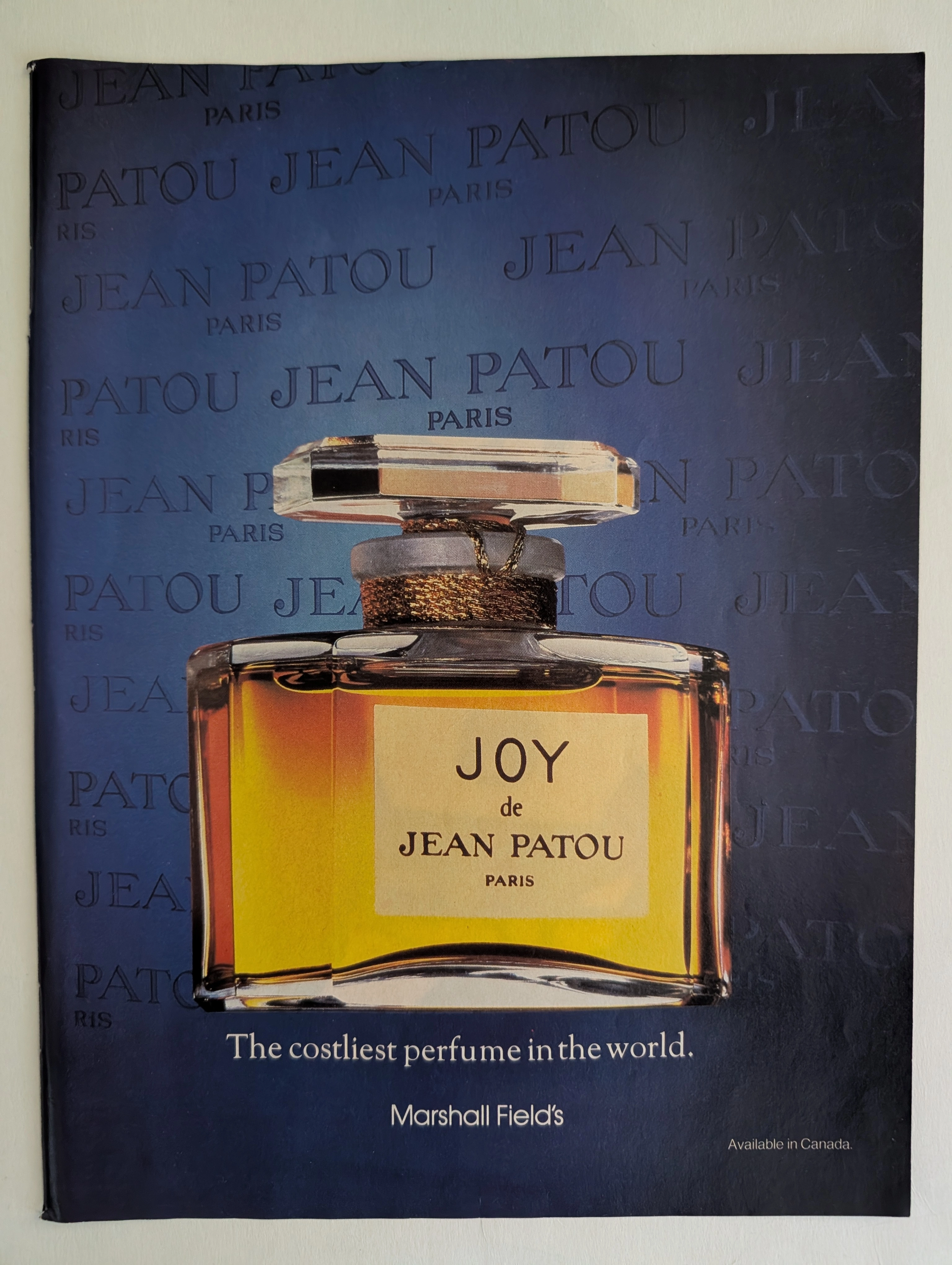
Launched during the height of the Great Depression in 1930, JOY was a defiant gesture of opulence by couturier Jean Patou. By 1974, when this specific advertisement was published, the fragrance had maintained its reputation for over four decades as the ultimate symbol of prestige. The slogan featured here—"The costliest perfume in the world"—is perhaps one of the most successful examples of "prestige pricing" in marketing history.
The visual composition of this 1974 campaign is a masterclass in minimalist luxury. It utilizes a repetitive typographic background ("JEAN PATOU PARIS") which serves as a texture, emphasizing the brand's Parisian heritage. The center of the frame is dominated by the "flacon baccarat" style bottle, noted for its clean lines and the traditional baudruchage seal—the gold thread hand-wrapped around the neck to ensure the bottle's airtight integrity.
During the mid-70s, JOY remained a staple at high-end retailers like Marshall Field's, as indicated by the credit at the bottom. The advertisement also reflects the era's global distribution, specifically noting its availability in Canada. Historically, the scent's exorbitant price was justified by its ingredients: it famously required 10,600 jasmine flowers and 28 dozen roses to produce just 30ml of the parfum. This ad captures the fragrance at a time when it was the primary rival to Chanel No. 5, appealing to an era of "The New Luxury" that favored heritage and uncompromising quality.
Paper & Print Condition
The specimen is printed on high-gloss magazine stock typical of mid-70s fashion periodicals. The deep blue tones are remarkably preserved, showing no significant UV fading or yellowing of the "JOY" label.
Provenance & Rarity
This specific plate was sourced from a North American fashion archive. It is a regional variant featuring the "Marshall Field's" retailer stamp and the "Available in Canada" footer, making it a valuable piece for collectors of department store history and fragrance marketing
Rarity & Condition Summary
A pristine example of 1970s luxury branding. The sharp focus on the bottle's facets and the metallic sheen of the gold thread remain crisp