The Time Traveller’s Dossier: 1983 Evyan White Shoulders Vintage Advertisement — An Ode to Classical Romance and Elegance
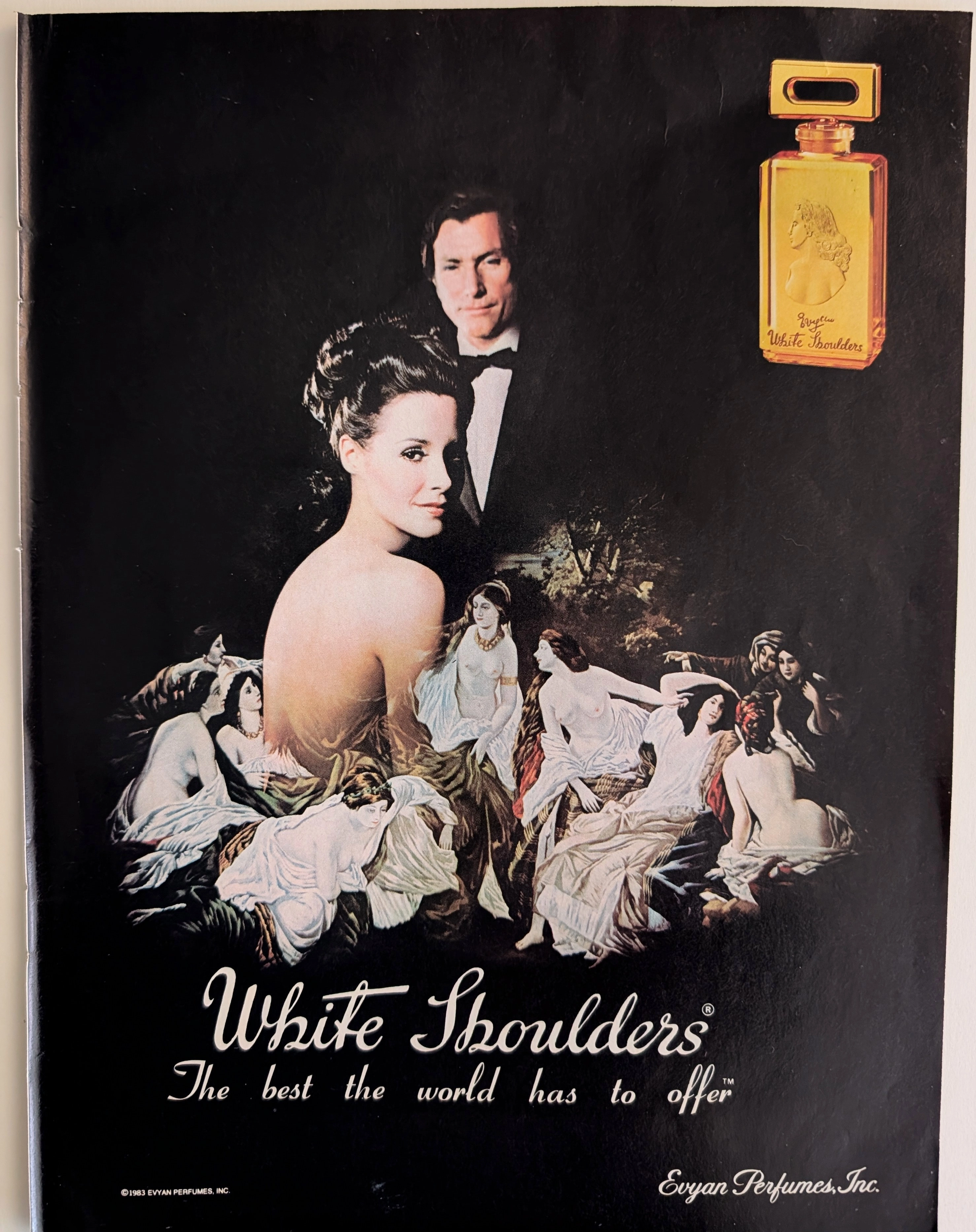
Delve into the captivating allure of this 1983 Evyan White Shoulders vintage advertisement, a quintessential piece of twentieth-century fragrance history. As a prime example of premium classic print ads, this visual masterpiece brilliantly intertwines modern sophistication with renaissance-inspired artistry. The piece highlights the iconic golden bottle alongside a deeply romantic tableau, showcasing the enduring legacy of Evyan Perfumes. For collectors and archivists studying old advertisements, this document represents a pivotal era in 1980s luxury marketing, where the visual narrative relied heavily on classical femininity and timeless elegance. By preserving such remarkable vintage ads, we gain profound insights into the evolution of beauty campaigns and consumer desires. This dossier meticulously examines the print's historical context, archival paper quality, and unparalleled visual impact, offering an authoritative look at one of the era's most recognizable fragrance promotions.
Category: Fashion
Brand: Evyan
The History
The story of Evyan Perfumes and its flagship fragrance, White Shoulders, is not merely a tale of cosmetic chemistry; it is a profound chapter in the cultural and economic history of American luxury. To understand the gravity of this 1983 advertisement, one must first trace the brand's audacious origins and the shifting zeitgeist of the twentieth century. The Genesis of an American Luxury House The house of Evyan was established in the late 1930s by Dr. Walter Langer—a European emigré who stylized himself as Baron Walter Langer von Langendorff—and his British-born wife, Evelyn (from whose name the portmanteau "Evyan" was derived). During this epoch, the global fragrance industry was unequivocally dominated by historic French houses like Chanel, Guerlain, and Houbigant. American perfumes were largely viewed as utilitarian or inferior. The Langers set out with a fiercely ambitious, contrarian mission: to create an unapologetically American perfume house that could rival the sophistication, complexity, and prestige of the Parisian masters. The Wartime Vacuum and Escapist Consumerism The true catalyst for White Shoulders occurred during World War II. The occupation of France and the subsequent Allied blockades abruptly choked off the supply of French perfumes to the United States. Recognizing this unprecedented vacuum in the luxury market, Evyan launched White Shoulders in 1943. The strategy was a masterclass in psychological marketing. In an era defined by rationing, industrial labor (the "Rosie the Riveter" era), and profound global anxiety, White Shoulders offered pure, unadulterated escapism. The name itself was evocative of a bygone era of aristocratic leisure—conjuring images of debutantes, sweeping evening gowns, and bare, powdered skin untouched by the harsh realities of wartime factories. Its olfactory profile—an opulent, heavy white floral bouquet dominated by tuberose, gardenia, jasmine, and lilac—was intensely feminine and romantic. It became a sensation, cementing Evyan’s status and proving that an American fragrance could capture the high-end market. The 1980s: A Counter-Cultural Stance in the Era of Excess Fast forward to 1983, the year this specific advertisement was circulated. The cultural landscape had shifted dramatically. The 1980s fragrance market was entering an era of aggressive "power scents"—massive, room-filling orientals and sharp florals like Yves Saint Laurent’s Opium, Dior’s Poison, and Giorgio Beverly Hills. Fashion was defined by sharp angles, corporate power dressing, and enormous shoulder pads. In stark contrast, this Evyan advertisement represents a deliberate, almost counter-cultural adherence to classical romanticism. Instead of padded shoulders, the ad emphasizes literal bare, white shoulders. While competing brands marketed to the aggressive corporate climber, Evyan positioned itself as a beacon of inherited, timeless elegance. Decoding the 1983 Visual Narrative The visual composition of this campaign bridges two distinct timelines. In the foreground, a modern 1980s couple in formal evening wear gazes out at the viewer. The woman is the epitome of contemporary high society. Yet, beneath them, seamlessly blended into her silhouette, is a painterly tableau straight from a Renaissance or Pre-Raphaelite canvas—ethereal women draped in classical robes, lounging in a pastoral, mythic setting. This juxtaposition is a brilliant piece of archival brand positioning. It communicates that White Shoulders is the thread connecting the mythic goddesses of antiquity to the modern elite. The bold, serif tagline—"The best the world has to offer"—is not just a boast; it is a defensive, authoritative statement in an increasingly crowded global market. It reasserts Evyan's original 1940s mission statement: that American luxury need not defer to Europe. The Archival Significance Historically, the 1980s marked the twilight of Evyan’s independent reign. By the end of the decade, the shifting tastes of younger demographics and the consolidation of the beauty industry would lead to the brand’s eventual sale (it was acquired by Elizabeth Arden in 1989). Therefore, this 1983 print advertisement is more than just a marketing asset; it is a poignant cultural artifact. It captures the final, defiant golden era of an independent American perfumery insisting on classical romance in a decade defined by neon and excess.
The Paper
From an archival perspective, the physical substrate of this advertisement provides a textbook example of 1980s high-end periodical printing. Extracted from a premium fashion or lifestyle publication of the era, the paper is a lightweight, clay-coated stock designed specifically to support high-resolution image reproduction. Print Technology & Archival Behavior: The piece was produced using four-color (CMYK) offset web lithography. The most striking technical feature of this specific ad is the extensive use of deep, rich black ink to create the void-like background. Achieving this level of density required heavy ink laydown, likely utilizing a "rich black" formula (a combination of black ink bolstered by percentages of cyan, magenta, and yellow) to prevent the background from appearing flat or gray. Condition & Preservation: Because of the heavy ink coverage, this type of paper is highly susceptible to mechanical damage; even slight abrasions can cause the glossy black surface to scuff, revealing the white clay coating beneath. Furthermore, the underlying paper fibers from this era often contain residual lignin. While the clay coating acts as a temporary buffer, exposure to ultraviolet light or fluctuating humidity can lead to oxidation, causing the paper to yellow and become brittle over time. Preserving the deep contrast and preventing the golden hues of the perfume bottle from fading requires strict archival storage in acid-free, light-proof environments.
The Rarity
In terms of sheer production numbers, the 1983 Evyan White Shoulders vintage advertisement is not inherently rare. During the early 1980s, Evyan placed these campaigns in major, high-circulation magazines such as Vogue, Harper's Bazaar, and Town & Country. Millions of impressions were printed and distributed globally. However, the archival rarity—the scarcity of finding a pristine, unblemished copy—is quite high. The aforementioned heavy black ink coverage makes this specific advertisement notoriously difficult to find in "mint" condition. Most surviving copies exhibit spine creasing, micro-tears, or edge-wear from decades of handling. For collectors of beauty ephemera and institutional archives, a copy that retains the crispness of the typography, the luminescent gold of the product shot, and an unmarred black background holds significant collector value and commands premium market perception.
Cite this article
- MLA
- Naodhinsuk, Ronin. “The Time Traveller’s Dossier: 1983 Evyan White Shoulders Vintage Advertisement — An Ode to Classical Romance and Elegance.” The Record Institute, 2 April 2026, https://therecord.institute/journal/the-time-travellers-dossier-1983-evyan-white-shoulders-vintage-advertisement-an-ode-to-classical-romance-and-elegance.
- APA
- Naodhinsuk, R. (2026, April 2). The Time Traveller’s Dossier: 1983 Evyan White Shoulders Vintage Advertisement — An Ode to Classical Romance and Elegance. The Record Institute. https://therecord.institute/journal/the-time-travellers-dossier-1983-evyan-white-shoulders-vintage-advertisement-an-ode-to-classical-romance-and-elegance
- CHICAGO
- Naodhinsuk, Ronin. 2026. “The Time Traveller’s Dossier: 1983 Evyan White Shoulders Vintage Advertisement — An Ode to Classical Romance and Elegance.” The Record Institute, April 2, 2026. https://therecord.institute/journal/the-time-travellers-dossier-1983-evyan-white-shoulders-vintage-advertisement-an-ode-to-classical-romance-and-elegance.