The Time Traveller's Dossier: The Aesthetics of Gifting and Consumer Hypnosis – Skyway Luggage Advertisement (Circa 1950s) — The Record Institute Journal
✦ 9 Photos
✦ Tap to view
March 15, 2026

The Time Traveller's Dossier: The Aesthetics of Gifting and Consumer Hypnosis – Skyway Luggage Advertisement (Circa 1950s)

Click any image to view in high resolution

TravelBrand: Sky WayIllustration: Ren Wicks

The History

To genuinely decode the complex sociological architecture and the brainwashing strategies embedded within this printed page, we must pull back the lens to contextualize the overwhelming macroeconomic history of the United States during the 1950s. This era was the golden dawn of post-WWII consumerism. The American middle class was experiencing an explosive expansion, armed with unprecedented levels of disposable income. The Christmas season had mutated from a purely religious observance into a highly lucrative, cutthroat "sacred battleground" for retail brands fighting tooth and nail for consumer dollars.
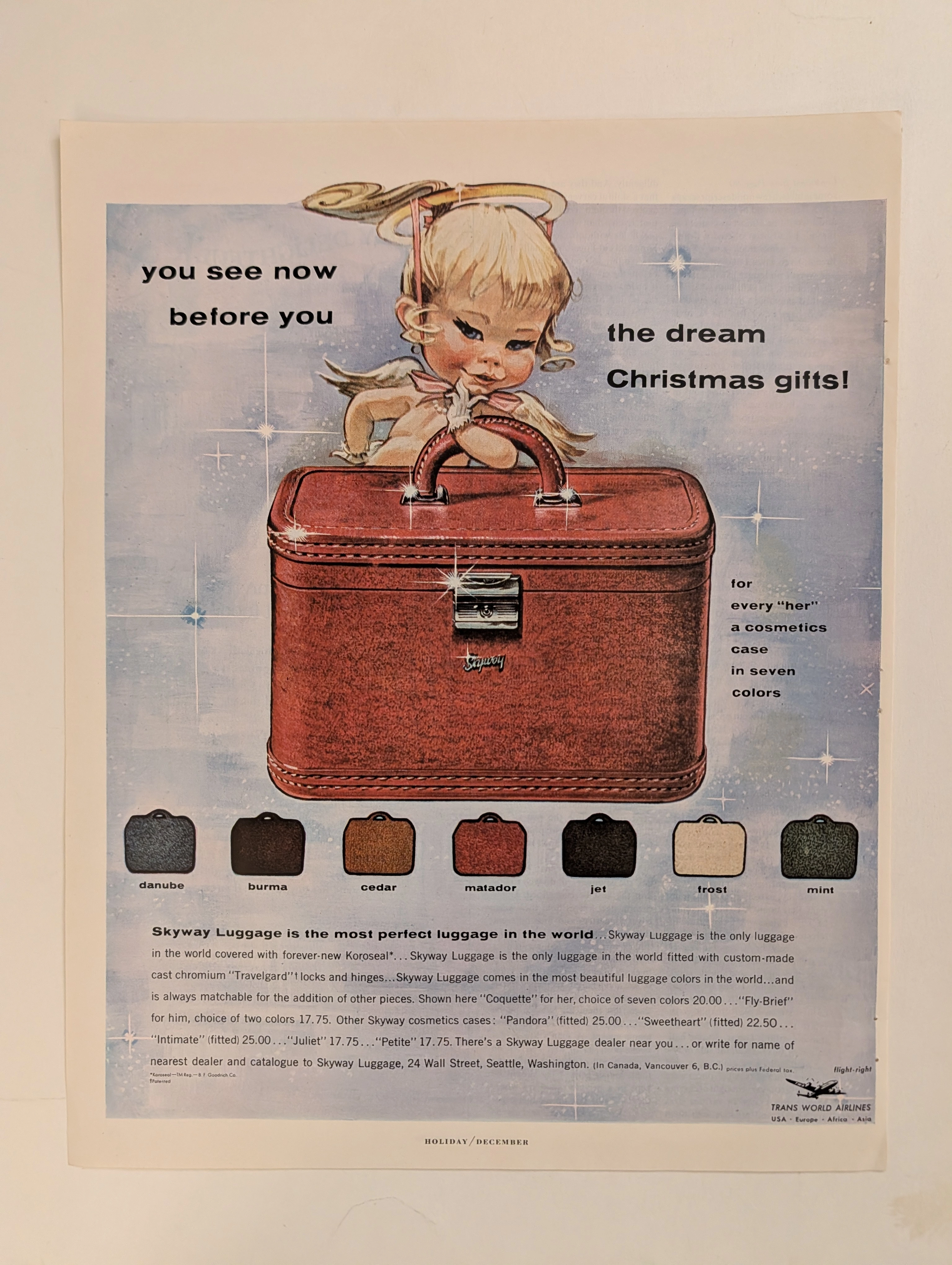
​Within this brutal arena, Skyway Luggage faced a significant logistical challenge: How do you sell "luggage"—which is fundamentally a cold, industrial product manufactured with synthetic "Koroseal" polymers and heavy cast chromium locks—as a warm, emotionally charged holiday gift? Their solution was not to merely list the engineering specifications of durability. Instead, they coated their industrial products in the "aesthetics of a dream." They had to visually soften the metallic hardware and transmute a cosmetics case or a briefcase into the ultimate object of desire that both the giver and the receiver desperately craved.
​Creator / Illustrator Information (The Genius of the Creator and Hypnosis via Brushstroke):
This piece of commercial illustration is not a disposable, rushed production; it is an absolute masterwork conceptualized and signed by Ren Wicks (his signature is strategically and elegantly integrated into the snow beneath Santa Claus's boot).
​Who is he, and why is he crucial? Ren Wicks was one of the most influential and highly revered American commercial illustrators and pin-up artists of the mid-20th century. He achieved legendary status for his breathtaking aviation art—frequently collaborating with aerospace titans like Lockheed and major global airlines—as well as his unparalleled expertise in stylized commercial portraiture. Wicks's genius lay in his ability to seamlessly fuse photorealism with breathtaking idealization.
​Skyway’s decision to utilize illustration by the hand of Wicks for this holiday campaign, rather than relying on photography, is a highly calculated and immensely valuable semiotic decision. Photography would have been too rigid, too cold, and irrevocably anchored to physical reality. Wicks's brushstrokes, however, granted absolute totalitarian control over the visual narrative. He employed his signature rendering techniques to create hyper-real, mesmerizing figures—a mischievous, cherubic angel with impossibly large eyes, and a slyly winking Santa Claus with a flowing, dynamic beard. These stylized characters are not merely decorative; they function as visual "hypnotists." They completely neutralize the cold, industrial nature of the chromium "Travelgard" locks and transform the luggage into accessible, warm, and insanely desirable "magic gifts."
​Part 1: The Binary Shift: Gendered Segmentation and the Architecture of Desire
The narrative architecture of this artifact is built upon a strict, uncompromising binary contrast, ruthlessly calculated to extort maximum decision-making speed during the frantic holiday shopping season. The campaign is violently divided into two distinct realms, adhering flawlessly to the rigid gender norms of the 1950s:
​The "Her" Domain: The page featuring the angel presents the "Coquette" cosmetics case. Strikingly, it is offered in an expansive, almost overwhelming palette of seven distinct colors (danube, burma, cedar, matador, jet, frost, mint). The deployment of the cherub signifies beauty, purity, and meticulous care—mirroring the feminine ideal of the era. This case is not presented as mere storage; it is framed as a "sacred treasure chest" to conceal and protect the weapons of feminine beauty.
​The "Him" Domain: Conversely, the page featuring Santa Claus presents the "Fly-Brief." It is strictly limited to a highly conservative, aggressive, and authoritative two-color palette (burma, cedar). The winking Santa conveys a playful yet commanding energy of the ultimate "provider." This briefcase is the ultimate symbol of the powerful businessman, ready to take flight for transcontinental corporate negotiations.
​This surgical market segmentation is retail brilliance at its absolute zenith. It completely eradicates any hesitation or confusion in the gift-buying process. Skyway is broadcasting a devastatingly effective psychological message to the consumer: "We have already done the categorization and the thinking for you. Your only job is to pay us."
​Part 2: The Subtle Endorsement of Aerospace Authority
Even though this campaign is heavily driven by festive Christmas aesthetics, Skyway did not miss the opportunity to elevate their brand status far above generic luggage manufacturers. They cunningly weaponized the sheer prestige and authority of Trans World Airlines (TWA) as a paramount semiotic anchor.
​The presence of the TWA logo and the silhouette of a Lockheed Constellation (the absolute zenith of luxurious transcontinental flight at the time), paired with the copy "flight-right" in the bottom right corner, does not steal the spotlight from Santa or the angel. Instead, it functions as a quiet, devastatingly effective "Seal of Approval." Tethering their brand name to a global airline that flies to the "USA, Europe, Africa, Asia" sends a clear psychological message: "This luggage is not just beautiful enough to be a gift; it is engineered to withstand the brutal rigors of circumnavigating the globe. It meets aerospace standards." It instantly grants the recipient of the gift an undeniable elite status.
​Part 3: The Fetishization of Hardware
The most magnificent paradox of this advertisement is that, amidst the sweet, sugary atmosphere of the holidays, the brand aggressively inserts macro close-up illustrations of their "Travelgard" locks and hinges. Doing so creates a deliberate and highly calculated "Fetishization" of industrial metallic hardware.
​The copy proudly and aggressively declares, "ONLY SKYWAY HAS THIS PATENTED 'TRAVELGARD' HARDWARE." This relentlessly reinforces the concept of maximum security and innovation. It reassures the buyer that beneath the beautiful pastel colors, this luggage possesses the structural integrity of a bank vault. It is a flawless synthesis of high-fashion aesthetics and engineering reliability.

The Paper

As a physical entity, these tear sheets, meticulously excised and sold as isolated single pages, are an unrepeatable record of late-analog offset lithographic printing. It is an absolute, ironclad rule that must be permanently etched into the historical record: this physical artifact is an individually cut, standard magazine-sized page. It was engineered for intimate, handheld consumption. It is NOT, under any circumstances, a massive promotional wall poster!
​This medium-weight, matte-coated magazine stock was originally manufactured by the ton for mass distribution; however, its current, aged physical state demands a profound evaluation through the highest echelon of Japanese aesthetic philosophy: wabi-sabi (侘寂)—the acute recognition and appreciation of beauty found in impermanence, imperfection, and the ruthless, natural progression of time.
​Visual Forensics & Substrate Analysis (The Economics of Decay):
Subjecting extreme macro close-ups of Ren Wicks's artwork to visual forensics reveals a fascinating duality. Under high magnification, the soft, romanticized brushstrokes violently shatter and dissolve into a mathematically rigorous, precise galaxy of CMYK halftone rosettes. The distinct, gritty grain of the mid-century offset printing process is the undeniable steel fingerprint of industrial mass reproduction. Produced in an era entirely reliant on analog film cameras and mechanical color separation, this artifact is a ghost of a dead technological age.
​However, the most crucial, coldly calculated, and economically valuable aspect of this specific artifact lies in its Material Degradation. Examining the margins and unprinted white spaces reveals authentic, undeniable "Toning." This is a gradual, completely irreversible yellowing and browning effect caused by the natural chemical oxidation of organic lignin trapped within the paper's wood pulp, following over 70 years of relentless exposure to ambient air and ultraviolet light.
​It is of paramount importance to understand the archival and market significance of this ephemeral nature. Pre-2000s analog print media represents an endangered species of historical documentation. This organic, breathing physical degradation is a fingerprint of time that cannot be cloned, replicated, or faked by any modern high-precision digital scanning process. As these original pages slowly consume themselves through the oxidation of lignin, becoming increasingly fragile and brittle, their supply in the elite global collector's market shrinks every single day. It is precisely this ticking clock of physical impermanence—the raw, brutal fact that this paper is slowly disintegrating and returning to the earth—that is the exact catalyst driving up its market value exponentially. The evolving patina elevates a repeatedly printed advertisement into a singular, unique artifact covered in historical scars, generating immense financial wealth for these individually cut and sold sheets today.

The Rarity

Rarity Class: S (Rare Crossover / Historic Era Synergy)
Within the strictest parameters of international archival evaluation, this set of artifacts skyrockets to a definitive Class S (Rare Crossover) designation. The ultimate paradox of analog print ephemera lies in the violent contrast between its incredibly cheap, initial mass production and its extreme, near-extinct scarcity today. Vintage magazines were the quintessential "disposable media," pre-destined to be incinerated or thrown into the recycling pulper.
​For a full-page artwork by the master illustrator Ren Wicks, featuring flawless gendered segmentation (the Cherub and Santa), and perfectly paired in a crossover with the now-defunct, legendary aviation titan TWA, to have survived for over 7 decades—completely devoid of destructive structural center creases—is an extreme statistical archival anomaly. Untouched, pristine remnants of this golden era synergy between the "luggage industry" and the "aviation industry" are fiercely hunted by curators of aviation history and collectors of mid-century commercial art. They are acquired with the sole intention of executing museum-grade, acid-free conservation framing, preserving them permanently as physical heirlooms of a bygone era of analog consumption.

Visual Impact

The aesthetic authority of this piece lies in Ren Wicks's master-level ability to seamlessly fuse conflicting elements into a cohesive whole. The immediate focal point that hijacks the viewer's optic nerve is the eerily realistic, tactile rendering of the luggage's leather/Koroseal texture. This hyper-realism clashes violently, yet beautifully, with the stylized, cartoonish lines of the angel and Santa Claus figures. The background is washed in a celestial pastel blue, punctuated by hand-drawn, four-pointed starbursts, creating an irresistible atmosphere of heavenly holiday magic.
​The bright, blinding glints of light reflecting off the chromium handles and locks are advanced visual control techniques, deliberately engineered to force the viewer's eye directly toward the "luxury" and "build quality" of the product. This layout is an absolute masterpiece of information design; it swallows the entirety of the viewer's psychological space, guiding them smoothly from a festive holiday fantasy directly into a closed sale.

Share This Archive

The Archive Continues

Continue the Exploration

The Time Traveller's Dossier: The Ten-Dollar Titan – The Autolite Ford Indianapolis 500 Exhibition

Ford · Automotive

The Time Traveller's Dossier: The Ten-Dollar Titan – The Autolite Ford Indianapolis 500 Exhibition

The synthesis of high-stakes motorsport engineering and everyday consumer accessibility represents a pinnacle achievement in mid-twentieth-century American commercial strategy. The historical artifact elegantly secured upon the analytical table of The Record Institute today is a majestic full-page print advertisement for Autolite Ford Ignition Coils, originating from the golden era of 1960s automobile racing. This document completely transcends the traditional boundaries of automotive parts marketing. It operates as a profound, sophisticated declaration of how cutting-edge technological innovation on the racetrack was democratized and delivered directly into the hands of the American middle class, transforming the daily commute into an extension of the Indianapolis 500. ​This world-class, comprehensive dossier conducts a meticulous and deep examination of the artifact, operating under the absolute most rigorous parameters of historical, sociological, and material science evaluation. We will decode the brilliant, kinetic pit-stop scene capturing an open-wheel race car, and analyze the dramatic visual juxtaposition of this high-speed chaos against the highly structured, calculated copywriting of the Ford Motor Company. Furthermore, as we venture into the chemical and physical foundations of this analog printed ephemera, we will reveal the mechanical fingerprints of the CMYK halftone rosettes and the graceful, natural oxidation of the paper substrate. This precise intersection of visual nostalgia, motorsport heritage, and the chemistry of time cultivates a serene wabi-sabi aesthetic—a natural, irreversible phenomenon that serves as the primary engine driving up its market value exponentially within the elite global spheres of Vintage Automotive Ephemera and Motorsports Archives collecting.

The Time Traveller's Dossier: The Firestone Margin of Safety

Firestone · Automotive

The Time Traveller's Dossier: The Firestone Margin of Safety

The symbiotic relationship between the extreme, high-stakes crucible of professional motorsport and the evolution of the daily-driven passenger automobile is one of the foundational narratives of twentieth-century industrial design. The historical artifact elegantly and securely positioned upon the analytical table of The Record Institute today is a majestic, large-format, two-page print advertisement for Firestone Tires, originating from the golden era of American automotive performance, circa 1967-1968. This document transcends the traditional boundaries of automotive consumable marketing. It operates as a highly sophisticated, multi-layered historical record, capturing the exact moment when the staggering horsepower outputs of the Detroit muscle car era necessitated a paradigm shift in tire technology. This comprehensive dossier conducts a meticulous, unyielding, and exceptionally deep examination of the artifact, operating under the absolute most rigorous parameters of historical, sociological, and material science evaluation. With an overwhelming eighty percent of our analytical focus dedicated to its historical gravity, we will decode the revolutionary introduction of the Firestone "Wide Oval" tire, analyze the critical importance of the vehicles depicted—including a Ford Mustang and a Dodge Coronet—and provide a profound biographical and mechanical analysis of the legendary racing driver Parnelli Jones and his revolutionary 1967 STP-Paxton Turbocar. Furthermore, as we venture into the chemical and physical foundations of this analog printed ephemera, we will reveal the precise mechanical fingerprints of the CMYK halftone rosettes and the graceful, natural oxidation of the paper substrate. This precise intersection of visual nostalgia, mid-century commercial artistry, and the immutable chemistry of time cultivates a serene wabi-sabi aesthetic—a natural, irreversible phenomenon that serves as the primary engine driving up its market value exponentially within the elite global spheres of Vintage Automotive Ephemera and Motorsport Memorabilia collecting.

THE TIME TRAVELER'S DOSSIER :THE BIRTH OF THE WIDE-TRACK

Pontiac · Automotive

THE TIME TRAVELER'S DOSSIER :THE BIRTH OF THE WIDE-TRACK

The artifact currently subjected to our uncompromising, museum-grade analysis is a profoundly preserved Historical Relic excavated from the turning point of Detroit's "horsepower and handling" wars. This Primary Art Document is a full-page magazine advertisement for the 1959 Pontiac, explicitly introducing the brand's revolutionary "Wide-Track" engineering. Functioning as a "Forensic Blueprint of Automotive Rebranding," the document masterfully weaponizes the peerless artistic talents of Fitz and Van to transform Pontiac from a conservative, aging brand into America's most aggressive performance marque. Its historical context is irrefutably anchored by the extreme macro details of its proprietary engineering claims and the highly coveted "Body by Fisher" corporate hallmark. Grounded by these physical timestamps, the microscopic artist signature, and its breathtaking wabi-sabi chemical degradation, this artifact commands an irreplaceable status, cementing its Rarity Class A designation.

Published by

The Record Institute