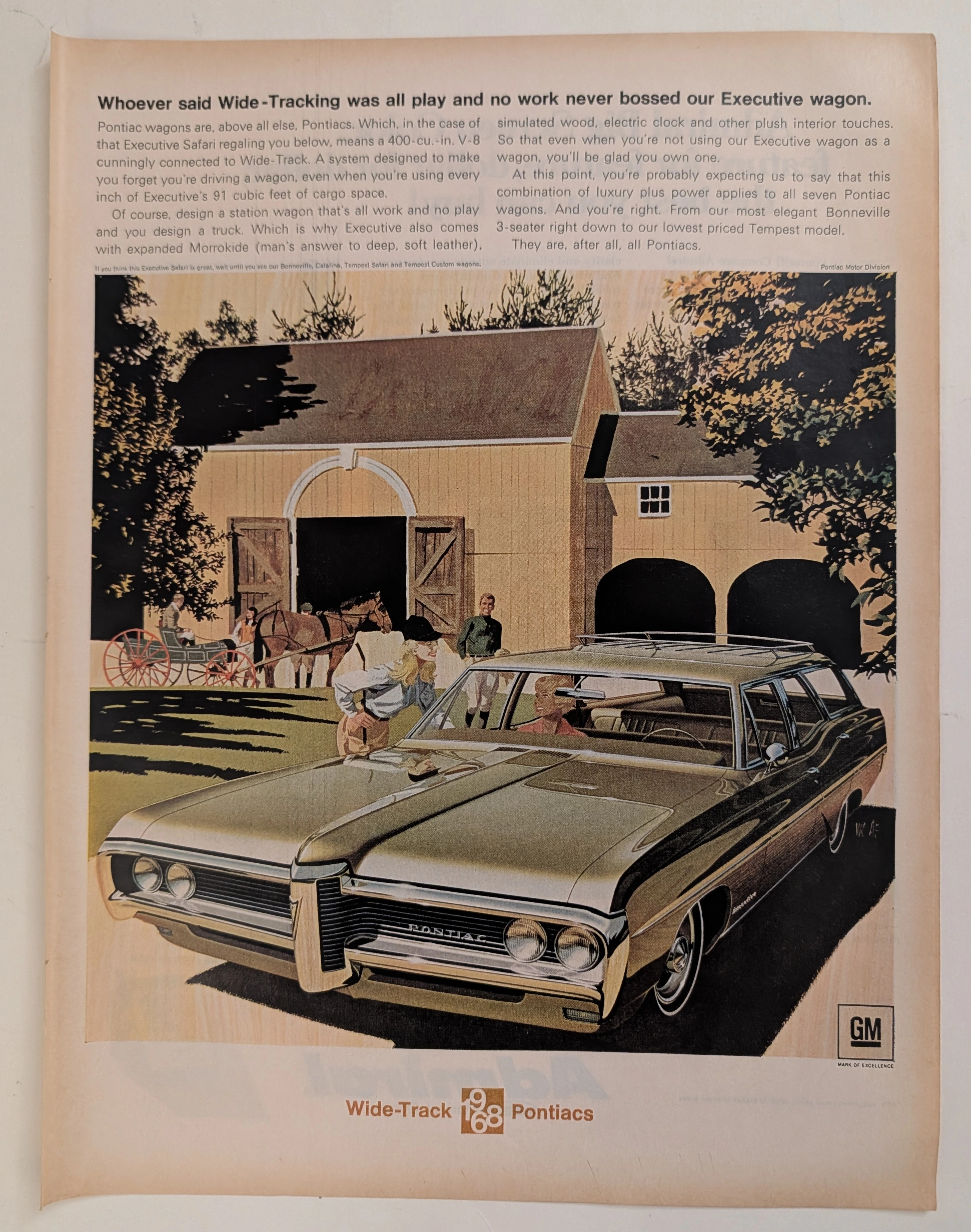
1968 Pontiac Executive Wagon "Wide-Tracking" Advertisement
In the twilight of the 1960s, the American automotive industry was operating at the absolute zenith of its cultural, economic, and design influence. Pontiac, under the visionary leadership of executives like John DeLorean, had successfully shed its post-war reputation as a conservative brand, entirely redefining itself as General Motors' premier performance division. The cornerstone of this transformation was the famous "Wide-Track" marketing campaign. Originally rooted in a genuine engineering decision to widen the physical axle track for better handling, "Wide-Tracking" was mythologized by marketers into a lifestyle—a promise of stability, aggressive road presence, and uncompromised power. This specific 1968 advertisement for the Executive Safari wagon marks a fascinating sociological pivot in American consumerism. As the Interstate Highway System expanded and suburban sprawl evolved into established, affluent enclaves, the station wagon ceased to be marketed purely as a utilitarian family hauler. Instead, Pontiac positioned it as a highly sophisticated necessity for the upwardly mobile, active upper-middle class. Against the backdrop of a broader cultural upheaval in 1968, this advertisement sells a comforting vision of insulated, traditional prosperity. The setting of a private country club equestrian estate explicitly ties the vehicle to a life of exclusive leisure and "old money" luxury. Furthermore, the artwork represents the legendary, defining partnership of Art Fitzpatrick (AF) and Van Kaufman (VK). For over a decade, this duo held an unprecedented grip on General Motors' visual identity. Fitzpatrick, a master of automotive illusion, radically manipulated proportions—cutting up photographs, lowering rooflines, and artificially stretching the vehicles' width and length to maximize their visual dominance. To ground these impossibly sleek machines in reality, Kaufman (a former Disney animator) painted the glamorous, aspirational environments from his global travels. Together, their work bypassed the rational mind and appealed directly to the mid-century American desire for status, space, and speed.
Category: Cars
Year: 1968
Rarity Class: B
Paper & Print Condition
Printed on standard mid-century, lightweight clay-coated magazine stock, typical of high-circulation prestige publications like Life or Look. High-resolution macro photography of the vehicle's grille and typography reveals the classic, overlapping rosettes of the CMYK (Cyan, Magenta, Yellow, and Key/Black) halftone dot structure. This specific dot spread is the distinct, uncounterfeitable signature of 1960s mass-market four-color commercial lithography. Tactilely, the paper retains its characteristic slickness, though it exhibits mild, uniform oxidation (acidic yellowing) predominantly along the margins—a natural degradation consistent with its half-century age and the lignin content of period paper pulp. Crucially, the ink saturation remains vibrant, and there are no significant tears, creases, or water damage apparent in the primary image field.
Provenance & Rarity
Extracted from a mainstream American periodical distributed in late 1967 or early 1968. Because these advertisements were ephemera—bound into magazines intended to be read once and subsequently discarded or recycled—their survival rate is remarkably low. While millions of impressions were originally struck, finding a surviving example carefully excised from the binding without tearing, and that has escaped the ravages of moisture, folding, and UV fading over five decades, is increasingly difficult. They are heavily sought after by automotive historians and mid-century modern design archivists.
Rarity & Condition Summary
his piece stands as a beautifully preserved, primary-source artifact of the golden age of American commercial art and automotive optimism. Its true historical and museum value lies not in absolute, single-item scarcity, but in its pristine, highly legible representation of the Fitzpatrick-Kaufman artistic partnership. It is a flawless time capsule that perfectly encapsulates the aesthetics, aspirations, and consumer psychology that defined a decade of American design.