The Time Traveller's Dossier: Aeronautical Architecture on the Asphalt – The SAAB 96 V4 and the Engineering of Adverse Weather Superiority
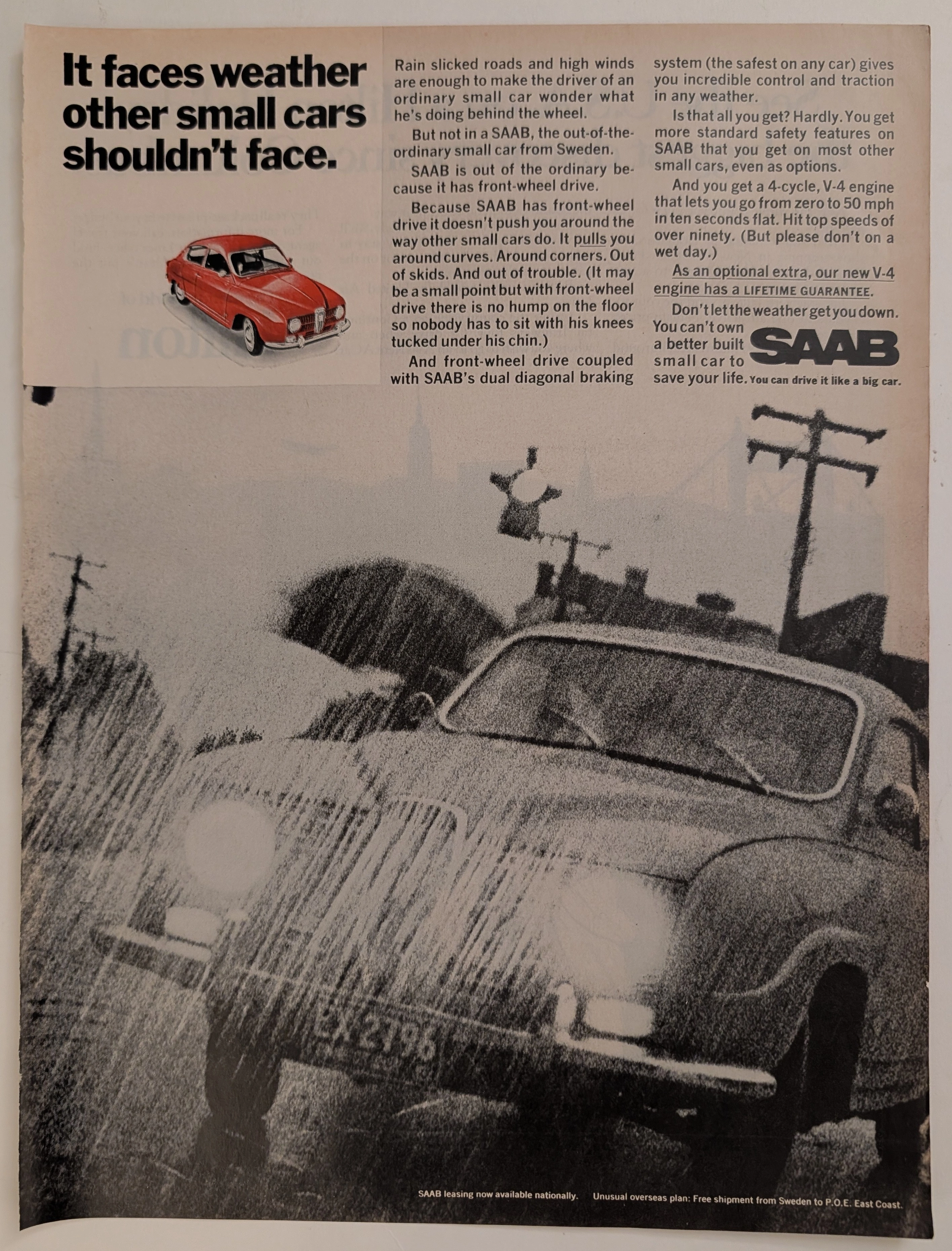
The evolution of the mid-twentieth-century American automotive landscape was heavily disrupted by the influx of European imports, each vying to dismantle the hegemony of the domestic V8, rear-wheel-drive giants. Elegantly and securely positioned upon the analytical table of The Record Institute today is a visually striking, narrative-driven full-page print advertisement for the SAAB Automobile (fe
Category: Automotive
Brand: Saab
The History
To fully appreciate the immense historical gravity, cultural magnitude, and sociological importance of this artifact, one must meticulously contextualize the complex, highly specific landscape of the imported automotive industry in the United States during the late 1960s. SAAB (Svenska Aeroplan Aktiebolaget), originally founded in 1937 as an aerospace and defense company to supply aircraft for the Swedish Air Force, began manufacturing automobiles in the late 1940s to diversify its post-war portfolio. This aeronautical heritage fundamentally dictated the DNA of every SAAB vehicle. Unlike tradi
The Paper
As a physical entity, this printed artifact functions as a living, breathing, and profoundly detailed record of mid-twentieth-century graphic reproduction and substrate chemistry. Under exceptional, high-magnification macro-lens examination, this document reveals the stunning complexity and mathematical precision of analog offset printing. The visual brilliance of this artifact lies in its dual-process printing technique. The main background is a heavily grained, high-contrast monochromatic photograph, intentionally utilizing an exaggerated halftone dot structure to simulate the chaotic, blind
The Rarity
RARITY CLASS: B (Very Good Archival Preservation with Natural Margin Toning) Evaluated under the most exacting, rigorous, and uncompromising archival parameters established by The Record Institute (which spans a meticulous classification system from Pristine Class A down to Heavily Degraded Class D), this artifact is definitively and securely designated as Class B. The remarkable and defining paradox of mid-century commercial ephemera is that these specific documents were produced by the millions as explicitly and intentionally "disposable media." Inserted into high-volume, mass-market consume