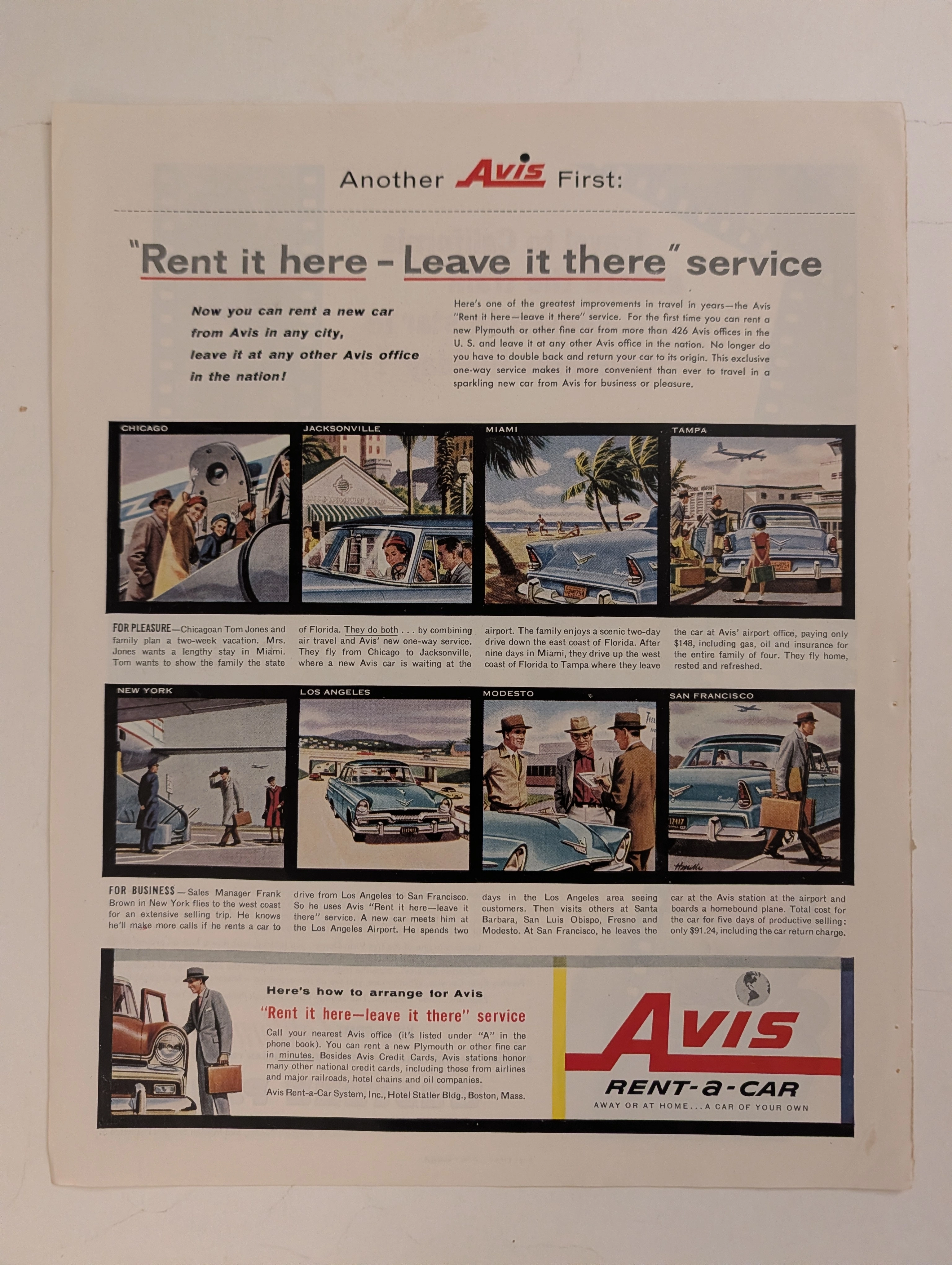
The Time Traveller's Dossier: The Architecture of Unrestricted Mobility – Avis "Rent it Here - Leave it There" Advertisement (Circa 1956)
History is not merely recorded; it is engineered, paved, and conquered through the relentless expansion of commercial logistics. Long before digital networks rendered physical distances obsolete, and before the globalized travel infrastructure became a mundane background hum of modern life, the conquest of geography was executed through bold, capital-intensive logistical paradigms. The historical
The History
To genuinely decode the complex sociological architecture and logistical supremacy embedded within this printed artifact, one must pull back the lens to contextualize the overwhelming macroeconomic history of the mid-1950s United States. This era was defined by a massive, unprecedented economic boom, the explosive birth of the suburban middle class, the dawn of the jet age (though dominated here by the final, glorious apex of propeller-driven commercial airliners like the Douglas DC-7), and the imminent authorization of the Interstate Highway System in 1956. The American landscape was rapidly
The Paper
As a physical entity, this tear sheet is an unrepeatable, isolated record of mid-century offset lithographic printing. The medium-weight, matte-coated magazine stock was originally engineered by the ton for mass distribution in publications like LIFE or The Saturday Evening Post; however, its current, aged state demands a profound evaluation through the highest echelon of Japanese aesthetic philosophy: wabi-sabi (侘寂)—the acute recognition and appreciation of beauty found in impermanence, imperfection, and the ruthless, natural progression of time. Visual Forensics & Substrate Analysis (The Ec
The Rarity
Rarity Class: B (Archival / Highly Significant) Within the strictest parameters of international archival evaluation, this artifact holds a solid Class B designation. The ultimate paradox of mid-20th-century analog print ephemera lies in the violent contrast between its initial, incredibly cheap mass production and its extreme scarcity today. Vintage magazines were the quintessential "disposable media," destined to be read once and then mercilessly discarded into incinerators or recycling pulpers. For this specific, full-page sequential storyboard illustration to have survived nearly seven de