THE RECORD · ARCHIVE PLAYER
MP4
■ PAUSED
1917 Keds Canvas Footwear Vintage AdvertisementANALOG ARCHIVE
1917 Keds Canvas Footwear Vintage Advertisement (1917) — Class A vintage Luxury Brands
CLASS A
1 of 6

1917 Keds Canvas Footwear Vintage Advertisement

Category|Luxury Brands
Subcategory|Fashion
Year|1917
Rarity Class|CLASS A
Archive Views|14
Medium/FormatMagazine Ad

Last updated: 12 May 2026

Historical Context

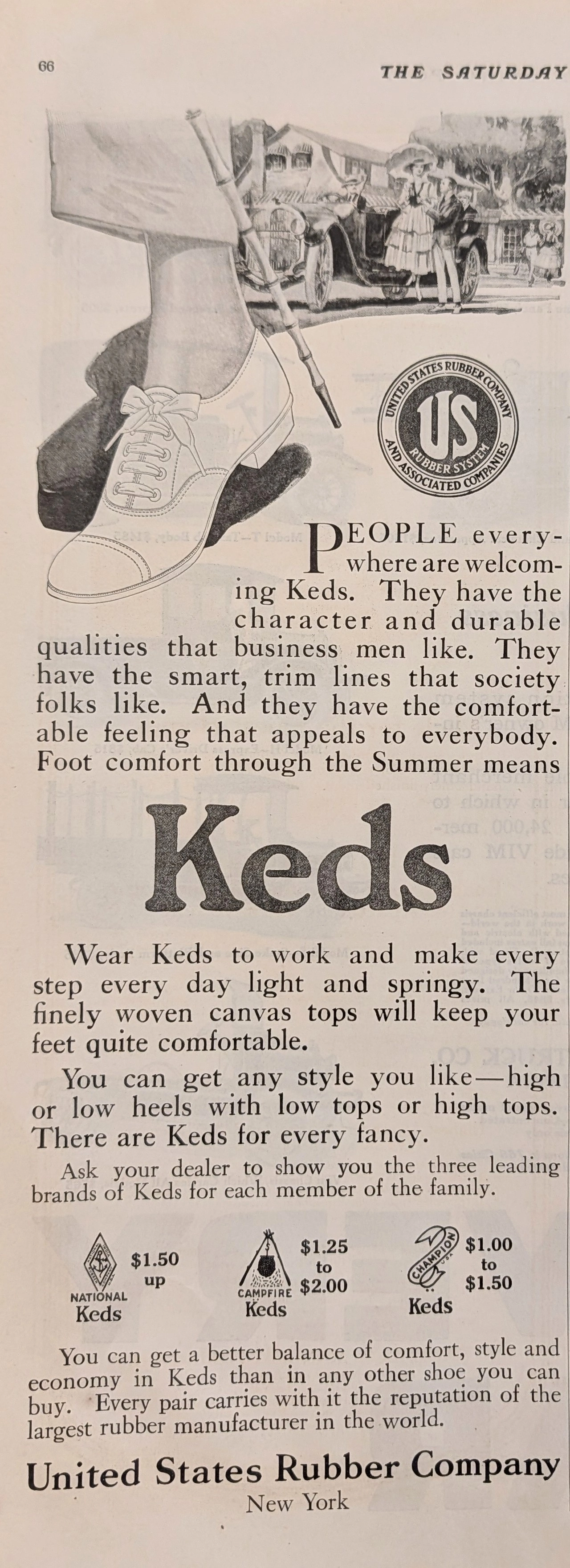
In the late 1910s, the United States Rubber Company consolidated over thirty distinct shoe brands under a single, unified moniker: Keds. Dated specifically to July 21, 1917, this advertisement represents the genesis of one of the world's first mass-marketed canvas sneakers. The marketing copy strategically positions the footwear as universally appealing, emphasizing that the shoes possess "the character and durable qualities that business men like" alongside "the smart, trim lines that society folks like". Visually, the advertisement utilizes a striking halftone illustration to establish a narrative of affluent leisure. A detailed focal point features a woman's foot clad in a pristine, finely woven canvas lace-up oxford with a delicate bow. In the background, a smartly dressed couple stands beside an early-era touring automobile and a grand estate, anchoring the product firmly within the aspirational lifestyle of the American upper-middle class during the WWI era. The piece also serves as a catalog of early Keds product lines and pricing tiers. It introduces consumers to three distinct sub-brands: National Keds ($1.50 and up), Campfire Keds ($1.25 to $2.00), and Champion Keds ($1.00 to $1.50). The presence of the intricate United States Rubber Company seal—proudly stating "US Rubber System and Associated Companies"—reinforces the manufacturing pedigree behind the new brand. Digital Exhibition & Restoration Potential Within modern archival environments, artifacts of this nature present remarkable opportunities for multimedia exhibition. The stark, hand-drawn stroke quality and flat illustration style make this piece an exceptional candidate for translation into a living 2D artwork. By strictly preserving the original illustrative qualities and the warm, aged paper texture, digital restorations can animate the historical tableau. Integrating subtle, era-appropriate ambient soundscapes—such as the distant mechanical hum of a 1910s automobile, a crackling radio, or the gentle bustle of an early 20th-century street—brings the static print to life while maintaining absolute respect for its original artistic integrity.

Paper & Print Condition

Paper & Print Condition: The document exhibits a beautiful, natural oxidative aging, presenting a warm aged paper texture characteristic of early 20th-century magazine stock. The original flat illustration style is impeccably preserved, highlighting the precise hand-drawn stroke quality of the artist. The bold serif typography and finely dotted halftone shading retain excellent contrast against the period color palette, showing no significant ink degradation, ghosting, or fading. The edges remain relatively crisp with minimal micro-tearing.

Provenance & Rarity

Provenance & Rarity: Authentic July 21, 1917, print media originating from an early 20th-century American publication. Surviving advertisements from the inaugural launch period of the United States Rubber Company's consolidated "Keds" brand name are exceedingly scarce. This specific piece documents the critical transitional era when rubber-soled canvas footwear shifted from niche athletic gear to mass-market consumer fashion. Its survival in such pristine archival condition elevates it to a highly significant artifact for historians of both industrial manufacturing and modern apparel advertising.

Rarity & Condition Summary

Rarity & Condition Summary: Classified as a Class A historical artifact, this 1917 print advertisement is an exceptionally well-preserved specimen from the inaugural launch of the Keds brand. Its physical condition—characterized by natural, warm oxidative aging and remarkably crisp typographical and illustrative integrity—far exceeds typical survival rates for early 20th-century newsprint. Given its pristine state and its critical historical role in documenting the dawn of the modern mass-market sneaker era, this piece represents an irreplaceable asset for both fashion archiving and industrial history.
Share This Archive

From the Journal

Related Articles

The Time Traveller's Dossier: The Semantics of Arrogance – JOY de Jean Patou Advertisement (Circa 1980s) — related article
Read Article

The Time Traveller's Dossier: The Semantics of Arrogance – JOY de Jean Patou Advertisement (Circa 1980s)

History is not written by the victors; it is printed by the industrialists. Long before digital algorithms began to sterilely dictate human consumption and virtual reality stripped away authentic tactile sensation, societal engineering and consumer psychology were executed through the calculated, mathematical geometry of the four-color offset press and the absolute mastery of analog darkroom photography. The historical artifact before us is not merely a disposable magazine tear sheet meant to peddle a fragrance. It is a perfectly weaponized blueprint of absolute capitalist supremacy, a visual declaration of class warfare, and an unwavering testament to an era of uncompromising, unapologetic ultra-luxury. This museum-grade, academic archival dossier presents an exhaustive deconstruction of a late-analog print advertisement for the legendary fragrance "JOY de Jean Patou," dating from the late 1970s to the early 1980s. Operating on a profound and ruthless binary structure, this document records a calculated paradigm shift within the global luxury goods industry. It captures the precise historical fracture where luxury transitioned conceptually from being a mere indicator of high-quality craftsmanship into a blatant, arrogant weapon of socioeconomic exclusion. Through the highly specialized lens of late-analog commercial artistry and stringent visual forensics, this document serves as a masterclass in psychological marketing. It established the foundational archetype for selling astronomically priced, exclusionary items—an archetype that unconditionally dictates the visual and strategic totems of modern ultra-luxury brands today.

The Time Traveller's Dossier: The Architecture of Desire – Guerlain "Shalimar" Advertisement (Circa Mid-20th Century) — related article
Read Article

The Time Traveller's Dossier: The Architecture of Desire – Guerlain "Shalimar" Advertisement (Circa Mid-20th Century)

History is not an accidental sequence of events; it is a meticulously engineered illusion crafted by those who command the aesthetic and cultural narratives of their time. Long before digital algorithms could sterilely dictate consumer preferences, the ultimate manifestation of psychological manipulation and corporate alchemy was executed through the calculated precision of the halftone printing press and the absolute mastery of analog darkroom photography. The historical artifact before us is not merely a disposable page torn from a vintage magazine. It is a perfectly weaponized blueprint of exoticism, a visual declaration of extreme luxury, and an unwavering testament to an era where fragrance was sold not as a cosmetic, but as an immortal "Love Song." ​This museum-grade, academic archival dossier presents an exhaustive, microscopic deconstruction of a mid-20th-century print advertisement for the legendary Guerlain "Shalimar" perfume. Operating on a profound and ruthless binary structure, this document records a calculated paradigm shift within the global luxury industry. It captures the precise historical fracture where a concoction of botanical extracts and synthetic molecules was conceptually transmuted into a literal, physical embodiment of a mythical Eastern romance. Through the highly specialized lens of late-analog commercial artistry and stringent visual forensics, this document serves as a masterclass in psychological marketing. It established the foundational archetype for selling intangible emotions at astronomical markups—an archetype that unconditionally dictates the visual and strategic totems of the modern haute parfumerie industry today.

The Time Traveller's Dossier: The Sartorial Armor of Terence Stamp – A Foster Grant Exhibition — related article
Read Article

The Time Traveller's Dossier: The Sartorial Armor of Terence Stamp – A Foster Grant Exhibition

The metamorphosis of sunglasses from a purely utilitarian device designed to protect the human cornea into a profound instrument of psychological transformation and sartorial armor is one of the most fascinating narratives in the history of modern fashion. The historical artifact elegantly and securely positioned upon the analytical table of The Record Institute today is a majestic, large-format print advertisement for Foster Grant Sunglasses, featuring the internationally renowned British actor Terence Stamp, originating from approximately 1968. This document completely transcends the traditional boundaries of optical equipment marketing. It operates as a highly sophisticated, multi-layered cultural mirror, reflecting the exact moment when celebrity mystique, mass-market manufacturing, and the volatile sociopolitical crosscurrents of the late 1960s converged on a single printed page. This world-class, comprehensive dossier conducts a meticulous, unyielding, and exceptionally deep examination of the artifact, operating under the absolute most rigorous parameters of historical, sociological, and material science evaluation. We will decode the brilliant advertising strategy that successfully elevated injection-molded plastics to the realm of high fashion, analyze the complex biographical and cultural significance of Terence Stamp as the chosen emissary of this campaign, and dissect the rich, era-defining semiotics embedded within the six distinct personas he portrays. Furthermore, as we venture deeply into the chemical and physical foundations of this analog printed ephemera, we will reveal the precise mechanical fingerprints of the CMYK halftone rosettes and the graceful, natural oxidation of the paper substrate. This precise intersection of visual nostalgia, mid-century commercial artistry, and the immutable chemistry of time cultivates a serene wabi-sabi aesthetic—a natural, irreversible phenomenon that serves as the primary engine driving up its market value exponentially within the elite global spheres of Vintage Fashion Ephemera and Cinematic Memorabilia collecting.

The Time Traveller's Dossier: The Stroke of Seduction – 1970s Christian Dior "Dioressence" Advertisement — related article
Read Article

The Time Traveller's Dossier: The Stroke of Seduction – 1970s Christian Dior "Dioressence" Advertisement

History is not written; it is printed. Before digital algorithms dictated consumer desires, societal engineering was executed through the calculated geometry of the four-color offset press and the masterful stroke of an illustrator's brush. The historical artifact before us is not merely a fragrance advertisement; it is a weaponized blueprint of unapologetic female sensuality and a testament to the absolute zenith of French haute couture marketing. This museum-grade archival dossier presents an academic deconstruction of a vintage 1970s print advertisement for Christian Dior's "Dioressence" perfume. Operating on a profound binary structure, it documents a calculated paradigm shift within the global luxury fragrance industry. It illustrates the precise historical fracture where the polite, restrained elegance of post-war fashion transitioned into the bold, liberated, and sexually assertive era of the 1970s. Through the lens of late-analog commercial artistry—specifically the genius of René Gruau—and precise visual forensics, this document serves as a masterclass in psychological semiotics, establishing the visual tropes of the empowered, enigmatic woman that unconditionally dominate modern luxury branding.