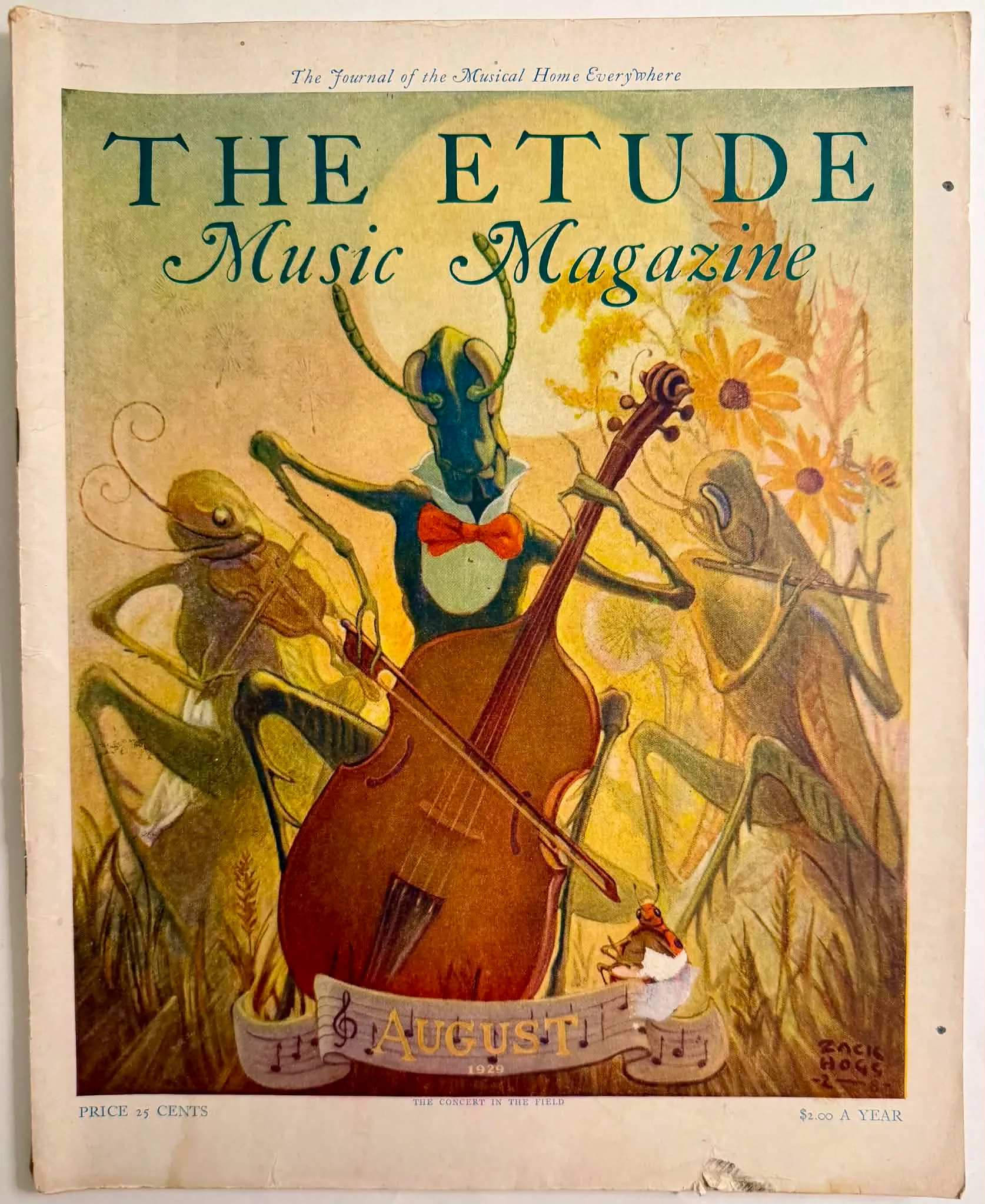
1929 Zack Hogg The Concert in the Field Etude Magazine Cover Art
The visual evidence presented in this digital surrogate reveals a highly illustrative, mass-market periodical cover dominated by a whimsical, anthropomorphic tableau. The central illustration depicts a trio of orthopteran insects—specifically grasshoppers or katydids—engaged in a classical musical performance amidst a magnified natural landscape. The focal point is a large, upright grasshopper executing a performance on a proportionally massive string instrument, resembling a cello or double bass. This central figure is striking in its juxtaposition of the natural and the civilized; it possesses the green exoskeleton and antennae of an insect but is anthropomorphized by a stark white, formal wing-collar and a vivid, oversized red bow tie. To the viewer's left, a second grasshopper is captu
Category: Pens & Writing
Year: 1929
Rarity Class: B
Paper & Print Condition
Based strictly on rigorous visual examination of the digital proxy, the artifact is printed on typical commercial magazine stock characteristic of the late 1920s, which appears highly porous and overtly susceptible to natural oxidation and cellular degradation. The most dominant condition issue is a severe surface avulsion (paper loss) located in the lower right-center quadrant, completely obliterating a section of the ladybug character and the illustrated sheet music, revealing the raw, white f
Provenance & Rarity
This artifact originates directly from a mass-circulated monthly publication, The Etude, which was distributed aggressively across the United States. Its initial physical scarcity was entirely non-existent, as it was specifically engineered for widespread, ubiquitous household consumption by the burgeoning middle class. The moderate rarity it possesses today is purely attritional. Magazines of this exact nature were interactive, utilitarian objects—opened, folded, physically placed on piano musi
Rarity & Condition Summary
The artifact is a Class B attritional survivor of late-1920s mass-market publishing. While the central printed image retains bold, summery hues and remarkably stable color reproduction, the structural integrity of the paper is heavily compromised by a severe surface avulsion in the lower right quadrant and rough mechanical tearing along the left binding edge, exhibiting typical acidic decay consistent with nearly a century of existence.