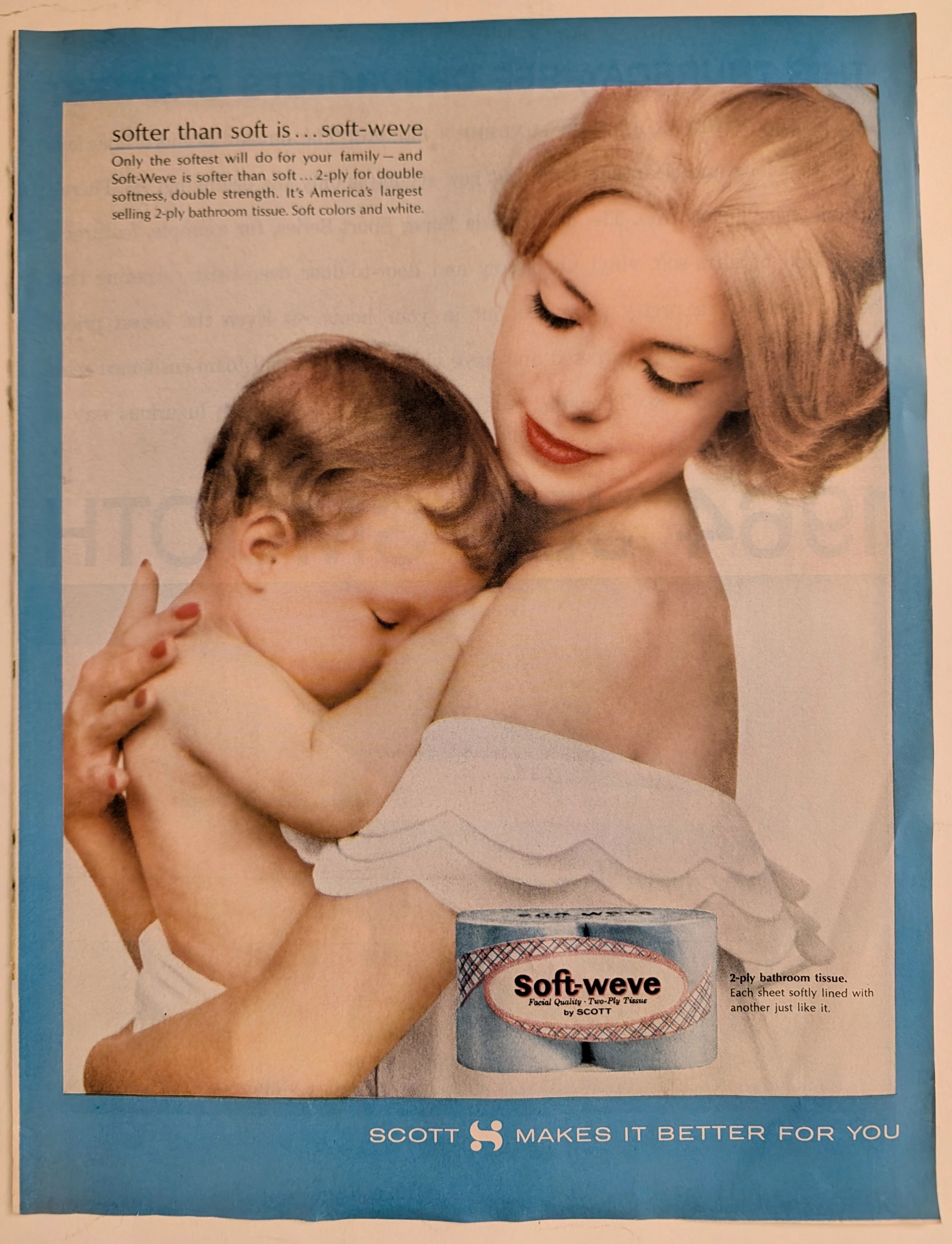
1950s Scott Soft-Weve Bathroom Tissue Vintage Advertisement
Circa 1950s Scott Soft-Weve Bathroom Tissue Vintage Print Advertisement Published during the post-war boom of the 1950s, this advertisement for Scott's "Soft-Weve" bathroom tissue beautifully illustrates the era's marketing shift toward domestic comfort. By utilizing the universally tender image of a mother holding a sleeping infant, the brand masterfully translates the physical attribute of "softness" into an emotional appeal, repositioning a utilitarian bathroom staple as a premium family necessity. During the 1950s, the American standard of living rose significantly, and consumer goods marketing evolved to emphasize elevated everyday experiences. This advertisement for Scott's "Soft-Weve" bathroom tissue perfectly encapsulates this mid-century trend. Rather than focusing solely on utility or price, the copy introduces the concept of "facial quality" toilet tissue. By promising "double softness, double strength" through its 2-ply construction, Scott aimed to transform a basic commodity into an affordable luxury for the modern household. The visual rhetoric of the advertisement is highly effective. The intimate, brightly lit photograph of an elegant mother cradling her sleeping, bare-skinned baby forms an immediate subconscious association between the product's gentleness and the utmost care required for an infant. Furthermore, the inclusion of the text "Soft colors and white" points to the mid-century phenomenon of colored bathroom fixtures and matching pastel toilet paper, which became a hallmark of stylish 1950s interior design.
Category: Home & Household
Year: 1950
Rarity Class: B
Paper & Print Condition
Printed on standard mid-century magazine stock. The paper exhibits mild, uniform toning consistent with its age. The four-color halftone photolithography remains exceptionally vivid, retaining the delicate skin tones of the mother and infant, as well as the bold, solid pastel blue bordering, without noticeable color degradation or ink offsetting. The extreme close-up analysis reveals the precise rosette dot patterns characteristic of mid-century commercial printing.
Provenance & Rarity
Rescued from a mainstream American women's or lifestyle magazine circulated during the 1950s. While basic household good advertisements are abundant, specimens that flawlessly capture the era's psychological marketing shift—elevating toilet tissue to a "facial quality" maternal necessity—are highly valued for sociological and advertising studies.
Rarity & Condition Summary
A beautifully preserved slice of 1950s domestic Americana. It serves as a foundational example of post-war marketing strategies aimed at selling comfort and maternal care.