1988 Dunhill Elite Watch Vintage Advertisement (1980) — Class B vintage Lifestyle & Vice
CLASS B
1 of 6

1988 Dunhill Elite Watch Vintage Advertisement

Category|Lifestyle & Vice
Year|1980
Rarity Class|CLASS B
Archive Views|6

Last updated: 25 Apr 2026

Historical Context

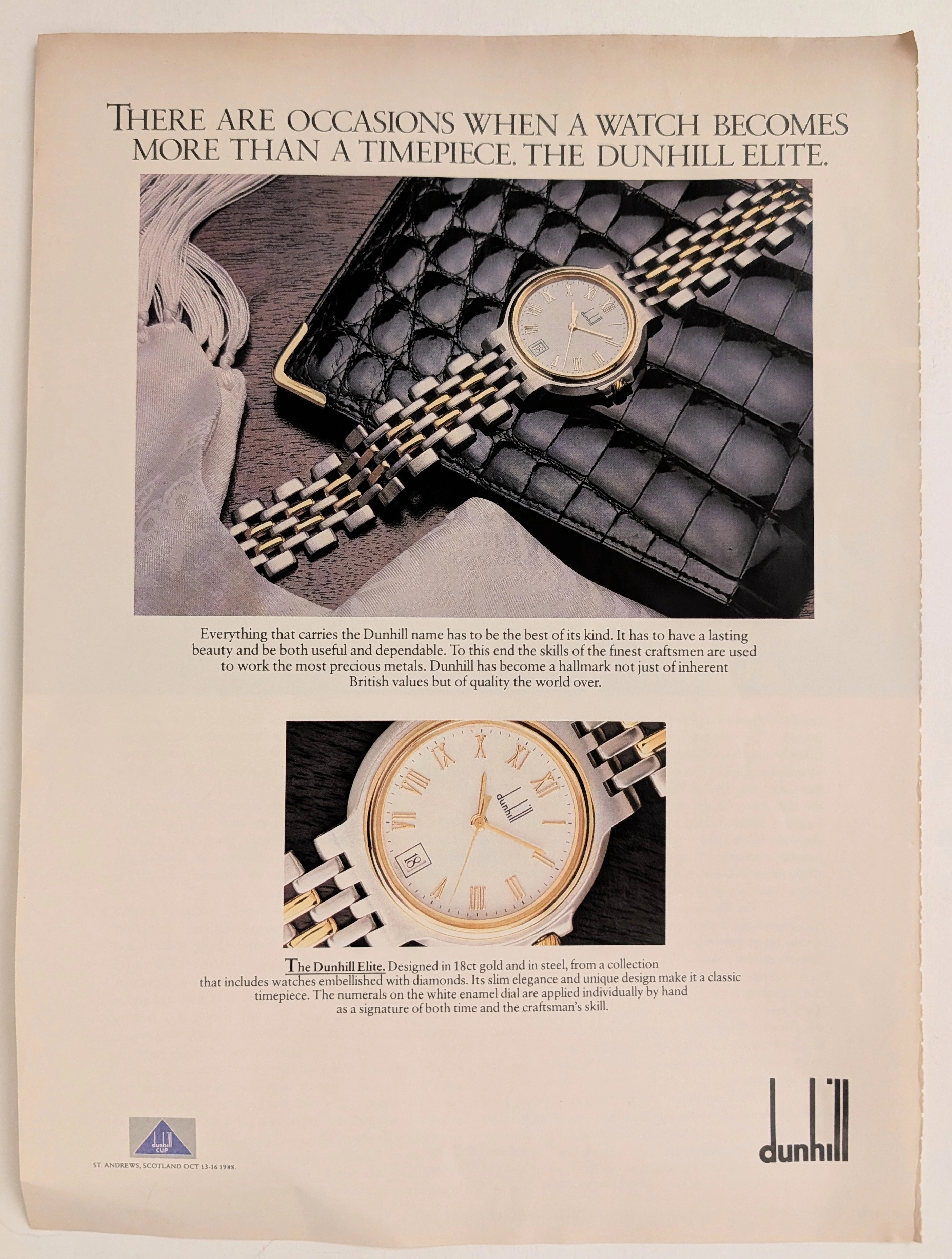
1988 The Dunhill Elite Watch Vintage Print Advertisement Published in the fall of 1988, this sophisticated advertisement for Alfred Dunhill captures the refined essence of British luxury during a decade defined by conspicuous yet elegant consumption. Featuring "The Dunhill Elite" timepiece, the imagery is anchored by the brand's sponsorship of the prestigious Dunhill Cup golf tournament at St. Andrews, seamlessly blending sporting prestige with high-end horology. During the late 1980s, the global luxury market experienced a massive boom, characterized by a renewed appreciation for heritage brands and meticulous craftsmanship. Alfred Dunhill, a brand deeply rooted in British gentlemanly pursuits, perfectly capitalized on this era. This advertisement for "The Dunhill Elite" introduces a watch designed in 18ct gold and steel—the quintessential "two-tone" aesthetic that came to define upper-class horology in the 1980s and 90s. The visual composition is a masterclass in establishing luxury cues without overt flashiness. The slim, elegant timepiece is draped casually yet deliberately over a piece of textured black crocodile leather and a white silk scarf with refined tassels. This still-life arrangement whispers exclusivity. The ad copy reinforces this, stating that the numerals on the white enamel dial are "applied individually by hand," highlighting the brand's commitment to traditional artisanal techniques in an era increasingly dominated by mass production. Furthermore, the inclusion of the "Dunhill Cup" logo and the text "St. Andrews, Scotland Oct 13-16 1988" grounds this piece in a specific cultural moment. By aligning the launch of an elite timepiece with one of the most prestigious events in the golfing world, Dunhill firmly positioned its products not merely as accessories, but as essential accoutrements for the international sporting gentleman.

Paper & Print Condition

Printed on high-quality, late-20th-century glossy magazine stock. The paper exhibits excellent structural integrity with minimal aging. The color registration is superb, allowing the warmth of the 18ct gold, the deep, textured blacks of the leather, and the crisp typography to remain vibrant and true to their original 1988 publication.

Provenance & Rarity

Sourced from an upscale international lifestyle and sporting publication surrounding the Autumn 1988 golf season. While luxury watch advertisements from this era are relatively common, pieces that specifically tie the horological launch to historic sporting events like the Dunhill Cup at St. Andrews carry distinct cross-collecting appeal for both watch enthusiasts and golf historians.

Rarity & Condition Summary

A beautifully preserved time capsule of 1980s British luxury marketing. Its significance lies in its elegant minimalist aesthetic and its documentation of high-society sporting sponsorships.
Share This Archive

From the Journal

Related Articles

The Time Traveller's Dossier: The Ultimate Horological Supremacy – A Museum-Grade Forensic Deconstruction of the 1968 Longines Ultra-Chron — related article
Read Article

The Time Traveller's Dossier: The Ultimate Horological Supremacy – A Museum-Grade Forensic Deconstruction of the 1968 Longines Ultra-Chron

The evolution of human timekeeping is not merely a passive record of hands rotating in concentric circles; it is a brutal, centuries-long engineering war waged against the absolute, unforgiving laws of physics—specifically gravity, temperature fluctuation, and physical friction. The historical artifact placed upon The Record Institute’s forensic examination table today is a monumental full-page print advertisement for the 1968 Longines Ultra-Chron, extracted from a mid-twentieth-century publication. Released precisely on the precipice of the "Quartz Crisis"—a technological tsunami that would soon decimate the traditional Swiss watch industry—this document represents the absolute pinnacle, the zenith, and the glorious final, defiant stand of analog mechanical engineering. This exhaustive, world-class academic archival dossier will ruthlessly dissect the artifact with microscopic precision, operating under the most rigorous parameters of historical and physical evaluation. We will decode the arrogant yet mathematically backed copywriting that boldly claims "A Minute A Month" accuracy, the profound mechanical significance of the 36,000 vibrations per hour (vph) high-beat movement, and the five specific medallions of honor that permanently anchor the brand’s bloodline to legendary aviation pioneers such as Charles Lindbergh and Howard Hughes. Furthermore, we will subject the heavy, dark-field offset lithography to a rigorous material science analysis, exposing the mechanical fingerprints of the analog halftone rosettes and the inevitable, profoundly beautiful wabi-sabi oxidation of the paper substrate. It is this exact intersection of horological mastery and chemical degradation that acts as the primary engine driving the artifact's market value exponentially upward among serious global collectors.

Rolex "Perpetually Yours" — related article
Read Article

Rolex "Perpetually Yours"

This rare mid-century Rolex "Perpetually Yours" advertisement captures the genesis of the modern Rolex empire. Featuring the legendary Oyster Perpetual, it celebrates the historic union of the world's first waterproof 'Oyster' case (1926) and the revolutionary self-winding 'Perpetual' rotor (1931). A true museum-grade horological archive, this piece represents the ultimate mechanical blueprint that defined Rolex's eternal supremacy.

Ahead of Its Time: The 1978 Heuer Chronosplit Manhattan GMT — related article
Read Article

Ahead of Its Time: The 1978 Heuer Chronosplit Manhattan GMT

Rediscover the ultimate analog-digital hybrid timepiece through a rare 1978 vintage magazine advertisement, meticulously preserved as a single sheet cut-out.

The Time Traveller's Dossier: The Anatomy of Autonomy – The 1966 Bulova Commander Collection and the American System of Watchmaking — related article
Read Article

The Time Traveller's Dossier: The Anatomy of Autonomy – The 1966 Bulova Commander Collection and the American System of Watchmaking

The evolution of the mid-twentieth-century luxury consumer market was fundamentally propelled by an intense post-war desire for unwavering reliability and transparent corporate accountability. The historical artifact elegantly and securely positioned upon the analytical table of The Record Institute today is a striking, full-page print advertisement for the 1966 Bulova Commander Collection, originating from a highly transformative era in global horology. This document completely transcends the standard, utilitarian boundaries of jewelry marketing. It operates as a highly sophisticated, multi-layered cultural mirror, reflecting the precise era when American industrial might directly challenged the fragmented traditions of European watchmaking, explicitly packaging and selling the concept of total mechanical autonomy to the American middle-class consumer. This world-class, comprehensive dossier conducts a meticulous, unyielding, and exceptionally exhaustive examination of the artifact, operating under the absolute most rigorous parameters of historical, sociological, and material science evaluation. With the vast majority of our analytical focus dedicated to its immense historical gravity, we will decode the brilliant marketing psychology embedded within the "If you want something done right, do it yourself" campaign, analyze the sociopolitical impact of the "American System of Watchmaking," and dissect the profound visual semiotics of the exploded mechanical view. Furthermore, as we venture deeply into the chemical and physical foundations of this analog printed ephemera, we will reveal the precise mechanical fingerprints of the CMYK halftone rosettes captured in the macro imagery of the watch dial and alligator strap. Finally, we will assess its archival rarity, exploring how the graceful, natural oxidation of the paper substrate cultivates a serene wabi-sabi aesthetic—a natural, irreversible phenomenon that serves as the primary engine driving up its market value exponentially within the elite global spheres of Vintage Commercial Ephemera and Horological Archives.