

The Time Traveller’s Dossier: 1983 Evyan White Shoulders Vintage Advertisement — An Ode to Classical Romance and Elegance
The History
The story of Evyan Perfumes and its flagship fragrance, White Shoulders, is not merely a tale of cosmetic chemistry; it is a profound chapter in the cultural and economic history of American luxury. To understand the gravity of this 1983 advertisement, one must first trace the brand's audacious origins and the shifting zeitgeist of the twentieth century.
The Genesis of an American Luxury House
The house of Evyan was established in the late 1930s by Dr. Walter Langer—a European emigré who stylized himself as Baron Walter Langer von Langendorff—and his British-born wife, Evelyn (from whose name the portmanteau "Evyan" was derived). During this epoch, the global fragrance industry was unequivocally dominated by historic French houses like Chanel, Guerlain, and Houbigant. American perfumes were largely viewed as utilitarian or inferior. The Langers set out with a fiercely ambitious, contrarian mission: to create an unapologetically American perfume house that could rival the sophistication, complexity, and prestige of the Parisian masters.
The Wartime Vacuum and Escapist Consumerism
The true catalyst for White Shoulders occurred during World War II. The occupation of France and the subsequent Allied blockades abruptly choked off the supply of French perfumes to the United States. Recognizing this unprecedented vacuum in the luxury market, Evyan launched White Shoulders in 1943.
The strategy was a masterclass in psychological marketing. In an era defined by rationing, industrial labor (the "Rosie the Riveter" era), and profound global anxiety, White Shoulders offered pure, unadulterated escapism. The name itself was evocative of a bygone era of aristocratic leisure—conjuring images of debutantes, sweeping evening gowns, and bare, powdered skin untouched by the harsh realities of wartime factories. Its olfactory profile—an opulent, heavy white floral bouquet dominated by tuberose, gardenia, jasmine, and lilac—was intensely feminine and romantic. It became a sensation, cementing Evyan’s status and proving that an American fragrance could capture the high-end market.
The 1980s: A Counter-Cultural Stance in the Era of Excess
Fast forward to 1983, the year this specific advertisement was circulated. The cultural landscape had shifted dramatically. The 1980s fragrance market was entering an era of aggressive "power scents"—massive, room-filling orientals and sharp florals like Yves Saint Laurent’s Opium, Dior’s Poison, and Giorgio Beverly Hills. Fashion was defined by sharp angles, corporate power dressing, and enormous shoulder pads.
In stark contrast, this Evyan advertisement represents a deliberate, almost counter-cultural adherence to classical romanticism. Instead of padded shoulders, the ad emphasizes literal bare, white shoulders. While competing brands marketed to the aggressive corporate climber, Evyan positioned itself as a beacon of inherited, timeless elegance.
Decoding the 1983 Visual Narrative
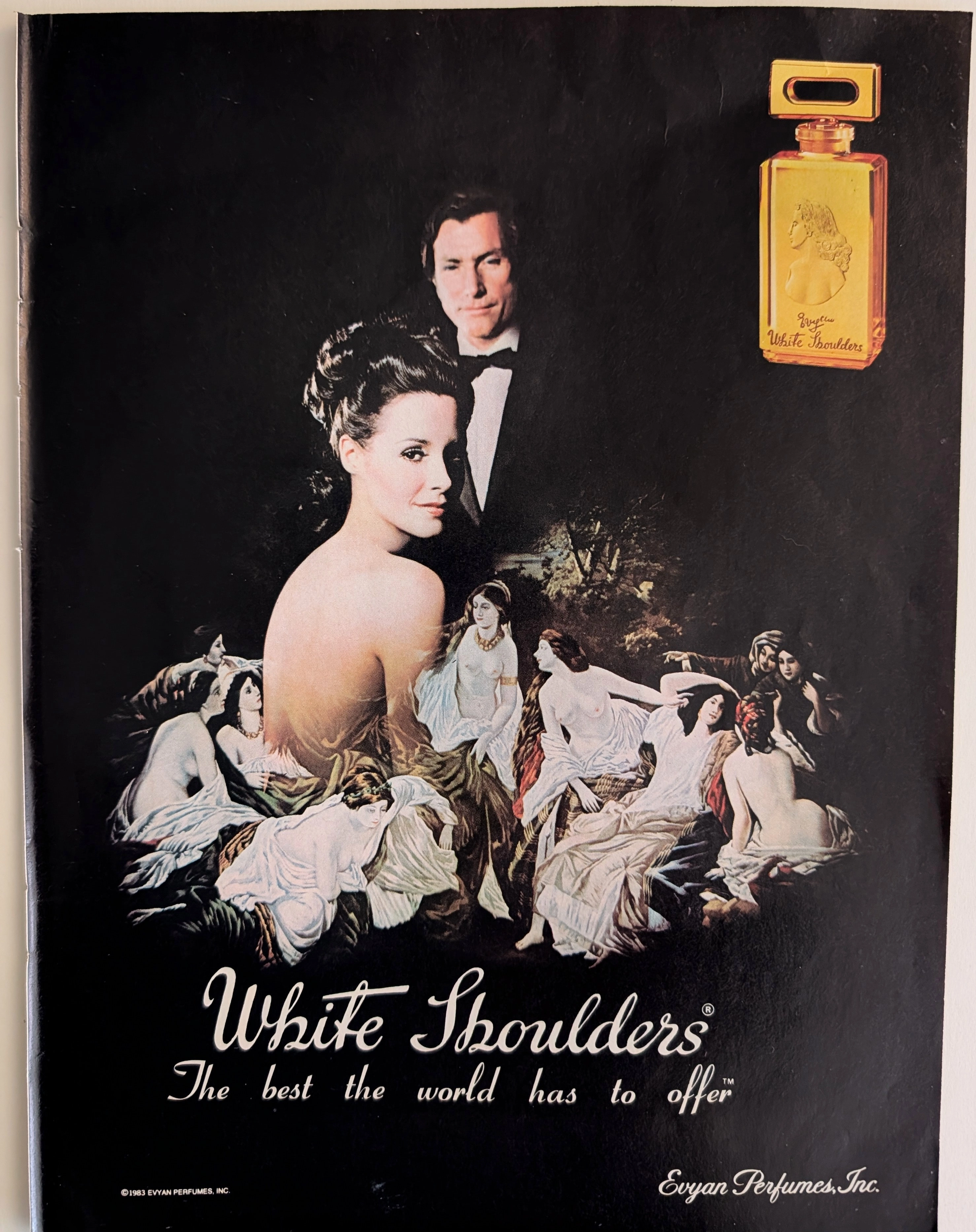
The visual composition of this campaign bridges two distinct timelines. In the foreground, a modern 1980s couple in formal evening wear gazes out at the viewer. The woman is the epitome of contemporary high society. Yet, beneath them, seamlessly blended into her silhouette, is a painterly tableau straight from a Renaissance or Pre-Raphaelite canvas—ethereal women draped in classical robes, lounging in a pastoral, mythic setting.
This juxtaposition is a brilliant piece of archival brand positioning. It communicates that White Shoulders is the thread connecting the mythic goddesses of antiquity to the modern elite. The bold, serif tagline—"The best the world has to offer"—is not just a boast; it is a defensive, authoritative statement in an increasingly crowded global market. It reasserts Evyan's original 1940s mission statement: that American luxury need not defer to Europe.
The Archival Significance
Historically, the 1980s marked the twilight of Evyan’s independent reign. By the end of the decade, the shifting tastes of younger demographics and the consolidation of the beauty industry would lead to the brand’s eventual sale (it was acquired by Elizabeth Arden in 1989). Therefore, this 1983 print advertisement is more than just a marketing asset; it is a poignant cultural artifact. It captures the final, defiant golden era of an independent American perfumery insisting on classical romance in a decade defined by neon and excess.
The Paper
From an archival perspective, the physical substrate of this advertisement provides a textbook example of 1980s high-end periodical printing. Extracted from a premium fashion or lifestyle publication of the era, the paper is a lightweight, clay-coated stock designed specifically to support high-resolution image reproduction.
Print Technology & Archival Behavior:
The piece was produced using four-color (CMYK) offset web lithography. The most striking technical feature of this specific ad is the extensive use of deep, rich black ink to create the void-like background. Achieving this level of density required heavy ink laydown, likely utilizing a "rich black" formula (a combination of black ink bolstered by percentages of cyan, magenta, and yellow) to prevent the background from appearing flat or gray.
Condition & Preservation:
Because of the heavy ink coverage, this type of paper is highly susceptible to mechanical damage; even slight abrasions can cause the glossy black surface to scuff, revealing the white clay coating beneath. Furthermore, the underlying paper fibers from this era often contain residual lignin. While the clay coating acts as a temporary buffer, exposure to ultraviolet light or fluctuating humidity can lead to oxidation, causing the paper to yellow and become brittle over time. Preserving the deep contrast and preventing the golden hues of the perfume bottle from fading requires strict archival storage in acid-free, light-proof environments.
The Rarity
In terms of sheer production numbers, the 1983 Evyan White Shoulders vintage advertisement is not inherently rare. During the early 1980s, Evyan placed these campaigns in major, high-circulation magazines such as Vogue, Harper's Bazaar, and Town & Country. Millions of impressions were printed and distributed globally.
However, the archival rarity—the scarcity of finding a pristine, unblemished copy—is quite high. The aforementioned heavy black ink coverage makes this specific advertisement notoriously difficult to find in "mint" condition. Most surviving copies exhibit spine creasing, micro-tears, or edge-wear from decades of handling. For collectors of beauty ephemera and institutional archives, a copy that retains the crispness of the typography, the luminescent gold of the product shot, and an unmarred black background holds significant collector value and commands premium market perception.
Visual Impact
The art direction of this piece is a study in chiaroscuro and psychological marketing. By utilizing a stark, black background, the art director forces the viewer's eye exactly where it needs to go, eliminating any peripheral distractions.
Composition & Art Direction:
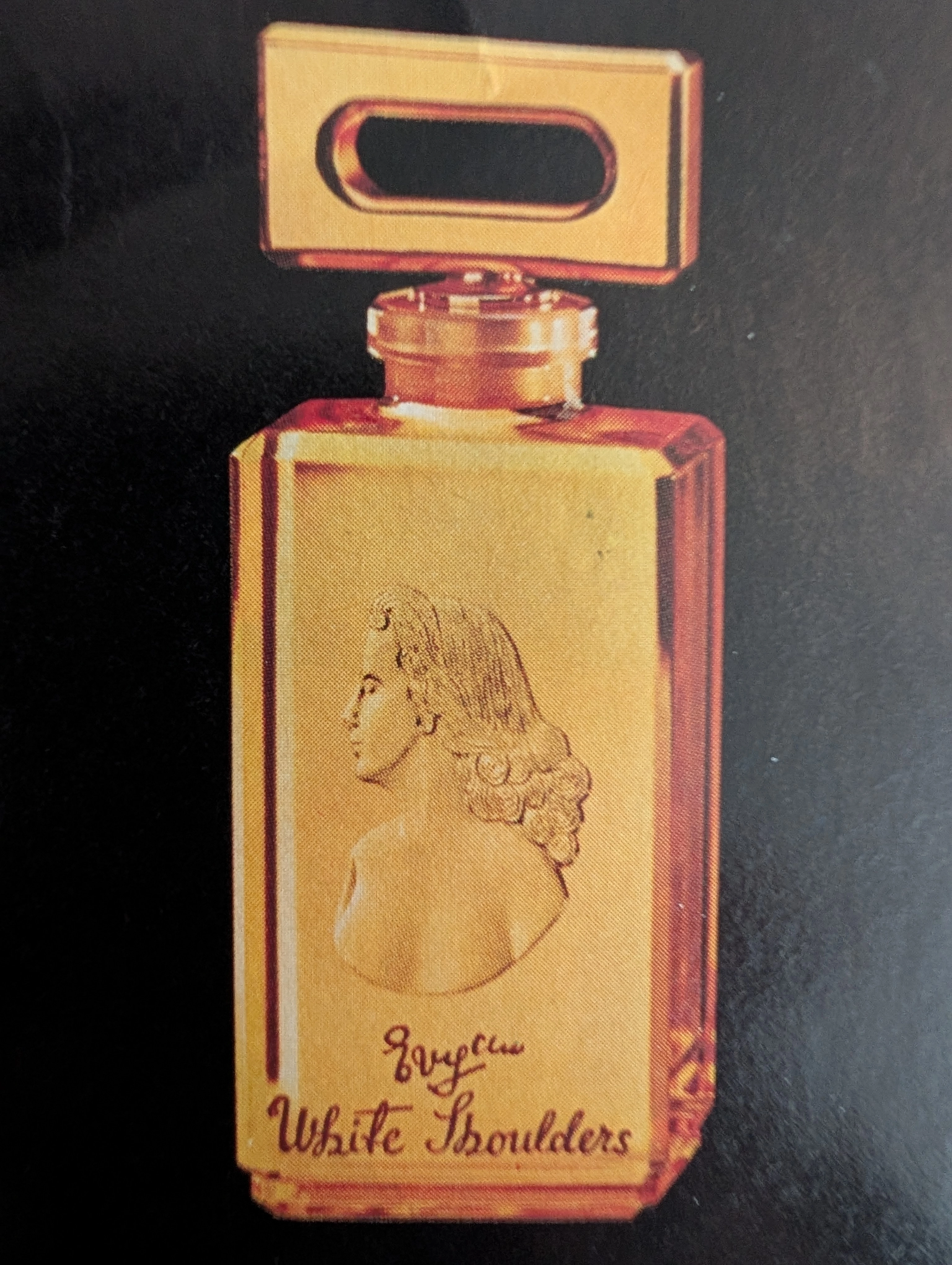
The layout is structured in a loose triangle. At the apex sits the glowing, amber-hued bottle of White Shoulders, suspended like a jewel in the dark. The eye then travels down to the modern-day couple: a woman with flawless, porcelain skin—literally showcasing her "white shoulders"—and a man in a tuxedo standing protectively behind her. Below them, blending seamlessly into the woman's form, is a painterly illustration reminiscent of Neoclassical or Pre-Raphaelite art, depicting women in classical drapery lounging in a pastoral setting.
Emotional Tone & Typography:
This visual synthesis creates an emotional tone of inherited luxury. The modern woman is portrayed as the contemporary heir to classical goddesses. The typography further anchors this feeling. The brand name "Evyan" and the product name "White Shoulders" are rendered in a flowing, elegant script that implies a handwritten signature, adding a touch of personal, aristocratic endorsement. The bold, serif tagline "The best the world has to offer" provides a grounded, authoritative counterpoint to the romantic imagery above it.
Exhibition Halls
The Archive Continues
Continue the Exploration
THE TIME TRAVELER'S DOSSIER: OLD CROW - THE MYTHOLOGY OF AMERICAN BOURBON
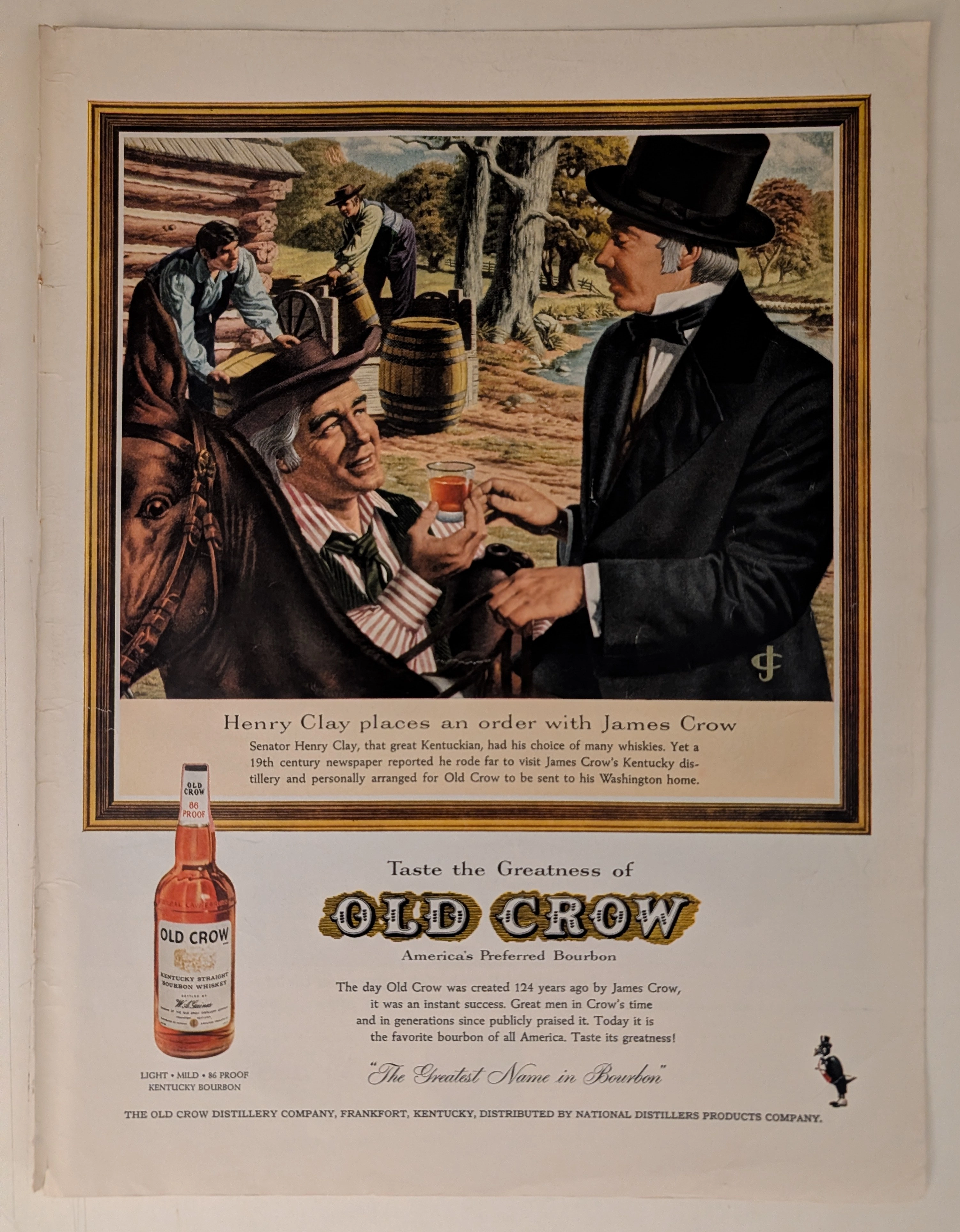
The artifact currently subjected to our uncompromising, museum-grade analysis is a profoundly preserved Historical Relic excavated from the golden age of American print media. This Primary Art Document is a full-page, magazine-sized advertisement for OLD CROW Kentucky Straight Bourbon Whiskey. Functioning as a "Forensic Blueprint of American Myth-Making," the document masterfully weaponizes political heritage and historical titans to validate the aristocratic taste and unparalleled quality of the bourbon. Its historical context is irrefutably anchored by the embossed text physically molded into the glass bottle itself—the most powerful and undeniable forensic evidence available in mid-century liquor advertising. Grounded by extreme macro details of the label, the microscopic golden monogram embroidered on the coat, and the breathtaking wabi-sabi chemical degradation of the highly acidic, magazine-sized paper, this artifact commands an irreplaceable status. It firmly cements its Rarity Class A designation as an absolute masterpiece of historical marketing engineering and analog preservation.
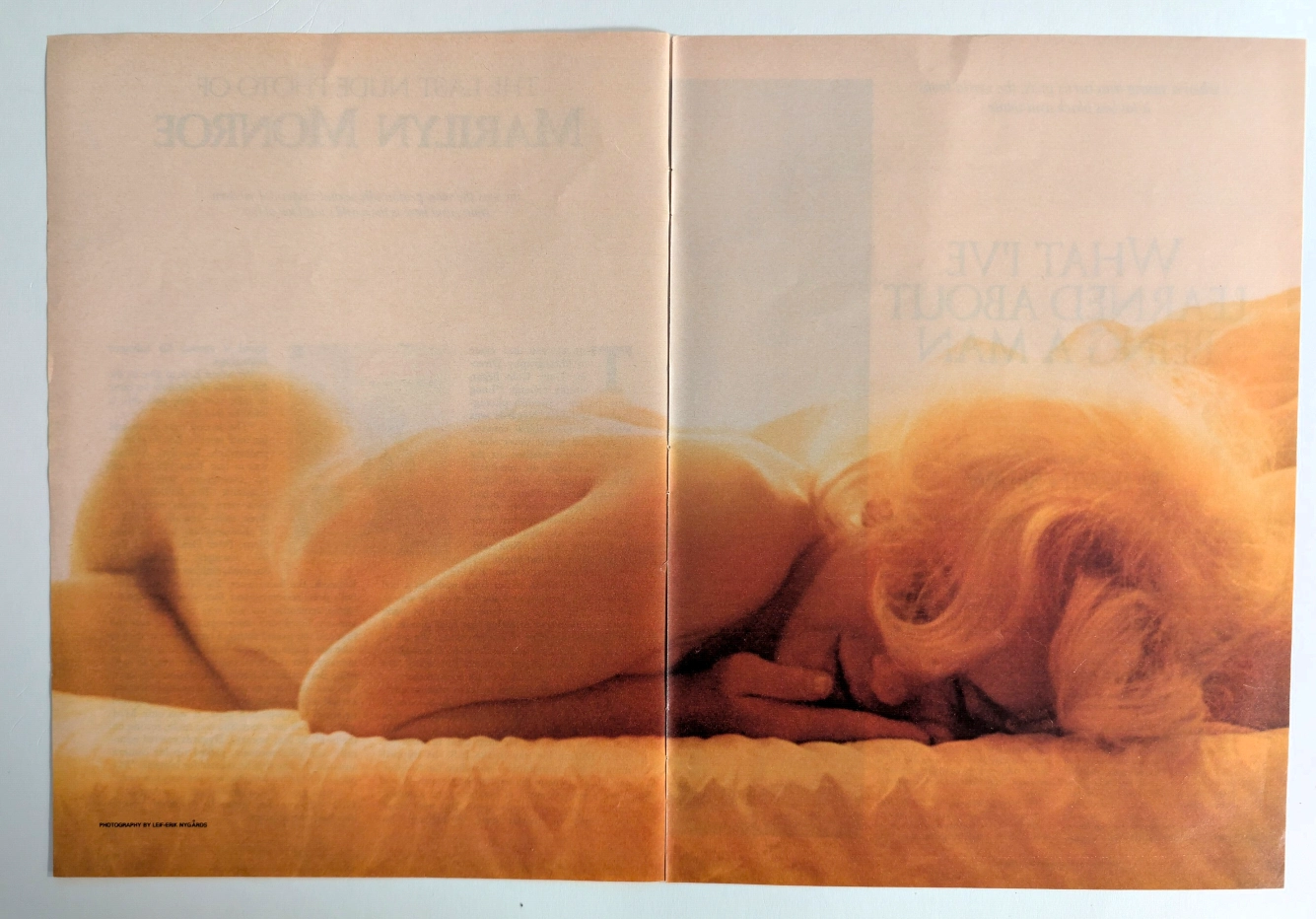
The Final Glimpse of a Legend: The History Behind Marilyn Monroe's Last Nude
Uncover the profound historical significance of the ultimate photograph of the 20th century's greatest pop culture icon, captured by Leif-Erik Nygårds just weeks before her tragic death.
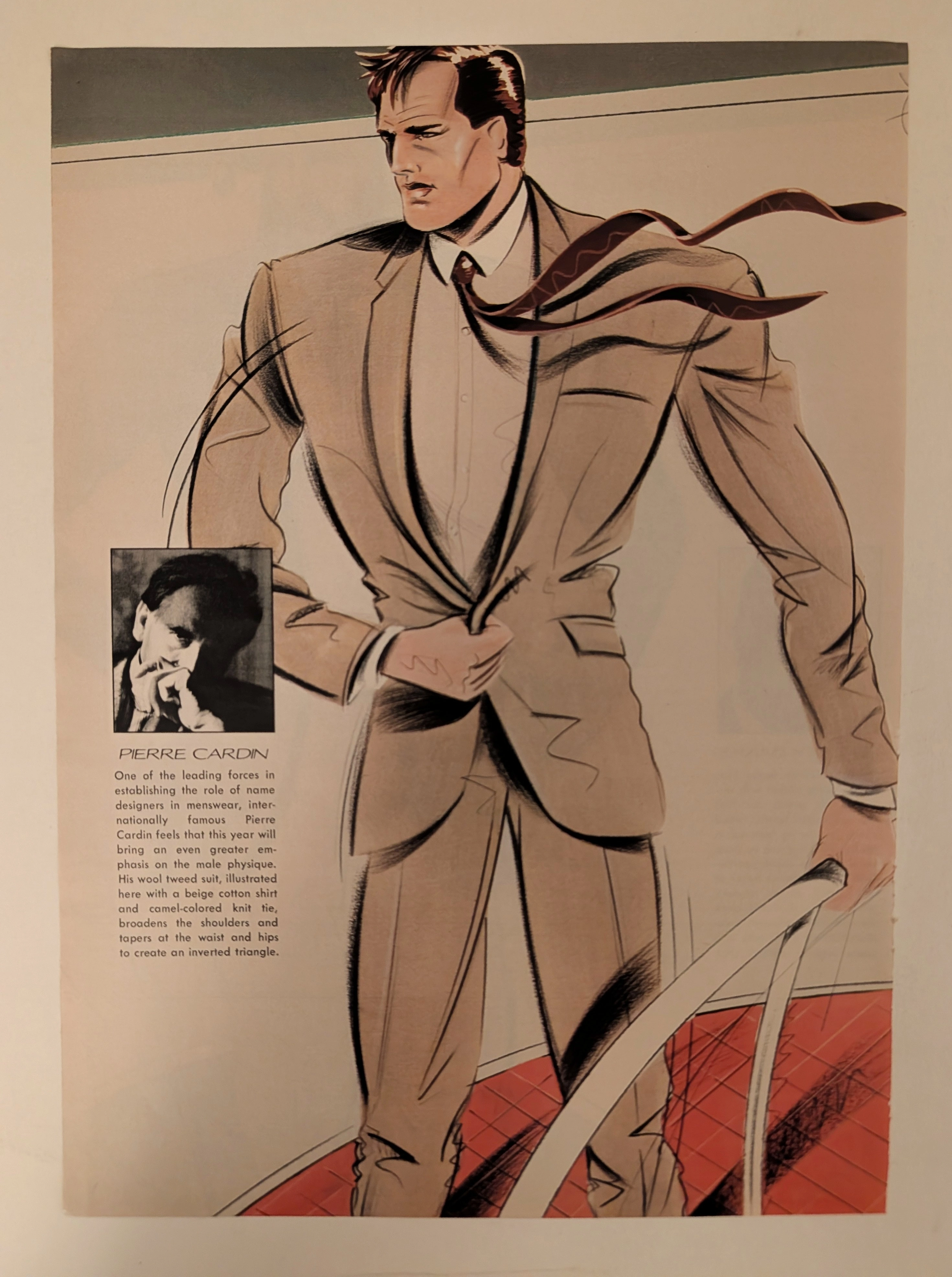
Pierre Cardin · Fashion
The Time Traveller's Dossier: The Architecture of Masculine Dominance – Pierre Cardin Editorial Illustration (Circa 1980s)
History is not merely written; it is tailored, draped, and aggressively padded at the shoulders. Long before digital algorithms dictated the sterile parameters of modern menswear, and before the casualization of the corporate wardrobe stripped the modern executive of his sartorial armor, societal engineering was executed through the calculated geometry of the designer suit. The historical artifact before us is not a mere disposable magazine tear sheet; it is a perfectly weaponized blueprint of 1980s hyper-masculinity, a visual manifesto of corporate dominance, and an unwavering testament to an era when clothing was utilized as a tool for physical and psychological intimidation. This museum-grade, academic archival dossier presents an exhaustive deconstruction of a late-analog editorial illustration featuring the revolutionary menswear of Pierre Cardin, dating to the pivotal "Power Suit" era of the 1980s. Operating on a profound, ruthless binary structure, this document records a calculated paradigm shift within the global fashion industry. It captures the precise historical fracture where menswear transitioned conceptually from the conservative, conformity-driven "Organization Man" of the mid-20th century into the aggressive, space-commanding "Power Broker" of the 1980s. Through the highly specialized lens of late-analog commercial artistry and stringent visual forensics, this document serves as a masterclass in the psychological marketing of gender and power. It established the foundational archetype for the modern, alpha-male aesthetic—an archetype that unconditionally dictates the visual and strategic totems of corporate dominance even today.