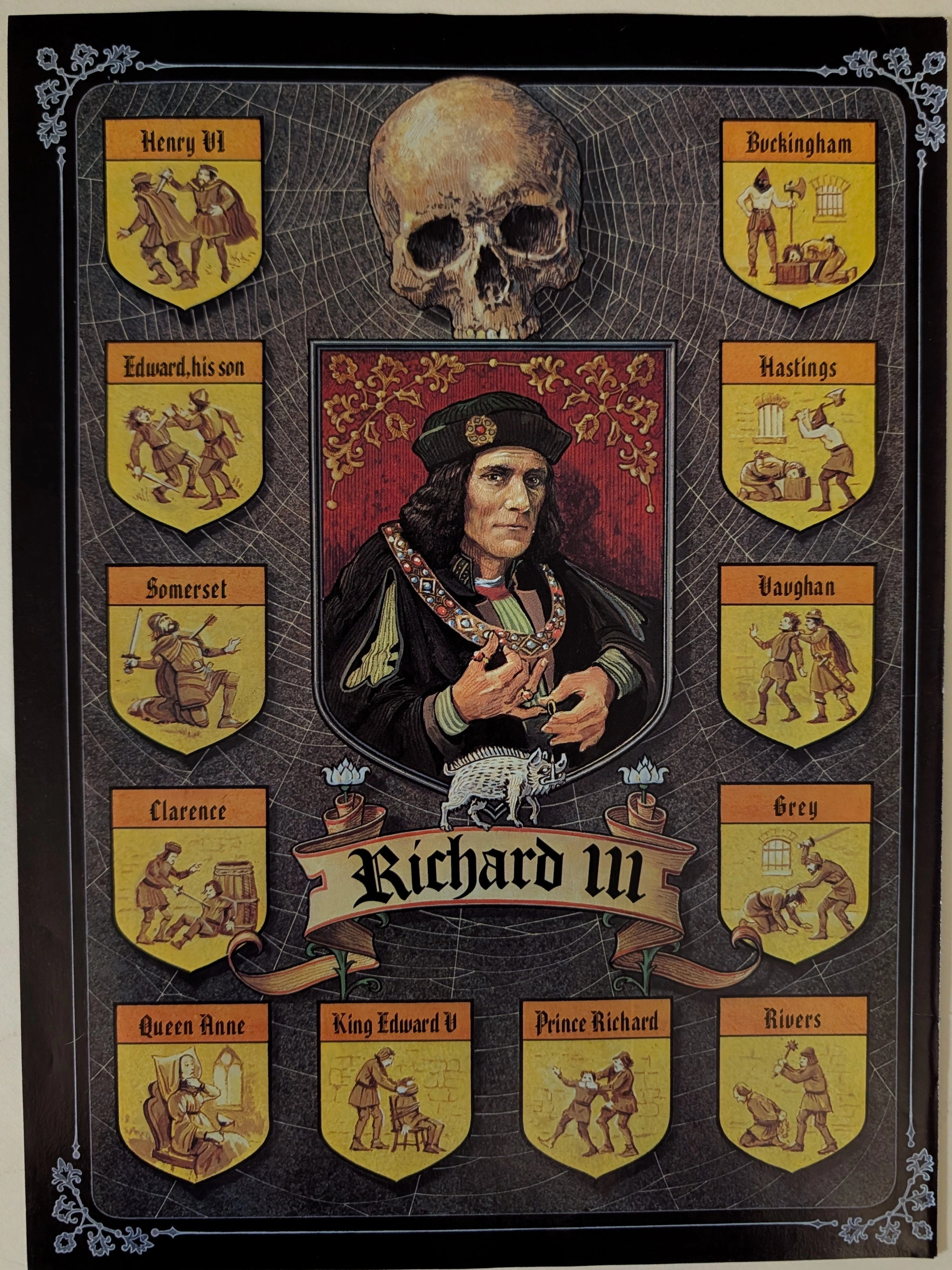
The Time Traveller’s Dossier: Circa 1970s Shakespearean Richard III Vintage Illustration — The Tudor Web of Blood
The History
The Context of the Wars of the Roses and the "Tudor Myth"
To fully decode the semiotics of this illustration, one must first understand the bloody backdrop of the Wars of the Roses—the decades-long dynastic civil war for the English throne fought between the rival Plantagenet cadet branches of Lancaster (the Red Rose) and York (the White Rose). King Richard III was the last monarch of the House of York and the final Plantagenet king. His death at the Battle of Bosworth Field in 1485 marked the definitive end of the Middle Ages in England and birthed a new dynasty: the House of Tudor, led by Henry VII.
The illustration before us is not a piece of objective historiography. Rather, it is a magnificent visual manifestation of history as written by the victors—the enduring "Tudor Myth." This mythos was permanently etched into the global cultural consciousness by William Shakespeare in his tragedy Richard III. Shakespeare portrayed Richard as a physical and moral monster—a hunchbacked, withered-armed Machiavellian mastermind who gleefully slaughtered his way to the crown. This artwork compresses hours of theatrical tragedy onto a single plane, utilizing a massive spiderweb as the foundational background to echo the exact insult lobbed at Richard in the play: the venomous "bottled spider" pulling the fatal strings.
Decoding the Twelve Shields of Blood: A Map of Usurpation
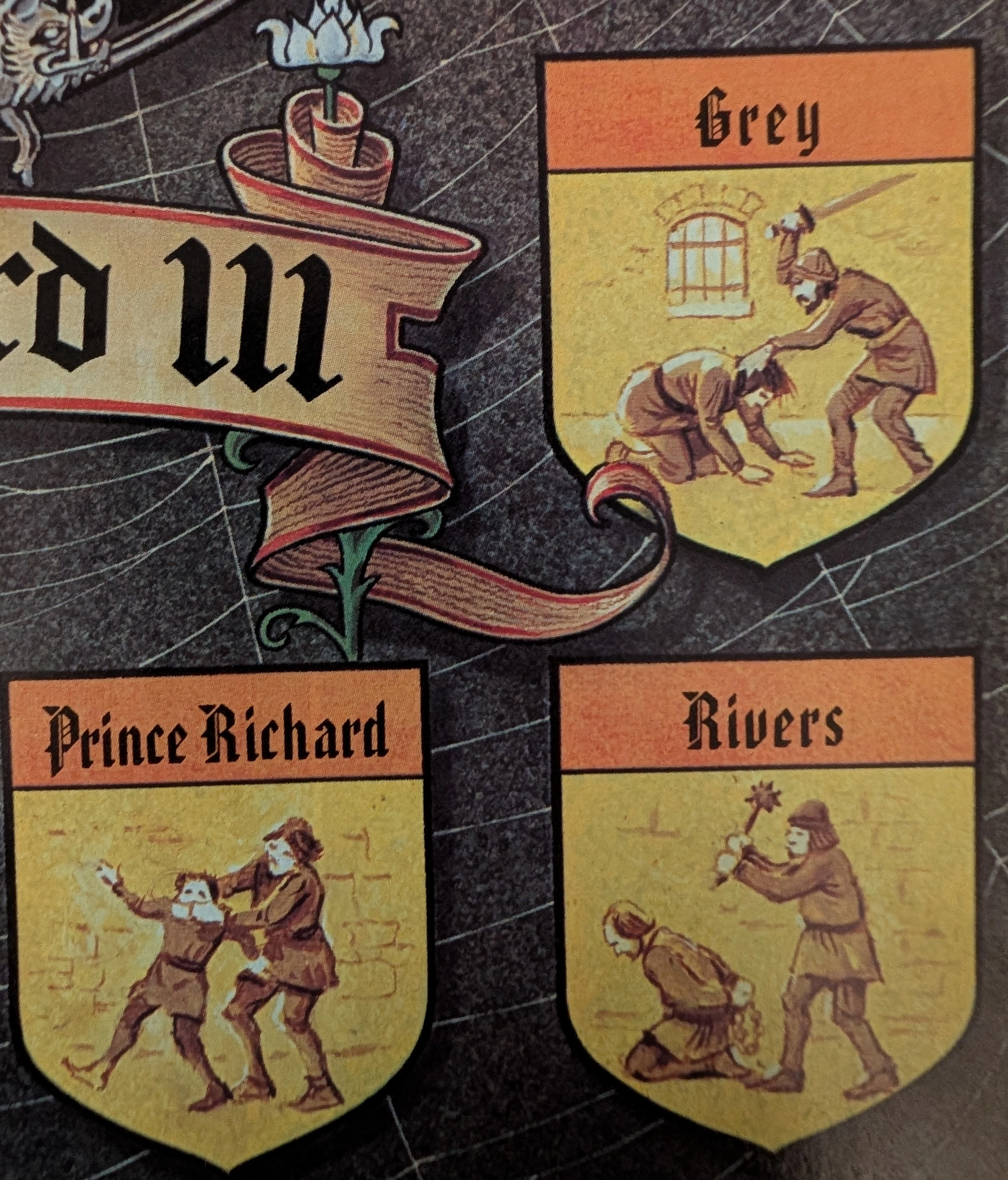
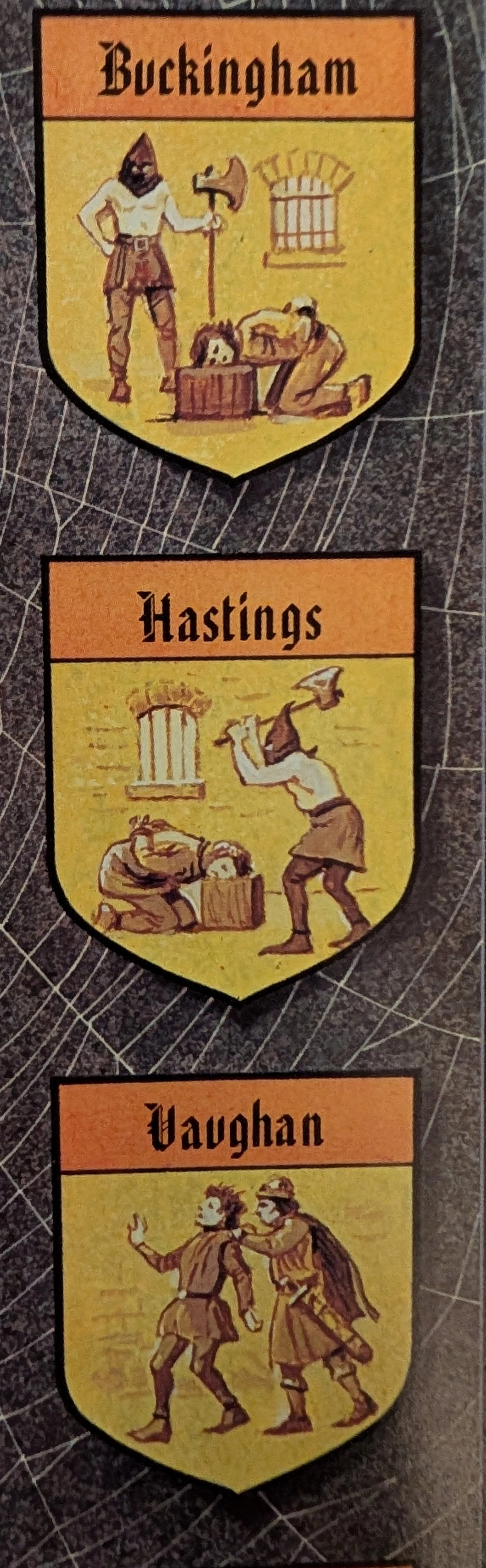
The most striking and historically dense element of this artwork is the perimeter of twelve heraldic shields. In traditional heraldry, these would bear family crests; here, they serve as a grim ledger of assassination and execution, depicting the factions, rivals, and kin who fell victim to Richard’s ambition:
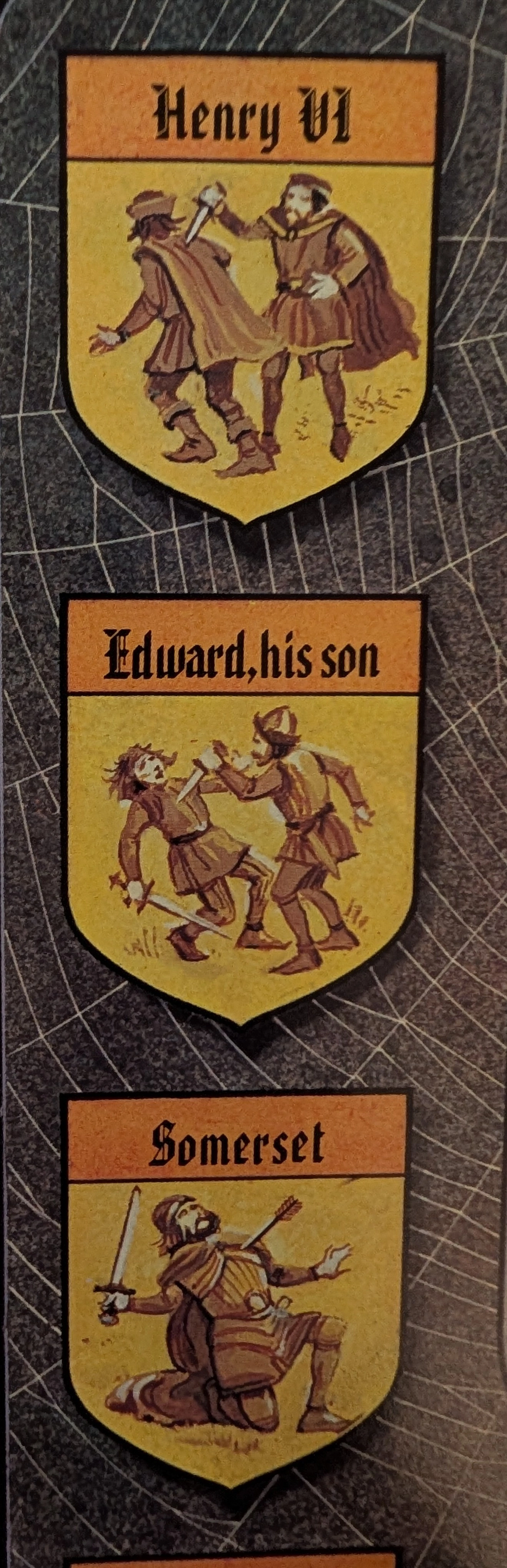
Henry VI: The top-left shield depicts a man being stabbed from behind. King Henry VI of the House of Lancaster, the pious but mentally unstable monarch, was imprisoned in the Tower of London. According to the Tudor tradition and Shakespeare, Richard (then Duke of Gloucester) personally murdered Henry to extinguish the Lancastrian line.
Edward, his son (Edward of Westminster, Prince of Wales): The subsequent shield shows a desperate sword fight and stabbing. The only son of Henry VI, Prince Edward was brutally killed following the Lancastrian defeat at the Battle of Tewkesbury in 1471. Shakespeare dramatizes Richard eagerly participating in his butchery right before the eyes of the prince's mother.
Somerset (Edmund Beaufort, 4th Duke of Somerset): Depicting a man pierced by an arrow and wielding a sword, this represents the Lancastrian commander captured after Tewkesbury and swiftly beheaded. It symbolizes the merciless purging of the old Lancastrian guard.
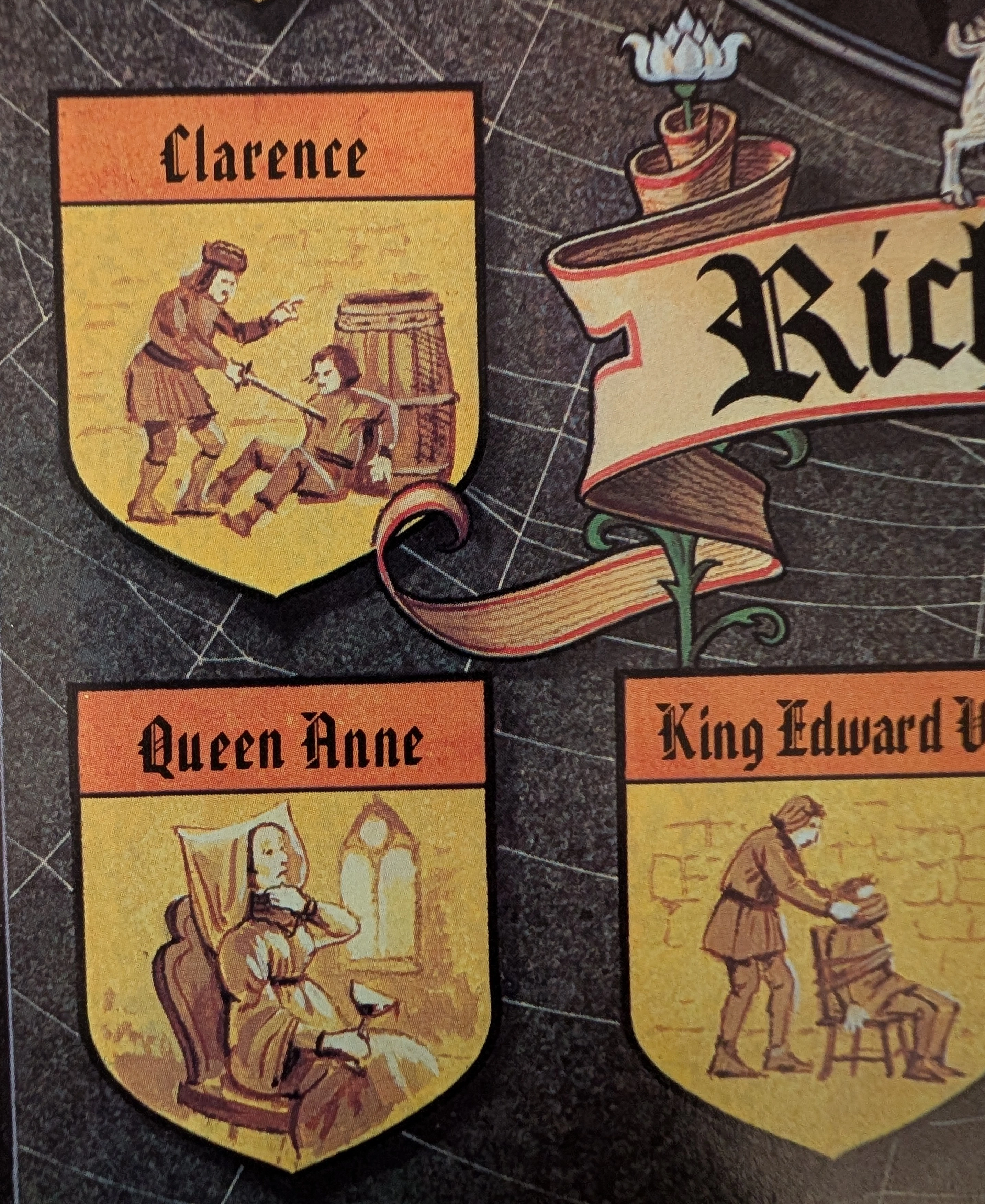
Clarence (George Plantagenet, Duke of Clarence): One of the most famous and grotesque murders in literary history. The shield shows a man being forced into a wooden barrel. George was Richard’s own older brother, convicted of treason against King Edward IV. According to the legend heavily promoted by Shakespeare, Richard engineered his downfall and dispatched assassins to drown George in a butt of Malmsey wine, removing a key rival with a superior claim to the throne.
Queen Anne (Anne Neville): The shield shows a pallid woman clutching her throat while holding a goblet of wine. Anne was Richard’s wife (and the widow of the Lancastrian Prince Edward whom Richard had killed). When Anne fell fatally ill, rumors swirled—and Shakespeare solidified—that Richard had poisoned her so he could politically remarry his own niece.
King Edward V & 7. Prince Richard (Duke of York): The bottom-center shields depict the most infamous, unresolved murders in English history: The Princes in the Tower. These were Richard’s own nephews, the rightful king and his brother. Richard imprisoned them in the Tower of London to usurp the crown. The illustration captures the chilling moment assassins crept into their bedchamber to smother the boys with pillows.
Rivers (Anthony Woodville), 9. Grey (Richard Grey), & 10. Vaughan (Thomas Vaughan): The bottom-right shields show noblemen being arrested and executed with an axe and mace. These men were the maternal relatives and loyalists of the young King Edward V (the Woodville faction). Richard intercepted them, arrested them without trial, and had them executed at Pontefract Castle to completely isolate the young king.
Hastings (William Hastings, 1st Baron Hastings): The shield depicts a hooded executioner swinging an axe. Hastings was a fiercely loyal Yorkist and a close friend of the late King Edward IV. When he refused to support Richard's illegal seizure of the throne, Richard ambushed him at a council meeting, falsely accused him of witchcraft, and had him dragged outside and beheaded on a piece of building timber.
Buckingham (Henry Stafford, Duke of Buckingham): The top-right shield completes the web. Buckingham was Richard’s "right-hand man" and chief co-conspirator in seizing the throne. However, he eventually turned against Richard and led a failed rebellion. The result was inevitable: Richard captured his former ally and had him executed without mercy.
The Psychological Symbolism of the Centerpiece
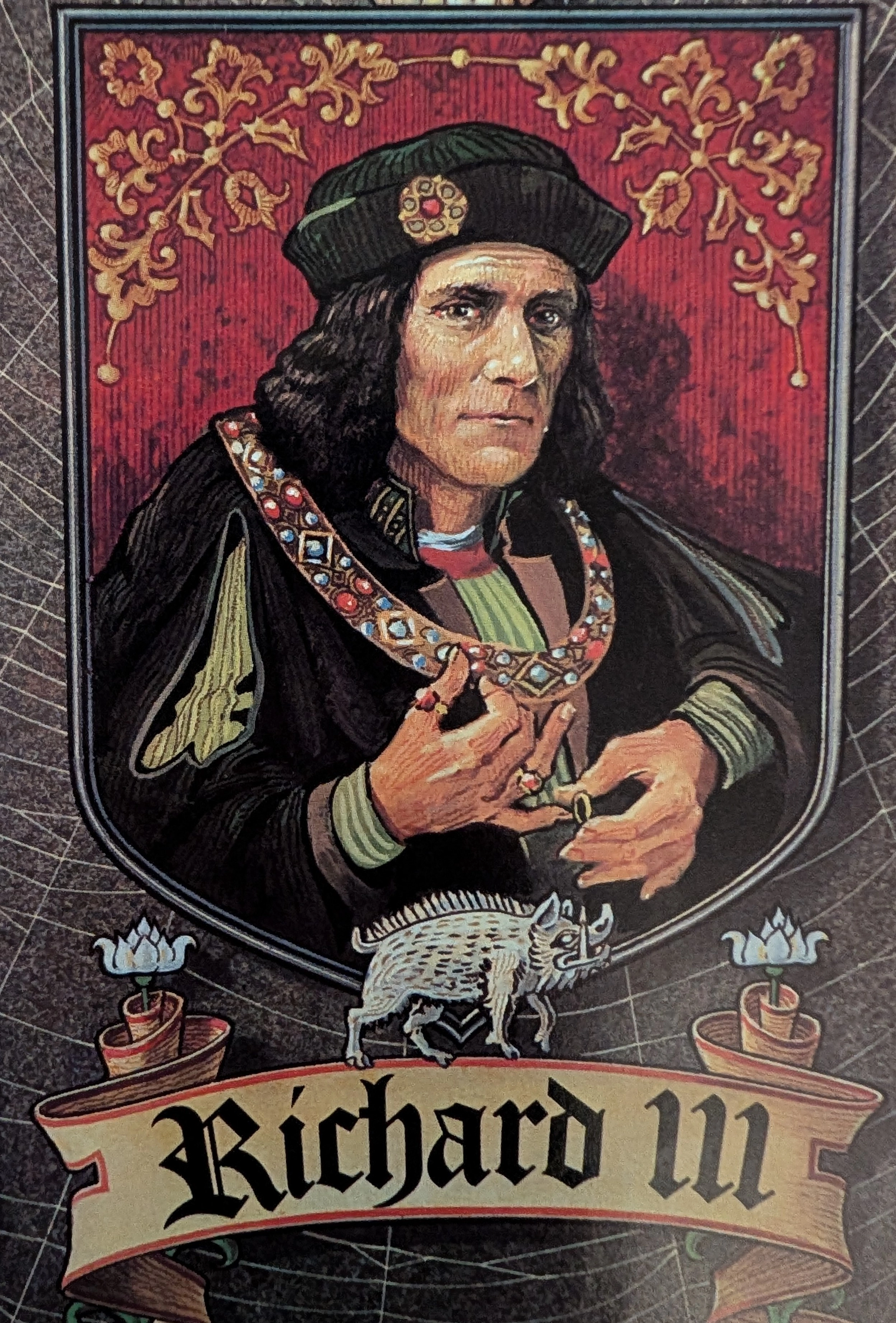
Beyond the perimeter of death, the central portrait is a masterclass in psychological symbolism. The colossal skull suspended above Richard operates as a Memento Mori—a reminder of the inevitability of death. It signifies that the bloody crown he wears is inherently temporary. Richard himself is draped in heavy black velvet and a jeweled chain of office, projecting absolute power, yet his face is devoid of triumph. He looks out with hollow, paranoid eyes, his hands nervously twisting a ring on his finger. This brilliantly captures the tortured psychology of the tyrant: a man who can never rest, consumed by the guilt and paranoia that the violence he unleashed will eventually consume him. Beneath him rests the White Boar, his personal emblem, often mocked in literature as a feral beast rooting up the sanctity of England.
The Paper
Examined through an archival lens, the physical substrate and printing technology anchor this piece firmly in the premium educational or theatrical publishing sector of the late 1970s to early 1980s. The artwork is printed on a substantial heavyweight cardstock, finished with a matte or satin coating. This lack of high gloss was an intentional design choice; it prevents glare when pinned to a classroom wall, a theatre lobby board, or framed in a study, allowing the muted, somber tones to absorb ambient light rather than reflect it.
The printing utilizes a standard 4-color CMYK offset lithography process. The technical triumph of this specific run lies in its ink density management—specifically the vast expanse of "rich black" required for the background. Poorly calibrated presses would render this black as a muddy, flat gray, but here, the darkness is deep and saturated, allowing the delicate, pale gray lines of the spiderweb to float eerily above it. The twelve shields utilize a highly contrasting palette of yellow ochre and burnt orange, immediately drawing the viewer's eye to the scenes of violence.
Given its age of roughly 40 to 50 years, the paper is subject to specific degradation. If not stored in an acid-free, climate-controlled portfolio, the inherent lignin in the pulp will cause the edges to become brittle (micro-tears) and susceptible to foxing (brown, oxidative spotting) driven by atmospheric humidity.
The Rarity
Rarity Class: S (Super Rare / Specialized Theatrical Ephemera)
The scarcity of this item does not stem from a deliberately limited "fine art" print run, but rather from the brutal nature of its intended use. Educational ephemera, literary broadsides, and theatrical posters were inherently functional. They were meant to be handled, tacked to corkboards, taped to brick walls, rolled, unrolled, and eventually thrown away once a semester ended or a play closed its curtain. Because of this high-attrition lifecycle, the survival rate of these pieces in pristine, unfaded condition is exceptionally low.
In the contemporary archival market, this piece occupies a highly coveted nexus of cross-over appeal. It is fiercely sought after not only by Tudor historians and Shakespearean collectors but also by enthusiasts of the Dark Academia aesthetic and collectors of macabre art. Locating a specimen of this size and thematic weight that has survived without center creases, pinholes in the corners, or UV fading on the crimsons and ochres elevates it securely into the 'S' tier of literary ephemera.
Visual Impact
The visual architecture of this illustration acts as a Gothic infographic. It utilizes a radial composition that is both deeply unsettling and highly effective. The viewer's gaze is immediately arrested by the paranoid, haunted eyes of King Richard in the center. From there, the subtle leading lines of the spiderweb forcibly draw the eye outward, compelling the viewer to circulate around the perimeter and process the grim catalog of murders one by one. The artwork does not strive for beauty; it strives for narrative oppression, successfully translating the claustrophobia and paranoia of a tyrant's mind into a single, cohesive visual statement.
Exhibition Halls
The Archive Continues
Continue the Exploration
The Time Traveller’s Dossier: 1980 Imperial Treasury Golden Reliquary Vintage Advertisement — The Weight of Divine Right
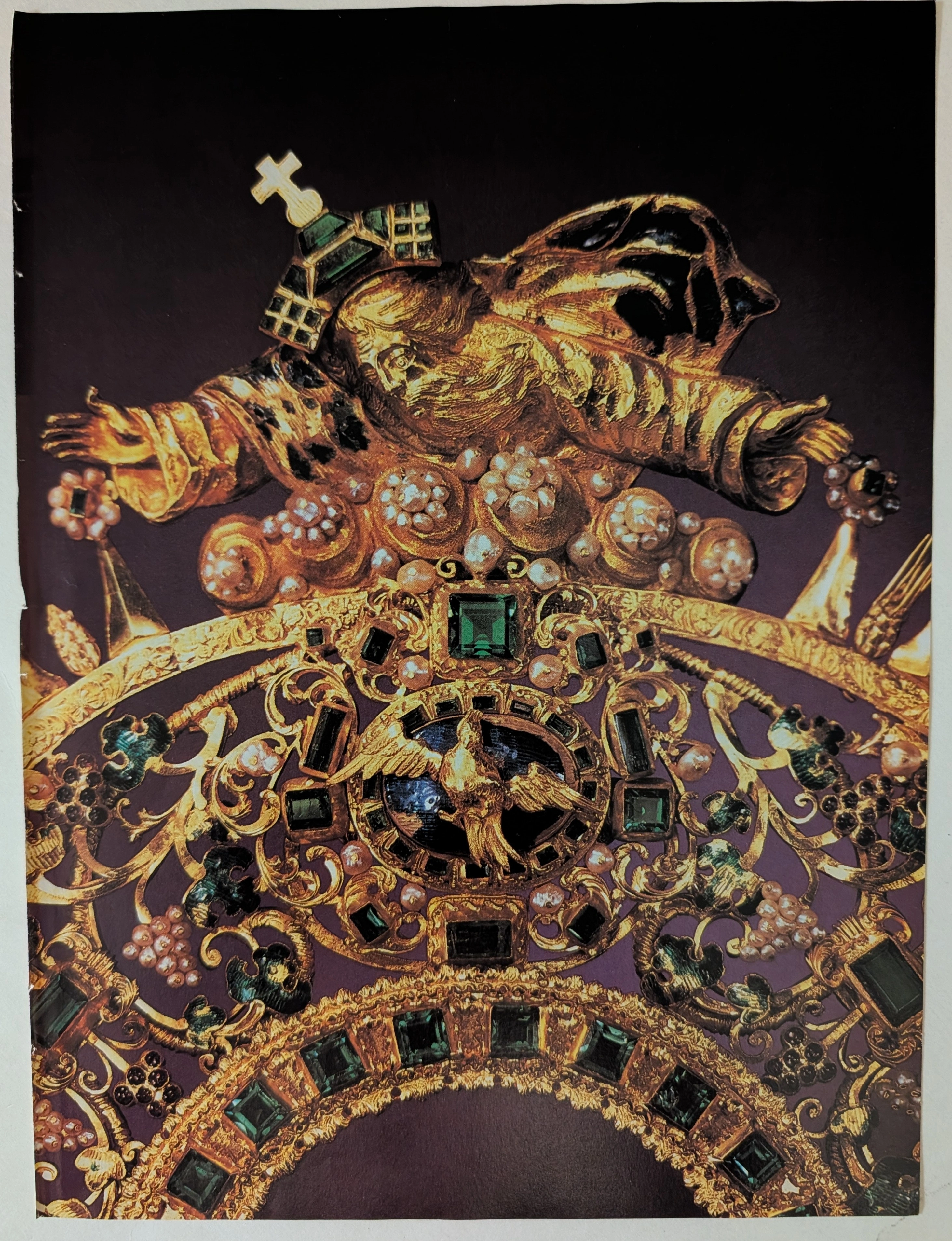
Explore the meticulous craftsmanship captured in this 1980 Imperial Treasury Golden Reliquary vintage advertisement, a stunning testament to both medieval goldsmithing and late 20th-century print reproduction. Among vintage ads, pieces that successfully bridge the gap between historical artifact and commercial art hold a unique, exalted position in curatorial archives. This comprehensive dossier examines the exquisite details of the reliquary’s goldwork, the prominent step-cut emeralds, and the intricate enamel eagle, all rendered through the distinct halftone dot matrix characteristic of classic print ads from the era. By analyzing the deep visual chiaroscuro and the material preservation of this specific lithograph, we uncover why old advertisements featuring such opulent antiquities remain highly sought after by archivists, art historians, and dedicated collectors alike. It is not merely a promotional print; it is a paper-bound exhibition of divine right, royal heritage, and institutional prestige, perfectly preserved in the annals of print history and curatorial excellence.
The Treaty of Two Empires: Deconstructing the 1982 Bacardi & Coca-Cola Vintage Ad (Class S)
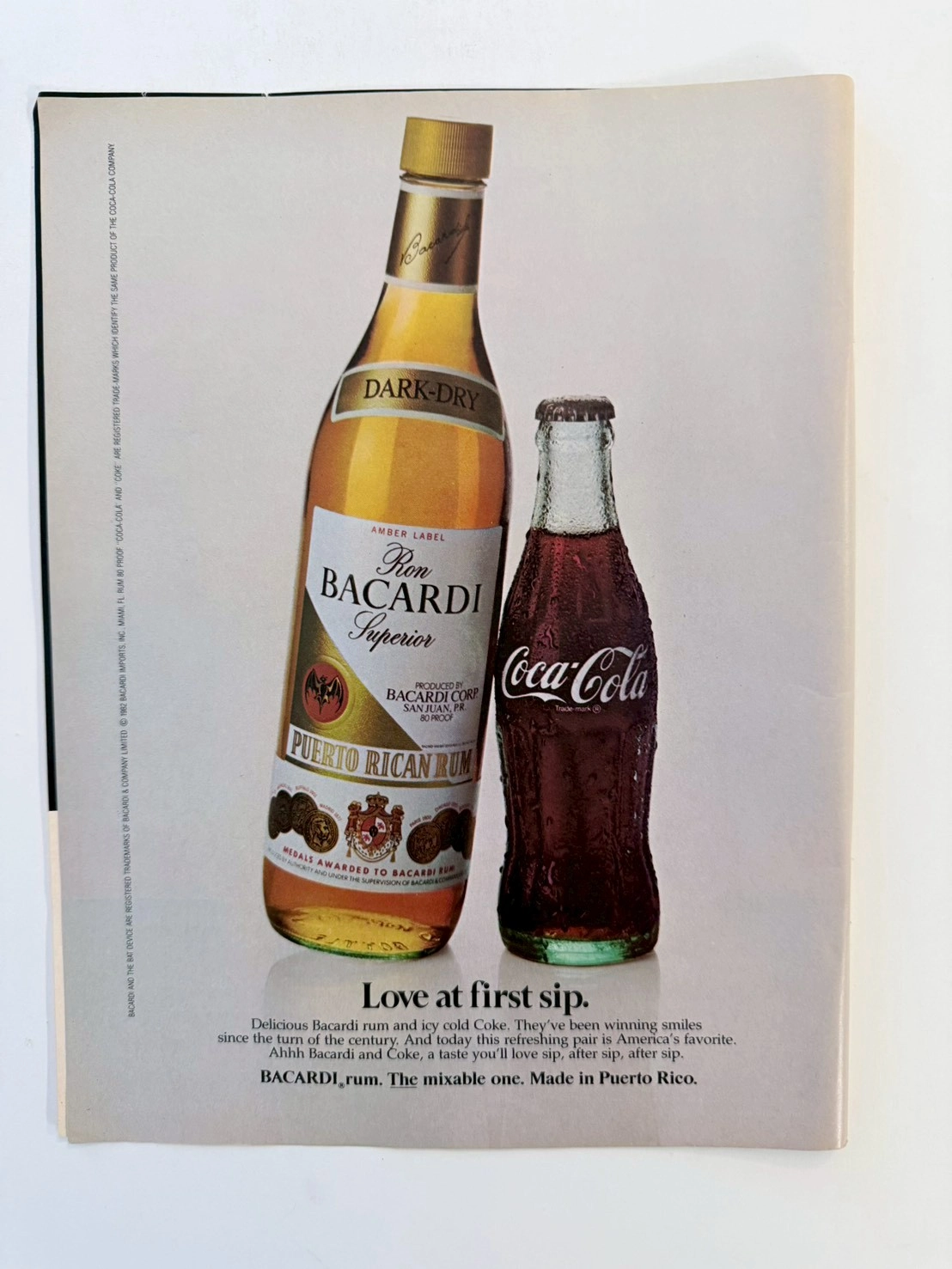
Dive into the history of American consumerism with this museum-grade analysis of the iconic 1982 Bacardi and Coca-Cola co-branding advertisement. This Class S archival piece captures the definitive shift from the Golden Age of Illustration to 1980s commercial studio photography. Explore the geopolitical legacy of the "Cuba Libre" and the analog practical effects behind the immortal condensation on the Coca-Cola contour bottle.
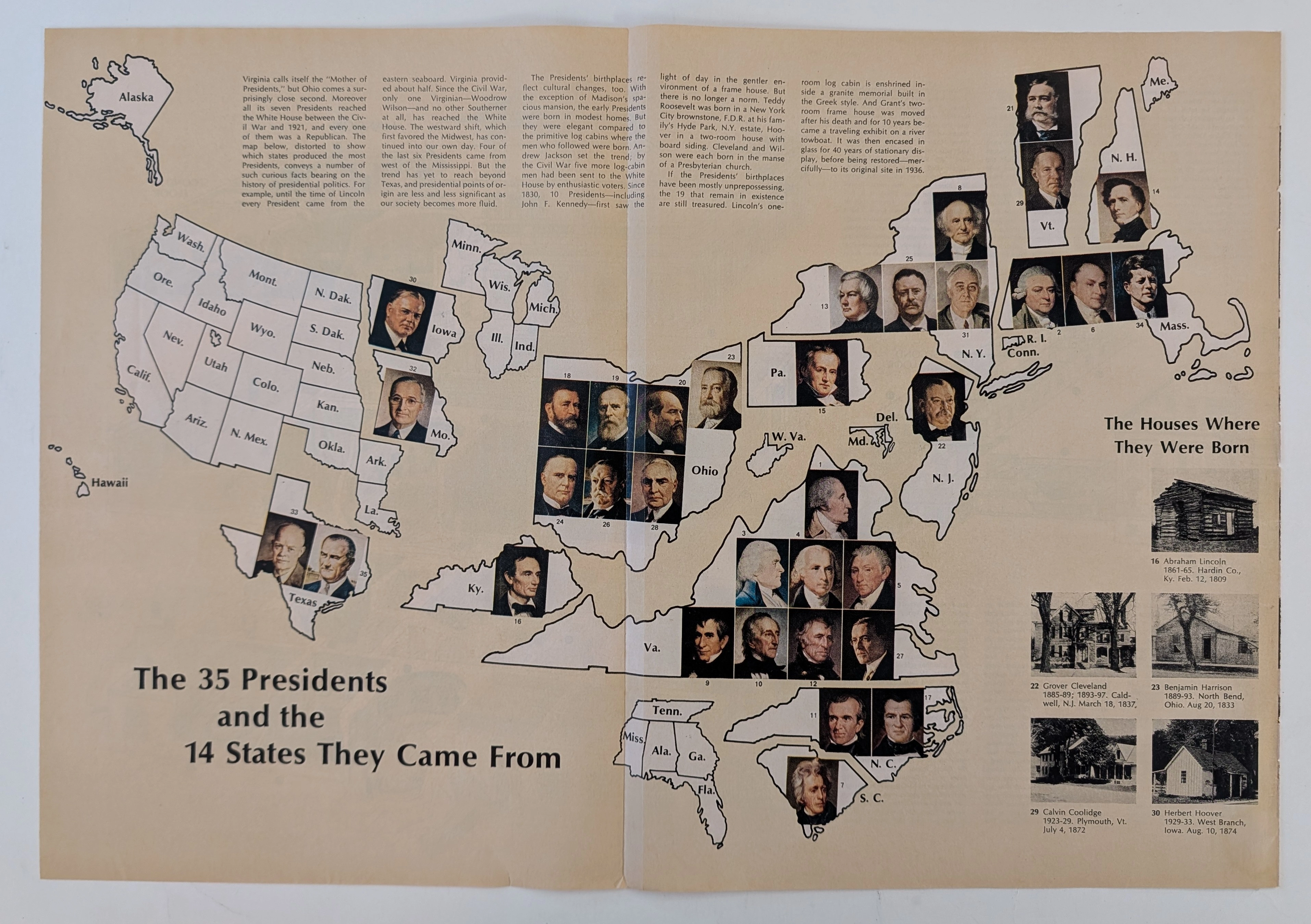
The Time Traveller's Dossier: The Geopolitics of Supreme Power – Cartographic Origins of the 35 U.S. Presidents (Circa Mid-1960s)
The history of supreme executive power is not inscribed solely within the text of legal documents, constitutional amendments, or international treaties; it is deeply rooted in the geographical origins and territorial foundations of political leaders. Long before the modern era of complex spatial data analysis or digital infographics, the structural understanding of state power in the United States was conveyed through the meticulous art of cartographic illustration. The historical artifact presented before us for museum-grade forensic analysis is not merely a conventional fold-out extracted from a mid-20th-century educational publication. It is a profound "geopolitical visual encyclopedia," meticulously compiling and categorizing the geographic birthplaces of the thirty-five individuals who had ascended to the highest office in the White House up to that point in history. This academic archival dossier presents an exhaustive, microscopic deconstruction of the historical and aesthetic framework of the diagram titled "The 35 Presidents and the 14 States They Came From." Operating on a profound scholarly narrative structure, this document decodes the shifting tectonic plates of executive power in the United States—from the foundational era concentrated on the Eastern Seaboard, moving steadily into the Midwest, and ultimately expanding toward the Southern and Western frontiers. Through the highly specialized lens of late-analog print analysis, American political history, and rigorous visual forensics, this document serves as a temporal window. It allows us to explore the foundational roots of the "American Dream" as conveyed through the birthplaces of these statesmen, ranging from humble log cabins to opulent estates, all rendered with the mechanical precision of mid-century offset lithography.