The Time Traveller's Dossier : Chevy '69 - L'Avènement du Prédateur
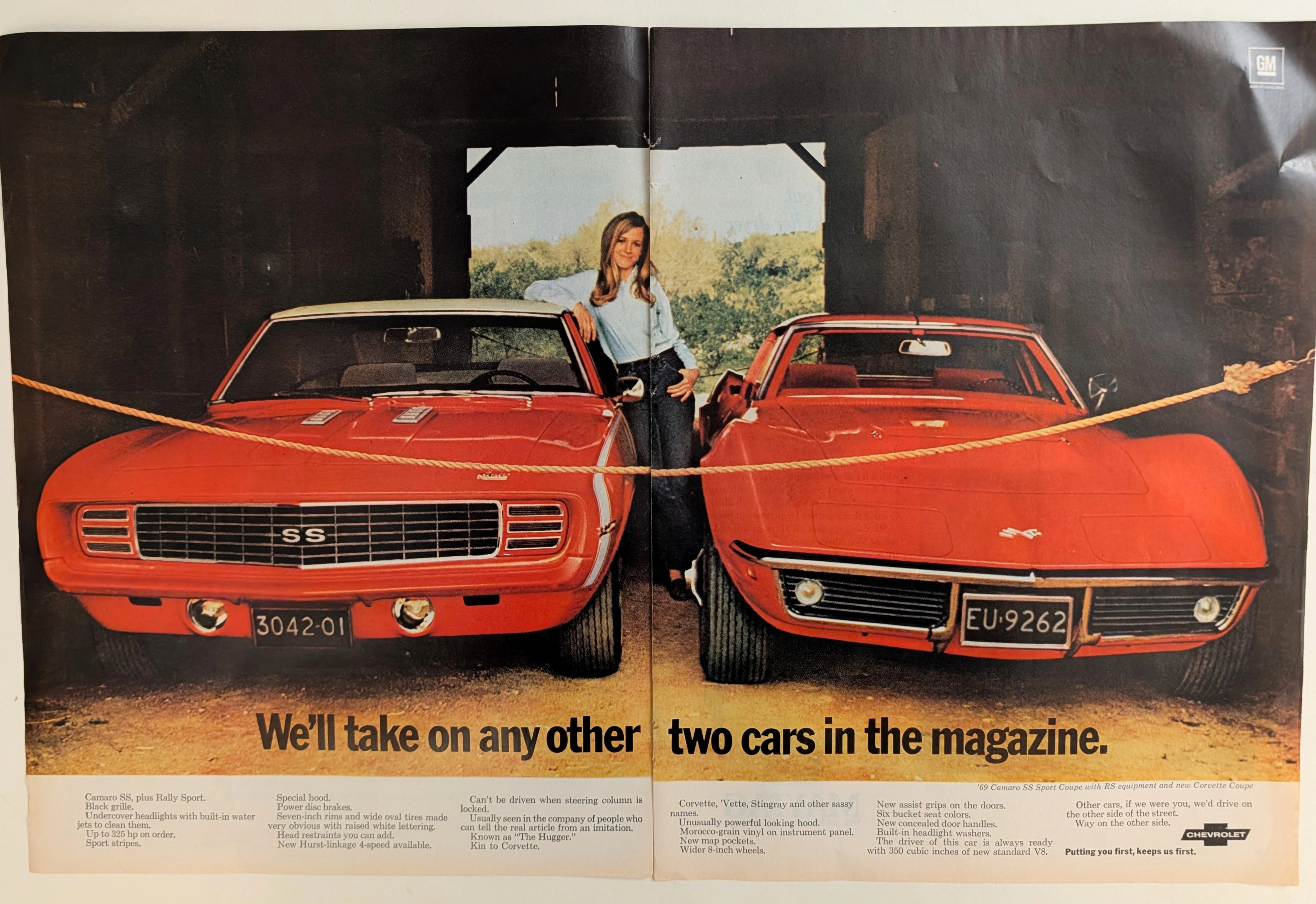
L'automobile fut d'abord commercialisée comme une solution solitaire. Une machine singulière, isolée sur une page, implorant silencieusement la validation du consommateur. La norme industrielle de l'époque était la comparaison polie. Puis, les règles d'engagement ont été violemment réécrites. Avant que cet artefact spécifique ne s'infiltre dans la conscience publique en 1969, les constructeurs automobiles se livraient à des duels de gentlemen. Ce document représente la seconde exacte où General Motors a abandonné le duel pour initier une véritable guerre des rues. En plaçant leurs deux prédateurs ultimes — la Camaro SS et la Corvette Stingray — côte à côte, séparés du lecteur par une véritable corde, Chevrolet a exécuté une leçon magistrale d'intimidation psychologique. Ils n'ont pas vendu une simple caractéristique technique. Ils ont vendu une hégémonie absolue et incontestable. Ce changement a redéfini les attentes du conducteur américain. Il a déclaré haut et fort que les rues n'étaient plus une infrastructure partagée, mais une hiérarchie brutale. Et Chevrolet en revendiquait le sommet. Cet artefact marque le basculement définitif du marketing produit défensif vers une domination territoriale purement offensive.
Category: Automotive
Brand: Chevrolet
The History
Le Zénith de l'Empire Analogique Pour appréhender l'arrogance absolue et le poids historique écrasant de cet artefact, il faut disséquer méticuleusement le paysage socio-technologique de l'année 1969. Le monde se tenait au bord d'un précipice vertigineux. L'humanité visait littéralement la lune, prête à y poser le pied. Pendant ce temps, la psyché culturelle américaine était profondément fracturée par des conflits outre-mer et des révolutions sociales internes. Pourtant, sur les vastes artères d'asphalte qui sillonnaient les États-Unis, une guerre d'une tout autre nature, intensément focalisée, faisait rage. C'était l'apogée des guerres de la puissance, la célèbre "Horsepower War". Détroit était la Rome incontestée de l'empire automobile mondial. General Motors en était l'empereur, et Chevrolet constituait son avant-garde la plus brutale et la plus efficace. Dans cette ère révolue, les réglementations environnementales n'existaient tout simplement pas. L'économie de carburant était un concept totalement étranger, presque risible. La seule mesure du succès automobile se calculait en cylindrée, en couple brut, et en la terreur viscérale provoquée par un accélérateur grand ouvert. Cette publicité est un instantané parfait, sans la moindre altération, de ce moment culturel spécifique. Elle capture une société obsédée par la puissance, l'élan vers l'avant, et une confiance inébranlable. Les voitures présentées ici ne sont pas de simples moyens de transport. Ce sont des armes mécaniques destinées à affirmer une souveraineté individuelle absolue. L'Arsenal de la Combustion La vérité fondamentale du message de cet artefact réside au plus profond de son ingénierie analogique, inflexible et pure. Observez ces machines. Sur la gauche, la Chevrolet Camaro SS (Super Sport) de 1969. Équipée du groupe d'options RS (Rally Sport), comme en témoignent ses phares dissimulés à l'allure menaçante. C'était à l'origine une "pony car", lourdement mutée par les ingénieurs de Détroit pour devenir un véritable bagarreur des rues, musclé et intimidant. Sur la droite, la Corvette Stingray. Un instrument de précision dédié à la vélocité, sculpté dans une carrosserie en fibre de verre. C'était la réponse unique, violente et définitive de l'Amérique à l'élite des voitures de sport européennes. Sous les lourds capots d'acier et de fibre de verre de ces machines reposaient d'immenses moteurs V8 en fonte. Il ne s'agissait pas de moteurs gérés par des microprocesseurs silencieux, ni de moteurs électriques stériles. Ils respiraient à travers des carburateurs massifs, engloutissant des volumes gigantesques d'air atmosphérique et d'essence lourdement plombée. Il n'y avait aucun contrôle de traction électronique pour sauver un conducteur imprudent de ses propres erreurs. Il n'y avait qu'un câble d'accélérateur en acier tressé, reliant directement le pied humain à une série contrôlée de violentes explosions internes. C'était le summum absolu de l'ingénierie automobile analogique. Une époque où des matériaux bruts et non raffinés — le fer, l'acier, l'aluminium et le caoutchouc — étaient violemment forgés pour créer de l'art cinétique. Chevrolet proposait ces deux lignées distinctes, unies par une seule philosophie partagée et intransigeante : la supériorité mécanique absolue. La Guerre Psychologique de la Corde Examinez la rhétorique et la stratégie visuelle avec une attention clinique. L'œuvre est entièrement dépouillée de toute approche commerciale traditionnelle. Il n'y a aucune poésie sur l'espace du coffre, l'économie à la pompe ou la sécurité familiale. Il n'y a qu'une intimidation psychologique froide et dure. Le texte déclare avec une audace inouïe : "Nous affronterons n'importe quelles autres deux voitures de ce magazine." (We'll take on any other two cars in the magazine.) Ce n'est pas une invitation amicale pour un essai routier chez le concessionnaire local. C'est une déclaration de guerre formelle. C'est un défi direct, sans la moindre excuse, lancé à tous les autres constructeurs partageant les pages de cette publication. Remarquez la barrière visuelle. Une corde épaisse, rugueuse et utilitaire s'étire devant les véhicules. Elle n'est pas là pour empêcher les voitures de sortir. Psychologiquement, elle est là pour empêcher le spectateur d'entrer. Elle suggère insidieusement que ces machines sont des bêtes dangereuses et indomptées qui tolèrent à peine leur captivité. La femme debout entre elles n'est pas présentée comme le modèle traditionnel, passif, faisant office de simple "ornement de capot", si commun à cette époque. Elle s'appuie nonchalamment, mais avec une confiance évidente, contre l'acier froid. Elle est la dompteuse. C'est elle qui contrôle la laisse. Cet indice visuel modifie entièrement la dynamique du pouvoir. Il murmure au consommateur : posséder ces voitures, c'est détenir un pouvoir dangereux qui exige d'être maîtrisé. Les Adversaires et l'Arrogance Pour mesurer l'ampleur de cette arrogance, il faut considérer les adversaires de 1969. Ford alignait la Mustang, créatrice de la race, armée de son redoutable pack Mach 1. Chrysler déployait les jumeaux Mopar : la Dodge Charger et la Plymouth Road Runner. Les concurrents se battaient à l'aide de personnages de dessins animés aux couleurs vives, d'ailerons arrière démesurés et de campagnes de marketing vibrantes et ludiques. Chevrolet a répondu à cette agressivité enjouée par un silence froid, dur et terrifiant. Le texte situé en bas à droite assène le coup psychologique final, dévastateur et hautement calibré. "Pour les autres voitures, si nous étions à votre place, nous conduirions de l'autre côté de la rue. Vraiment de l'autre côté." (Other cars, if we were you, we'd drive on the other side of the street. Way on the other side.) Dans le contexte ultra-compétitif de la fin des années 1960, ce langage était périlleux. Il implique sans détour que la Chevrolet est un prédateur au sommet de la chaîne alimentaire. La rue est son terrain de chasse désigné. Cela force le consommateur à faire un choix binaire, inconfortable. Soit vous conduisez le prédateur, soit vous conduisez la proie. La publicité manipule l'ego masculin et l'instinct primaire de domination avec une précision purement chirurgicale. La Guillotine Législative : Le Basculement Permanent Finalement, le changement historique profond que représente cet artefact réside dans son rôle d'épitaphe glorieuse et défiante. Cette publicité est historiquement vitale car elle représente le zénith absolu d'une époque. C'est une photographie en haute résolution prise quelques secondes seulement avant une chute dévastatrice. C'était le sommet de la montagne, avant l'abîme. Quelques années seulement après cette publication, le monde allait changer de manière irréversible. Le Clean Air Act de 1970 allait être promulgué, faisant s'abattre une véritable guillotine législative sur l'ère de la combustion non réglementée. En 1973, l'embargo pétrolier de l'OPEP allait anéantir l'illusion américaine de ressources infinies et bon marché. Les primes d'assurance pour les véhicules à forte puissance allaient grimper à des niveaux punitifs. Les taux de compression des moteurs allaient s'effondrer pour s'adapter à l'essence sans plomb. La puissance brute, indomptée, si explicitement dépeinte dans cet artefact, allait être systématiquement et impitoyablement effacée de l'existence par la loi. Par conséquent, cet artefact spécifique n'est pas le simple enregistrement d'un commencement. C'est la documentation d'une fin spectaculaire. Avant cette époque, les voitures étaient des machines au potentiel illimité. Après cette époque, elles sont devenues des appareils de compromis, hautement réglementés. Ce morceau de papier capture le tout dernier rugissement désinhibé de l'empire automobile américain avant qu'il ne soit contraint de se rendre à une réalité mondiale changeante, restreinte et régulée. Il s'impose comme un cours magistral sur l'utilisation de l'arrogance pure et de la vérité mécanique absolue comme arme agressive ultime dans le domaine du commerce.
The Paper
Cet artefact survit sur un papier de magazine double page de grammage moyen, oscillant probablement autour de 80 GSM. Il est né d'une pâte de bois hautement acide et produite en masse, un matériau intrinsèquement voué à l'autodestruction. La lignine contenue dans les fibres du papier réagit en permanence avec l'oxygène ambiant et la lumière ultraviolette. Le papier se consume lentement et silencieusement au fil des décennies. Les bords ont fortement jauni, adoptant une teinte sépia maladive, et la pliure centrale — là où les agrafes le maintenaient autrefois dans le magazine — est devenue dangereusement cassante et se dégrade activement. Il agit comme le chronomètre physique de son propre déclin inévitable. L'impression utilise un processus de demi-teintes quadrichromiques (CMJN) standard de la fin des années 1960. Sous la loupe d'un archiviste, les peintures vibrantes Hugger Orange et Monza Red des véhicules se décomposent en une constellation chaotique mais magnifique de points d'encre cyan, magenta, jaune et noir. Ces points sont enfoncés profondément dans la surface poreuse et texturée du papier vieilli. La dégradation physique de la page crée une ironie profonde, presque inéluctable. Le papier fragile, qui fait la promotion agressive de la puissance immortelle et inflexible de l'acier et du fer américains, succombe lui-même entièrement à la friction du temps. La pliure centrale divise physiquement l'image, rappelant de manière poignante que l'ère qu'elle représente a été, elle aussi, violemment arrachée à la chronologie de l'histoire.
The Rarity
Classification : Classe S (Valeur Contextuelle Supérieure). L'artefact physique en lui-même, en tant que page imprimée, est modérément rare. Des millions de magazines ont été imprimés en 1969. Cependant, en tant que page centrale double et intacte, son taux de survie chute de manière drastique. Les pages centrales étaient souvent arrachées, épinglées sur les murs des garages, et détruites par la graisse, la lumière du soleil et le temps. Mais sa véritable rareté, d'une ampleur immense, réside dans sa valeur contextuelle. La plupart des publicités automobiles de cette époque vendaient une seule voiture en s'appuyant sur des caractéristiques techniques spécifiques ou des aspirations de style de vie. Cet artefact est extrêmement rare car il vend une attitude corporative toute entière. C'est un assaut unifié, à deux véhicules, contre le reste de l'industrie. Trouver une publicité comparative à plusieurs véhicules aussi nue, aussi ouvertement agressive et structurellement aussi parfaite dans les années 1960 est hautement inhabituel. Sa valeur ultime se mesure par son inclusion nécessaire dans un programme d'études sur l'histoire de l'automobile et la guerre stratégique des marchés.
Citer cet article
- MLA
- Naodhinsuk, Ronin. “The Time Traveller's Dossier : Chevy '69 - L'Avènement du Prédateur.” The Record Institute, 14 May 2026, https://therecord.institute/fr/journal/the-time-travellers-dossier-69-chevy-the-apex-predator-shift.
- APA
- Naodhinsuk, R. (2026, May 14). The Time Traveller's Dossier : Chevy '69 - L'Avènement du Prédateur. The Record Institute. https://therecord.institute/fr/journal/the-time-travellers-dossier-69-chevy-the-apex-predator-shift
- CHICAGO
- Naodhinsuk, Ronin. 2026. “The Time Traveller's Dossier : Chevy '69 - L'Avènement du Prédateur.” The Record Institute, May 14, 2026. https://therecord.institute/fr/journal/the-time-travellers-dossier-69-chevy-the-apex-predator-shift.