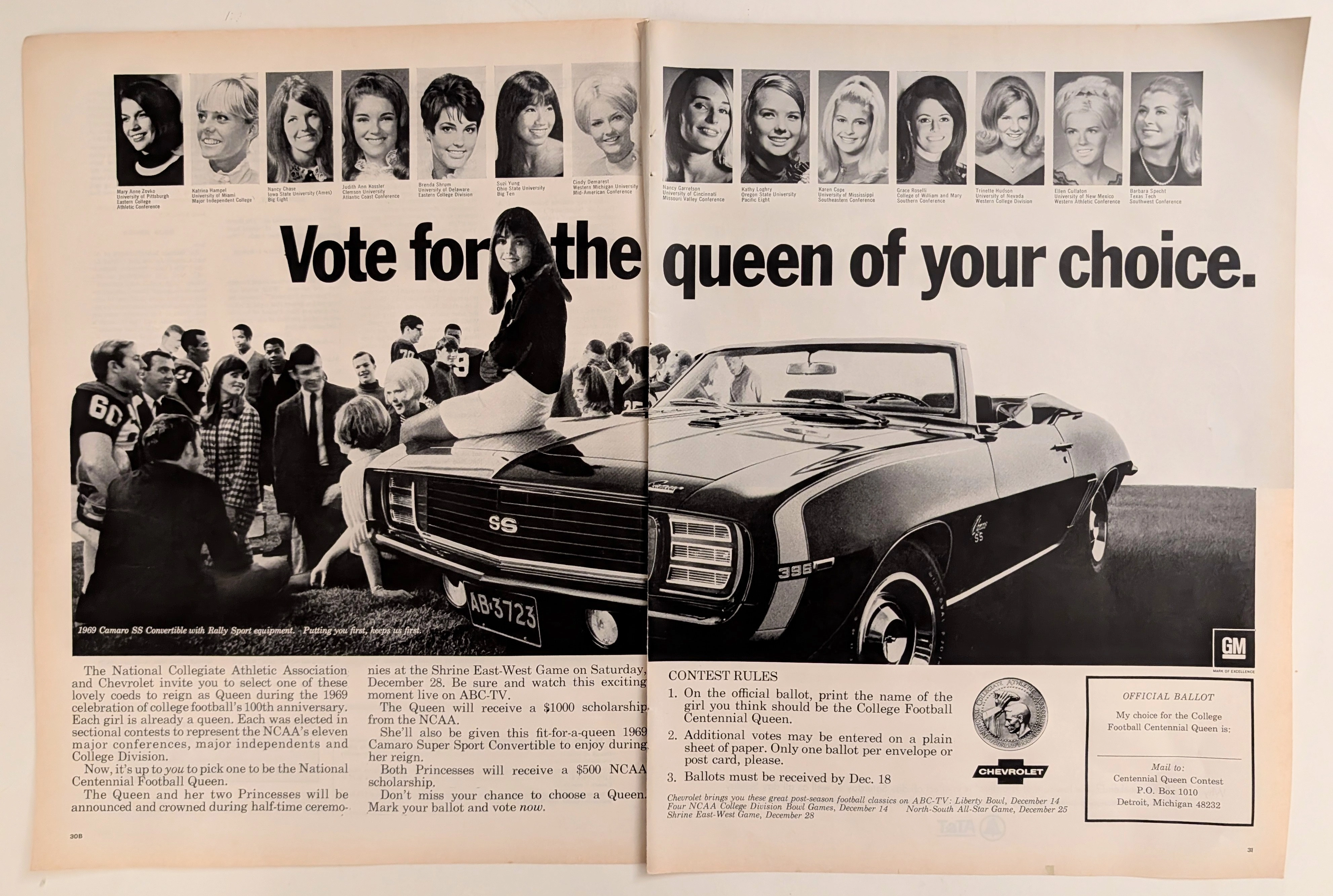
The Time Traveller's Dossier : 1969 Camaro SS & The Centennial Queen - A Societal Intersection
Before this artifact. The automobile was utility. The university was an academic sanctuary. Pageantry was isolated. Detroit sold machines; colleges sold degrees. Then, a shift. The 1969 College Football Centennial Queen Contest. A profound intersection of American cultural pillars: collegiate athletics, the burgeoning muscle car era, and the commodification of collegiate femininity. Chevrolet didn
Category: Automotive
Brand: Chevrolet
The History
The Centennial Convergence To understand the immense cultural weight of this artifact, one must analyze the specific intersection of events in 1969. This was the 100th anniversary of college football, a milestone celebrated with immense national fervor. The NCAA, seeking to elevate the centennial, partnered with the most potent symbol of American industrial might: General Motors, specifically the Chevrolet division. This was not a mere financial sponsorship; it was a deep, structural integration of brand and event. Simultaneously, 1969 represented the absolute zenith of the first-generation mu
The Paper
The physical substrate of this artifact is a standard, mid-weight magazine stock typical of mass-circulation publications of the late 1960s (likely 60-70 GSM). It is a two-page spread, indicating a significant financial investment by Chevrolet in media placement. The printing utilizes a standard web offset process, but the absence of color is striking. In an era where color advertising was prevalent, the choice of high-contrast black and white (monochrome) serves a specific purpose. It lends a documentary, almost news-like quality to the advertisement, increasing its perceived legitimacy. Unde
The Rarity
Class B. As a two-page spread in what were likely highly circulated magazines (such as Sports Illustrated, Life, or major collegiate programs) during the fall of 1969, this specific advertisement was printed in the hundreds of thousands, if not millions. Physical copies of the magazines containing this spread are not exceedingly rare in archival collections or vintage paper markets. However, its contextual and historical value is extraordinary. It serves as a pristine primary source document encapsulating the intersection of the muscle car zenith, the commercialization of college sports, and t