The Time Traveller's Dossier: The Illumination of Memory – The Kodak Instamatic 104 and the Flashcube Revolution
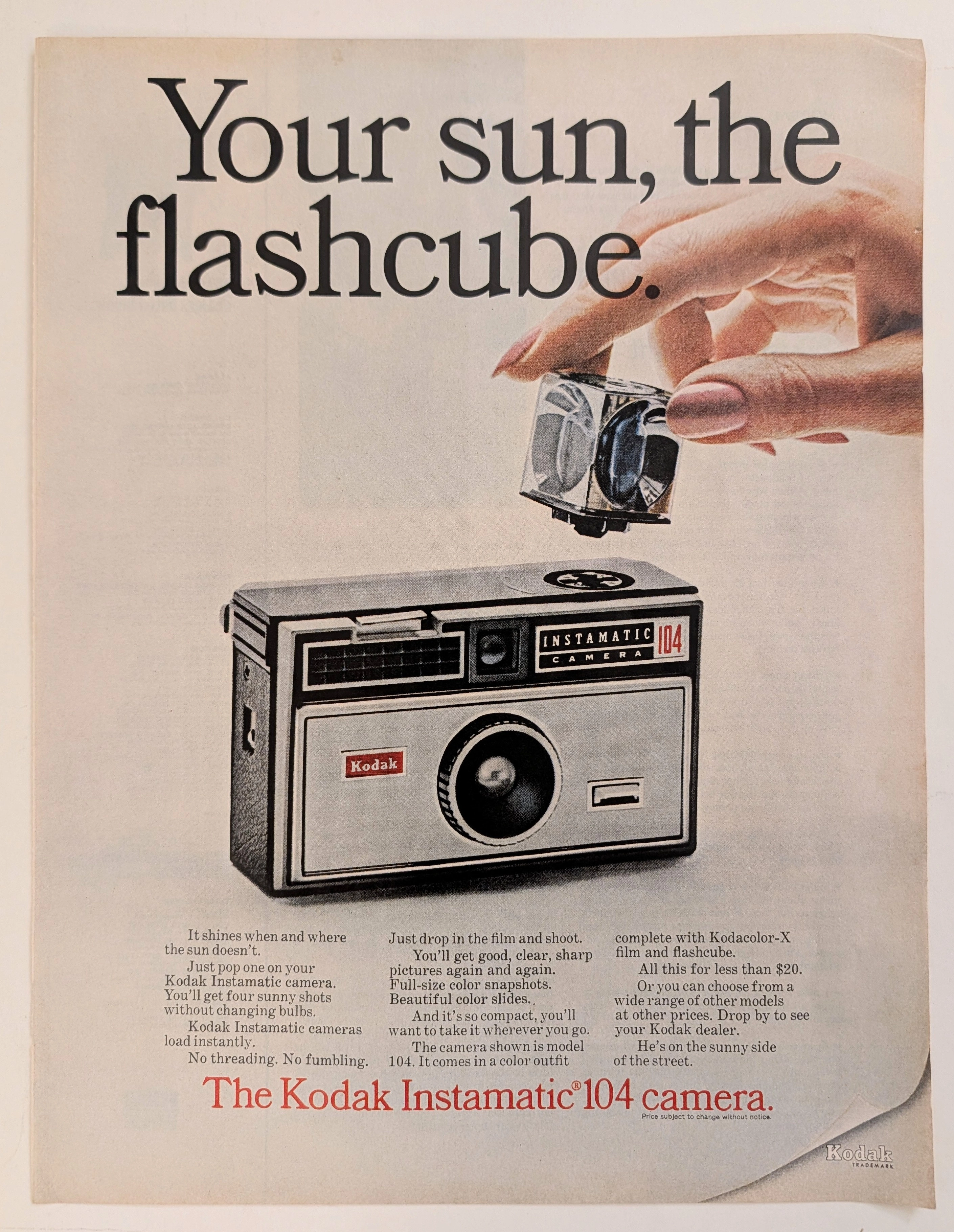
The evolution of the American domestic experience during the mid-twentieth century was inextricably linked to the ability of the average citizen to document it. The historical artifact elegantly and securely positioned upon the analytical table of The Record Institute today is a striking, full-page print advertisement for the Kodak Instamatic 104 camera, dating to the mid-1960s. This document comp
Category: Technology
Brand: Kodak
The History
To fully appreciate the immense historical gravity, cultural magnitude, and sociological importance of this artifact, one must meticulously contextualize the profound paradigm shift in visual documentation that occurred in the 1960s, a shift built directly upon the foundational philosophy of George Eastman. George Eastman (1854–1932) was the visionary American innovator, entrepreneur, and philanthropist who founded the Eastman Kodak Company. Prior to Eastman's interventions in the late 19th century, photography was a highly arduous, deeply technical, and chemically hazardous profession restric
The Paper
As a physical entity, this printed artifact functions as a living, breathing, and profound record of mid-twentieth-century graphic reproduction and substrate chemistry. Under exceptional, high-magnification macro-lens examination, this document reveals the stunning complexity and mathematical precision of analog color printing. The intricate, shaded details of the hand holding the flashcube, the precise rendering of the red Kodak logo, and the subtle metallic gradients of the camera body are all meticulously constructed from a precise, mathematically rigorous galaxy of halftone rosettes. This
The Rarity
RARITY CLASS: B (Very Good Archival Preservation) Evaluated under the most exacting, rigorous, and uncompromising archival parameters established by The Record Institute (which utilizes a rigorous classification scale from Class A down to Class D), this specific artifact is definitively and securely designated as Class B. We must prioritize the inherent rarity of the media when assigning this classification. The remarkable and defining paradox of mid-century commercial ephemera is that these specific documents were produced by the millions as explicitly and intentionally "disposable media." In