The Time Traveller's Dossier : 1968 Equitable - The Security Shift
The History
The artifact before us requires an exhaustive and unflinching contextualization.
To comprehend this printed document, we must dissect the socio-political and psychological anatomy of the world that necessitated its creation.
The year 1968 is not merely a date; it is a historical centrifuge.
The outside world is spinning into unprecedented chaos.
The Tet Offensive shatters the illusion of American military invincibility.
Martin Luther King Jr. and Robert F. Kennedy are assassinated, fracturing the national psyche.
Cities are burning.
Universities are paralyzed by strikes.
The cultural hegemony of the post-war era is being aggressively dismantled by a youth-driven counterculture.
The silent majority is watching their established order dissolve.
They are gripped by a profound, existential anxiety.
In the decades prior, the life insurance industry operated on a grim, rudimentary premise.
It was essentially a wager on mortality.
Agents sold "death benefits."
The narrative was fundamentally morbid: providing a financial safety net for a widow and orphans after the catastrophic loss of the male breadwinner.
It was a product rooted in tragedy.
It relied on the fear of the inevitable.
But by 1968, fear was no longer a future abstract; it was the daily reality.
The American consumer was oversaturated with dread.
Selling a product based on death in a year defined by it was psychologically untenable.
Enter The Equitable Life Assurance Society.
They execute a profound philosophical pivot.
They recognize that the consumer does not want to contemplate their own demise.
The consumer wants a shield against the present.
They introduce the concept of "Living Insurance."
"Living Insurance is the name, because it's all about your life—your needs, your finances, your future."
This is a masterstroke of semantic engineering.
It transforms a morbid necessity into a vital asset.
It suggests that the policy is active, not passive.
It implies that the institution is working for the policyholder while they are still breathing, guarding their capital against the insidious threats of inflation and economic instability.
To deliver this new philosophy, Equitable required a new archetype.
They could not rely on the image of the traditional, door-to-door insurance salesman—a figure often viewed with suspicion or mild annoyance.
They required a figure of authority.
They required "The Protectors."
The nomenclature is highly deliberate.
It is militaristic.
It is heroic.
It borrows from the language of law enforcement and civil defense.
In a year when the police and the military were highly visible forces on American streets, Equitable positioned its actuaries and salesmen as a private, benevolent security force for the middle-class wallet.
"It's good to know they're in town."
This headline reads less like a financial pitch and more like a reassurance that the cavalry has arrived.
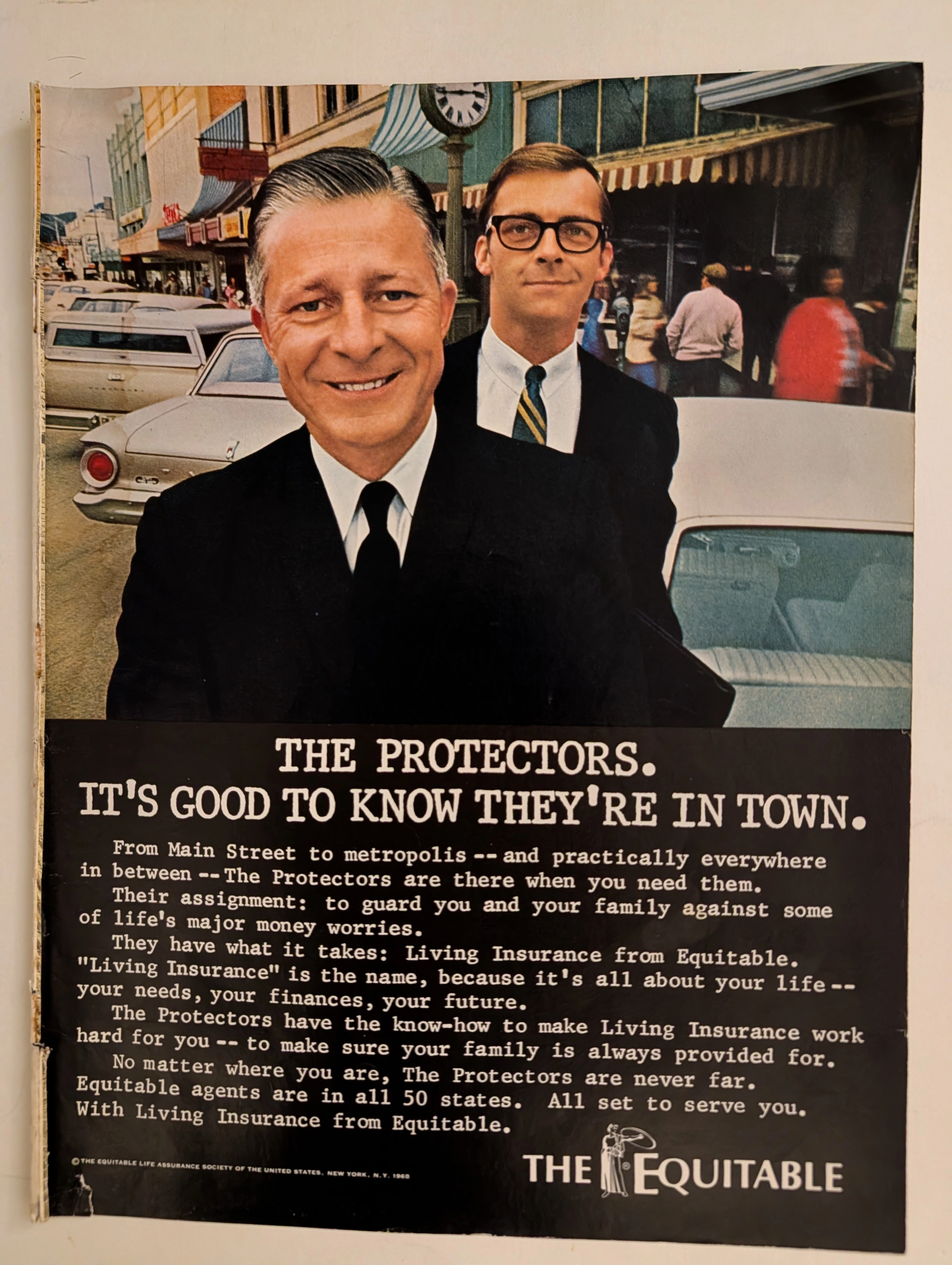
Let us analyze the two figures deployed in this visual narrative.
They are carefully constructed archetypes of the American establishment.
In the foreground, we have the older patriarch.
His hair is silvering and neatly parted.
His smile is warm, paternal, and deeply reassuring.
He represents experience, stability, and human empathy.
He is the grandfather who has weathered the storm.
Directly behind him stands the younger man.
His expression is serious, unsmiling, and focused.
He wears thick, dark-rimmed glasses.
He represents the modern, analytical mind.
He is the actuary, the mathematician, the master of the modern corporate machine.
Together, they form a complete psychological package: the warmth of human trust backed by the cold, infallible calculus of institutional finance.
They are the synthesis of ethos and logos.
The setting of the photograph is equally critical.
They are standing on an idealized "Main Street."
It is a composite of American commercial nostalgia.
We see parked cars—models from the mid-1960s, representing industrial progress.
We see pedestrians walking calmly.
We see a clock on a pole, symbolizing order and the steady, predictable passage of time.
There are no protests here.
There is no urban decay.
There is no tear gas.
The background is a sanitized projection of the America that the silent majority desperately wanted to preserve.
The Protectors stand between the viewer and the encroaching chaos of the era.
They are the guardians of the status quo.
Consider the competitors of this era.
Prudential relied on "The Rock" of Gibraltar—a symbol of massive, inanimate, geological stability.
Mutual of Omaha sponsored "Wild Kingdom," associating their brand with the harsh realities of survival, tamed for television.
Equitable chose human intervention.
They did not offer a rock; they offered a vanguard.
They transformed the bureaucratic mechanism of underwriting into an active, localized patrol.
"No matter where you are, The Protectors are never far. Equitable agents are in all 50 states."
This advertisement documents a critical evolution in corporate messaging.
It is the moment the financial sector learned to commodify peace of mind during a period of acute national trauma.
It weaponized nostalgia and authority.
It took the abstract mathematics of risk assessment and dressed it in a dark suit and a reassuring smile.
The artifact proves that in times of extreme societal volatility, the most effective product a corporation can sell is the illusion of absolute control.
The Paper
The physical medium is a testament to the mechanics of mass distribution in the late 1960s.
We are examining a magazine tear sheet, printed via high-speed web offset lithography.
The paper stock is a lightweight, coated sheet, designed for rapid ink absorption and quick drying times in massive print runs.
The coating provides a slight sheen, intended to give the photographic elements a sense of depth and fidelity.
Under macro examination, the mechanical truth of "The Protectors" is revealed.
The reassuring smile of the older man, the sharp suit of the younger man, and the bustling Main Street are reduced to a precise, mechanical matrix.
The image is constructed entirely of Cyan, Magenta, Yellow, and Key (Black) halftone dots.
The illusion of human warmth is a cold, calculated arrangement of ink droplets.
The deep black of their suits—the uniform of their authority—is achieved by heavily saturating the paper with the Key plate, anchoring the visual weight of the page.
The aging process of the artifact is a study in material contradiction.
The document promises lifelong security and institutional permanence.
Yet, the paper itself is highly acidic, born of cheap wood pulp.
The edges are brittle, frayed, and actively oxidizing.
The lignin within the fibers is reacting with light and oxygen, turning the once-white margins into a bruised, yellowed amber.
It is an artifact recording its own slow destruction.
The physical manifestation of "Living Insurance" is slowly succumbing to the natural laws of decay.
The corporation remains, but the paper that carried its promise is dying.
The Rarity
Classification: Class B.
In 1968, this advertisement was inserted into national publications like LIFE, Look, or Time magazine.
Its initial production run was in the millions.
As a physical object, the raw material is not inherently scarce.
However, the survival rate of ephemeral magazine pages is statistically minute.
They were designed for momentary consumption and immediate disposal.
The true value of this artifact lies entirely outside of its monetary appraisal.
Its value is deeply contextual.
It is a pristine psychological artifact.
It is a flawless record of how American corporate entities navigated the cultural minefield of the late 1960s.
Its rarity is defined by its utility as a historical mirror, reflecting the anxieties and the desired comforts of a fractured society.
Visual Impact
The visual composition is a rigorous exercise in anchoring authority.
The image is split into two distinct hemispheres.
The top half is the photographic reality; the bottom half is the institutional decree.
The camera angle is placed slightly below the eyeline of the men.
This is a classic technique of visual elevation.
It forces the viewer to look slightly up at "The Protectors," establishing their dominance and capability.
The depth of field is carefully manipulated.
The two men are in sharp, undeniable focus.
They are the undeniable reality of the frame.
The background—Main Street—is slightly blurred.
This blur achieves two things: it prevents the background details from distracting the viewer, and it renders the setting universal.
It is not a specific town; it is every town.
It is the concept of community itself.
The bottom hemisphere is a solid block of deep black.
This serves as a massive visual foundation.
It grounds the photograph, giving the men a heavy, immovable base to stand upon.
The typography emerges from this black void in stark white.
The headline, "THE PROTECTORS," is set in a bold, heavy serif typeface.
It looks like it was hammered into a stone monument.
It is unyielding.
The body copy resembles the output of a high-quality typewriter, lending the text the air of an official government dossier or a highly classified assignment brief.
The eye is directed from the paternal smile, down the dark suits, directly into the stark, authoritarian text.
It is a closed circuit of trust and command.
Exhibition Halls
Tags