The Time Traveller's Dossier : Chanel No. 5 - The Architecture of Absolute Desire — The Record Institute JournalThe Time Traveller's Dossier : Chanel No. 5 - The Architecture of Absolute Desire — The Record Institute JournalThe Time Traveller's Dossier : Chanel No. 5 - The Architecture of Absolute Desire — The Record Institute Journal
1 / 3

✦ 3 Photos — Click any image to view in high resolution

April 24, 2026

The Time Traveller's Dossier : Chanel No. 5 - The Architecture of Absolute Desire

FashionBrand: Chanel
Archive Views: 12

The History

The Epoch of Elaborate Fictions and the Birth of the Monolith
To comprehend the sheer gravitational pull of this artifact, one must dissect the historical landscape of luxury marketing that preceded it. For decades, the global perfume industry operated on the currency of elaborate fantasy. Competitors relied heavily on lush, saturated imagery and complex storytelling. They sold elaborate scenarios. They sold the promise of romance, the allure of the exotic, or the warmth of the bourgeois domestic sphere. Fragrance was presented as a magical elixir, a potion designed to activate a specific, often submissive, narrative around the woman who wore it.

Chanel No. 5 was inherently designed to break these narratives. Created in 1921 by perfumer Ernest Beaux and Gabrielle Chanel, it was the first truly modern fragrance. It relied heavily on synthetic aldehydes to create a scent that did not mimic a specific flower—a rose or a lily—but rather smelled like an abstract, manufactured concept. It smelled like a "composition."

Yet, it took decades for the visual marketing of the product to catch up to the radical, synthetic chemistry of the fluid itself. This artifact represents that exact, delayed convergence. It marks the historical moment the advertising became as precise, clinical, and abstract as the aldehydes suspended within the glass.

The Economic Landscape of Mass-Market Exclusivity
We must place this image within the broader socio-economic context of the late 1960s and early 1970s. The post-war economic boom had culminated in a vast, affluent middle class across the Western hemisphere. Luxury was no longer the exclusive, hidden domain of the aristocracy. It had mutated into a scalable, global commodity.

However, the inherent paradox of modern luxury is that it must rigorously maintain an aura of untouchable exclusivity while simultaneously selling in massive, industrial volumes. How does a corporate entity achieve this? By shifting the marketing language from the experiential to the authoritative.

If an advertisement shows a woman in an evening gown, it psychologically alienates the consumer in a tailored business suit. If it shows a romantic European street, it alienates the modern, urban executive. Therefore, this artifact ruthlessly strips away all environmental context. There is no background. There is no setting. There is only the void.

In doing so, the art director created a universal vacuum. Any consumer, from any demographic, can step into this void. The brand transitions from being a mere participant in the consumer's life to acting as the absolute, gravitational center of it.

The Syntactic Weaponry of the Absolute Decree
The copy hovering at the top of this page is a masterclass in psychological dominance.
"Every woman alive loves Chanel N°5."
This is not a marketing slogan. It is a linguistic weapon.

Consider the syntactic structure of the sentence. It leaves absolutely no room for debate. It does not invite the reader to "Discover the scent." It does not ask a question like "Do you love it?" It states a universal, unbending law of nature.

During this era, second-wave feminism was gaining immense cultural traction. Women were actively questioning and dismantling universal assumptions about their identities, roles, and desires. In the face of this rising individualism, Chanel issued a declarative statement of absolute conformity.

The strategic brilliance lies in its sheer audacity. By declaring that every living woman loves this specific fluid, the advertisement implies a severe psychological consequence. It implies that to reject the perfume is to reject a fundamental, intrinsic aspect of one's own femininity. It weaponizes the human desire for belonging. It is an aggressive, definitive categorization of the female experience, compressed flawlessly into seven words.

Architectural Dominance Over the Biological
Observe the scale and the precise positioning of the subjects within the photographic frame. There are two distinct entities present: the biological human and the machine-made vessel.

The bottle of Chanel No. 5 is rendered in massive, monumental proportions. It entirely dwarfs the human element. The bottle itself is an architectural marvel of the 20th century. Originally designed by Chanel to resemble an austere, minimalist apothecary vial—a direct rejection of the ornate, overly decorative Lalique crystal popular in the 1920s—it had evolved by this era into a heavy, faceted monolith of thick glass. The stopper, cut geometrically like a diamond, directly mirrors the overhead topography of the Place Vendôme in Paris.

In this artifact, the bottle is photographed with razor-sharp focus. The studio light catches the hard, unyielding edges of the glass. It projects an image of permanence. It is a fortress.

In stark contrast, the woman's profile is rendered soft. She is slightly out of focus, her form pushed to the extreme left margin of the page. She is looking toward the bottle, her lips slightly parted in a state of suspended, silent reverence. She is not a specific individual with a name or a backstory. She is an archetype. She has been systematically depersonalized to serve as a biological counterbalance to the geometric perfection of the glass.

The visual hierarchy of the artifact dictates a clear message: the human being is temporary, but the brand is eternal. The woman is merely a biological vessel for the desire; the true, enduring protagonist is the manufactured product.

The Monochromatic Vacuum and the Rejection of Color
During the era this artifact was printed, advanced color photography was the absolute standard for high-end fashion and lifestyle magazines. Competitors were actively utilizing vibrant, hyper-saturated color film to sell the illusion of vitality, youth, and warmth. This artifact deliberately, coldly rejects that technological advancement.

The choice to utilize a high-contrast, black-and-white halftone process is profoundly strategic. Color carries immediate emotional weight. Color suggests a specific time of day. It suggests a specific season, a temperature, a passing mood. By stripping away the color spectrum, the art director successfully removed time itself from the equation.

The resulting image becomes clinical, sculptural, and archival. It elevates the advertisement from a disposable, temporal page in a monthly periodical to the status of a timeless photographic print. The stark contrast between the deep, inky blacks of the void and the sharp, bleached whites of the label ("N°5 CHANEL") directs the viewer's eye with an inescapable, physical force. It is a visual command. It strips away the chaotic noise of the physical world, leaving nothing but the pure, unadulterated signal of the brand's identity.

The Legacy of the Blank Canvas
This specific artifact laid the architectural groundwork for the next fifty years of luxury marketing. The concept of the "blank stare"—the utilization of a model devoid of distinct emotional context, serving purely as an elegant hanger for the brand's aura—was perfected on this page.

It completely removed the financial risk of alienating consumers with an overly specific narrative. The viewer is forced to project their own desires onto the blank canvas of the model's profile. This cold, aesthetic strategy became the dominant visual language of high fashion, eventually adopted by massive conglomerates in the subsequent decades. They all owe a structural debt to the calculated geometry of this specific advertisement. It proved, definitively, that in the realm of absolute luxury, a brand does not need to tell a story if the product is presented as an undeniable, structural fact.

The Paper

The substrate is a mid-to-heavyweight coated magazine stock, calibrated approximately at 90 GSM. It was engineered specifically to hold dense, heavy ink saturation without suffering from bleed-through. The printing method is high-resolution web offset lithography, utilizing a single, dense black plate.

Under magnification, the artifact exhibits a microscopic halftone dot matrix. This process translates the smooth, continuous gradients of the original photographic negative into a brutally calculated, mathematical arrangement of black ink and negative space. Aging is distinctly present. The extreme edges of the page exhibit a faint, brittle yellowing—the inevitable chemical oxidation of the paper’s lignin binders. This slight physical degradation only enhances the artifact's philosophical weight. The pulp it is printed on is subject to the relentless decay of time, yet the geometric form of the bottle and the absolute declaration of the text remain conceptually impervious to it.

The Rarity

Classification: Class S (Semiotic Keystone).
In terms of pure physical scarcity, this artifact was mass-produced within the premium print periodicals of its specific decade. However, within the realm of archival analysis, market price is entirely superseded by contextual gravity.

This is firmly a Class S artifact because it represents a flawless, textbook paradigm shift in consumer psychology and visual communication. Locating an intact, high-contrast specimen from this specific campaign run, untorn and cleanly preserved without severe fading, offers immense analytical value to historians of industrial design and corporate strategy. It acts as the Rosetta Stone for understanding modern, minimalist luxury branding.
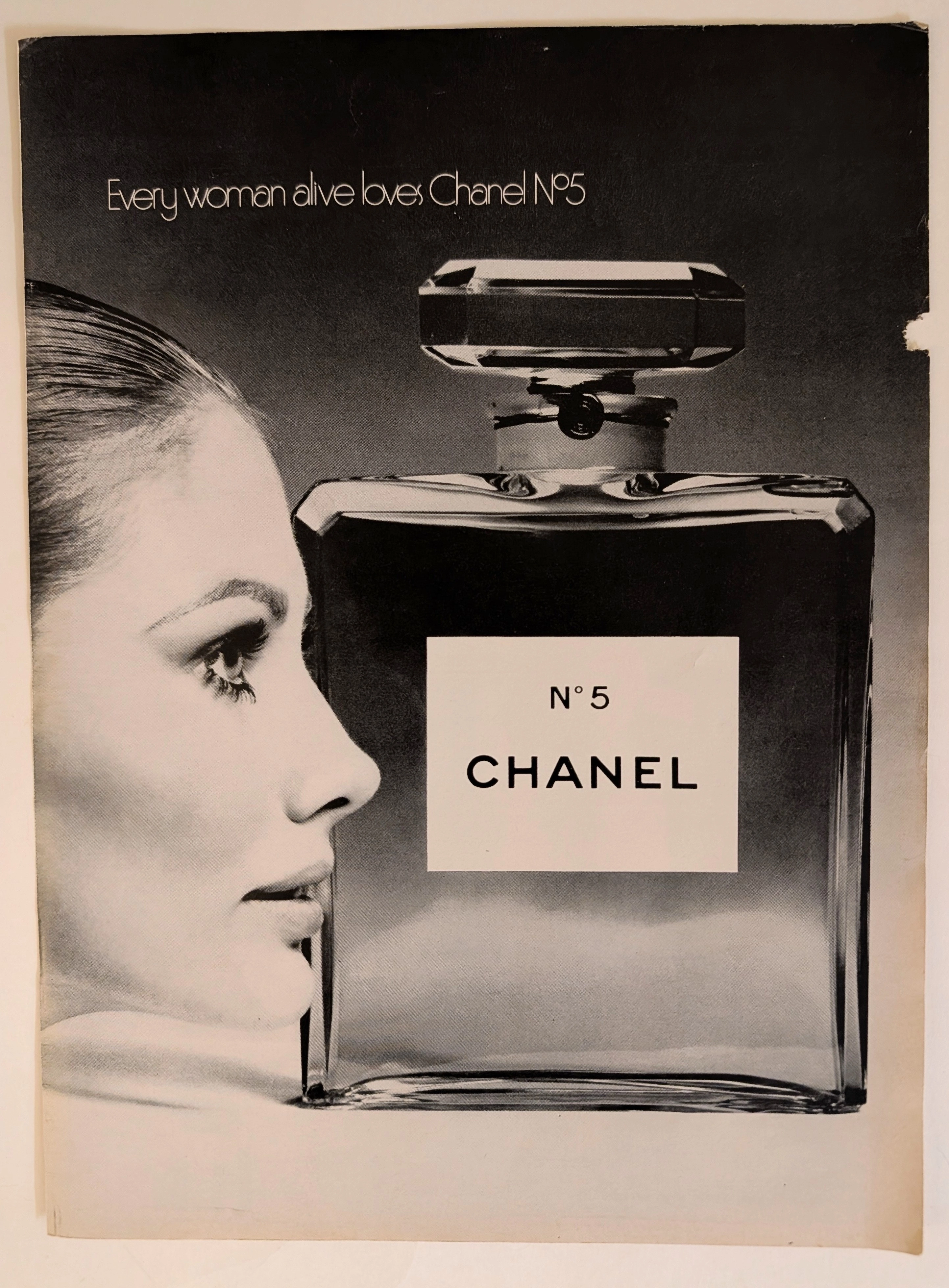
Visual Impact

The composition relies entirely on a severe, asymmetrical balance.
The left hemisphere is dominated by the biological form—the sweeping, organic curve of the model's pulled-back hair, the precise contour of her profile.
The right hemisphere is entirely industrial—the heavy, rectilinear mass of the glass flacon.

The visual genius lies in the manipulation of light. The background fades from a deep, velvety black at the top border into a luminous, cloudy gray at the base, generating a profound sense of infinite depth. The primary light source strikes the bottle from the front, transforming the faceted glass into a glowing prism, while leaving the woman's face softly contoured and secondary. The typography floats delicately above, thin and elegant, contrasting violently with the heavy, bold, block-letter tracking of the label on the bottle. The viewer's eye is forced into a continuous triangle: from the declarative headline, down the trajectory of the model's gaze, crashing inevitably into the unmovable wall of the Chanel label.

Share This Archive

The Archive Continues

Continue the Exploration

The Time Traveller's Dossier: The Sanctuary of the Highway – The 1968 Ford LTD and the Democratization of Silence

Ford · Automotive

The Time Traveller's Dossier: The Sanctuary of the Highway – The 1968 Ford LTD and the Democratization of Silence

The evolution of the American domestic automobile during the mid-twentieth century was fundamentally propelled by a relentless pursuit of accessible luxury and physical isolation from the rapidly expanding, concrete-laden modern world. The historical artifact elegantly and securely positioned upon the analytical table of The Record Institute today is a striking, full-page print advertisement for the 1968 Ford LTD, originating from a highly volatile and transformative year in American history. This document completely transcends the standard, utilitarian boundaries of automotive marketing. It operates as a highly sophisticated, multi-layered cultural mirror, reflecting the precise era when raw horsepower was momentarily subjugated to the pursuit of absolute silence, and European-grade luxury was explicitly packaged and sold to the American middle-class consumer. This world-class, comprehensive dossier conducts a meticulous, unyielding, and exceptionally exhaustive examination of the artifact, operating under the absolute most rigorous parameters of historical, sociological, and material science evaluation. With the vast majority of our analytical focus dedicated to its immense historical gravity (80%), we will decode the brilliant marketing psychology embedded within Ford's audacious "Quiet" campaign, analyze the brutalist architectural juxtaposition of the concrete overpass against the sleek lines of the vehicle, and dissect the profound corporate semiotics of the iconic "Ford has a better idea" lightbulb logo. Furthermore, as we venture deeply into the chemical and physical foundations of this analog printed ephemera (10%), we will reveal the precise mechanical fingerprints of the CMYK halftone rosettes captured in the macro imagery of the wheel hubcap. Finally, we will assess its archival rarity (10%), exploring how the graceful, natural oxidation of the paper substrate cultivates a serene wabi-sabi aesthetic—a natural, irreversible phenomenon that serves as the primary engine driving up its market value exponentially within the elite global spheres of Vintage Commercial Ephemera and Automotive Archives.

The Time Traveller's Dossier: The Semantics of Arrogance – JOY de Jean Patou Advertisement (Circa 1980s)

๋Joy De Jean Patou · Fashion

The Time Traveller's Dossier: The Semantics of Arrogance – JOY de Jean Patou Advertisement (Circa 1980s)

History is not written by the victors; it is printed by the industrialists. Long before digital algorithms began to sterilely dictate human consumption and virtual reality stripped away authentic tactile sensation, societal engineering and consumer psychology were executed through the calculated, mathematical geometry of the four-color offset press and the absolute mastery of analog darkroom photography. The historical artifact before us is not merely a disposable magazine tear sheet meant to peddle a fragrance. It is a perfectly weaponized blueprint of absolute capitalist supremacy, a visual declaration of class warfare, and an unwavering testament to an era of uncompromising, unapologetic ultra-luxury. This museum-grade, academic archival dossier presents an exhaustive deconstruction of a late-analog print advertisement for the legendary fragrance "JOY de Jean Patou," dating from the late 1970s to the early 1980s. Operating on a profound and ruthless binary structure, this document records a calculated paradigm shift within the global luxury goods industry. It captures the precise historical fracture where luxury transitioned conceptually from being a mere indicator of high-quality craftsmanship into a blatant, arrogant weapon of socioeconomic exclusion. Through the highly specialized lens of late-analog commercial artistry and stringent visual forensics, this document serves as a masterclass in psychological marketing. It established the foundational archetype for selling astronomically priced, exclusionary items—an archetype that unconditionally dictates the visual and strategic totems of modern ultra-luxury brands today.

The Time Traveller's Dossier: The Firestone Margin of Safety

Firestone · Automotive

The Time Traveller's Dossier: The Firestone Margin of Safety

The symbiotic relationship between the extreme, high-stakes crucible of professional motorsport and the evolution of the daily-driven passenger automobile is one of the foundational narratives of twentieth-century industrial design. The historical artifact elegantly and securely positioned upon the analytical table of The Record Institute today is a majestic, large-format, two-page print advertisement for Firestone Tires, originating from the golden era of American automotive performance, circa 1967-1968. This document transcends the traditional boundaries of automotive consumable marketing. It operates as a highly sophisticated, multi-layered historical record, capturing the exact moment when the staggering horsepower outputs of the Detroit muscle car era necessitated a paradigm shift in tire technology. This comprehensive dossier conducts a meticulous, unyielding, and exceptionally deep examination of the artifact, operating under the absolute most rigorous parameters of historical, sociological, and material science evaluation. With an overwhelming eighty percent of our analytical focus dedicated to its historical gravity, we will decode the revolutionary introduction of the Firestone "Wide Oval" tire, analyze the critical importance of the vehicles depicted—including a Ford Mustang and a Dodge Coronet—and provide a profound biographical and mechanical analysis of the legendary racing driver Parnelli Jones and his revolutionary 1967 STP-Paxton Turbocar. Furthermore, as we venture into the chemical and physical foundations of this analog printed ephemera, we will reveal the precise mechanical fingerprints of the CMYK halftone rosettes and the graceful, natural oxidation of the paper substrate. This precise intersection of visual nostalgia, mid-century commercial artistry, and the immutable chemistry of time cultivates a serene wabi-sabi aesthetic—a natural, irreversible phenomenon that serves as the primary engine driving up its market value exponentially within the elite global spheres of Vintage Automotive Ephemera and Motorsport Memorabilia collecting.

Published by

The Record Institute

Taxonomy Match

Related Articles

The Time Traveller's Dossier: The Architecture of Aristocracy – Chivas Regal "Prince of Whiskies" Advertisement (Circa Mid-1950s) — related article
Read Article

The Time Traveller's Dossier: The Architecture of Aristocracy – Chivas Regal "Prince of Whiskies" Advertisement (Circa Mid-1950s)

analysis is a meticulously preserved, single magazine tear sheet representing a pinnacle era of mid-20th-century commercial illustration and brand positioning. Far removed from the realm of disposable consumer advertising, this artifact operates as a sophisticated sociological document. It captures a precise historical epoch where the global spirits industry—specifically the Scotch whisky sector—transitioned from marketing regional agricultural products to curating internationally recognized symbols of aristocratic heritage and refined lineage. ​Operating with absolute curatorial precision, this dossier deconstructs a circa mid-1950s advertisement for Chivas Regal 12-Year-Old Blended Scotch Whisky. By analyzing the intersection of classical illustration, the strategic deployment of British royal iconography, and the meticulous visual forensics of the analog printing process, this document illuminates the foundational strategies of modern heritage branding. It demonstrates how a brand gracefully orchestrated a narrative of ancient nobility and warmth to captivate the post-war American consumer, establishing an enduring standard for the premium spirits market that remains profoundly influential today.

The Time Traveller's Dossier: The Semantics of Arrogance – JOY de Jean Patou Advertisement (Circa 1980s) — related article
Read Article

The Time Traveller's Dossier: The Semantics of Arrogance – JOY de Jean Patou Advertisement (Circa 1980s)

History is not written by the victors; it is printed by the industrialists. Long before digital algorithms began to sterilely dictate human consumption and virtual reality stripped away authentic tactile sensation, societal engineering and consumer psychology were executed through the calculated, mathematical geometry of the four-color offset press and the absolute mastery of analog darkroom photography. The historical artifact before us is not merely a disposable magazine tear sheet meant to peddle a fragrance. It is a perfectly weaponized blueprint of absolute capitalist supremacy, a visual declaration of class warfare, and an unwavering testament to an era of uncompromising, unapologetic ultra-luxury. This museum-grade, academic archival dossier presents an exhaustive deconstruction of a late-analog print advertisement for the legendary fragrance "JOY de Jean Patou," dating from the late 1970s to the early 1980s. Operating on a profound and ruthless binary structure, this document records a calculated paradigm shift within the global luxury goods industry. It captures the precise historical fracture where luxury transitioned conceptually from being a mere indicator of high-quality craftsmanship into a blatant, arrogant weapon of socioeconomic exclusion. Through the highly specialized lens of late-analog commercial artistry and stringent visual forensics, this document serves as a masterclass in psychological marketing. It established the foundational archetype for selling astronomically priced, exclusionary items—an archetype that unconditionally dictates the visual and strategic totems of modern ultra-luxury brands today.

The Time Traveller's Dossier: The Suburb's Sea – Avon for Men, the Windjammer Mythos, and the Commodification of Mid-Century Masculinity — related article
Read Article

The Time Traveller's Dossier: The Suburb's Sea – Avon for Men, the Windjammer Mythos, and the Commodification of Mid-Century Masculinity

The evolution of mid-twentieth-century American domestic commerce was fundamentally reshaped by the aggressive expansion of the direct-sales model into the male grooming sector. The historical artifact elegantly and securely positioned upon the analytical table of The Record Institute today is a visually arresting, full-page print advertisement for Avon for Men: Windjammer, definitively dated by its copyright macro to the turbulent year of 1968. This document completely transcends the standard, utilitarian boundaries of fragrance marketing. It operates as a highly sophisticated, multi-layered cultural mirror, reflecting a precise era in consumer psychology where the American male—increasingly confined to the sterile environments of corporate offices and manicured suburbs—yearned for visceral, physical validation. By utilizing the universally potent, romanticized motif of the solitary sailor battling the elements, Avon ingeniously packaged the concept of raw, nautical adventure into a socially acceptable, easily purchasable glass bottle. This world-class, comprehensive dossier conducts a meticulous, unyielding, and exceptionally exhaustive examination of the artifact, operating under the absolute most rigorous parameters of historical, sociological, and material science evaluation. Dedicating the overwhelming majority of our analytical focus to its immense historical gravity, we will decode the brilliant marketing psychology embedded within the "Windjammer" maritime narrative, analyze the profound sociopolitical genius of the "Avon Lady" distribution network selling masculinity to wives, and dissect the semiotics of the product's mid-century packaging design. Furthermore, as we venture deeply into the chemical and physical foundations of this analog printed ephemera, we will reveal the precise mechanical fingerprints of the CMYK halftone rosettes captured in the macro imagery. Finally, we will assess its archival rarity, exploring how the graceful, natural oxidation of the paper substrate cultivates a serene wabi-sabi aesthetic—a natural, irreversible phenomenon that serves as the primary engine driving up its market value exponentially within the elite global spheres of Vintage Commercial Ephemera and Lifestyle Archives.

The Time Traveller's Dossier : VW Type 3 Automatic - The Compromise of Engineering — related article
Read Article

The Time Traveller's Dossier : VW Type 3 Automatic - The Compromise of Engineering

We often remember early Volkswagen history through the lens of simplicity, air-cooled engines, and rugged manual transmissions. But as the American market matured, the demand for comfort began to clash with the brand's original philosophy. This document is historical evidence capturing that moment of compromise. It is not just a car advertisement; it is an engineering confession and a declaration. After a decade of hesitation, Volkswagen of America introduced a fully automatic transmission for the 1969 models. It is a turning point showing that even the most stubborn brand had to adapt to the American consumerism trend that sought ultimate convenience.

THE TIME TRAVELER'S DOSSIER: THE KOREAN WAR ANCHOR AND THE SCARCITY OF LUXURY — related article
Read Article

THE TIME TRAVELER'S DOSSIER: THE KOREAN WAR ANCHOR AND THE SCARCITY OF LUXURY

The artifact under our uncompromising, unprecedented museum-grade analysis is a profoundly preserved Historical Relic excavated from the golden age of post-WWII American opulence. This Primary Art Document is a monumental magazine advertisement for the Imperial by Chrysler, dating to the pivotal 1951-1952 era. This document is a "Forensic Blueprint of American Aristocracy and Geopolitical Crisis." It masterfully weaponizes regal European iconography to elevate Chrysler's flagship model above mere transportation, explicitly targeting "those who can afford any motor car in the world". Yet, its most significant historical anchor is hidden in the microscopic fine print: "WHITE SIDEWALLS WHEN AVAILABLE". This single sentence instantly transforms the advertisement into a wartime relic, reflecting the severe rubber shortages imposed during the Korean War. Grounded by the iconic jeweled emblem and its breathtaking wabi-sabi chemical degradation—highlighted by its violently torn binding edge—this artifact commands an irreplaceable status, cementing its Rarity Class A designation.

The Time Traveller's Dossier: The Alchemy of Acoustics – Marantz "Discover Gold" Advertisement (1981) — related article
Read Article

The Time Traveller's Dossier: The Alchemy of Acoustics – Marantz "Discover Gold" Advertisement (1981)

History is not an accidental sequence of events; it is a meticulously engineered illusion crafted by those who command the aesthetic and cultural narratives of their time. Long before digital algorithms could sterilely dictate consumer preferences, the ultimate manifestation of psychological manipulation and corporate alchemy was executed through the calculated precision of the offset printing press and the absolute mastery of analog darkroom photography. The historical artifact before us is not merely a disposable page torn from a vintage magazine. It is a perfectly weaponized blueprint of audio-exoticism, a visual declaration of extreme consumer luxury, and an unwavering testament to an era where electronic hardware was sold not merely as a functional utility, but as a precious, excavated commodity. ​This museum-grade, academic archival dossier presents an exhaustive, microscopic deconstruction of a 1981 print advertisement for the Marantz "Solid Gold" audio equipment line. Operating on a profound and ruthless binary structure, this document records a calculated paradigm shift within the global consumer electronics industry. It captures the precise historical fracture where silicon, copper, and plastic were conceptually transmuted into a literal, physical embodiment of a precious metal. Through the highly specialized lens of late-analog commercial artistry and stringent visual forensics, this document serves as a masterclass in psychological marketing. It established the foundational archetype for selling technology as a high-yield status symbol—an archetype that unconditionally dictates the visual and strategic totems of the modern high-end audiophile industry today.