The Time Traveller's Dossier: The Instant Gratification Protocol – The Polaroid Color Pack Camera Exhibitio
Click any image to view in high resolution
The History
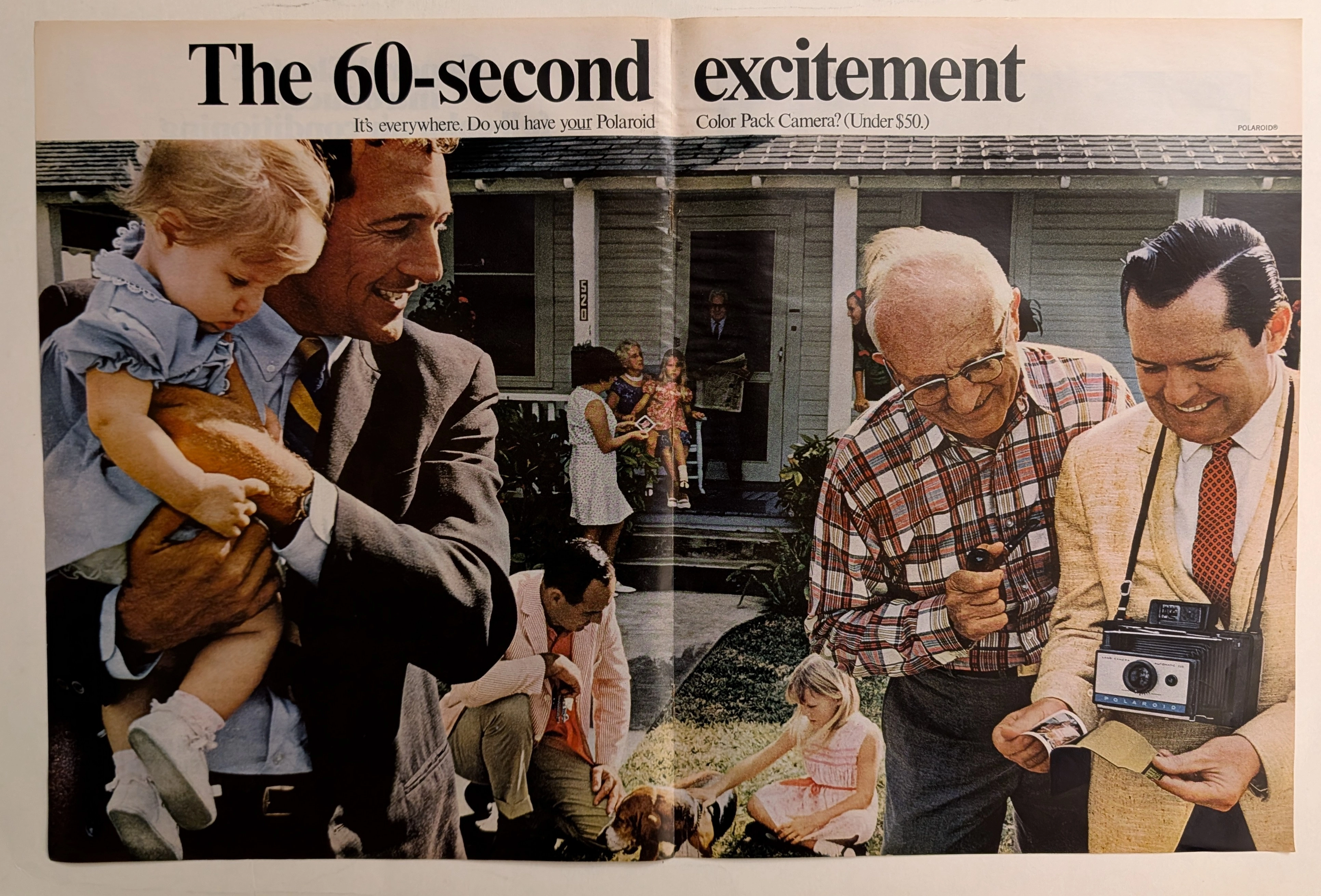
To fully appreciate the immense historical gravity, cultural magnitude, and sociological importance of this artifact, one must meticulously contextualize the optical revolution spearheaded by Dr. Edwin H. Land and the Polaroid Corporation, alongside the shifting paradigms of the American suburban lifestyle during the volatile yet prosperous era of the late 1960s. The genesis of this photographic paradigm shift can be traced back to 1947, when Dr. Land first demonstrated his revolutionary one-step photographic process to the Optical Society of America. Prior to this monumental invention, photography was an exercise in delayed gratification and chemical patience. A roll of film had to be painstakingly exposed, carefully removed in darkness, and sent to a commercial laboratory—or processed in a private darkroom—meaning that days or even weeks would pass before the memories were finally rendered visible. Edwin Land’s invention shattered this timeline, compressing the entire laboratory process into a self-contained film packet that developed in the palm of the user's hand.
However, the early decades of Polaroid photography were dominated by heavy, expensive, metallic roll-film cameras that produced exclusively sepia or black-and-white images. While technologically miraculous, they remained somewhat niche, often viewed as luxury items or specialized tools for professionals. The true turning point for mass consumer culture—the exact historical inflection point perfectly captured and immortalized in this artifact—was the introduction of the Polaroid Color Pack Camera line (the 100-400 series), and specifically the advent of Polacolor film in 1963. Polacolor was a marvel of chemical engineering, utilizing a complex dye-developer process that managed to stabilize full-color images outside the darkroom. By the time the Automatic 210 was introduced to the market, produced between 1967 and 1969, Polaroid had successfully refined both the chemistry and the hardware to a point of mass-market viability.
The headline’s strategic, parenthetical callout—"(Under $50.)"—is of paramount historical and economic importance. Adjusted for inflation, fifty dollars in the late 1960s was still a significant purchase, but it represented a deliberate, calculated move by Polaroid to breach the middle-class market. By engineering a camera with a rigid plastic body, a simplified automatic exposure system utilizing a CdS (cadmium sulfide) electric eye, and a folding bellows design, Polaroid successfully democratized instant color photography. The Automatic 210 utilized the revolutionary Type 108 peel-apart pack film. The "60-second excitement" loudly proclaimed in the typography was no longer an exclusive luxury reserved for the wealthy elite or the professional studio photographer; it was now highly accessible to the average American family, ready to be deployed at backyard barbecues, birthday parties, and holiday gatherings.
The visual narrative of the advertisement brilliantly and flawlessly captures the shifting sociological paradigm of the American suburban lifestyle during this era. The scene is a bustling, idyllic front lawn featuring a complex, multi-generational tableau. We observe a grandfather holding a smoking pipe, a father in a sharp suit carrying a toddler, young children interacting with a dog on the grass, and neighbors conversing on the porch in the background. In the exact center of this intricate social fabric stands the man in the textured yellow jacket, holding the Automatic 210 and peeling apart a freshly developed print. In this moment, the camera is not merely documenting the social event; the camera is the social event.
The physical, performative ritual of the peel-apart film was a crucial component of its cultural success. After pulling the film tab through the camera's steel rollers—which ruptured the chemical reagent pod and spread the developer evenly across the negative and positive sheets—the user had to wait exactly sixty seconds. This minute of waiting became a shared, communal experience of intense anticipation. Friends and family would crowd around, watching the clock. Then came the physical act of peeling the sticky, chemically pungent negative away from the pristine, full-color positive print. The reveal was a daily magic trick that instantly drew people together, forging immediate emotional connections. This advertisement flawlessly documents the exact historical moment when photography transitioned from a passive, documentary medium into a highly interactive, instantaneous social catalyst.
Furthermore, the sartorial and architectural semiotics embedded within the image provide a rich tapestry of late-1960s Americana. The architecture of the house—with its prominent front porch, neat siding, and manicured lawn—represents the ultimate realization of the post-war suburban dream, a space designed for leisure and community visibility. The clothing styles reflect a society in transition yet clinging to traditional values. The older generation is represented by the grandfather in a casual yet conservative plaid shirt, symbolizing established wisdom and stability. The man holding the camera wears a bold, vibrant yellow sport coat with a patterned tie, indicative of the era's increasingly adventurous men's fashion. The father holding the child remains in a traditional grey suit, suggesting he has perhaps just returned from a white-collar job to participate in this domestic bliss.
It is also vital to analyze the role of the advertising agency behind this masterpiece. During the 1960s, Polaroid's advertising account was famously and masterfully handled by the legendary agency Doyle Dane Bernbach (DDB). Under the visionary leadership of Bill Bernbach, DDB revolutionized the global advertising industry by discarding the heavy-handed, specification-obsessed, hard-sell tactics of the past. Instead, they championed an entirely new philosophy based on emotional connection, striking photography, clean minimalist layouts, and highly intelligent, conversational copywriting. This artifact is a quintessential example of DDB's genius. Rather than inundating the reader with complex diagrams of the camera's shutter speeds, focal lengths, or the complex chemistry of the dye-developers, the agency focused entirely on the human experience. They sold the emotion, the anticipation, and the joy of the result. The phrase "The 60-second excitement" distills the entire technological miracle into a digestible, highly desirable psychological state.
The lasting legacy of this specific campaign, and the product it promoted, cannot be overstated. The Polaroid Color Pack cameras laid the psychological groundwork for the modern era of instant gratification that we currently experience with smartphones and digital social media. By conditioning the public to expect immediate visual feedback and the instant sharing of memories, Polaroid forever altered the human relationship with the captured image. This large-format printed advertisement is not simply a piece of commercial marketing; it is a primary historical document recording the dawn of the instantaneous visual culture that defines the modern world.
The Paper
As a physical entity, this printed artifact functions as a living, breathing, and profound record of mid-twentieth-century graphic reproduction and substrate chemistry. Under exceptional macro-lens examination, this document reveals the stunning complexity and mathematical precision of analog color printing. The rich, warm tones of the grandfather's plaid shirt, the highly reflective metallic sheen of the Polaroid camera body's chrome accents, and the absolute crispness of the registered trademark are all meticulously constructed from a precise, mathematically rigorous galaxy of halftone rosettes. This intricate pattern constitutes the mechanical fingerprint of the pre-digital analog offset printing press. Microscopic, varying sizes of Cyan, Magenta, Yellow, and Key (Black) ink dots are elegantly and systematically layered at specific angles to trick the human eye and the biological visual cortex into perceiving continuous, vibrant, and dimensional photographic reality.
Yet, the most profound and impactful factor elevating the immense value of this artifact in the contemporary collector's market is the natural, organic, and entirely irreversible process of Material Degradation. The expansive margins and the overall paper substrate exhibit a genuine, unavoidable, and entirely unforgeable "Toning." This gradual, graceful transition from the original bright, bleached manufactured paper to a warm, antique ivory and golden hue is caused by the slow chemical oxidation of Lignin—the complex organic polymer that binds cellulose fibers together within the raw wood pulp of the paper. As the substrate is exposed to ambient oxygen and ultraviolet light over a span of nearly six decades, the molecular structure of the lignin gracefully and systematically breaks down. This accumulation of time, this naturally evolving patina, represents the absolute core of the wabi-sabi aesthetic. The profound appreciation for the beauty found in natural aging, impermanence, and the physical manifestation of history upon a fragile medium is an irreversible chemical reaction. It is precisely this authentic, unreplicable degradation that acts as the primary engine driving up its market value exponentially among elite collectors, as it provides the ultimate, irrefutable proof of the artifact's historical authenticity and its miraculous journey through time.
The Rarity
RARITY CLASS: A (Excellent Archival Preservation)
Evaluated under the most exacting, rigorous, and uncompromising archival parameters, this artifact is definitively and securely designated as Class A.
The remarkable and defining paradox of mid-century print advertising is that these specific documents were produced by the millions as explicitly and intentionally "disposable media." They were inherently destined by their very nature to be briefly observed, casually folded, read over a morning coffee, and ultimately discarded into the recycling bins and incinerators of history. For a large-format advertisement—particularly one that spans a highly vulnerable, physically fragile two-page spread (centerfold)—to survive entirely intact since the late 1960s without catastrophic structural tearing at the central bind, without destructive moisture staining, or without the fatal fading of the delicate, light-sensitive halftone inks constitutes a highly significant statistical archival anomaly. The impeccable structural integrity of this paper, combined with the immense cultural nostalgia associated with the Polaroid brand and the historic weight of the Doyle Dane Bernbach advertising legacy, elevates the desirability of this document far beyond standard camera collectors. It makes it a highly prized, museum-worthy piece of Americana. It is ardently sought after by global curators to ensure its historical permanence through acid-free, UV-protected conservation framing.
Visual Impact
The aesthetic brilliance and psychological power of this artifact lie in its masterful execution of "Focal Convergence within Controlled Chaos." The art director has meticulously orchestrated a highly populated, kinetic scene that could, in lesser hands, easily overwhelm the viewer with visual noise. There is dynamic movement everywhere: a dog being enthusiastically petted by a young girl, a toddler shifting in her father's arms, animated conversations happening on the porch in the background.
However, the lighting design and the compositional geometry expertly and subliminally guide the human eye. The brightest, most deliberate lighting falls directly upon the older man with the pipe and the younger man holding the camera in the bottom right quadrant. Furthermore, their intense downward gaze creates a powerful psychological vector, virtually forcing the viewer to look exactly where they are looking: directly at the Polaroid Automatic 210 and the freshly developed, colorful print. The bold, heavy serif typography of the headline ("The 60-second excitement") sits with immense gravity at the top of the pages, framing the entire scene and providing immediate, unmissable context to the joyous, anticipatory expressions on the subjects' faces. It is a flawless, textbook integration of product placement, emotional storytelling, and typographical hierarchy.
The Archive Continues
Continue the Exploration

Marantz · Entertainment
The Time Traveller's Dossier: The Alchemy of Acoustics – Marantz "Discover Gold" Advertisement (1981)
History is not an accidental sequence of events; it is a meticulously engineered illusion crafted by those who command the aesthetic and cultural narratives of their time. Long before digital algorithms could sterilely dictate consumer preferences, the ultimate manifestation of psychological manipulation and corporate alchemy was executed through the calculated precision of the offset printing press and the absolute mastery of analog darkroom photography. The historical artifact before us is not merely a disposable page torn from a vintage magazine. It is a perfectly weaponized blueprint of audio-exoticism, a visual declaration of extreme consumer luxury, and an unwavering testament to an era where electronic hardware was sold not merely as a functional utility, but as a precious, excavated commodity. This museum-grade, academic archival dossier presents an exhaustive, microscopic deconstruction of a 1981 print advertisement for the Marantz "Solid Gold" audio equipment line. Operating on a profound and ruthless binary structure, this document records a calculated paradigm shift within the global consumer electronics industry. It captures the precise historical fracture where silicon, copper, and plastic were conceptually transmuted into a literal, physical embodiment of a precious metal. Through the highly specialized lens of late-analog commercial artistry and stringent visual forensics, this document serves as a masterclass in psychological marketing. It established the foundational archetype for selling technology as a high-yield status symbol—an archetype that unconditionally dictates the visual and strategic totems of the modern high-end audiophile industry today.

Ford · Automotive
The Time Traveller's Dossier: The Ten-Dollar Titan – The Autolite Ford Indianapolis 500 Exhibition
The synthesis of high-stakes motorsport engineering and everyday consumer accessibility represents a pinnacle achievement in mid-twentieth-century American commercial strategy. The historical artifact elegantly secured upon the analytical table of The Record Institute today is a majestic full-page print advertisement for Autolite Ford Ignition Coils, originating from the golden era of 1960s automobile racing. This document completely transcends the traditional boundaries of automotive parts marketing. It operates as a profound, sophisticated declaration of how cutting-edge technological innovation on the racetrack was democratized and delivered directly into the hands of the American middle class, transforming the daily commute into an extension of the Indianapolis 500. This world-class, comprehensive dossier conducts a meticulous and deep examination of the artifact, operating under the absolute most rigorous parameters of historical, sociological, and material science evaluation. We will decode the brilliant, kinetic pit-stop scene capturing an open-wheel race car, and analyze the dramatic visual juxtaposition of this high-speed chaos against the highly structured, calculated copywriting of the Ford Motor Company. Furthermore, as we venture into the chemical and physical foundations of this analog printed ephemera, we will reveal the mechanical fingerprints of the CMYK halftone rosettes and the graceful, natural oxidation of the paper substrate. This precise intersection of visual nostalgia, motorsport heritage, and the chemistry of time cultivates a serene wabi-sabi aesthetic—a natural, irreversible phenomenon that serves as the primary engine driving up its market value exponentially within the elite global spheres of Vintage Automotive Ephemera and Motorsports Archives collecting.

The Time Traveller's Dossier: The Geopolitics of Supreme Power – Cartographic Origins of the 35 U.S. Presidents (Circa Mid-1960s)
The history of supreme executive power is not inscribed solely within the text of legal documents, constitutional amendments, or international treaties; it is deeply rooted in the geographical origins and territorial foundations of political leaders. Long before the modern era of complex spatial data analysis or digital infographics, the structural understanding of state power in the United States was conveyed through the meticulous art of cartographic illustration. The historical artifact presented before us for museum-grade forensic analysis is not merely a conventional fold-out extracted from a mid-20th-century educational publication. It is a profound "geopolitical visual encyclopedia," meticulously compiling and categorizing the geographic birthplaces of the thirty-five individuals who had ascended to the highest office in the White House up to that point in history. This academic archival dossier presents an exhaustive, microscopic deconstruction of the historical and aesthetic framework of the diagram titled "The 35 Presidents and the 14 States They Came From." Operating on a profound scholarly narrative structure, this document decodes the shifting tectonic plates of executive power in the United States—from the foundational era concentrated on the Eastern Seaboard, moving steadily into the Midwest, and ultimately expanding toward the Southern and Western frontiers. Through the highly specialized lens of late-analog print analysis, American political history, and rigorous visual forensics, this document serves as a temporal window. It allows us to explore the foundational roots of the "American Dream" as conveyed through the birthplaces of these statesmen, ranging from humble log cabins to opulent estates, all rendered with the mechanical precision of mid-century offset lithography.