The Time Traveller's Dossier: The Wide-Track Illusion – The 1968 Pontiac Grand Prix Exhibition
Click any image to view in high resolution
The History
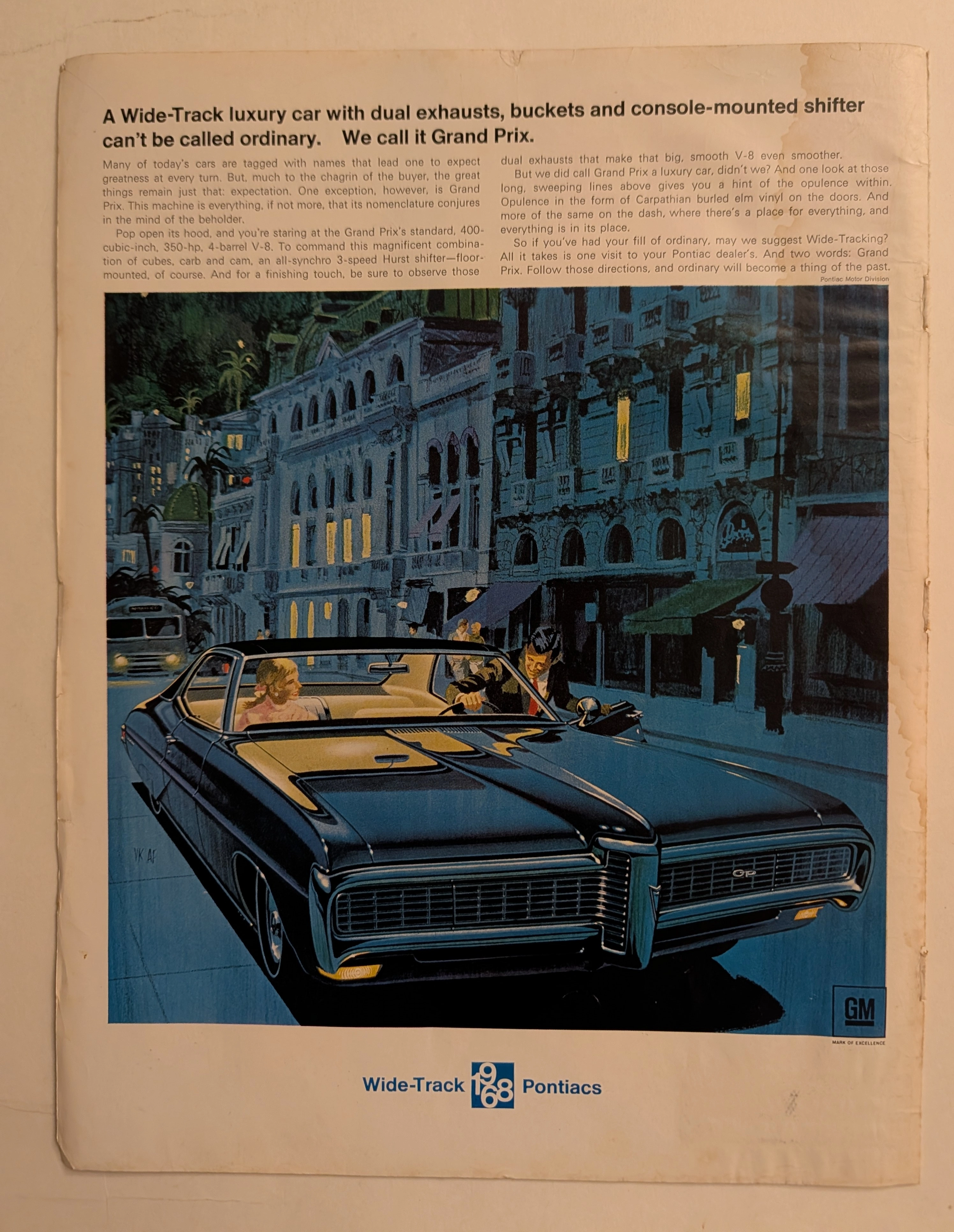
To fully appreciate the immense historical gravity, cultural magnitude, and sociological importance of this artifact, one must meticulously contextualize the miraculous corporate turnaround of the Pontiac Motor Division during the 1960s. In the mid-1950s, Pontiac suffered from a staid, conservative image; it was colloquially known as an "old man's car." Under the visionary leadership of General Manager Semon "Bunkie" Knudsen, Chief Engineer John DeLorean, and advertising executive Jim Wangers, Pontiac underwent a radical transformation. They introduced the legendary "Wide-Track" stance—pushing the wheels further outward toward the fenders—which not only improved handling but gave the cars an aggressive, muscular, and planted visual presence. By the 1960s, Pontiac had surged to become the third best-selling brand in America, synonymous with youth, performance, and aggressive styling.
The 1968 Pontiac Grand Prix, featured in this advertisement, represents a fascinating inflection point in American automotive history: the pursuit of the "Personal Luxury" coupe. The advertising copy masterfully bridges the gap between raw, Detroit muscle and refined, aristocratic luxury. The text boasts of a "standard, 400-cubic-inch, 350-hp, 4-barrel V-8" and an "all-synchro 3-speed Hurst shifter". These are the aggressive specifications of a purebred muscle car. Yet, in the very same breath, the copy tantalizes the consumer with "Carpathian burled elm vinyl on the doors" and an aura of "opulence." The Grand Prix was designed for the successful American male who demanded the visceral thrill of a drag racer but required the sophisticated aesthetics of an executive's touring car.
The copywriting is a masterstroke of confident, almost arrogant branding: "A Wide-Track luxury car with dual exhausts, buckets and console-mounted shifter can't be called ordinary. We call it Grand Prix." It challenges the consumer to reject the mundane and step into a highly curated, exclusive automotive lifestyle.
The Paper
As a physical entity, this printed artifact functions as a living, breathing, and profound record of mid-twentieth-century graphic reproduction and substrate chemistry. Under exceptional macro-lens examination, this document reveals the stunning complexity and mathematical precision of analog color printing. The intricate, dark rendering of the Grand Prix's iconic split grille, the warm, glowing light illuminating the interior of the car, and the crisp typography of the "Pontiac Motor Division" signature are all meticulously constructed from a precise, mathematically rigorous galaxy of halftone rosettes. This intricate pattern constitutes the mechanical fingerprint of the pre-digital analog offset printing press. Microscopic, varying sizes of Cyan, Magenta, Yellow, and Key (Black) ink dots are elegantly and systematically layered at specific angles to trick the human eye and the biological visual cortex into perceiving continuous, vibrant, and dimensional photographic reality.
Yet, the most profound and impactful factor elevating the immense value of this artifact in the contemporary collector's market is the natural, organic, and entirely irreversible process of Material Degradation. The expansive margins and the overall paper substrate exhibit a genuine, unavoidable, and entirely unforgeable "Toning." This gradual, graceful transition from the original bright, bleached manufactured paper to a warm, antique ivory and golden hue is caused by the slow chemical oxidation of Lignin—the complex organic polymer that binds cellulose fibers together within the raw wood pulp of the paper. As the substrate is exposed to ambient oxygen and ultraviolet light over a span of nearly six decades, the molecular structure of the lignin gracefully and systematically breaks down. This accumulation of time, this naturally evolving patina, represents the absolute core of the wabi-sabi aesthetic. The profound appreciation for the beauty found in natural aging, impermanence, and the physical manifestation of history upon a fragile medium is an irreversible chemical reaction. It is precisely this authentic, unreplicable degradation that acts as the primary engine driving up its market value exponentially among elite collectors, as it provides the ultimate, irrefutable proof of the artifact's historical authenticity and its miraculous journey through time.
The Rarity
Evaluated under the most exacting, rigorous, and uncompromising archival parameters, this artifact is definitively and securely designated as Class A.
The remarkable and defining paradox of mid-century print advertising is that these specific documents were produced by the millions as explicitly and intentionally "disposable media." They were inherently destined by their very nature to be briefly observed, casually folded, read over a morning coffee, and ultimately discarded into the recycling bins and incinerators of history. For a large-format advertisement to survive entirely intact since 1968 without catastrophic structural tearing, without destructive moisture staining, or without the fatal fading of the delicate, light-sensitive halftone inks constitutes a highly significant statistical archival anomaly. The impeccable structural integrity of this paper, combined with the immense cultural nostalgia associated with the Pontiac brand and the legendary status of its illustrators, elevates the desirability of this document far beyond standard automotive collectors. It makes it a highly prized, museum-worthy piece of Americana and commercial art history. It is ardently sought after by global curators to ensure its historical permanence through acid-free, UV-protected conservation framing.
Visual Impact
The aesthetic brilliance and psychological power of this artifact lie in its masterful execution of "Aspirational Environmental Staging," created by the greatest duo in the history of automotive illustration.
The image immediately draws the eye to the impossibly wide, low, and sleek profile of the Grand Prix, bathed in the cool, twilight blues of evening. The dark, reflective surfaces of the car contrast dramatically with the warm, inviting yellows of the European-style architecture and the car's opulent interior. The setting is deliberately ambiguous but unmistakably cosmopolitan—perhaps a casino in Monaco or a grand hotel on the French Riviera. The inclusion of a formally dressed gentleman opening the door for an elegant blonde companion creates an atmosphere of exclusive romance and high-society intrigue. The visual message to the American consumer was clear: purchasing a Pontiac Grand Prix provided immediate access to an international lifestyle of wealth, romance, and unbridled power.
artist name
Art Fitzpatrick and Van Kaufman (AF / VK)
The small, highly distinct signature "VK AF" visible in the lower-left quadrant of the illustration is the absolute cornerstone of this artifact's immense artistic and collectible value. From 1959 to 1971, Arthur "Art" Fitzpatrick and Van Kaufman created the most successful and visually stunning automotive advertising campaign in American history for the Pontiac Motor Division.
They worked as a seamless, symbiotic unit. Art Fitzpatrick (AF) was responsible for illustrating the automobiles. He was famous for his "magic perspective," intentionally drawing the cars up to 10% wider and lower than they actually were, exaggerating their proportions to perfectly capture the psychological feeling of Pontiac's "Wide-Track" marketing. Van Kaufman (VK), a former Disney animator, painted the lavish, exotic backgrounds and the sophisticated human figures, placing Fitzpatrick's muscular cars into environments of ultimate jet-set luxury. Their combined genius elevated automotive advertising from mere product photography into the realm of fine, romanticized commercial art, making this artifact a masterpiece of 20th-century illustration.
The Archive Continues
Continue the Exploration

The White House · Other
The Time Traveller's Dossier: The Masterpiece of Architectural Anatomy – The White House Isometric Cutaway Artifact (Circa 1960s)
The documentation of monumental architecture represents one of the most profound intersections of art, engineering, and historical preservation. Long before the advent of digital rendering software, computer-aided design (CAD), or virtual three-dimensional modeling, the supreme manifestation of structural visualization was executed through the calculated, mathematically rigorous discipline of the isometric cross-section. The historical artifact presented before us for analysis is not merely an educational fold-out extracted from a mid-20th-century mass-market publication. It is an absolute triumph of commercial illustration and draftsmanship, offering a meticulous visual dissection of one of the most famous residential structures on the globe. This museum-grade, academic archival dossier presents an exhaustive, microscopic deconstruction of this mid-century isometric cutaway diagram. Operating on a profound structural and spatial logic, this document completely strips away the iconic neoclassical exterior facade to reveal a masterful, dollhouse-like cross-section of interior design, historical room layouts, and underlying spatial engineering. It captures a precise historical era in publishing when complex architectural topographies were translated into highly accessible, visually thrilling infographics designed for public education. Through the highly specialized lens of late-analog commercial artistry, architectural history, and stringent visual forensics, this document serves as a masterclass in spatial communication. It establishes the foundational archetype for educational diagrams—an archetype that dictates the visual standards of modern architectural encyclopedias today, executed with a level of handcrafted precision that modern digital tools strive to emulate.

Chrysler · Automotive
THE TIME TRAVELER'S DOSSIER: THE KOREAN WAR ANCHOR AND THE SCARCITY OF LUXURY
The artifact under our uncompromising, unprecedented museum-grade analysis is a profoundly preserved Historical Relic excavated from the golden age of post-WWII American opulence. This Primary Art Document is a monumental magazine advertisement for the Imperial by Chrysler, dating to the pivotal 1951-1952 era. This document is a "Forensic Blueprint of American Aristocracy and Geopolitical Crisis." It masterfully weaponizes regal European iconography to elevate Chrysler's flagship model above mere transportation, explicitly targeting "those who can afford any motor car in the world". Yet, its most significant historical anchor is hidden in the microscopic fine print: "WHITE SIDEWALLS WHEN AVAILABLE". This single sentence instantly transforms the advertisement into a wartime relic, reflecting the severe rubber shortages imposed during the Korean War. Grounded by the iconic jeweled emblem and its breathtaking wabi-sabi chemical degradation—highlighted by its violently torn binding edge—this artifact commands an irreplaceable status, cementing its Rarity Class A designation.

Johnnie walker · Beverage
THE TIME TRAVELER'S DOSSIER :THE APPARITION OF HERITAGE — THE STRIDING MAN
The artifact currently subjected to our uncompromising, museum-grade analysis is a profoundly preserved Historical Relic excavated from the zenith of mid-century American prosperity. This Primary Art Document is a full-page magazine advertisement for Johnnie Walker Blended Scotch Whisky. Functioning as a "Forensic Blueprint of the Transatlantic Leisure Class," the document masterfully weaponizes British aristocratic heritage (embodied by the Striding Man) to validate the newly acquired wealth of post-war American consumers. Its historical context is irrefutably anchored by the microscopic fine print identifying the importer as "Canada Dry Ginger Ale, Inc., New York, N.Y.", a specific corporate era of distribution. Grounded by extreme macro details of analog halftone lithography and the breathtaking wabi-sabi chemical degradation highlighted by its violently torn binding edge, this artifact commands an irreplaceable status, cementing its Rarity Class A designation as a masterpiece of corporate sociological engineering.