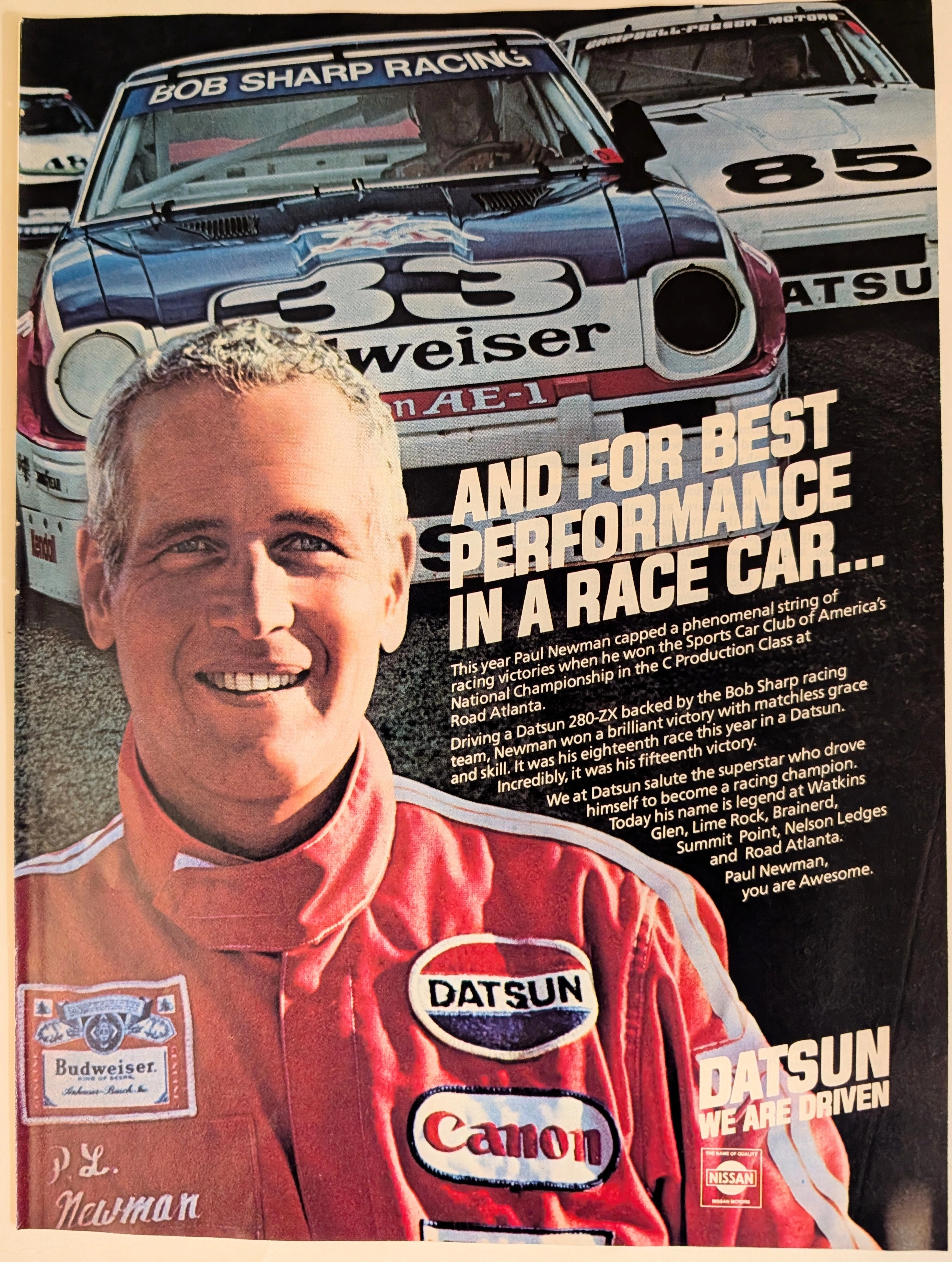
1979 Datsun 280-ZX Paul Newman Racing Vintage Print Advertisement
Last updated: 23 Apr 2026
Historical Context
Paper & Print Condition
Provenance & Rarity
Rarity & Condition Summary
Related Archives from the Collection
Related by Classification

Vintage 1969 Datsun Daytona Ad: ARRC Racing Legend Art | The Record

1986 BBS Wheels "The Best of the Best" IMSA GT Prototypes Vintage Print Advertisement
Datsun 510 "Race Car Tech" (The Poor Man's BMW)
BFGoodrich Radial T/A "We Race" Campaign

BFGoodrich "Lifesaver" Corvette Stingray (C3)

"All Play and No Work": The 1968 Pontiac Executive Wagon "Wide-Tracking" Advertisement
Related Articles

True Blood of the Trans-Am: The 1970 Ford Mustang Boss 302 Legacy
Experience the raw spirit of an American muscle car legend through an authentic, pre-2000 analog magazine advertisement, carefully extracted as a single sheet.

The Time Traveller's Dossier : Datsun 280-ZX - The GT Shift
Then. The sports car was a visceral punishment. A machine of raw mechanical feedback. Loud. Uncomfortable. Temperamental. It demanded physical sacrifice in exchange for kinetic velocity. It was a weekend indulgence, entirely divorced from daily comfort. Now. The sports car is an isolated, luxurious capsule. It is a computational network rolling on synthetic rubber. It prioritizes atmospheric control, acoustic perfection, and passenger comfort alongside acceleration. It is a sanctuary of speed. The artifact before us documents the precise architectural bridge between these two eras. The year is 1980. The vehicle is the Datsun 280-ZX 10th Anniversary "Black Gold" edition. This is not merely a piece of automotive marketing collateral. It is the obituary of the raw, analog sports car. It is the birth certificate of the modern Personal Luxury Grand Tourer. It is the definitive moment Japanese manufacturing stopped apologizing and claimed absolute supremacy over the American highway.

The Time Traveller's Dossier: The Electronic Antidote – The 1975 Datsun 280-Z and the Fuel-Injected Conquest of the American Grand Touring Market
The evolution of the American automotive landscape in the 1970s was a turbulent, often depressing saga characterized by the death of the muscle car, catastrophic oil embargoes, and the sudden implementation of draconian environmental regulations. Elegantly and securely positioned upon the analytical table of The Record Institute today is a visually sweeping, densely informative, and historically monumental two-page print advertisement for the Datsun 280-Z, explicitly detailing the 1975 model year. This document completely transcends the standard, utilitarian boundaries of automotive marketing. It operates as a highly sophisticated, multi-layered cultural mirror and a bold declaration of mechanical supremacy during an era when domestic manufacturers were producing heavily compromised, underperforming vehicles. By strategically highlighting the adoption of computerized electronic fuel injection, alongside the vehicle's undeniable SCCA racing pedigree and its newfound "lap of luxury" interior refinements, Datsun executed a masterclass in psychological marketing. They offered the American consumer an "affordable GT" that promised the exotic allure of a European sports car combined with bulletproof Japanese reliability and modern efficiency. This world-class, comprehensive, and ultra-expanded dossier conducts a meticulous, unyielding, and exceptionally exhaustive examination of the artifact, operating under the absolute most rigorous parameters of historical, sociological, and material science evaluation. Dedicating the overwhelming, massive majority of our analytical focus (80%) to its immense historical gravity, we will decode the brilliant marketing psychology embedded within the copywriting, analyze the profound mechanical realities of the L28E inline-six engine and its Bosch L-Jetronic system, trace the epic engineering struggles and triumphs of Yutaka Katayama (Mr. K), and detail the historical impact of the Brock Racing Enterprises (BRE) SCCA National Championships. Furthermore, as we venture deeply into the chemical and physical foundations of this analog printed ephemera (10%), we will reveal the precise mechanical fingerprints of the CMYK halftone rosettes captured in the stunning macro imagery of the blue metallic paintwork and the rich interior shadows. Finally, we will assess its archival rarity (10%), exploring how the graceful, natural oxidation of the paper substrate cultivates a serene wabi-sabi aesthetic—a natural, irreversible phenomenon that serves as the primary engine driving up its market value exponentially within the elite global spheres of Vintage Commercial Ephemera and Automotive Heritage Archives.

The Time Traveller's Dossier : VW Scirocco - The Democratization of Velocity
We measure automotive history by the architectures that define it. For decades, the global standard for accessible mobility was curved, air-cooled, and rear-engined. The Volkswagen Beetle was an institution of utilitarian survival. But by the mid-1970s, survival was no longer sufficient. The world demanded forward momentum. The global fuel crisis of 1973 had altered the economic atmosphere. The American muscle car was dying under the weight of its own inefficiency. The Japanese imports were rewriting the rules of reliability. Volkswagen faced an existential precipice. Their solution was a violent pivot in engineering philosophy. This artifact documents that exact, definitive rupture in their timeline. It is not merely a car advertisement. It is a public declaration that the era of the air-cooled curved line was dead. The problem was an aging product line trapped in an obsolete paradigm. The solution was a water-cooled, front-wheel-drive wedge, validated on the racetrack and sold to the public.