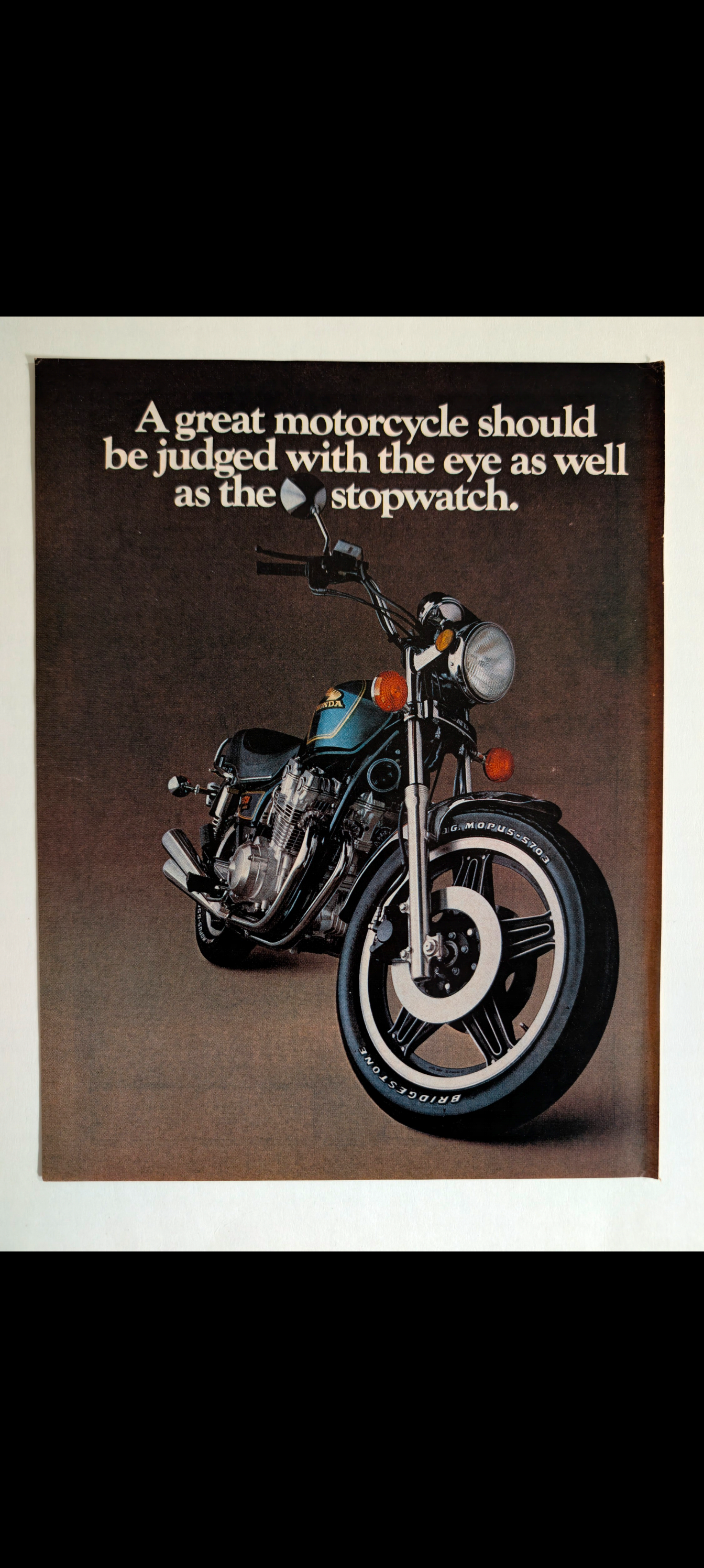
Honda CB750F Super Sport "Eye & Stopwatch"
Last updated: 28 Apr 2026
Historical Context
Related Archives from the Collection
Related by Classification

Honda 750 (CB750) "America's Most Popular"

Yamaha Midnight Maxim "Invest in Gold and Black"

1975 Toyota Celica GT Vintage Advertisement – JDM Archive

Suzuki GS-550L "The Performer" (Four Powerful Reasons)

Datsun 510 "Race Car Tech" (The Poor Man's BMW)

Dodge Charger SE (1977) "The Night Belongs to Charger"
Related Articles

The Time Traveler's Dossier: The Midnight Superbike – The 1979 Honda CB750K 10th Anniversary Limited Edition and the Dawn of the Universal Japanese Motorcycle Era
The evolution of the global motorcycle landscape in the 1970s was a saga of absolute disruption, characterized by the death of the leaky, vibrating parallel-twins of Europe and the sudden, overwhelming dominance of multi-cylinder Japanese engineering. Elegantly and securely positioned upon the analytical table of The Record Institute today is a visually sweeping, deeply atmospheric, and historically monumental two-page print advertisement for the 1979 Honda CB750K 10th Anniversary Limited Edition. This document completely transcends the standard boundaries of automotive marketing. It operates as a highly sophisticated cultural mirror and a bold declaration of mechanical supremacy. By strategically placing the motorcycle in a moody, high-fashion twilight setting, accompanied by the audacious headline "FUTURE CLASSIC.", American Honda Motor Co. executed a masterclass in psychological marketing. They were not merely selling a two-wheeled vehicle; they were selling a piece of pre-ordained history, a collectible artifact for the discerning rider who understood the gravity of the CB750 lineage. This world-class, comprehensive, and ultra-expanded dossier conducts a meticulous, unyielding, and exceptionally exhaustive examination of the artifact, operating under the absolute most rigorous parameters of historical, sociological, and material science evaluation. Dedicating the overwhelming, massive majority of our analytical focus (80%) to its immense historical gravity, we will decode the profound mechanical revolution sparked by the original 1969 CB750, trace the evolution of the inline-four engine, analyze the specific aesthetic upgrades of this 1979 Limited Edition (including the revolutionary Comstar wheels), and detail the intense corporate warfare of the 1970s superbike boom. Furthermore, as we venture deeply into the chemical and physical foundations of this analog printed ephemera (10%), we will reveal the precise mechanical fingerprints of the CMYK halftone rosettes captured in the stunning macro imagery of the golden side-cover crest and the gleaming exhaust pipes. Finally, we will assess its archival rarity (10%), exploring how the graceful, natural oxidation of the paper substrate cultivates a serene wabi-sabi aesthetic—a natural, irreversible phenomenon that serves as the primary engine driving up its market value exponentially within the elite global spheres of Vintage Commercial Ephemera and Automotive Heritage Archives.

The Time Traveller's Dossier: Engineering as High Art – 1981 Honda CBX Advertisement
History is not written; it is printed. Before digital algorithms dictated human behavior, societal engineering was executed through the calculated geometry of the four-color offset press. The historical artifact before us is not merely an advertisement; it is a weaponized blueprint of mechanical aspiration and a testament to the golden age of Japanese technological supremacy. This museum-grade archival dossier presents an academic deconstruction of a 1981 print advertisement for the legendary Honda CBX. Operating on a profound binary structure, it documents a calculated paradigm shift within the global motorcycle industry. It illustrates the precise historical fracture where the motorcycle was conceptually transitioned from a stigmatized symbol of counter-culture rebellion into a highly sophisticated, aerodynamic marvel tailored for the affluent connoisseur. Through the lens of late-analog commercial artistry and precise visual forensics, this document serves as a masterclass in psychological marketing, establishing the archetype of the high-tech superbike that unconditionally dominates modern automotive pop culture.

The Time Traveller's Dossier : Datsun 280-ZX - The GT Shift
Then. The sports car was a visceral punishment. A machine of raw mechanical feedback. Loud. Uncomfortable. Temperamental. It demanded physical sacrifice in exchange for kinetic velocity. It was a weekend indulgence, entirely divorced from daily comfort. Now. The sports car is an isolated, luxurious capsule. It is a computational network rolling on synthetic rubber. It prioritizes atmospheric control, acoustic perfection, and passenger comfort alongside acceleration. It is a sanctuary of speed. The artifact before us documents the precise architectural bridge between these two eras. The year is 1980. The vehicle is the Datsun 280-ZX 10th Anniversary "Black Gold" edition. This is not merely a piece of automotive marketing collateral. It is the obituary of the raw, analog sports car. It is the birth certificate of the modern Personal Luxury Grand Tourer. It is the definitive moment Japanese manufacturing stopped apologizing and claimed absolute supremacy over the American highway.

The Time Traveller's Dossier: Rotary Audacity – The Mazda Wankel Engine, the 1970s Oil Crisis, and the Rolls-Royce Provocation
The evolution of the global automotive landscape in the latter half of the twentieth century was violently disrupted during the 1970s, an era defined by stringent new environmental regulations, catastrophic oil embargoes, and a growing consumer disillusionment with traditional engineering paradigms. Elegantly and securely positioned upon the analytical table of The Record Institute today is a visually arresting, densely informative, and highly significant full-page print advertisement for the Mazda Rotary-Engine Lineup. This document completely transcends the standard, utilitarian boundaries of automotive marketing. It operates as a highly sophisticated, multi-layered cultural mirror and a bold declaration of mechanical survival against insurmountable odds. By audaciously juxtaposing their experimental rotary-engine vehicles against the ghostly, monolithic silhouette of a Rolls-Royce Silver Shadow, Mazda executed a masterclass in psychological marketing. They utilized the objective, undeniable metric of a "50,000-mile / 3-year warranty" to shatter the consumer anxiety surrounding the Wankel engine's durability. This world-class, comprehensive dossier conducts a meticulous, unyielding, and exceptionally exhaustive examination of the artifact, operating under the absolute most rigorous parameters of historical, sociological, and material science evaluation. Dedicating the overwhelming, massive majority of our analytical focus (80%) to its immense historical gravity, we will decode the brilliant, confrontational marketing psychology embedded within the copywriting, analyze the profound mechanical realities of the Wankel rotary engine, trace the epic engineering struggles of the "47 Ronin," and detail the historical impact of the legendary RX-3, RX-4, and the mythical Rotary Engine Pickup (REPU). Furthermore, as we venture deeply into the chemical and physical foundations of this analog printed ephemera (10%), we will reveal the precise mechanical fingerprints of the CMYK halftone rosettes captured in the stunning macro imagery of the blue metallic paintwork. Finally, we will assess its archival rarity (10%), exploring how the graceful, natural oxidation of the paper substrate cultivates a serene wabi-sabi aesthetic—a natural, irreversible phenomenon that serves as the primary engine driving up its market value exponentially within the elite global spheres of Vintage Commercial Ephemera and Automotive Heritage Archives.