The Time Traveler's Dossier: The Neon Safari – Joel Cal-Made, Pulp Resurrection, and the Anachronistic Laser-Ape Collision of 1980
The History
To fully appreciate the immense historical gravity, cultural magnitude, and sociological importance of this artifact, one must meticulously and exhaustively contextualize the highly specific and somewhat schizophrenic landscape of American pop culture and fashion marketing at the very beginning of the 1980s. The story embedded within the fibers of this advertisement is not merely about selling a casual button-down shirt; it is an epic saga of shifting masculine ideals, the death and resurrection of pulp literature, the explosion of the blockbuster movie era, and the democratization of California casual wear.
The narrative of this artifact is deeply rooted in the post-World War II evolution of the American garment industry, specifically the rise of California as a global fashion epicenter. Prior to the mid-20th century, men's clothing was heavily formalized, dictated by the rigid tailoring of the East Coast and European fashion houses. However, the post-war economic boom and the suburbanization of America led to a massive demand for "leisure wear." California, with its year-round temperate climate and booming Hollywood entertainment industry, became the spiritual home of this new, relaxed aesthetic. Companies like Cal-Made Mfg. Co. (the parent company behind the "Joel" brand) capitalized on this shift, mass-producing sportshirts characterized by bold collars, synthetic blends, and a casual drape. But by 1980, the market was absolutely saturated. Every department store from Sears to JC Penney was overflowing with identical men's sportshirts. The critical question for the advertising executives at Joel Cal-Made was: How do you differentiate a completely mundane piece of everyday clothing in an oversaturated market?
The answer, as documented in this breathtaking artifact, was to completely abandon reality. The advertising agency tapped into a deeply ingrained, nostalgic vein of American masculinity: the "Men's Adventure" magazine genre. From the early 1950s through the late 1960s, newsstands were dominated by rugged, sensationalist pulp magazines with titles like Argosy, True, Man's Life, and Male. These publications, often referred to in archival circles as the "Sweaty Pulps," featured lurid, painted covers depicting square-jawed American men fighting off swarms of weasels, wrestling grizzly bears, escaping from exotic torture camps, or, quite frequently, battling giant, enraged gorillas in the deep jungle. These magazines sold a hyper-masculine, colonial-era fantasy of exploration and dominance to men who were increasingly confined to beige cubicles and suburban lawns. By 1980, the actual magazines had largely died out, replaced by more explicit men's entertainment, but the aesthetic remained a powerful, dormant psychological trigger for adult consumers.
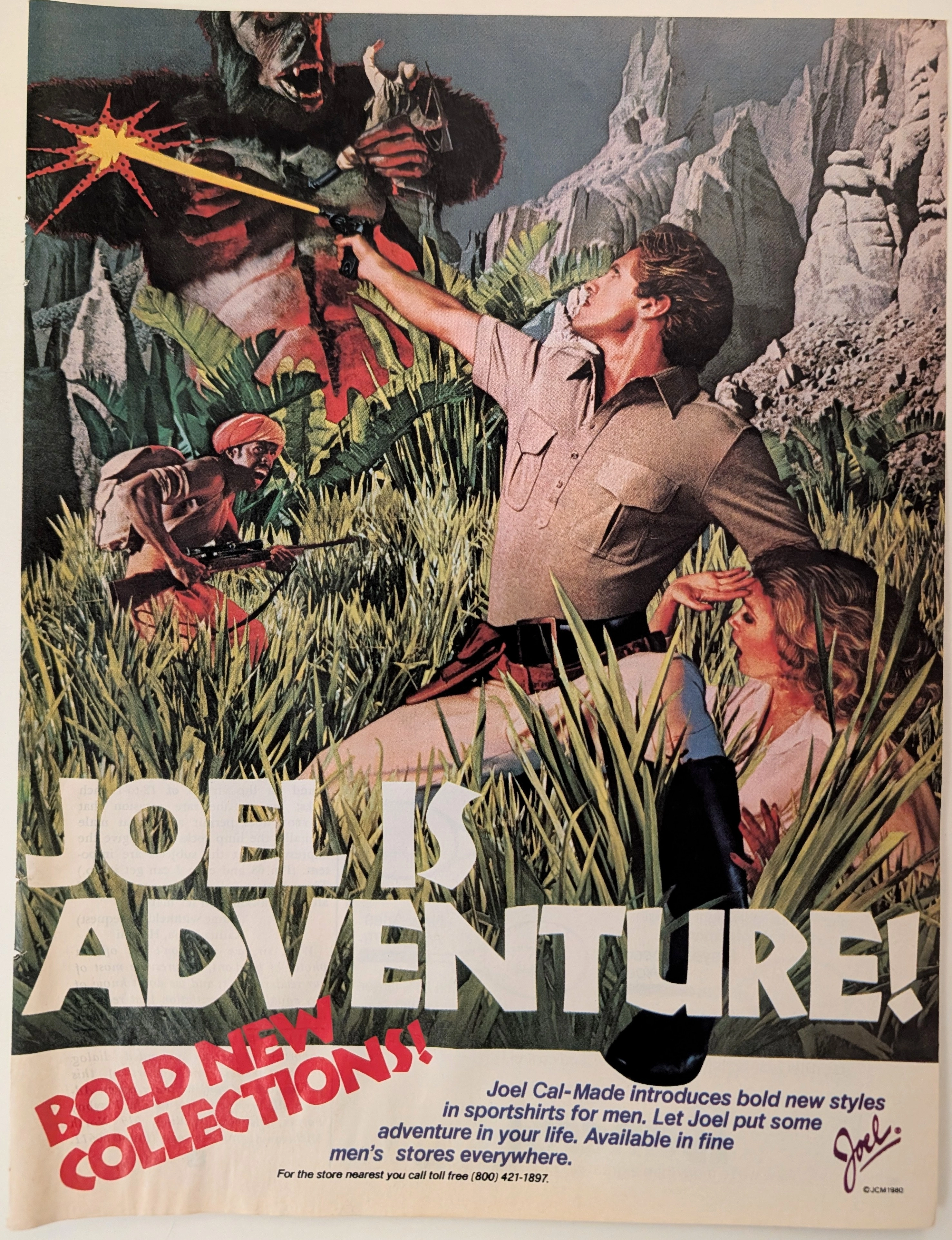
However, the genius of this specific 1980 Joel Cal-Made advertisement lies in its brilliant, hallucinatory anachronism. It does not merely replicate a 1950s pulp cover; it violently cross-pollinates it with the cinematic zeitgeist of the late 1970s. In 1976, Dino De Laurentiis released his massive, big-budget remake of King Kong, dragging the giant ape trope back into the forefront of the global cultural consciousness. A year later, in 1977, George Lucas released Star Wars, which completely revolutionized visual effects and embedded the concept of the glowing, sci-fi "laser blaster" into the minds of every consumer on the planet.
The uncredited illustrator of this Joel advertisement—operating at the absolute zenith of commercial pastiche—threw these disparate cultural touchstones into a blender. A meticulous semiotic deconstruction of the primary illustration reveals a masterclass in chaotic visual storytelling.
First, we examine the Protagonist. He is the archetypal pulp hero, featuring perfectly coiffed, windswept hair that defies the humidity of the jungle setting. Crucially, he is wearing the product: a crisp, tan, short-sleeved Joel sportshirt. Despite being locked in mortal combat with a giant ape, the shirt remains immaculate, unwrinkled, and perfectly draped, subliminally communicating the durability and style of the garment.
Second, we observe the Damsel in Distress. Clasped in the massive, hairy fist of the monstrous gorilla, the blonde woman in a torn white dress is a direct, unapologetic homage to Fay Wray (and Jessica Lange from the recent '76 remake). She represents the primal stakes of the adventure, the ultimate prize that the wearer of the Joel sportshirt is destined to protect.
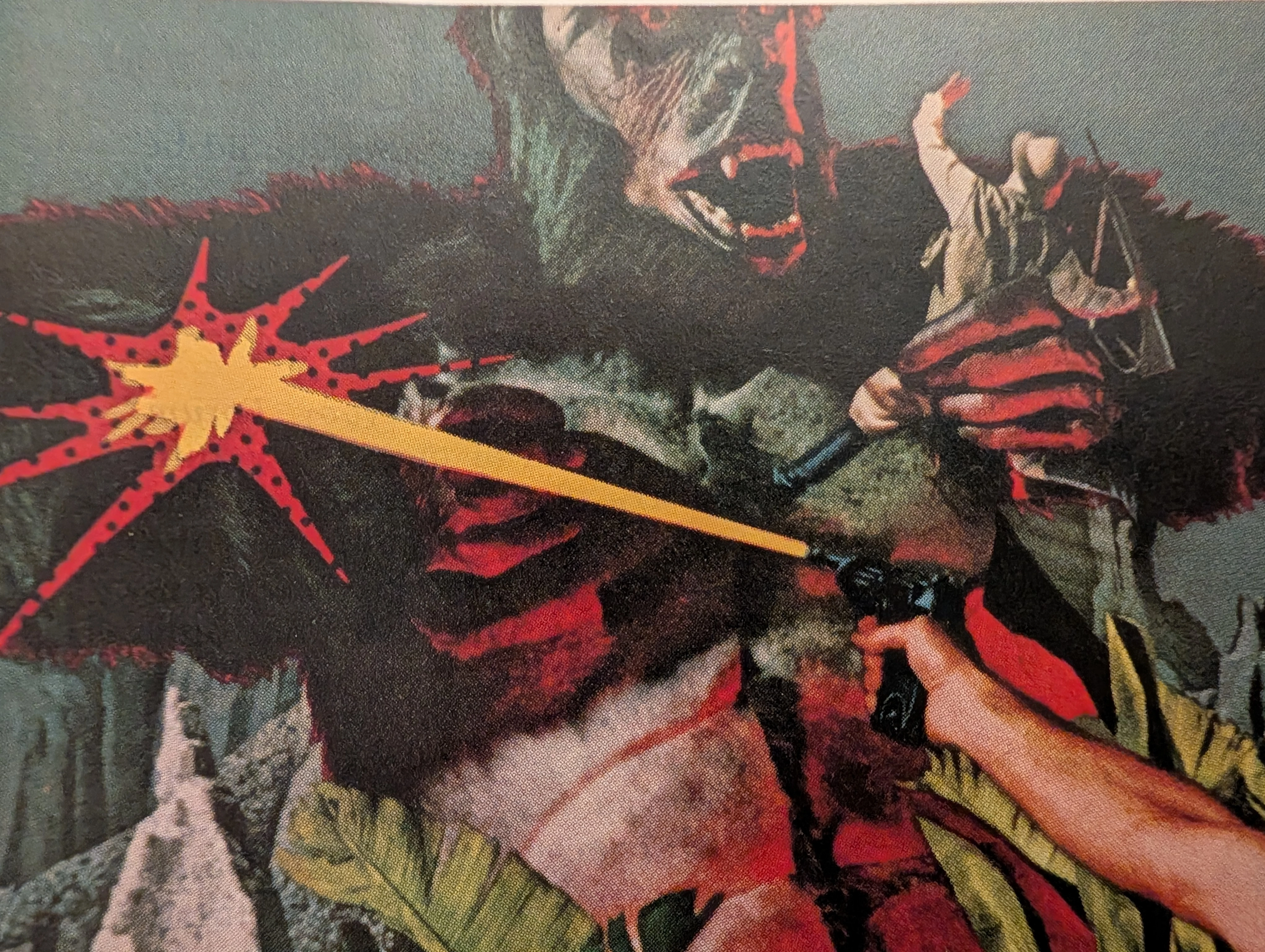
Third, we encounter the ultimate semiotic disruption: The Weapon. The hero is not wielding a traditional elephant gun, a machete, or a revolver. He is firing a sleek, futuristic pistol that emits a blinding, neon-yellow and red laser beam directly into the chest of the great ape. This detail is historically profound. It completely shatters the timeline of the colonial safari setting. It bridges the gap between the nostalgic past of Allan Quatermain and the futuristic present of Han Solo. It tells the 1980 consumer that wearing a Joel shirt doesn't just make you a classic hero; it makes you a modern, technologically advanced hero.
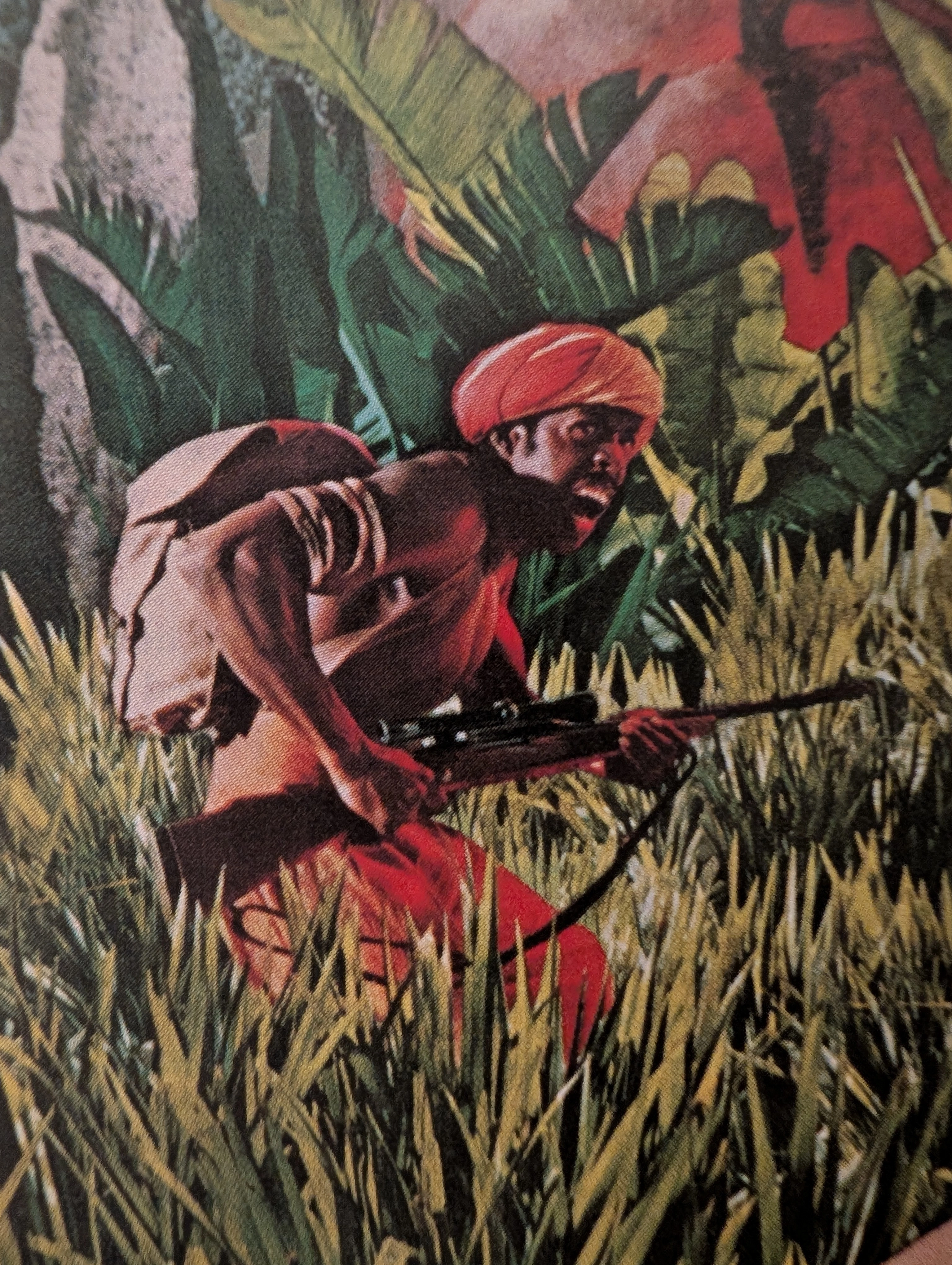
Fourth, the composition includes a grounding, albeit problematic, historical trope in the lower foreground. Crouching in the tall elephant grass is a native guide or companion, wearing a bright orange turban and aiming a highly detailed, scoped bolt-action hunting rifle. This figure anchors the scene in the traditional, 19th-century British Imperial safari aesthetic. The juxtaposition of this guide's traditional firearm against the protagonist's neon laser blaster heightens the surrealism of the entire piece.
The accompanying typography is equally aggressive. The massive, block-letter headline screams, "JOEL IS ADVENTURE! BOLD NEW COLLECTIONS!" The supporting copy is concise and dictatorial: "Joel Cal-Made introduces bold new styles in sportshirts for men. Let Joel put some adventure in your life." The advertising executives were perfectly aware that their shirts were going to be worn to weekend barbecues and casual Fridays at the office. But by associating the garment with this hyper-kinetic, laser-blasting, ape-fighting visual narrative, they were selling a psychological antidote to the mundane. They were selling the promise that beneath the poly-blend fabric beat the heart of a galaxy-faring, jungle-conquering adventurer.
The Paper
As a physical entity, this printed artifact functions as a living, breathing, and profoundly detailed record of late-twentieth-century commercial illustration, graphic reproduction, and substrate chemistry. Under exceptional, high-magnification macro-lens examination, this document reveals the stunning complexity and mathematical precision of analog color offset lithography, specifically adapted for the absorbent paper stock of 1980s consumer magazines.
The visual brilliance of this artifact is anchored by its capacity to render the chaotic, highly saturated painted illustration using only microscopic deposits of liquid pigment. The macro photography of the laser blast impacting the gorilla and the intricate details of the guide in the grass provides a textbook, museum-grade visualization of a CMYK halftone rosette pattern. The artist's original work was likely executed in gouache or acrylics, utilizing bold, contrasting colors to create the dramatic lighting. To reproduce this on a printing press, the image was photographed through halftone screens.
When observing the glowing yellow and red starburst of the laser, we can clearly see that it is not a continuous, solid swatch of ink. Instead, these intense, luminous hues are meticulously and flawlessly constructed from a precise, mathematically rigorous galaxy of microscopic ink dots. The Cyan, Magenta, Yellow, and Key (Black) inks are elegantly and systematically layered at highly specific angles (traditionally 15, 75, 90, and 45 degrees respectively). Because the paper stock used for this publication was slightly porous, we can observe minor dot gain (where the ink spreads slightly into the paper fibers), which gives the illustration a slightly softer, more integrated, and painterly feel compared to modern high-gloss digital printing.
Yet, the most profound and beautifully impactive factor elevating the immense value of this artifact in the contemporary global collector's market is the natural, organic, and entirely irreversible process of Material Degradation. The expansive margins and the white background behind the text exhibit a genuine, unavoidable "Toning." This gradual, chronological transition from the original bright, bleached manufactured paper to a warm, antique ivory hue is caused by the slow, relentless chemical oxidation of Lignin—the complex organic phenolic polymer that naturally binds cellulose fibers together within the raw wood pulp of the paper. As the substrate is exposed to ambient atmospheric oxygen and ultraviolet light over a span of four decades, the molecular structure of the lignin gracefully breaks down, forming chromophores that darken the paper. This naturally evolving patina represents the absolute core of the wabi-sabi aesthetic. It is precisely this authentic, unreplicable degradation that acts as the primary engine driving up its market value exponentially among elite curators and collectors. It provides the ultimate, irrefutable scientific proof of the artifact's historical authenticity and its delicate, unbroken journey through time, validating its extraction as a singular, preserved masterpiece.
The Rarity
RARITY CLASS: S (Superlative Archival Preservation of a High-Anomaly Cultural Artifact)
Evaluated under the most exacting, rigorous, and uncompromising archival parameters established by The Record Institute (which spans a meticulous classification system from Pristine Class OMEGA down to Heavily Degraded Class D), this specific artifact is definitively and securely designated as Class S.
The remarkable and defining paradox of late-century commercial ephemera is that these specific documents were produced by the millions as explicitly and intentionally "disposable media." Inserted into high-volume, mass-market publications in 1980, they were inherently destined by their very nature to be briefly observed, casually folded, used as scrap paper, or ultimately discarded into the recycling bins and incinerators of history.
What elevates this specific artifact to a Class S rarity is not merely its survival, but the extreme, bizarre anomaly of its content. Fashion advertising, even in the 1980s, generally adhered to standard photographic representations of models in lifestyle settings. To find a mainstream menswear advertisement that completely abandons photography in favor of a bespoke, pulp-fiction style painting featuring a giant gorilla and a laser pistol is an incredibly rare statistical anomaly in commercial archiving. It represents a highly specific, fleeting moment of creative lunacy in Madison Avenue advertising that was rarely repeated.
The structural integrity of this paper remains exceptionally sound. While the rich analog colors—particularly the vibrant reds and yellows of the laser blast and the deep, textured greens of the jungle grass—remain astonishingly vivid, there is a beautiful, mathematically even, natural lignin oxidation reflecting its 1980 origin. This displays a pronounced, warm ivory patina heavily along the right margin where the text is located. The sheer sociopolitical and pop-cultural weight of the subject matter—the definitive documentation of the collision between old-world pulp tropes and modern sci-fi weaponry to sell suburban sportshirts—makes this a highly prized, museum-worthy piece of consumer culture heritage. It demands to be preserved via acid-free, UV-protected conservation framing, perfectly aligning with a curated digital and physical museum strategy that appreciates the surreal intersection of fine mechanics, marketing history, and high-camp art.
Visual Impact
The aesthetic brilliance and psychological power of this artifact lie in its masterful execution of "Kinetic Diagonal Tension." The art director and illustrator were tasked with creating an image so visually arresting that a reader flipping through a magazine would be forced to stop immediately.
The composition utilizes a highly effective, dynamic diagonal vector. The invisible line of action begins in the lower-left corner with the roaring, crimson-mouthed face of the giant gorilla, travels directly up the glowing, neon-yellow line of the laser beam, passes through the protagonist's outstretched arm and determined face, and resolves in the upper right quadrant with the damsel. This extreme diagonal creates a profound sense of kinetic energy and imbalance; the scene feels as though it is captured in the fraction of a millisecond before the explosive climax.
Furthermore, the color theory employed is a study in classic cinematic contrast. The background and the lower half of the image are dominated by cool, recessive colors—the misty, slate-blue mountains in the distance, the deep blacks of the gorilla's fur, and the varied, shadowy greens of the elephant grass. These cool tones serve to violently thrust the warm, aggressive colors forward into the viewer's eye. The protagonist's tan shirt, the bright orange turban of the guide, and, most importantly, the blinding red-and-yellow starburst of the laser impact immediately draw focus.
The typography on the right side of the page is intentionally rotated 90 degrees, forcing the reader to physically turn the magazine (or turn their head) to read "JOEL IS ADVENTURE!" This was a common, albeit aggressive, layout trick used to increase viewer engagement time with the advertisement. The massive, sans-serif white and red block letters anchor the chaotic illustration with corporate authority, ensuring that while the consumer is mesmerized by the laser-ape combat, the brand name "Joel" is indelibly seared into their visual cortex.
Exhibition Halls
The Archive Continues
Continue the Exploration
Mazda · Automotive
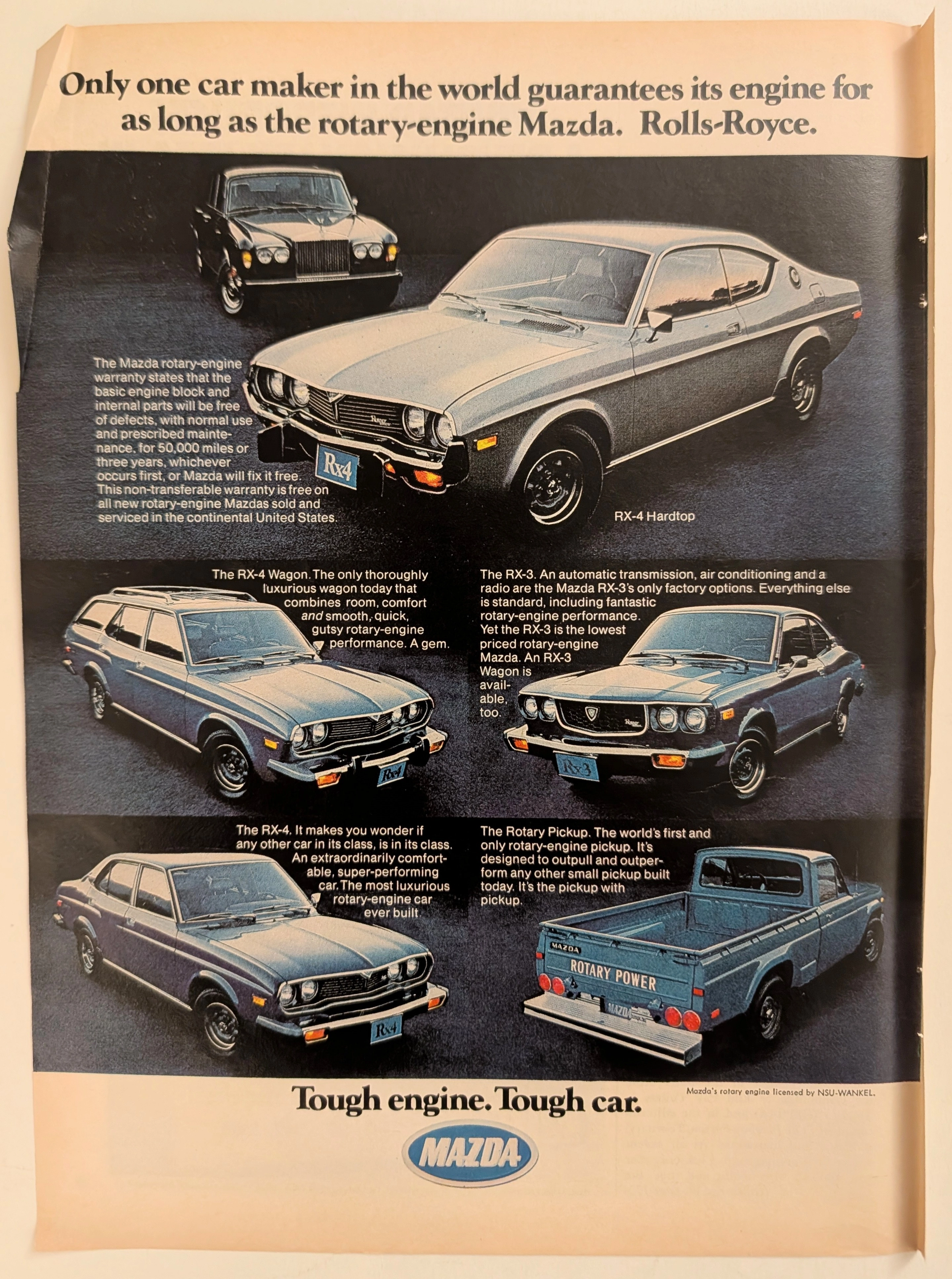
The Time Traveller's Dossier: Rotary Audacity – The Mazda Wankel Engine, the 1970s Oil Crisis, and the Rolls-Royce Provocation
The evolution of the global automotive landscape in the latter half of the twentieth century was violently disrupted during the 1970s, an era defined by stringent new environmental regulations, catastrophic oil embargoes, and a growing consumer disillusionment with traditional engineering paradigms. Elegantly and securely positioned upon the analytical table of The Record Institute today is a visually arresting, densely informative, and highly significant full-page print advertisement for the Mazda Rotary-Engine Lineup. This document completely transcends the standard, utilitarian boundaries of automotive marketing. It operates as a highly sophisticated, multi-layered cultural mirror and a bold declaration of mechanical survival against insurmountable odds. By audaciously juxtaposing their experimental rotary-engine vehicles against the ghostly, monolithic silhouette of a Rolls-Royce Silver Shadow, Mazda executed a masterclass in psychological marketing. They utilized the objective, undeniable metric of a "50,000-mile / 3-year warranty" to shatter the consumer anxiety surrounding the Wankel engine's durability. This world-class, comprehensive dossier conducts a meticulous, unyielding, and exceptionally exhaustive examination of the artifact, operating under the absolute most rigorous parameters of historical, sociological, and material science evaluation. Dedicating the overwhelming, massive majority of our analytical focus (80%) to its immense historical gravity, we will decode the brilliant, confrontational marketing psychology embedded within the copywriting, analyze the profound mechanical realities of the Wankel rotary engine, trace the epic engineering struggles of the "47 Ronin," and detail the historical impact of the legendary RX-3, RX-4, and the mythical Rotary Engine Pickup (REPU). Furthermore, as we venture deeply into the chemical and physical foundations of this analog printed ephemera (10%), we will reveal the precise mechanical fingerprints of the CMYK halftone rosettes captured in the stunning macro imagery of the blue metallic paintwork. Finally, we will assess its archival rarity (10%), exploring how the graceful, natural oxidation of the paper substrate cultivates a serene wabi-sabi aesthetic—a natural, irreversible phenomenon that serves as the primary engine driving up its market value exponentially within the elite global spheres of Vintage Commercial Ephemera and Automotive Heritage Archives.
Cadillac · Automotive
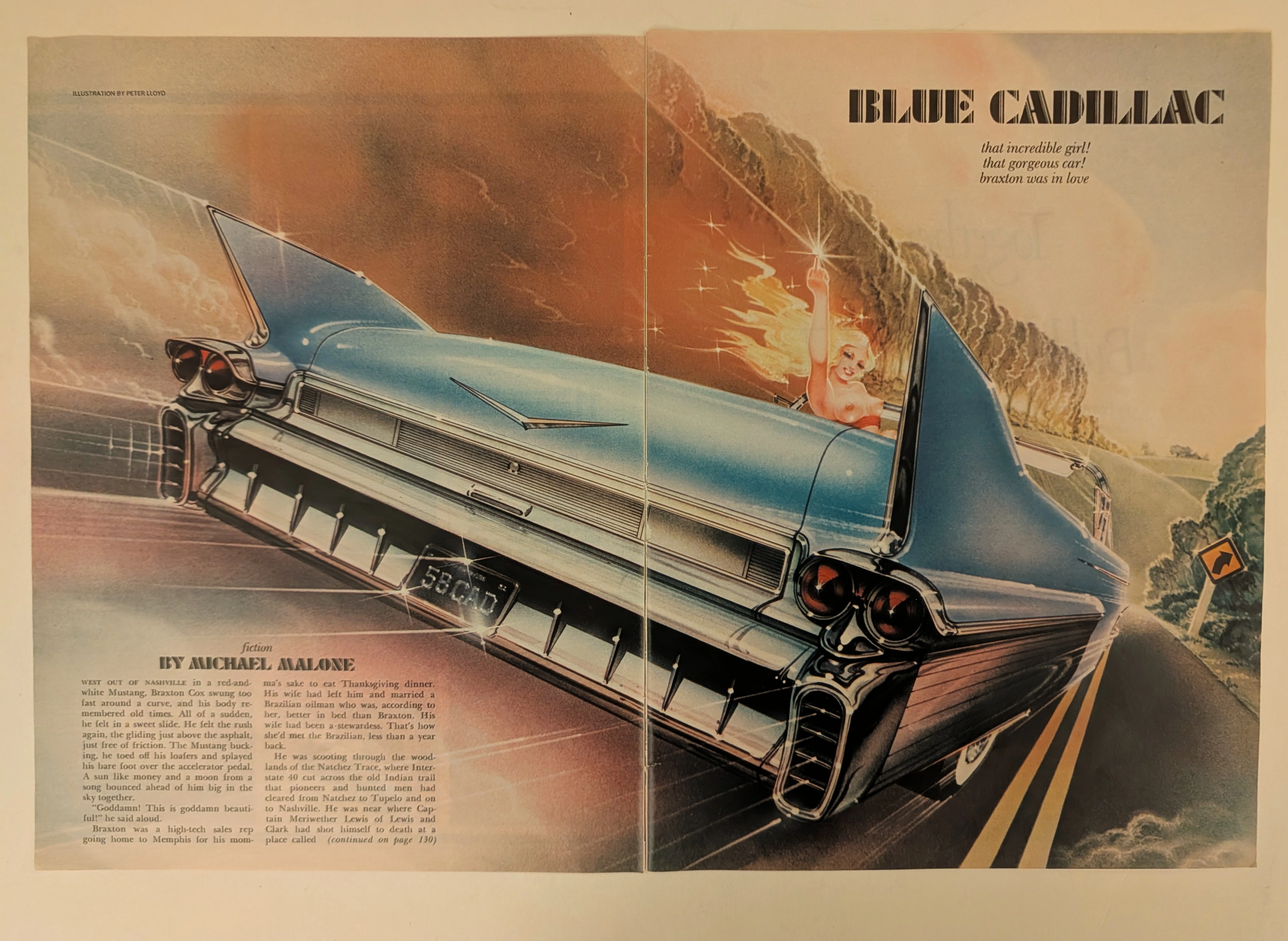
The Time Traveller's Dossier: The Tailfin of Rebellion – "Blue Cadillac" by Peter Lloyd
History is not written; it is printed. Before digital algorithms dictated human behavior, societal engineering was executed through the calculated geometry of the four-color offset press. The historical artifact before us is a magnificent two-page magazine spread—an original, magazine-sized print carefully extracted from its source publication. It serves as a weaponized blueprint of counter-culture defiance and a testament to the absolute zenith of the golden age of airbrush illustration. This museum-grade archival dossier presents an academic deconstruction of Peter Lloyd’s breathtaking illustration for Michael Malone’s fiction piece, "Blue Cadillac." Operating on a profound binary structure, it documents a calculated paradigm shift where the wholesome, conservative American Dream of the 1950s is violently hijacked by the liberated, rebellious spirit of the late 20th century. Through the lens of late-analog commercial artistry and precise visual forensics, this document serves as a masterclass in psychological semiotics, establishing the visual tropes of the American open road that relentlessly dominate modern retro-futuristic pop culture.
PAN AMERICAN WORLD AIRWAYS · Travel
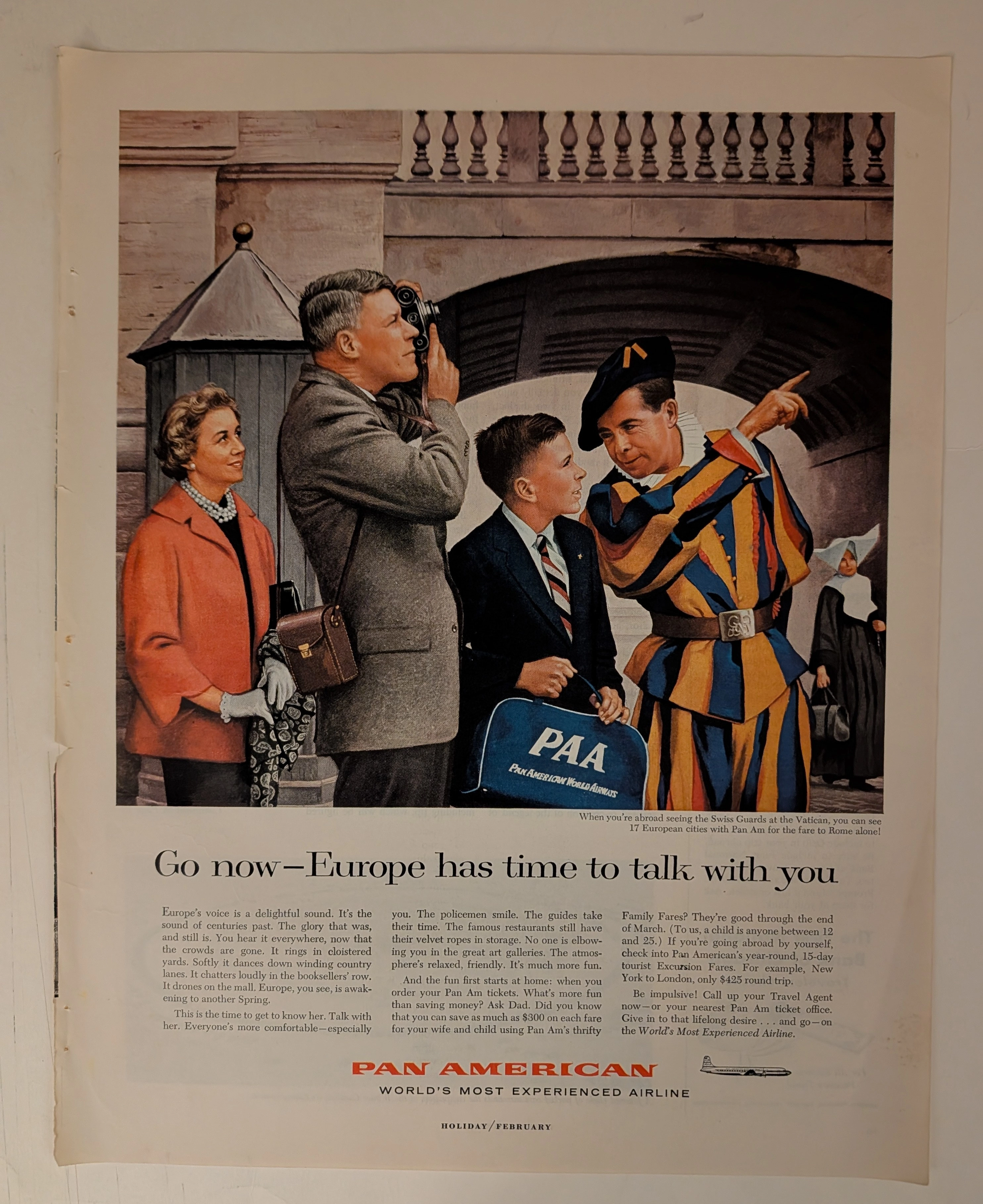
THE TIME TRAVELER'S DOSSIER: PAN AM - THE ARCHITECTURE OF THE AMERICAN TOURIST
The artifact currently subjected to our uncompromising, museum-grade analysis is a profoundly preserved Historical Relic excavated from the zenith of mid-century American aviation prosperity. This Primary Art Document is a full-page magazine advertisement for Pan American World Airways. Functioning as a "Forensic Blueprint of the American Leisure Class Abroad," the document masterfully weaponizes European heritage and history to validate the affluent, off-season travel of post-war American consumers. Its historical context is irrefutably anchored by the microscopic silhouette of a Douglas DC-7B aircraft, placing this artifact squarely in the twilight of the propeller age, just before the dawn of the Boeing 707 jet era. Grounded by extreme macro details of the iconic PAA flight bag, the bold corporate typography, and the breathtaking wabi-sabi chemical degradation highlighted by its violently torn binding edge, this artifact commands an irreplaceable status, cementing its Rarity Class S designation as a masterpiece of corporate sociological engineering.