The Time Traveller's Dossier: The Tailfin of Rebellion – "Blue Cadillac" by Peter Lloyd
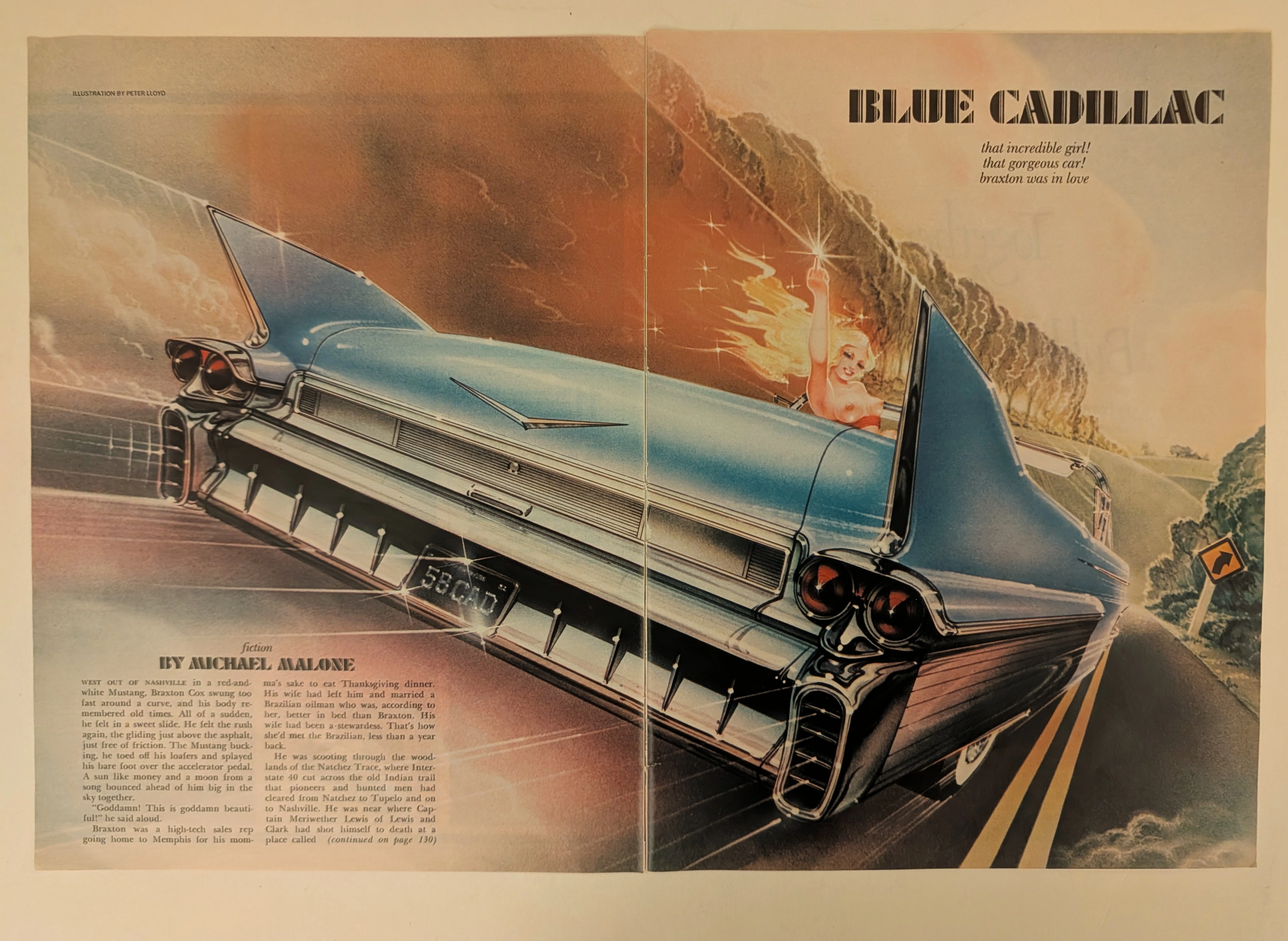
History is not written; it is printed. Before digital algorithms dictated human behavior, societal engineering was executed through the calculated geometry of the four-color offset press. The historical artifact before us is a magnificent two-page magazine spread—an original, magazine-sized print carefully extracted from its source publication. It serves as a weaponized blueprint of counter-culture defiance and a testament to the absolute zenith of the golden age of airbrush illustration. This museum-grade archival dossier presents an academic deconstruction of Peter Lloyd’s breathtaking illustration for Michael Malone’s fiction piece, "Blue Cadillac." Operating on a profound binary structure, it documents a calculated paradigm shift where the wholesome, conservative American Dream of the 1950s is violently hijacked by the liberated, rebellious spirit of the late 20th century. Through the lens of late-analog commercial artistry and precise visual forensics, this document serves as a masterclass in psychological semiotics, establishing the visual tropes of the American open road that relentlessly dominate modern retro-futuristic pop culture.
Category: Automotive
Brand: Cadillac
The History
To decode the sociological architecture embedded within this printed artifact, it is mandatory to contextualize the subject matter: the 1958 Cadillac. In the post-war era, the massive tailfins of the '58 Cadillac—heavily inspired by aerospace and jet fighter design—represented the absolute peak of American economic optimism and conservative luxury. However, by the time this illustration was commissioned (during the peak of the airbrush era in the late 1970s to early 1980s), the cultural landscape had radically shifted. The '58 Cadillac was no longer a symbol of rigid, elite status; it had been reclaimed by the counter-culture, rock and roll, and pulp fiction as an icon of excessive, untamed Americana. Part 1: The Binary Shift: Conservative Chrome vs. Unapologetic Rebellion The narrative architecture of this artifact is built upon a strict, uncompromising binary contrast. The vehicle itself—rendered with meticulous, gleaming precision—represents the establishment: heavy, expensive, and rooted in the conservative values of the 1950s. Peter Lloyd obliterates that wholesome narrative by introducing the human element: a topless blonde leaning out of the passenger window, gleefully delivering a sparkling middle finger to the viewer. This visual executes a flawless cultural pivot. It deliberately contrasts the old world of rigid social conformity with the new world of sexual liberation and aggressive anti-establishment defiance. By marrying the ultimate symbol of 1950s automotive excess with the ultimate gesture of disrespect, the artwork maps the concept of freedom onto the unapologetic lawlessness of the American highway. Part 2: The Airbrush Discourse & Mechanical Supremacy Executing this binary shift required a highly specific visual vocabulary. The illustration is a masterclass in the airbrush technique—a medium that defined the aesthetic of late-20th-century commercial art. Lloyd’s flawless manipulation of compressed air and pigment creates an illusion of hyper-realism mixed with dreamlike surrealism. The gleaming chrome of the massive bumper, the glowing red of the rocket-exhaust taillights, and the smooth, flawless gradients of the blue chassis elevate the machine to a mythic status. The deliberate inclusion of "starburst" light flares—on the chrome, the "58 CAD" license plate, and hilariously, on the tip of the woman's middle finger—aligns the artwork with the era's obsession with slick, high-gloss visual perfection. Part 3: The Sovereign Rebel and the Highway Mythos The socioeconomic structure of late-analog pop culture fetishized the "open road" as the last bastion of true freedom. For this cultural archetype to succeed globally, it required the explicit visual approval of excess. The illustration targets the intellectual vanity of the pulp fiction reader, where danger, sex, and high-performance machinery intertwine. This conceptual boundary eradicated the line between luxury and vulgarity; when the luxury is a two-ton classic Cadillac, the vulgarity of a raised middle finger becomes a potent symbol of absolute, untouchable power. Part 4: Visual Semiotics: Aerodynamics and Defiance The illustration functions as a precise semiotic indicator of raw confidence, engineering the mythos through visual juxtaposition: The Jet-Age Tailfin: The aggressive, sweeping lines of the Cadillac's rear thrust toward the viewer, turning the car into a grounded fighter jet. The massive, bullet-shaped taillights signify raw propulsion, visually reinforcing the fiction's narrative of high-speed escapism. The Sparkling Digit: The middle finger, crowned with a brilliant starburst flare, acts as the ultimate focal point. It is a visual punctuation mark, symbolizing that the occupants of the "Blue Cadillac" are entirely beyond the reach of the law, societal norms, and the viewer themselves. Part 5: Pop Culture Impact and Enduring Legacy The visual language pioneered by artists like Peter Lloyd left an indelible, structural mark on global pop culture. The aesthetic of hyper-glossy, neon-lit retro cars speeding through stylized landscapes became the foundational DNA for the "Synthwave" and "Outrun" aesthetics that dominate contemporary digital art today. The ruthless juxtaposition of classic Americana with subversive, adult themes birthed an entire genre of entertainment, directly influencing modern cinematic homages and graphic novels. This artifact is the foundational source code for the modern mythology of the rebellious road trip.
The Paper
As a physical entity, this two-page spread is an unrepeatable record of late-analog offset printing. The medium-weight coated magazine stock was engineered for mass distribution, yet its current state demands evaluation through the Japanese aesthetic philosophy of wabi-sabi (侘寂)—the recognition of beauty in impermanence and the natural progression of time. It is crucial to note that this is a magazine-sized artifact, not a large-scale modern poster reproduction, which intrinsically ties it to its original historical context. Visual Forensics & Substrate Analysis (The Ephemeral Value): Examining the extreme close-ups of this artifact reveals the mechanical heartbeat of the analog press. Under magnification, the hyper-smooth illusion of the airbrushed chrome and the woman's skin shatters into a precise, mathematical galaxy of CMYK halftone rosettes. The authentic nature of this piece is further validated by the physical center crease—a structural necessity of a two-page magazine spread. Most importantly, the margins exhibit authentic "toning"—a gradual, irreversible yellowing caused by the natural oxidation of lignin within the wood pulp. As these pre-2000 printed pages organically degrade, they are slowly vanishing from existence. This irreversible progression toward dust—this authentic wabi-sabi aging—is precisely what guarantees the continuous upward trajectory of their historical and market value. The fact that this ephemeral paper has survived while millions of others have perished elevates it from a mere print to a singular, historically scarred relic.
The Rarity
Rarity Class: S (Superior / Museum Grade) Within archival parameters, this artifact holds a definitive Class S designation. The paradox of analog print ephemera lies in its initial mass production versus its extreme current scarcity. The survival of this specific editorial spread—extracted and preserved as individual magazine pages without yielding to destructive moisture damage or severe tearing—is an archival anomaly. Works by Peter Lloyd are highly coveted globally. Finding a pristine two-page specimen that retains its original pigment saturation while bearing only the authentic hallmarks of wabi-sabi aging is exceptionally rare, making it a prime candidate for museum-grade preservation.
Cite this article
- MLA
- Naodhinsuk, Ronin. “The Time Traveller's Dossier: The Tailfin of Rebellion – "Blue Cadillac" by Peter Lloyd.” The Record Institute, 13 March 2026, https://therecord.institute/journal/the-time-travellers-dossier-the-tailfin-of-rebellion-blue-cadillac-by-peter-lloyd.
- APA
- Naodhinsuk, R. (2026, March 13). The Time Traveller's Dossier: The Tailfin of Rebellion – "Blue Cadillac" by Peter Lloyd. The Record Institute. https://therecord.institute/journal/the-time-travellers-dossier-the-tailfin-of-rebellion-blue-cadillac-by-peter-lloyd
- CHICAGO
- Naodhinsuk, Ronin. 2026. “The Time Traveller's Dossier: The Tailfin of Rebellion – "Blue Cadillac" by Peter Lloyd.” The Record Institute, March 13, 2026. https://therecord.institute/journal/the-time-travellers-dossier-the-tailfin-of-rebellion-blue-cadillac-by-peter-lloyd.