The Time Traveller's Dossier : 1964 Studebaker Cruiser - The Euphoric Facade of a Dying Empire
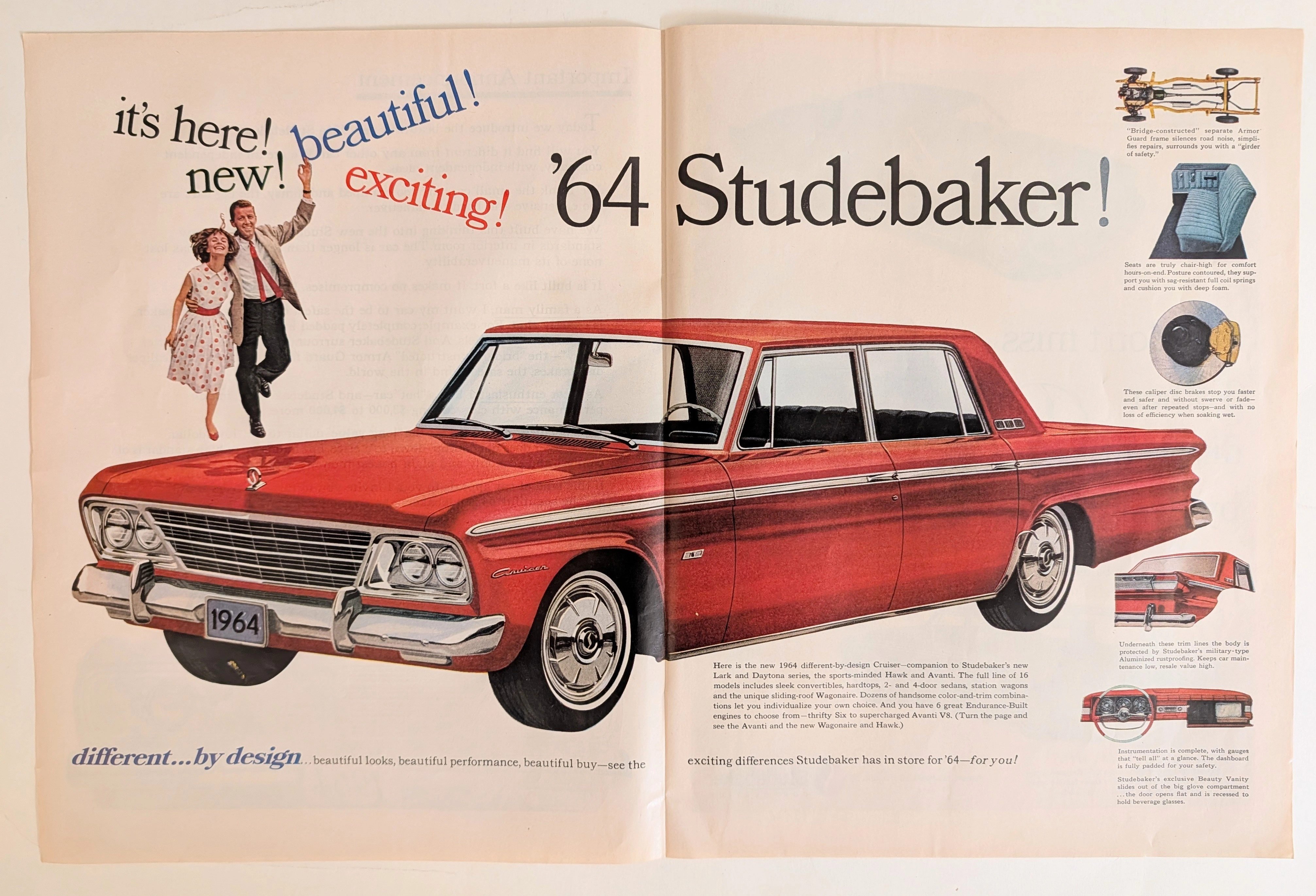
Then, it was a desperate masquerade. A corporate death rattle disguised as a celebration. As this vibrant, two-page centerfold spread graced the glossy pages of American magazines in late 1963, the Studebaker Corporation was quietly bleeding to death. To the casual observer, the advertisement projects an atmosphere of unbridled optimism. A couple leaps into the air with forced, hysterical joy. The typography dances across the page, screaming, "it's here! beautiful! new! exciting!" It is a masterclass in the marketing of artificial momentum. Yet, to the side, anchored in a rigid column of diagrams and technical specifications, lies the stubborn, unyielding truth of a company that still believed superior engineering could save it from financial ruin. Now, this artifact is a profound psychological study of cognitive dissonance in industrial capitalism. It is the physical record of a brand caught in a fatal crossfire: desperately trying to mimic the lifestyle-driven, emotion-heavy advertising of Detroit’s Big Three, while simultaneously clinging to its heritage of hyper-rational, utilitarian engineering. The historical shift here is the final realization that in the modern consumer economy, a superior machine cannot survive if the dream it sells has already expired.
Category: Automotive
Brand: Studebaker
The History
The Architecture of False Euphoria To understand the tragic irony embedded in this document, one must analyze the economic and psychological landscape of the American automobile industry in 1964. The market was entirely dominated by General Motors, Ford, and Chrysler. These titans had successfully transitioned the automobile from a mere mode of transportation into a vital extension of the American ego. They sold speed, sex, status, and suburban supremacy. Studebaker, the oldest vehicle manufacturer in the nation, was structurally incapable of competing in this war of illusions. Their South Bend facilities were archaic, their capital was vanishing, and their market share was a rounding error compared to Chevrolet. In response, their advertising agency orchestrated the scene we see here. The couple suspended in mid-air, ecstatic and untethered from gravity, represents a forced attempt to manufacture "excitement." It is a performative joy. The corporation was attempting to hypnotize the consumer—and perhaps itself—into believing that the 1964 lineup heralded a triumphant new dawn, rather than the closing of a century-old chapter. Brooks Stevens and the Shoestring Miracle The vehicle anchored in the center of the spread is the 1964 Studebaker Cruiser. Its design is a testament to the genius of industrial designer Brooks Stevens. Hired to update the aging, stubby Lark platform on an impossibly microscopic budget, Stevens performed a visual miracle. He could not change the underlying structure or the inner door panels, so he worked on the extremities. He flattened the roofline, removed the dated tailfins, and squared off the front fascia. Notice the prominent, upright, almost architectural grille. At the time, Studebaker was the official United States distributor for Mercedes-Benz. Stevens deliberately infused the humble Studebaker with the austere, premium design cues of a European luxury sedan. He attempted to elevate the car’s status through association, creating a vehicle that looked far more expensive and sophisticated than its price tag suggested. The Cruiser was a beautiful, dignified machine, born from absolute financial desperation. It was a rational man's luxury car, introduced to a market that craved irrational excess. The Margin of Truth: A Column of Defiance While the left side of the spread is dedicated to the emotional hysteria of the jumping couple and the dancing typography, the extreme right margin tells the true story of Studebaker. This vertical column of four technical illustrations is the company’s final, stubborn defense of its engineering philosophy. It is as if the engineers wrested control of the advertisement away from the marketing department for just one sliver of the page. The top diagram proudly displays the "Bridge-constructed separate Armor Guard frame." In an era where the Big Three were rapidly adopting lighter, cheaper unibody construction (where the body and frame are one piece), Studebaker proudly retained a heavy, separate ladder frame. They argued it silenced road noise and simplified repairs. It was a structural philosophy rooted in 19th-century wagon building: build it to last forever. Below that, the cross-section of the seat boasts of "sag-resistant full coil springs" and "chair-high" posture. They were selling orthopedic comfort and long-term durability to a demographic that was being trained to trade their cars in every two years. The Caliper Revolution: Stopping Faster Than the World The third diagram in the margin is perhaps the most historically significant technical feature of the artifact: the caliper disc brake. The text calmly states, "These caliper disc brakes stop you faster and safer and without swerve or fade." In the context of 1964 America, this was revolutionary. The domestic auto industry was obsessed with forward propulsion. V8 engines were growing exponentially in displacement and horsepower, yet the vehicles were still equipped with archaic, undersized drum brakes that would critically fail (fade) after a few hard stops. Studebaker, looking to Europe, partnered with Bendix to make caliper disc brakes available on their production sedans. It was a massive leap forward in active automotive safety. Yet, the tragedy is evident in its placement: this world-class safety innovation is relegated to a tiny, two-inch illustration on the far right of the page, overshadowed by a woman in a polka-dot dress jumping in the air. The market did not want to hear about stopping; it only wanted to hear about going. The Final Irony of South Bend The historical shift this artifact captures is the death of the independent pragmatist. The text at the bottom promises "dozens of handsome color-and-trim combinations" and "6 great Endurance-Built engines to choose from." It speaks of a future that did not exist. In December 1963, right around the time the magazines carrying this centerfold hit American newsstands and coffee tables, the Studebaker board of directors made the grim decision to shutter the massive South Bend, Indiana manufacturing plant forever. The promise of the '64 Cruiser was rendered void almost immediately upon its release. Production was drastically scaled back and moved to a smaller facility in Canada, where the company would produce a dwindling number of cars until its final breath in 1966. Therefore, this advertisement is not merely a piece of commercial ephemera. It is a corporate ghost story. The heavy, red Cruiser points toward a future it would never reach. The couple leaps into a void. The engineers present their brilliant disc brakes to a public that has already walked away. It stands as a beautifully printed monument to the realization that logic, safety, and honest engineering are not enough to survive the brutal gravity of industrial monopolies.
The Paper
An exhaustive physical analysis of this artifact reveals the high-volume commercial printing standards of the early 1960s. The spread is printed on a lightweight, coated magazine stock, likely hovering around 60 to 70 GSM. The paper underwent a calendering process to create a smooth, slightly glossy surface, which was absolutely critical for the sharp reproduction of the complex four-color halftones. The aging process is visible in the subtle oxidation of the paper fibers along the central gutter, where the staple bindings originally held the pages together. The stark white background has shifted toward a warm, archival cream, betraying the acidic nature of the mid-century wood pulp. The printing method is a high-speed web offset lithography. Under magnification, the CMYK rosette patterns are distinctly visible, particularly in the deep, saturated red ink of the Cruiser’s bodywork. The registration—the alignment of the four color plates—is remarkably tight for a mass-produced magazine, allowing the tiny, intricate details of the chrome wheel covers and the mechanical blueprint of the Armor Guard frame to remain sharp and legible. The physical paper is fragile, a fleeting medium chosen to carry a message that the corporation hoped would be permanent.
The Rarity
Classification: Class S (Psychological and Contextual Masterpiece) In terms of pure physical scarcity, this two-page spread is not exceptionally rare. As a centerfold in major national periodicals, millions of copies were circulated across the United States. It can still be acquired by dedicated archivists and automotive historians. However, this artifact earns a Class S rating due to its profound psychological and contextual weight. Its rarity lies in the sheer magnitude of the cognitive dissonance it captures. It is exceedingly rare to find a corporate document that so perfectly juxtaposes hysterical, manufactured optimism against the backdrop of an imminent, multibillion-dollar industrial collapse. To possess this artifact is to hold the exact moment a legacy American corporation attempted to smile through its own execution. The visual tension between the leaping couple and the pragmatic engineering diagrams elevates it from a mere advertisement to a definitive historical record of corporate denial.
Cite this article
- MLA
- Naodhinsuk, Ronin. “The Time Traveller's Dossier : 1964 Studebaker Cruiser - The Euphoric Facade of a Dying Empire.” The Record Institute, 5 April 2026, https://therecord.institute/journal/the-time-travellers-dossier-1964-studebaker-cruiser-the-euphoric-facade-of-a-dying-empire.
- APA
- Naodhinsuk, R. (2026, April 5). The Time Traveller's Dossier : 1964 Studebaker Cruiser - The Euphoric Facade of a Dying Empire. The Record Institute. https://therecord.institute/journal/the-time-travellers-dossier-1964-studebaker-cruiser-the-euphoric-facade-of-a-dying-empire
- CHICAGO
- Naodhinsuk, Ronin. 2026. “The Time Traveller's Dossier : 1964 Studebaker Cruiser - The Euphoric Facade of a Dying Empire.” The Record Institute, April 5, 2026. https://therecord.institute/journal/the-time-travellers-dossier-1964-studebaker-cruiser-the-euphoric-facade-of-a-dying-empire.