THE TIME TRAVELER'S DOSSIER: THE ARCHITECT OF CAPITALISM AND THE AESTHETICS OF RUIN — The Record Institute Journal
4 Photos
March 7, 2026

THE TIME TRAVELER'S DOSSIER: THE ARCHITECT OF CAPITALISM AND THE AESTHETICS OF RUIN

Click any image to view in high resolution

The History

(THE HISTORY: The GM Empire, Sloan’s Scripture, and Weaver’s Brush )

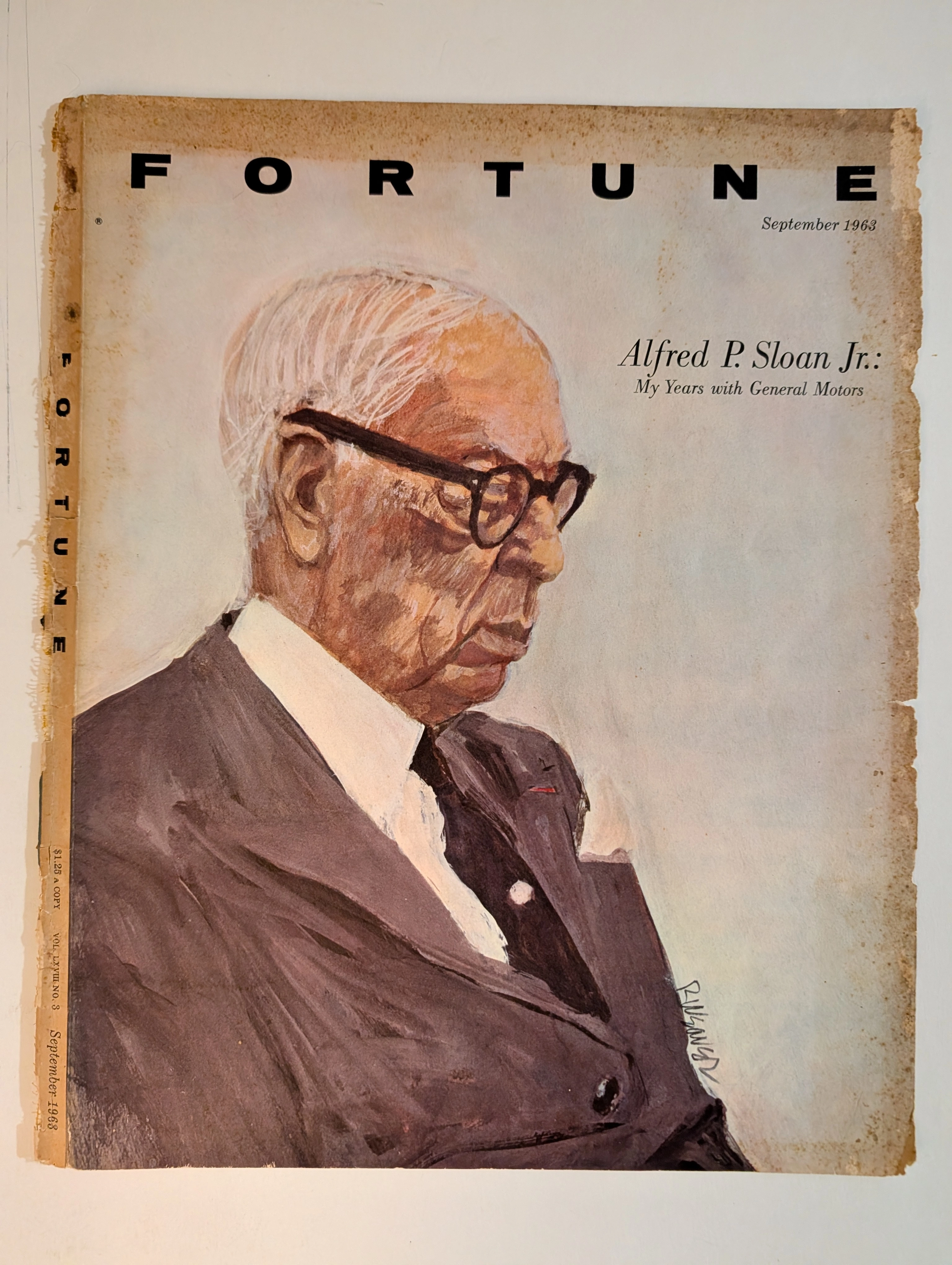
​As the Chief Curator of The Record, I welcome you to the ultimate archive of capitalist history. The impeccably preserved Historical Relic before you is not merely a vintage magazine cover. It is a "Monument of Corporate Blueprinting." This Primary Art Document is the formidable front cover of FORTUNE magazine, dated September 1963—the absolute pinnacle publication for America's corporate elite.
​The bold typography announces: "Alfred P. Sloan Jr.: My Years with General Motors". The elderly, bespectacled man occupying the center of the canvas is a deity of the modern industrial age. Alfred P. Sloan Jr. was the visionary CEO and Chairman who transformed General Motors (GM) into the largest, most dominant corporation on the planet. He single-handedly invented the modern decentralized corporate structure and conceived the brilliant, ruthless strategy of "planned obsolescence" and "a car for every purse and purpose" to finally defeat Henry Ford.

​In 1963, Fortune magazine secured the exclusive rights to serialize Sloan's highly anticipated memoir, My Years with General Motors, within its pages. This very text would go on to become the undisputed "Bible of Business Management," heavily praised by modern titans like Bill Gates. Owning the original cover that heralded the birth of this scripture is akin to possessing a holy relic of commercial history.

​Furthermore, the evocative, gritty portrait was masterfully executed by Robert Weaver (whose distinctive signature 'R. Weaver' is embedded in the lower right). Weaver was a revolutionary pioneer of "Visual Journalism" in American illustration. He rejected the sanitized, overly polished commercial art of the 1950s, utilizing raw, expressive brushstrokes that captured the authentic, weary psychology of his subjects. Applying this rebellious, expressive fine-art style to the ultimate corporate capitalist creates a staggering historical and artistic juxtaposition.

(THE PAPER: The Aesthetics of Destruction (Wabi-Sabi) — The Collapse of Premium Stock

​At The Record, we do not fetishize pristine, sterile modern reproductions; we fiercely worship the "Scars of Time." This 60-year-old Primary Document is the ultimate physical manifestation of the Japanese philosophy of wabi-sabi—finding profound beauty in impermanence and decay. Fortune utilized a distinctly heavy, premium paper stock to project an aura of unshakeable corporate power. But in the analog world, everything has an expiration date.

​Direct your analytical gaze to the right and bottom margins: witness the severe edge fraying, the jagged paper loss, and the aggressive biological deterioration. This is not damage to be hidden; it is the unforgeable "Signature of History." Over the decades, the inherent lignin within the wood-pulp has engaged in a relentless chemical war with ambient oxygen. This oxidation process has birthed a deep, burning amber patina and moisture mottling that creeps inward from the edges. This profound fragility creates a poetic paradox: while Sloan’s corporate legacy was built to be immortal, the very paper celebrating him is literally burning itself alive at a molecular level. Preserving it is an act of freezing this magnificent chemical destruction in time.

​( THE RARITY: Class A — The Boardroom Artifact )
​Fortune covers, especially those carrying monumental historical texts, were not mass-disposable media; they were hoarded, but rarely survived intact without suffering catastrophic environmental damage. The survival of this specific Primary Document—documenting the debut of the greatest business book of the 20th century and painted by a legendary illustrator—elevates it to the highest echelons of archival collecting.

​Fusing its paramount importance to the history of global corporate management, the prestige of Robert Weaver’s fine art, and the breathtaking visual trauma of its analog decay, this artifact unequivocally commands a Rarity Class A designation. It has evolved far beyond commercial ephemera. It is a highly coveted Historical Relic, demanding to be framed and possessed by a discerning visionary who understands the heavy, beautiful weight of capitalist history.

Share This Archive

The Archive Continues

Continue the Exploration

Mattel Electronics Computer Chess 1981 Full-Page Ad | Bruce Pandolfini | Julio Kaplan | Chess AI History | Deep Analysis Rarity Class A

Mattel Electronics Computer Chess 1981 Full-Page Ad | Bruce Pandolfini | Julio Kaplan | Chess AI History | Deep Analysis Rarity Class A

The advertisement analyzed here is a full-page full-color magazine advertisement for the Mattel Electronics Computer Chess™ handheld/tabletop electronic game, copyright © Mattel, Inc. 1981. The ad ran in major American consumer magazines during 1981–1982 — the golden apex of the first electronic game boom. It features a dramatic theatrical photograph of the device spotlit against red velvet curtains on a wooden stage, with a bold competitive claim endorsed by U.S. National Chess Master Bruce Pandolfini: that Mattel's Computer Chess beat Fidelity Electronics' Sensory Chess Challenger '8' in more than 62% of over 100 head-to-head games. The ad also credits International Chess Master Julio Kaplan as programmer. This single page represents the intersection of early consumer AI history, 1980s toy advertising at its most theatrical, and a pivotal moment in the chess-computer arms race that prefigured Deep Blue.

Rolex "Perpetually Yours"

Rolex "Perpetually Yours"

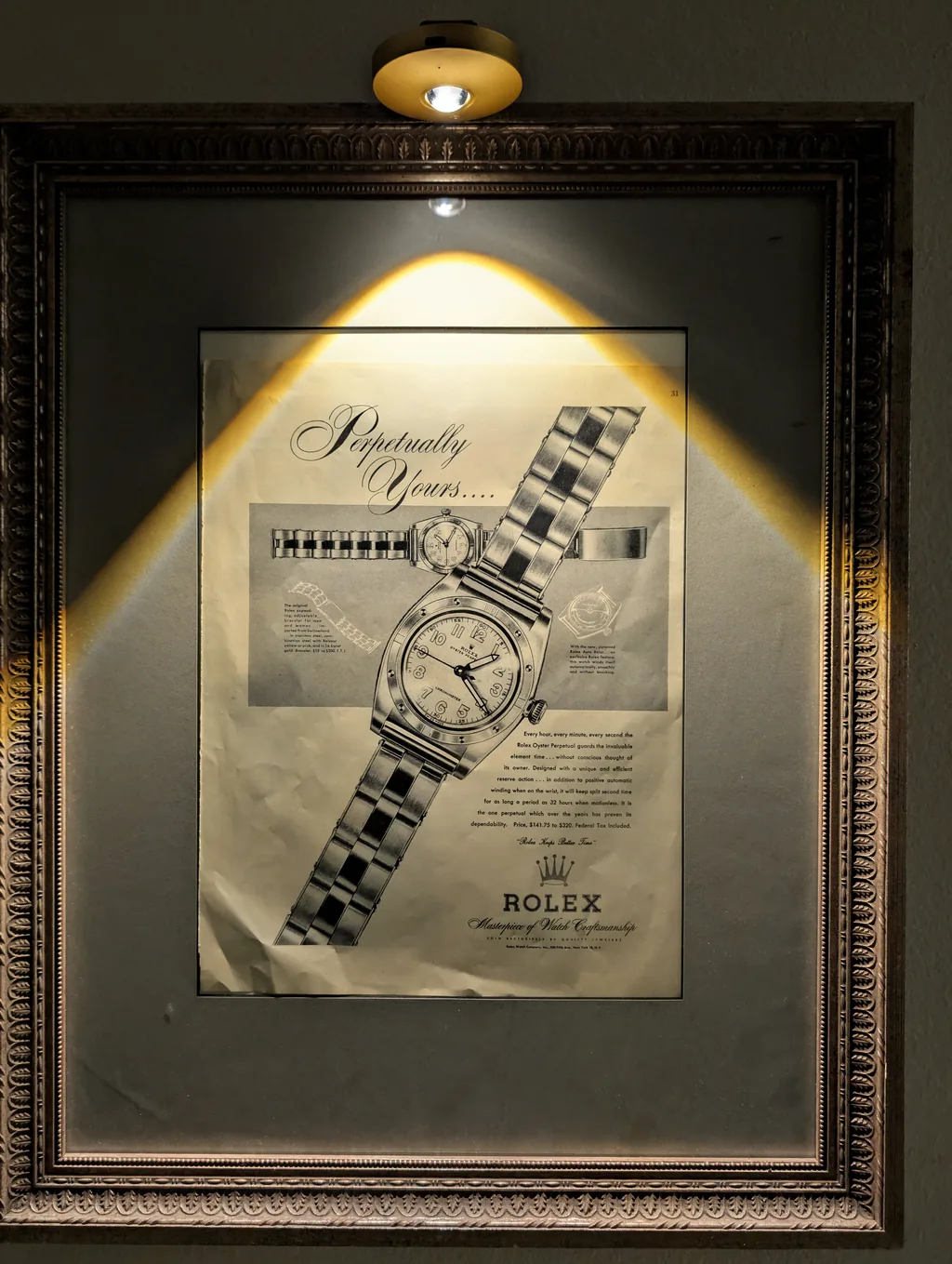
This rare mid-century Rolex "Perpetually Yours" advertisement captures the genesis of the modern Rolex empire. Featuring the legendary Oyster Perpetual, it celebrates the historic union of the world's first waterproof 'Oyster' case (1926) and the revolutionary self-winding 'Perpetual' rotor (1931). A true museum-grade horological archive, this piece represents the ultimate mechanical blueprint that defined Rolex's eternal supremacy.

THE TIME TRAVELER'S DOSSIER :THE APPARITION OF HERITAGE — THE STRIDING MAN

Johnnie walker · Beverage

THE TIME TRAVELER'S DOSSIER :THE APPARITION OF HERITAGE — THE STRIDING MAN

The artifact currently subjected to our uncompromising, museum-grade analysis is a profoundly preserved Historical Relic excavated from the zenith of mid-century American prosperity. This Primary Art Document is a full-page magazine advertisement for Johnnie Walker Blended Scotch Whisky. Functioning as a "Forensic Blueprint of the Transatlantic Leisure Class," the document masterfully weaponizes British aristocratic heritage (embodied by the Striding Man) to validate the newly acquired wealth of post-war American consumers. Its historical context is irrefutably anchored by the microscopic fine print identifying the importer as "Canada Dry Ginger Ale, Inc., New York, N.Y.", a specific corporate era of distribution. Grounded by extreme macro details of analog halftone lithography and the breathtaking wabi-sabi chemical degradation highlighted by its violently torn binding edge, this artifact commands an irreplaceable status, cementing its Rarity Class A designation as a masterpiece of corporate sociological engineering.

Published by

The Record Institute