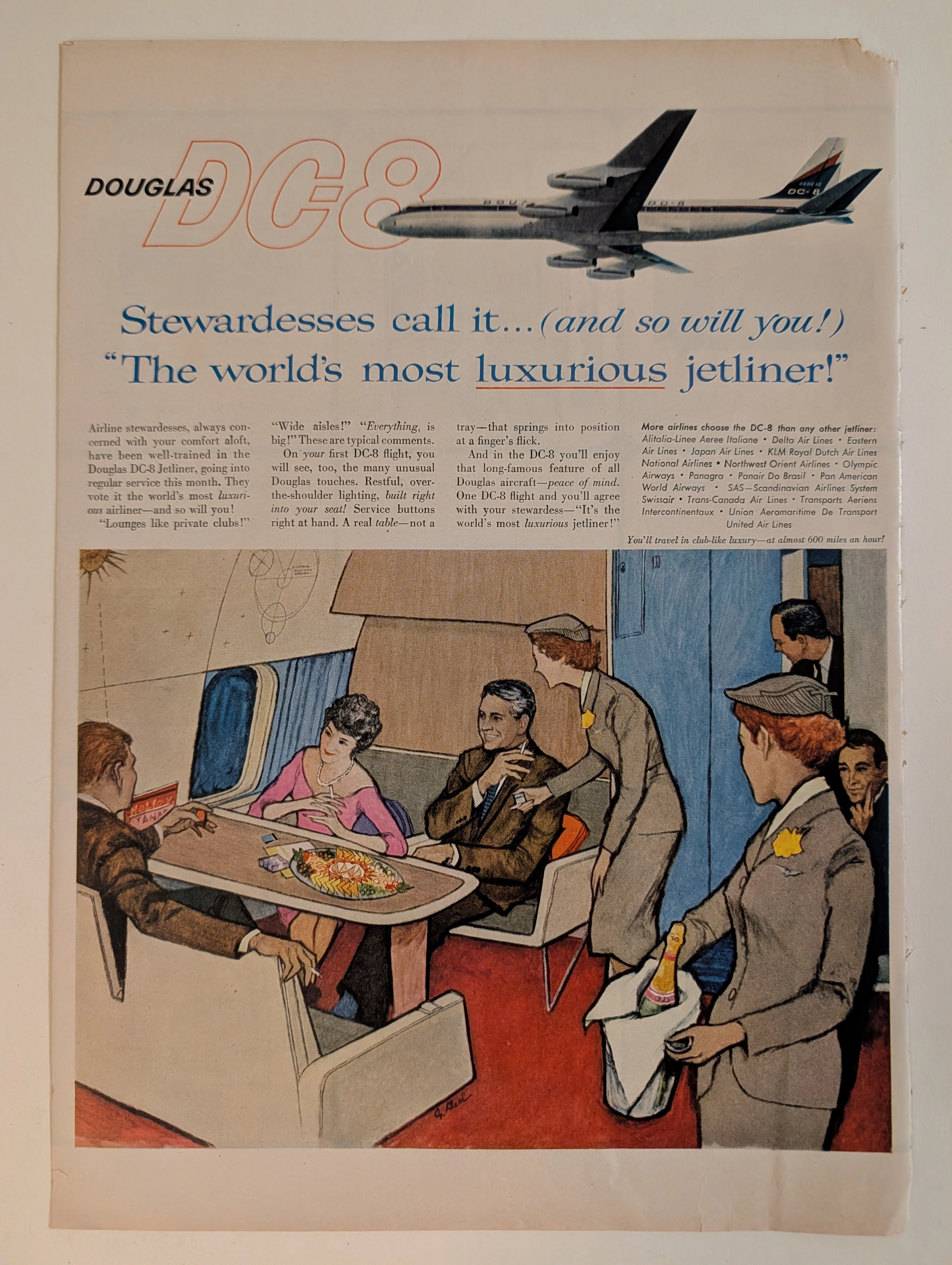
( THE HISTORY: The Jet Age War, Aristocratic Architecture, and the Authority of the Stewardess ) As the Chief Curator of The Record, I welcome you to the absolute stratosphere of mid-century capitalist ambition. The flawlessly preserved Historical Relic before you is not a mere aviation advertisement. It is a "Blueprint of Stratospheric Segregation," engineered during the most pivotal juncture in commercial aviation history: The Dawn of the Jet Age. In the late 1950s and early 1960s, the world was irrevocably transformed by the advent of the jetliner. Boeing had delivered a massive psychological blow with the 707. The Douglas Aircraft Company—the undisputed king of the propeller era whose legendary DC-3 through DC-7 had built modern airlines—was forced to unleash its ultimate weapon: the Douglas DC-8. But Douglas understood that merely selling the raw speed of 600 miles per hour was insufficient. They had to sell an exclusive, untouchable lifestyle. This advertisement is a masterclass in psychological luxury marketing. The evocative, signed illustration completely abandons the reality of cramped seating. Instead, it places the viewer directly inside the "Palomar Lounge"—a sky-bound private club. Analyze the deliberate details: gentlemen in tailored suits smoking cigars and playing cards, a woman draped in pearls, an actual table ("A real table—not a tray"), and a golden champagne bucket being attended to by a pristine stewardess. Furthermore, the rear bulkhead is decorated with a fascinating Space-Age celestial mural depicting orbits and stars, subtly aligning this opulent luxury with the cutting-edge science of the era. The ultimate psychological weapon of this Primary Art Document is its headline: "Stewardesses call it... (and so will you!) The world's most luxurious jetliner!". In the 1960s, the airline stewardess was the absolute cultural arbiter of glamour, service, and sophistication. By leveraging her authority to validate the aircraft's supremacy, Douglas declared that the DC-8 wasn't just built for pilots to fly; it was engineered for the elite to be pampered. The staggering roster of global airlines listed in the bottom right corner (from Japan Air Lines to Pan Am) acts as the final declaration of absolute industrial dominance over the global skies. (THE PAPER: The Aesthetics of Destruction (Wabi-Sabi) — The Scars of the Dawn of Jets) At The Record, our highest reverence is reserved for the inevitable, tragic beauty of analog destruction. This Primary Art Document is the ultimate physical manifestation of the Japanese philosophy of wabi-sabi—the profound realization of beauty in impermanence and decay. The wood-pulp paper of this magazine was manufactured with high acidity; it was genetically programmed with a chemical death sentence. Direct your analytical, curatorial gaze to the physical borders of this artifact. The right margin exhibits a violent, jagged tear where it was forcibly and surgically rescued from the magazine's binding. This is the forensic evidence of a preserved relic, a survivor of the incinerator. Over the course of six decades, the inherent lignin within the paper fibers has engaged in a relentless chemical war with ambient oxygen and ultraviolet light. This oxidation process has birthed a deep, warm ivory "patina" that permeates the entire sheet. The authentic analog halftone dots of the celestial mural and the lounge scene have settled permanently into the brittle, degrading fibers. This paper is quietly, literally burning itself alive at a molecular level. Its slow, majestic death is precisely what transfigures it from a corporate advertisement into immortal Primary Art. ( THE RARITY: Class A — A Survivor of the Aviation Archives ) Finding authentic Jet-Age ephemera that retains such crisp illustrative fidelity, complete with a visible artist's signature and a deeply saturated historical narrative, is exceedingly difficult. Mass-market magazines of this era were overwhelmingly consumed, discarded, or destroyed by environmental neglect. Synthesizing its paramount importance to the history of the Boeing vs. Douglas Jet Age war, its brilliant sociological depiction of exclusive 1960s luxury, and the breathtaking physical trauma of its analog decay, this artifact unequivocally commands a Rarity Class A designation. It has evolved far beyond a disposable commercial message. It is a highly coveted Historical Relic, demanding to be framed and possessed by a discerning curator who truly understands the heavy, beautiful weight of aviation history.
THE TIME TRAVELER'S DOSSIER: THE STRATOSPHERIC MANSION AND THE AESTHETICS OF DECAY
The artifact under exhaustive, museum-grade analysis is a flawlessly preserved Historical Relic originating from the absolute dawn of the commercial Jet Age (circa late 1950s to early 1960s). This Primary Art Document is a magnificent full-page advertisement for the Douglas DC-8, the aerospace leviathan engineered to rival the Boeing 707 and conquer the global skies. Visually anchored by an elegant, sweeping illustration of the aircraft's exterior and a highly detailed, evocative rendering of its opulent passenger lounge, the piece represents the zenith of mid-century aspirational marketing. Signed by an elusive mid-century commercial artist, the illustration captures the "Palomar Lounge"—a private club in the stratosphere where the elite played cards, smoked, and drank champagne beneath a Space-Age celestial diagram. By utilizing the ultimate authority of the era—the airline stewardess—to validate its luxury ("Stewardesses call it... The world's most luxurious jetliner!"), Douglas masterfully sold the illusion of exclusive, aristocratic segregation at 600 miles per hour. Rescued from the binding of a forgotten periodical, this pre-2000s analog artifact is an unforgeable testament to the aesthetic of wabi-sabi. Printed on inherently acidic wood-pulp paper, it exhibits a beautifully frayed right margin and a deep, warm ivory oxidation. This majestic chemical degradation transforms a mass-produced corporate propaganda piece into an irreplaceable, ready-to-frame Primary Art Document of aerospace history.
Cite this article
- MLA
- Naodhinsuk, Ronin. “THE TIME TRAVELER'S DOSSIER: THE STRATOSPHERIC MANSION AND THE AESTHETICS OF DECAY.” The Record Institute, 7 March 2026, https://therecord.institute/journal/the-time-travelers-dossier-the-stratospheric-mansion-and-the-aesthetics-of-decay.
- APA
- Naodhinsuk, R. (2026, March 7). THE TIME TRAVELER'S DOSSIER: THE STRATOSPHERIC MANSION AND THE AESTHETICS OF DECAY. The Record Institute. https://therecord.institute/journal/the-time-travelers-dossier-the-stratospheric-mansion-and-the-aesthetics-of-decay
- CHICAGO
- Naodhinsuk, Ronin. 2026. “THE TIME TRAVELER'S DOSSIER: THE STRATOSPHERIC MANSION AND THE AESTHETICS OF DECAY.” The Record Institute, March 7, 2026. https://therecord.institute/journal/the-time-travelers-dossier-the-stratospheric-mansion-and-the-aesthetics-of-decay.