THE TIME TRAVELLER'S DOISSIER — THE WWII HOME FRONT AND THE AESTHETICS OF DESTRUCTION — The Record Institute Journal
5 Photos
March 6, 2026

THE TIME TRAVELLER'S DOISSIER — THE WWII HOME FRONT AND THE AESTHETICS OF DESTRUCTION

Click any image to view in high resolution

The History

" THE HISTORY: World War II, The Tribunal of Rations, and the Soul of America "

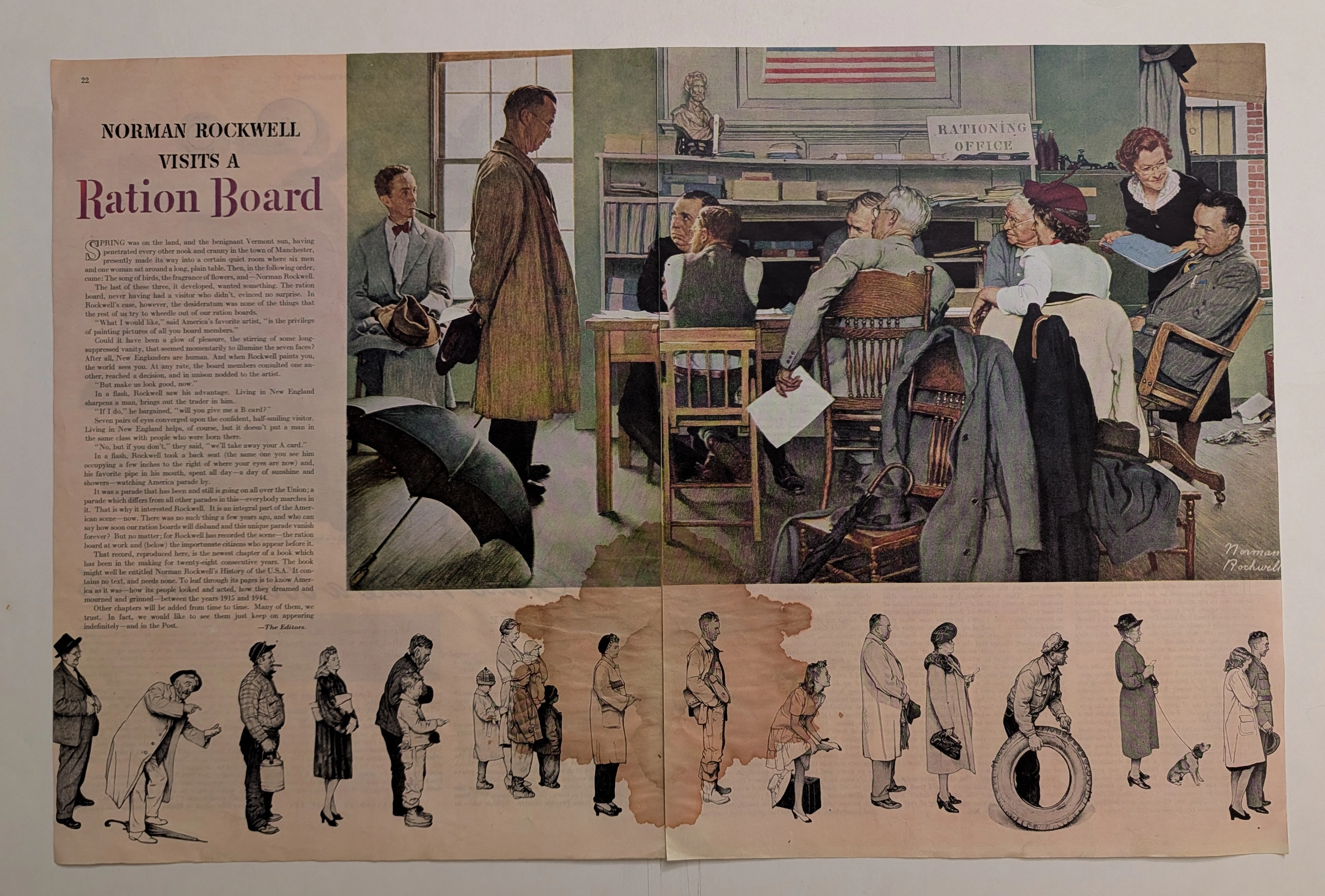
Welcome to the inner sanctum of The Record, where we do not merely deal in paper; we act as the custodians of frozen time. The artifact you are staring at is not just an illustration; it is a mirror held up to humanity during its darkest, most defining hour of the 20th century. This is a monumental masterpiece titled "Norman Rockwell Visits a Ration Board" (published circa 1944), born from the brilliant mind and meticulous brush of America’s undisputed master of illustration, Norman Rockwell.

To truly absorb the visceral gravity of this piece, you must strap into our time machine and hurl yourself back to the suffocating tension of World War II. While American soldiers were bleeding into the soil of Europe and the sands of the Pacific, the "Home Front" was engaged in a quiet, desperate war of sacrifice. The United States government enacted draconian rationing policies. Gasoline, tires, sugar, meat, and shoes were severely restricted to fuel the war machine. The absolute arbiters of life, livelihood, and mobility in every town were the "Ration Boards"—ordinary citizens thrust into positions of god-like local authority.

Rockwell brilliantly chronicles a real event from his adopted hometown of Manchester, Vermont. He paints a quiet, tense room where six men and one woman sit stoically around a plain table. Looming over them in the background is a bust of Abraham Lincoln, a silent judge of their patriotic duty. The man standing on the far left, clutching his hat and pipe with a nervous, ingratiating smile? That is Norman Rockwell himself. The accompanying text humorously reveals that Rockwell attempted to use his immense celebrity to bribe the board, offering to paint their portraits in exchange for a coveted "B Card" (which granted extra gasoline). The unyielding, fiercely egalitarian New England board members stared him down and bluntly replied: "No, but if you don't [paint us well], we'll take away your A card."

​This is Rockwell’s true genius. He uses his own humiliation to broadcast the most vital propaganda of the war: Absolute Equality. In that room, there are no celebrities, no titans of industry—only Americans bound by the same restrictions. This message is immortalized in the continuous "parade" of citizens forming a line across the bottom of the spread. From the wealthy dowager and the sharp-suited businessman to the mechanic hauling a massive rubber tire and the grandmother walking her dog, every single soul is forced to wait in the exact same line of deprivation. It is the most powerful, egalitarian snapshot of American endurance ever committed to paper.

(THE PAPER: The Beautiful Death — The Bloodstain of Time )
​At The Record, our operational philosophy is absolute: we curate analog magazine pages and explicitly cut and sell them as individual, frame-ready sheets. We do this because the medium itself is dying, and its death is breathtaking. For this specific double-page spread, its historical magnitude is rivaled only by its physical "wounds."

Manufactured in the 1940s, this paper is composed of highly acidic wood pulp. It was born with a chemical death sentence. Observe the magnificent, massive water stain blooming aggressively across the lower quadrant, bleeding right through the parade of citizens. To an untrained eye, this is damage. To a master curator, this is a "Historical Scar." Over 80 years, the moisture reacted with the paper's inherent lignin and ambient oxygen, creating a deep rust-colored oxidation that looks remarkably like dried blood from the war era itself. This profound wabi-sabi—the beauty of imperfection and decay—reinforces the sheer fragility of this artifact. This paper is burning alive at a molecular level, and its organic decay makes it infinitely more valuable than a pristine digital reproduction.

(THE RARITY: Class S — A Survivor of the Incinerators)
​During World War II, paper was a critical munition. Through nationwide "Paper Drives," millions of magazines were collected, shredded, and recycled into ammunition boxes and wartime packaging. The survival rate of a complete, intact double-page spread from 1944 is staggeringly low.

The fact that this specific sheet escaped the wartime shredders, survived eight decades of environmental hazards, and acquired such a dramatically beautiful, abstract water stain elevates its desirability to the stratosphere. Because it is a verified Norman Rockwell WWII masterwork combined with extreme physical scarcity, this piece undeniably commands a Rarity Class S designation. It has evolved from a mass-produced periodical into a singular piece of primary art. You are not buying a picture; you are preserving a dying breath of the 1940s.

Share This Archive

The Archive Continues

Continue the Exploration

Mattel Electronics Computer Chess 1981 Full-Page Ad | Bruce Pandolfini | Julio Kaplan | Chess AI History | Deep Analysis Rarity Class A

Mattel Electronics Computer Chess 1981 Full-Page Ad | Bruce Pandolfini | Julio Kaplan | Chess AI History | Deep Analysis Rarity Class A

The advertisement analyzed here is a full-page full-color magazine advertisement for the Mattel Electronics Computer Chess™ handheld/tabletop electronic game, copyright © Mattel, Inc. 1981. The ad ran in major American consumer magazines during 1981–1982 — the golden apex of the first electronic game boom. It features a dramatic theatrical photograph of the device spotlit against red velvet curtains on a wooden stage, with a bold competitive claim endorsed by U.S. National Chess Master Bruce Pandolfini: that Mattel's Computer Chess beat Fidelity Electronics' Sensory Chess Challenger '8' in more than 62% of over 100 head-to-head games. The ad also credits International Chess Master Julio Kaplan as programmer. This single page represents the intersection of early consumer AI history, 1980s toy advertising at its most theatrical, and a pivotal moment in the chess-computer arms race that prefigured Deep Blue.

The Time Traveller's Dossier: How a 1959 Beer Ad Turned Alcohol into 'Health Food' – Barley and Malt Institute Advertisement

The Time Traveller's Dossier: How a 1959 Beer Ad Turned Alcohol into 'Health Food' – Barley and Malt Institute Advertisement

History is not written; it is printed. Before digital algorithms dictated human behavior, societal engineering was executed through the calculated geometry of the four-color offset press. The artifact before us is not merely an advertisement; it is a weaponized blueprint of middle-class aspiration. This museum-grade archival dossier presents an academic deconstruction of a 1959 print advertisement commissioned by the Barley and Malt Institute of Chicago. Operating on a profound binary structure, it documents a calculated paradigm shift within the American alcohol industry. It illustrates the precise historical fracture where beer was conceptually transitioned from a stigmatized working-class vice into a health-conscious staple of suburban domesticity. Through the lens of mid-century commercial artistry and precise visual forensics, this document serves as a masterclass in psychological marketing, establishing cultural tropes that unconditionally dominate modern pop culture and contemporary branding

The Treaty of Two Empires: Deconstructing the 1982 Bacardi & Coca-Cola Vintage Ad (Class S)

The Treaty of Two Empires: Deconstructing the 1982 Bacardi & Coca-Cola Vintage Ad (Class S)

Dive into the history of American consumerism with this museum-grade analysis of the iconic 1982 Bacardi and Coca-Cola co-branding advertisement. This Class S archival piece captures the definitive shift from the Golden Age of Illustration to 1980s commercial studio photography. Explore the geopolitical legacy of the "Cuba Libre" and the analog practical effects behind the immortal condensation on the Coca-Cola contour bottle.

Published by

The Record Institute