THE TIME TRAVELER'S DOSSIER:THE SMILE IN THE TRENCHES AND THE HOME FRONT BRAINWASHING
Click any image to view in high resolution
The History
The Crucible of 1943, Psychological Architecture, and the State's Instrument ]
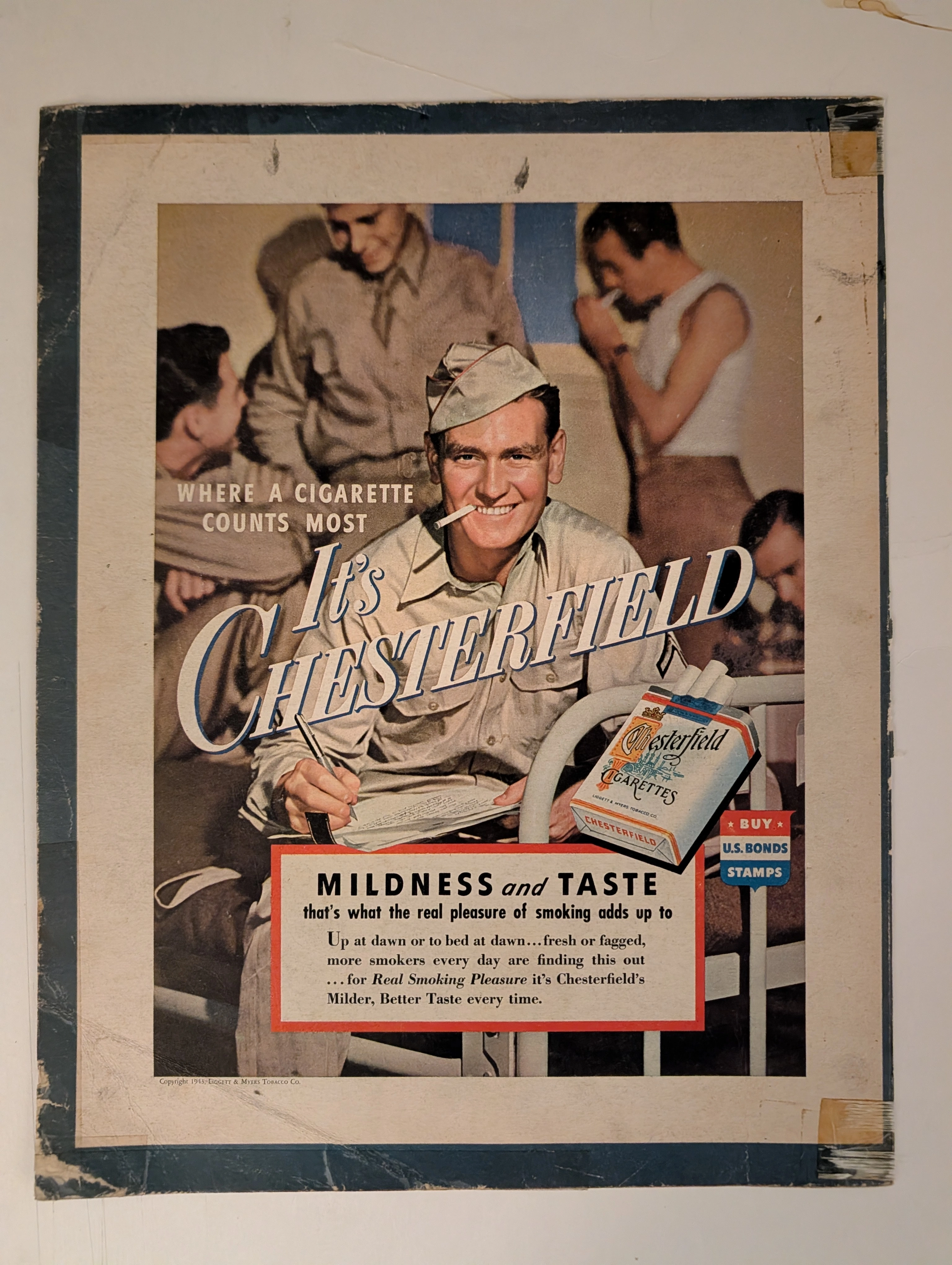
As the Chief Curator of The Record, I welcome you to the absolute, suffocating zenith of the Second World War. This Primary Art Document is forensically and undeniably dated to 1943 by the explicit legal text: "Copyright 1943, LIGGETT & MYERS TOBACCO CO.". The year 1943 was the terrifying climax of WWII. Madison Avenue ad executives brilliantly weaponized the anxiety of the Home Front. The Visual Architecture forcefully presents an idealized, smiling American G.I., sitting on his military cot, a Chesterfield cigarette hanging casually from his lips as he writes a letter home. The commanding headline, "WHERE A CIGARETTE COUNTS MOST," sent a direct, pacifying message to anxious families: Your boy is fine, and his ultimate solace in the horror of war is a Chesterfield. The true chilling gravity of this artifact is its role as "State-Sponsored Propaganda." Imposed upon the commercial art is a bold, patriotic shield bearing a strict government mandate: "BUY U.S. BONDS STAMPS". Smoking Chesterfield was inextricably linked to being a loyal, patriotic American.
The Paper
The Aesthetics of Decay (Wabi-Sabi) & The Fossils of Cellophane Tape
This artifact is the absolute epitome of a "Battered War Veteran." Magazines printed during WWII utilized exceptionally cheap, highly acidic wood-pulp paper due to strict Wartime Rationing. The left margin exhibits severe, jagged tears. But the true forensic miracles are the ancient, calcified residues of cellophane tape gripping the corners. Decades ago, a desperate owner attempted to repair this disintegrating page. That tape has turned into a hardened fossil, leaving deep chemical burns. Ambient oxygen has burned the once-white paper into a deep, toasted amber. This majestic death perfectly embodies the Japanese aesthetic of wabi-sabi.
The Rarity
Class S — A Miraculous Survivor of the Government Incinerators ]
Finding a 1943 primary document articulating both military history and explicit War Bond propaganda is an archival miracle. During the war, the U.S. government launched massive "Paper Drives," pulping millions of magazines for artillery packaging. The fact that this advertisement survived for over eight decades unequivocally commands the absolute highest Rarity Class S designation.
Exhibition Halls
The Archive Continues
Continue the Exploration

THE TIME TRAVELER'S DOSSIER: OLD CROW - THE MYTHOLOGY OF AMERICAN BOURBON
The artifact currently subjected to our uncompromising, museum-grade analysis is a profoundly preserved Historical Relic excavated from the golden age of American print media. This Primary Art Document is a full-page, magazine-sized advertisement for OLD CROW Kentucky Straight Bourbon Whiskey. Functioning as a "Forensic Blueprint of American Myth-Making," the document masterfully weaponizes political heritage and historical titans to validate the aristocratic taste and unparalleled quality of the bourbon. Its historical context is irrefutably anchored by the embossed text physically molded into the glass bottle itself—the most powerful and undeniable forensic evidence available in mid-century liquor advertising. Grounded by extreme macro details of the label, the microscopic golden monogram embroidered on the coat, and the breathtaking wabi-sabi chemical degradation of the highly acidic, magazine-sized paper, this artifact commands an irreplaceable status. It firmly cements its Rarity Class A designation as an absolute masterpiece of historical marketing engineering and analog preservation.

THE TIME TRAVELER'S DOSSIER: BLOOD CAPITALISM AND THE WEAPONIZATION OF WHISKEY
This impeccably preserved Historical Relic is a Primary Art Document from the brutal crucible of World War II, featuring a sweeping advertisement for THREE FEATHERS V.S.R. Blended Whiskey. It chronicles the ultimate mid-century psychological strategy of "Patriotic Capitalism." The artifact is forensically and definitively dated to the WWII era by the explicit, government-aligned directive in the upper right corner: "Buy War Bonds regularly!". Visually, the brand masterfully hijacked American nationalism by rendering its iconic three feathers in a vibrant Red, White, and Blue patriotic color scheme. Surviving the aggressive scrap paper drives of the 1940s, the acidic analog paper exhibits a profound integration of the deep crimson ink into its degrading fibers, perfectly encapsulating the analog aesthetic of wabi-sabi. This slow chemical death elevates this rescued wartime artifact to an irreplaceable Primary Art Document of Rarity Class A.

Viceroy: Al Unser and the "Taste of Excitement"
A legendary artifact linking Al Unser's racing dominance to the golden age of tobacco advertising, a style now permanently banned. The value of this original page will appreciate significantly as pre-2000 analog media naturally decays and vanishes forever.