THE TIME TRAVELER'S DOSSIER: THE FALLEN IDOL AND THE MASTER'S REBELLION
Click any image to view in high resolution
The History
**"WARNING: HISTORICAL & MATURE CONTENT" > The following archive contains explicit vintage satirical art by Neal Adams. Viewer discretion is advised.**
( THE HISTORY: The Dismantling of the American Dream, the Genius of Neal Adams, and the Ultimate Iconoclasm )
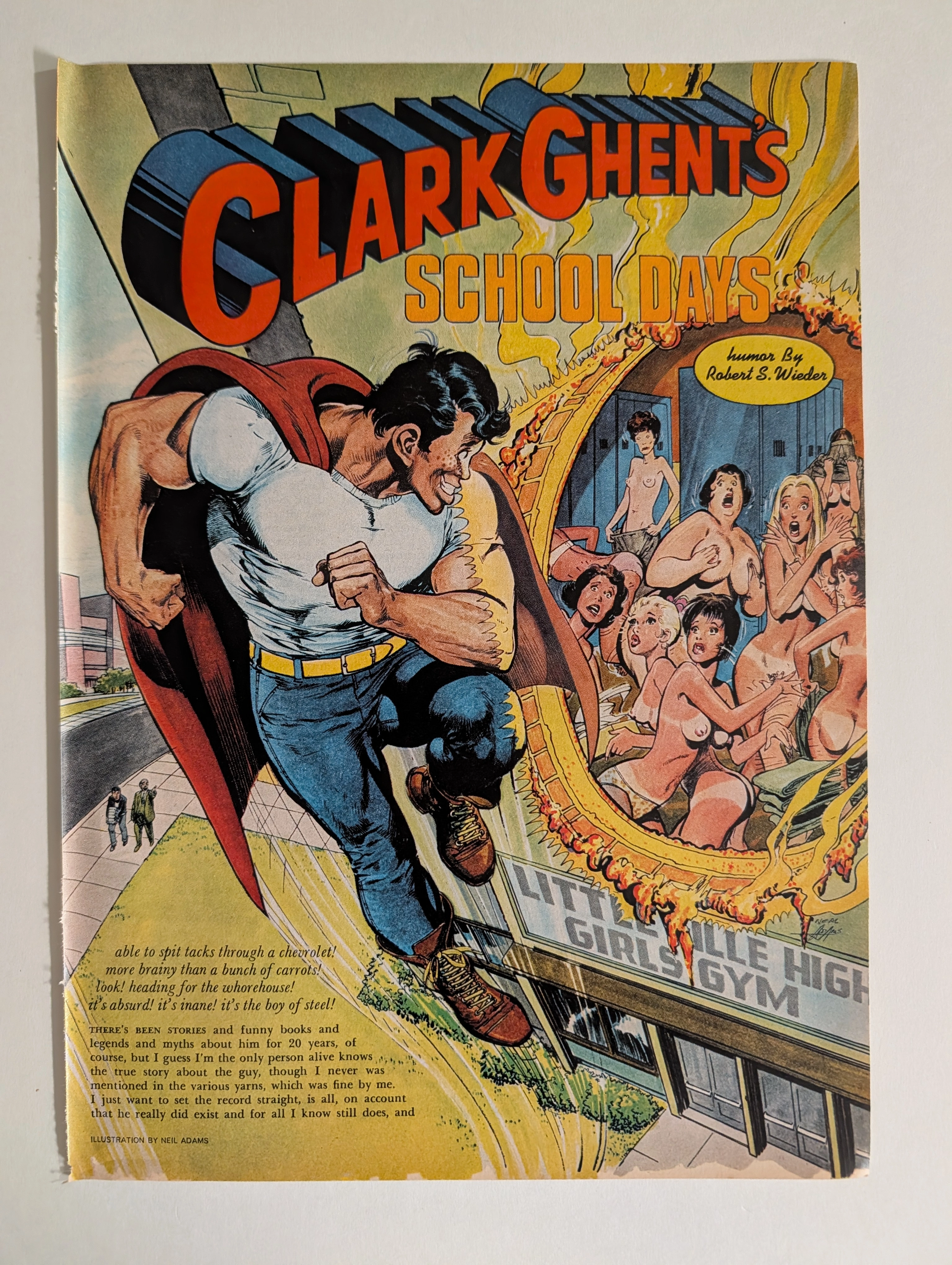
As the Chief Curator of The Record, I welcome you to the darkest, most potent corner of American publishing history. The impeccably preserved Historical Relic before you is not merely a piece of bawdy, low-brow vintage humor. It is a forensic "cultural time bomb" that was specifically engineered to detonate against the pristine, sanitized facade of 1970s Americana. This Primary Art Document, titled "CLARK GHENT'S SCHOOL DAYS", represents a ruthless, unapologetic desecration of the ultimate American symbol of righteousness, moral absolutism, and hope: Superman.
To truly absorb the staggering, visceral gravity of this preserved document, you must immediately direct your analytical focus to the artist's credit: Neal Adams (ironically misspelled here as 'Neil Adams', a common, almost deliberate quirk of anti-establishment underground publishing). Neal Adams is not a mere illustrator; he is an undeniable deity of the comic book Bronze Age. He is the visionary architect who rescued Batman from campy obscurity, returning him to the shadows as a brooding, terrifying detective. He is the master who drew Superman and Green Lantern with an anatomical realism and dynamic hyper-perfection previously unseen in the history of DC Comics. Adams’ linework was literally synonymous with "heroic truth" and moral superiority.
Yet, the 1970s was an era defined by fierce, post-Vietnam cynicism and counter-cultural rebellion. The American youth were actively dismantling the sacred institutions of their parents—questioning the war, exposing political corruption (Watergate), and suffocating under the draconian censorship of the era. Satirical underground juggernauts provided an unfiltered, anarchic arena for this rebellion. It is within this chaotic crucible that a master like Neal Adams chose to unleash his absolute, unbridled subversion. He deliberately weaponized the very style that made him famous.
By illustrating a legally safe parody of Superman ("Clark Ghent") utilizing his god-like powers—his heat and x-ray vision—to melt through the brick wall of the "Littleville High Girls Gym" to voyeuristically observe terrified, nude women, Adams delivered a devastating, masterful slap in the face to the draconian Comics Code Authority (CCA). Look closely at the artwork. Adams uses the exact same hyper-realistic musculature, the same dramatic, explosive foreshortening he used to sell millions of superhero comics, but applies it to the most base, prurient, and pathetic human desires. The heroic jawline is twisted into a lecherous, maniacal grin.
Paired with Robert S. Wieder's biting satirical prose, which mocks the iconic Superman introduction—"able to spit tacks through a chevrolet! more brainy than a bunch of carrots! look! heading for the whorehouse! it's absurd! it's inane! it's the boy of steel!"—the artifact becomes a masterclass in Iconoclasm. This preserved page documents the exact, agonizing moment when American pop culture became mature enough, and cynical enough, to ruthlessly drag its own infallible gods down into the mud.
( THE PAPER: The Aesthetics of Decay — The Chemistry of Rebellious Pulp )
At The Record, our ultimate reverence is reserved for the inevitable, tragic beauty of analog destruction. This standalone Primary Art Document was surgically rescued and preserved from a vintage 1970s underground publication. These counter-culture magazines were printed on cheap, highly acidic wood-pulp paper. They were explicitly designed for mass, disposable consumption, harboring a chemical death sentence within their very fibers from the moment they rolled off the printing press.
After half a century, ambient oxygen and ultraviolet light have waged a relentless chemical war against the paper's inherent lignin. This irreversible oxidation process has birthed the magnificent, undeniable "patina" you see creeping inward from the edges. The once-stark margins have gracefully degraded into a warm, creamy ivory and deep, burning amber. The authentic analog halftone dots of the lithography ink have settled permanently into the brittle, degrading fibers. This is the profound aesthetic of wabi-sabi—finding absolute perfection in impermanence. This paper is literally burning itself alive at a molecular level. No modern digital reprint, no high-resolution scan can ever replicate the fragile, tactile soul, nor the distinct olfactory signature of aging 1970s pulp. Its slow, majestic death is precisely what transfigures it from a magazine page into immortal Primary Art.
( THE RARITY: Class S — A Survivor of the Censorship Purges )
To understand the valuation of this artifact, you must comprehend the survival odds of explicit, subversive material from the 1970s. These publications were the primary targets of societal destruction. They were confiscated and burned by outraged parents, thrown away during coming-of-age purges, or left to rot and mold in damp basements. The statistical probability of a page containing explicit nudity and savage, copyright-skirting satire surviving fifty years in such crisp, visually immaculate condition is staggeringly low.
When you fuse this extreme physical scarcity with the monumental historical presence of Neal Adams—an artist whose original comic pages regularly command hundreds of thousands of dollars at auction—and the artifact's sheer audacity as a piece of savage pop-culture deconstruction, it unequivocally commands a Rarity Class S designation. It has evolved far beyond a disposable piece of ephemera. It is a highly coveted Historical Relic, demanding to be framed and preserved by a curator who truly understands the heavy, beautiful weight of an artistic rebellion that can never be replicated.
Exhibition Halls
The Archive Continues
Continue the Exploration

THE TIME TRAVELER'S DOSSIER: THE MAGIC OF COLOR AND THE REVOLUTION OF HUMAN MEMORY
The artifact under exhaustive, uncompromising, and unprecedented museum-grade analysis is an exceptionally preserved Historical Relic originating from the absolute golden age of mid-century American consumer technology. This Primary Art Document is a monumental, full-page advertisement for Eastman Kodak Company, specifically promoting the legendary Kodachrome Film and its ecosystem of 35mm miniature cameras. Based on the featured camera models—the Kodak Pony 135 Model B, the Kodak Signet 35, and the Bantam RF—this artifact is forensically dated to the mid-1950s, specifically circa 1954–1955, extracted from a June issue of HOLIDAY magazine. This is not a mere camera advertisement; it is a profound "Sociological Blueprint of the Post-War American Dream." The headline, "This is the magic of Kodachrome Photography", encapsulates the technological democratization of color memory. Prior to this era, color photography was the exclusive domain of elite professionals. Kodachrome, with its iconic yellow and red box, transformed ordinary suburbanites into archivists of their own vibrant lives. The ad brilliantly sells not just hardware, but a deeply emotional ritual: the "home screen" slide projection. Visually anchored by the hyper-realistic red cardboard mount of the "KODACHROME TRANSPARENCY", the document is a masterclass in aspirational marketing. Rescued from the inevitable oblivion of disposable mass media, this pre-2000s analog artifact is a breathtaking embodiment of the Japanese aesthetic of wabi-sabi. Printed on inherently acidic wood-pulp paper, it exhibits a beautifully authentic jagged left binding edge, microscopic structural creasing, and a profound, warm amber oxidation across its entire surface. This unstoppable molecular death transforms a piece of mass-produced corporate propaganda into an irreplaceable, ready-to-frame Primary Art Document of photographic and sociological history.

THE TIME TRAVELER'S DOSSIER: THE ARCHITECTURE OF POWER AND THE BIRTH OF THE DIGITAL WORLD IN THE 50S
The artifact under exhaustive, uncompromising museum-grade analysis is a remarkably preserved Historical Relic originating from the absolute zenith of the post-war American economic boom. This Primary Art Document is a sweeping, monumental full-page advertisement for the Sheraton Hotels empire, forensically dated to circa 1958–1959 via the explicitly illustrated Pittsburgh Bicentennial (1758-1958) stamp embedded within the artwork. This document is not merely a travel advertisement; it is a profound "Sociological Blueprint of the American Corporate Ascendancy." Visually anchored by four hyper-stylized, architectural illustrations of Sheraton's flagship properties—New York, Cleveland, Pittsburgh, and Detroit—the piece captures the era's unbridled optimism. Each panel is a masterpiece of mid-century commercial illustration, particularly the Detroit panel featuring ethereal, floating tail-fin automobiles symbolizing the Motor City's dominance. Furthermore, this artifact documents critical milestones in global business history. It proudly advertises the acceptance of the Diners' Club card, marking the revolutionary dawn of the modern credit card era. It also boasts of Sheraton's "Reservatron" electronic system—one of the earliest commercial applications of computing in the hospitality industry—and proudly declares its listing on the New York Stock Exchange. Rescued from the binding of a forgotten, heavy-stock periodical, this pre-2000s analog artifact is an unforgeable testament to the Japanese aesthetic of wabi-sabi. Printed on inherently acidic wood-pulp paper, it exhibits a beautifully violent, jagged right margin and a deep, warm amber oxidation across its surface. This majestic, unstoppable chemical degradation transforms a mass-produced corporate propaganda piece into an irreplaceable, ready-to-frame Primary Art Document of mid-century architectural and economic history.

ROLL ROYCE · Automotive
The Time Traveller's Dossier: The Oil Baron's Chariot – 1970s "HOU$TON" Editorial Illustration
History is not written; it is printed. Before digital algorithms dictated human behavior, societal engineering was executed through the calculated geometry of the four-color offset press. The historical artifact before us is not merely a magazine editorial illustration; it is a weaponized blueprint of American myth-making and a testament to the era of unchecked petro-wealth. This museum-grade archival dossier presents an academic deconstruction of a 1970s print feature on Houston, Texas, brilliantly illustrated by the legendary Eraldo Carugati. Operating on a profound binary structure, it documents a calculated paradigm shift in the global perception of wealth. It illustrates the precise historical fracture where the "Texas Oil Boom" transitioned from a regional economic event into a larger-than-life cultural archetype. Through the lens of late-analog commercial artistry and precise visual forensics, this document serves as a masterclass in psychological semiotics, establishing the visual tropes of the brash, high-rolling American Wildcatter that unconditionally dominates modern pop culture.