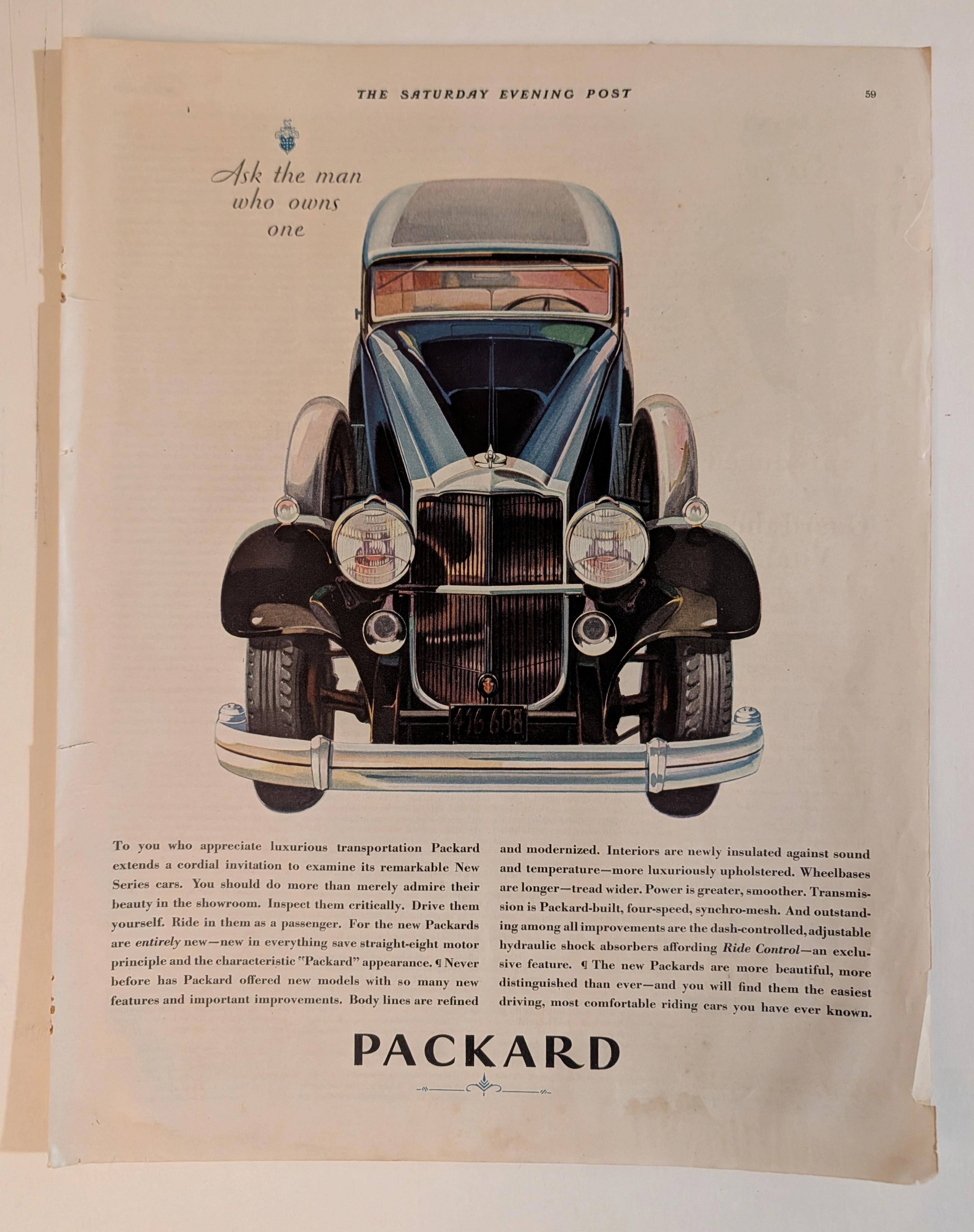
(THE HISTORY: The Legendary Slogan, Packard's Unyielding Arrogance, and the Economic Abyss ) As the Chief Curator of The Record, I welcome you to the absolute zenith of American automotive aristocracy. The flawlessly preserved Historical Relic before you is not a mere vintage car ad, devoid of soul or context. It is a "Monument of Opulence" engineered to mock the darkest of times. This Primary Art Document, surgically extracted from the archives of The Saturday Evening Post, features a formidable, high-society machine: the Packard. This was an American luxury brand that, in its prime, commanded the same, if not more, global reverence from royalty and heads of state as Rolls-Royce. The undisputed focal point and the beating heart of this artifact is the elegant, sweeping typography anchored in the upper left corner: "Ask the man who owns one." This is not merely an advertising tagline; it is arguably one of the most brilliant, arrogant, and overwhelmingly successful slogans in the history of corporate marketing. Legend dictates that in the early 1900s, when founder James Ward Packard received a letter from a prospective buyer inquiring if the car was truly as good as claimed, he refused to dictate a long-winded technical response. Instead, he simply told his secretary to reply: "Ask the man who owns one." This slogan was the ultimate flex of corporate confidence. It declared that Packard’s engineering didn't need to be proven on a printed page; the millionaire driving it on the avenue was the most loyal and credible testament to its perfection. The illustration utilizes a dramatic, aggressive head-on perspective, a stark departure from the standard side-profile automotive illustrations of the era. It showcases the imposing, architectural radiator grille, the classic, commanding round headlamps, and a license plate reading "416 608." But the true, chilling historical gravity of this piece lies in the exact era it was published. In the early 1930s, America and the world were suffocating in the relentless grip of the Great Depression. Banks had collapsed, and over 25% of the American workforce was unemployed, desperately standing in breadlines to survive. Yet, amidst the starvation and the wailing of the working class, Packard purchased a full-page spread to aggressively market its "New Series cars." They boasted luxurious innovations: a four-speed synchro-mesh transmission for seamless shifting, and exclusive "Ride Control"—dash-controlled, adjustable hydraulic shock absorbers. This was revolutionary engineering. The ad isn't just selling a vehicle; it is selling a fortress of class segregation. It details the newly insulated interiors designed against sound and temperature, effectively ensuring that the wealthy occupant never had to hear or feel the harsh, collapsing world outside. This document is a profound sociological record capturing immense wealth surviving, unapologetically, amidst global financial ruin. (THE PAPER: The Aesthetics of Decay (Wabi-Sabi) — The Scars of Acidic Wood-Pulp ) At The Record, our highest reverence is reserved for the inevitable, tragic beauty of analog destruction. This nearly century-old Primary Document is the ultimate physical manifestation of the Japanese philosophy of wabi-sabi—the profound realization of beauty in impermanence, imperfection, and decay. The wood-pulp paper of this magazine was manufactured with high acidity; it was genetically programmed with a chemical death sentence from the moment it rolled off the press. Direct your analytical, curatorial gaze to the physical borders of this artifact. The left margin exhibits a violent, jagged tear where it was forcibly liberated from the magazine's glued and stitched spine. This is not damage; it is the forensic evidence of a rescued relic. Now look at the bottom margin: profound, creeping moisture stains have bloomed across the paper like a masterful, organically created watercolor painting. Combined with the highly acidic nature of the pulp, the inherent lignin has reacted with ambient oxygen over nine decades to transform the entire sheet into a deep, burning amber and toasted brown patina. These elements are not flaws to be retouched. They are the unforgeable "Signatures of Time." This paper is quietly, literally burning itself alive at a molecular level, and this magnificent mortality is exactly what transfigures it into immortal Primary Art. ( THE RARITY: Class A — A Pre-War Survivor of the Fire ) Finding automotive ephemera from the Pre-War era that retains such crisp illustrative fidelity and carries such a heavy historical narrative is akin to finding a needle in an ocean. Magazines from the Great Depression were not saved; they were desperately used by impoverished families for wall insulation or burned as fuel in fireplaces. Those that miraculously survived the 1930s were then largely decimated by the aggressive government scrap paper drives of World War II, pulped down to create artillery packaging. Synthesizing its status as a testament to the defunct, legendary Packard empire, its preservation of marketing history's most arrogant and brilliant slogan, and the breathtaking physical trauma of its analog decay, this artifact unequivocally commands a Rarity Class A designation. It has evolved far beyond a disposable commercial message. It is a highly coveted Historical Relic, demanding to be framed and preserved by a curator who truly understands the heavy, beautiful weight of 1930s automotive supremacy.
THE TIME TRAVELER'S DOSSIER: THE AUTOMOTIVE ARISTOCRACY AND THE AESTHETICS OF RUIN
The artifact under rigorous, museum-grade analysis is an exceptionally preserved Historical Relic originating from the golden age of American automotive supremacy. Sourced from a vintage issue of The Saturday Evening Post, this Primary Art Document features a commanding, full-page advertisement for Packard, one of the most prestigious luxury automobile manufacturers in world history. Visually dominated by a striking, head-on illustration of a New Series Packard, the piece explicitly highlights the legendary corporate slogan: "Ask the man who owns one". Published during the turbulent economic landscape of the early 1930s Great Depression, this advertisement is a profound sociological marker. It boldly markets uncompromising luxury—boasting features like a four-speed synchro-mesh transmission and "Ride Control" shock absorbers—to an elite aristocracy largely insulated from the era's financial collapse. Physically, this pre-2000s analog artifact is a breathtaking embodiment of wabi-sabi. It exhibits a violently torn left binding edge, significant moisture blooming along the bottom margin, and deep amber lignin oxidation. This natural chemical and environmental degradation transforms a mass-produced commercial print into an irreplaceable, ready-to-frame Primary Art Document, forever capturing the magnificent mortality of the analog age.
Cite this article
- MLA
- Naodhinsuk, Ronin. “THE TIME TRAVELER'S DOSSIER: THE AUTOMOTIVE ARISTOCRACY AND THE AESTHETICS OF RUIN.” The Record Institute, 7 March 2026, https://therecord.institute/journal/the-time-travelers-dossier-the-automotive-aristocracy-and-the-aesthetics-of-ruin.
- APA
- Naodhinsuk, R. (2026, March 7). THE TIME TRAVELER'S DOSSIER: THE AUTOMOTIVE ARISTOCRACY AND THE AESTHETICS OF RUIN. The Record Institute. https://therecord.institute/journal/the-time-travelers-dossier-the-automotive-aristocracy-and-the-aesthetics-of-ruin
- CHICAGO
- Naodhinsuk, Ronin. 2026. “THE TIME TRAVELER'S DOSSIER: THE AUTOMOTIVE ARISTOCRACY AND THE AESTHETICS OF RUIN.” The Record Institute, March 7, 2026. https://therecord.institute/journal/the-time-travelers-dossier-the-automotive-aristocracy-and-the-aesthetics-of-ruin.