THE TIME TRAVELER'S DOSSIER: THE ENGINEERING OF IMMORTALITY AND ARISTOCRATIC AESTHETICS
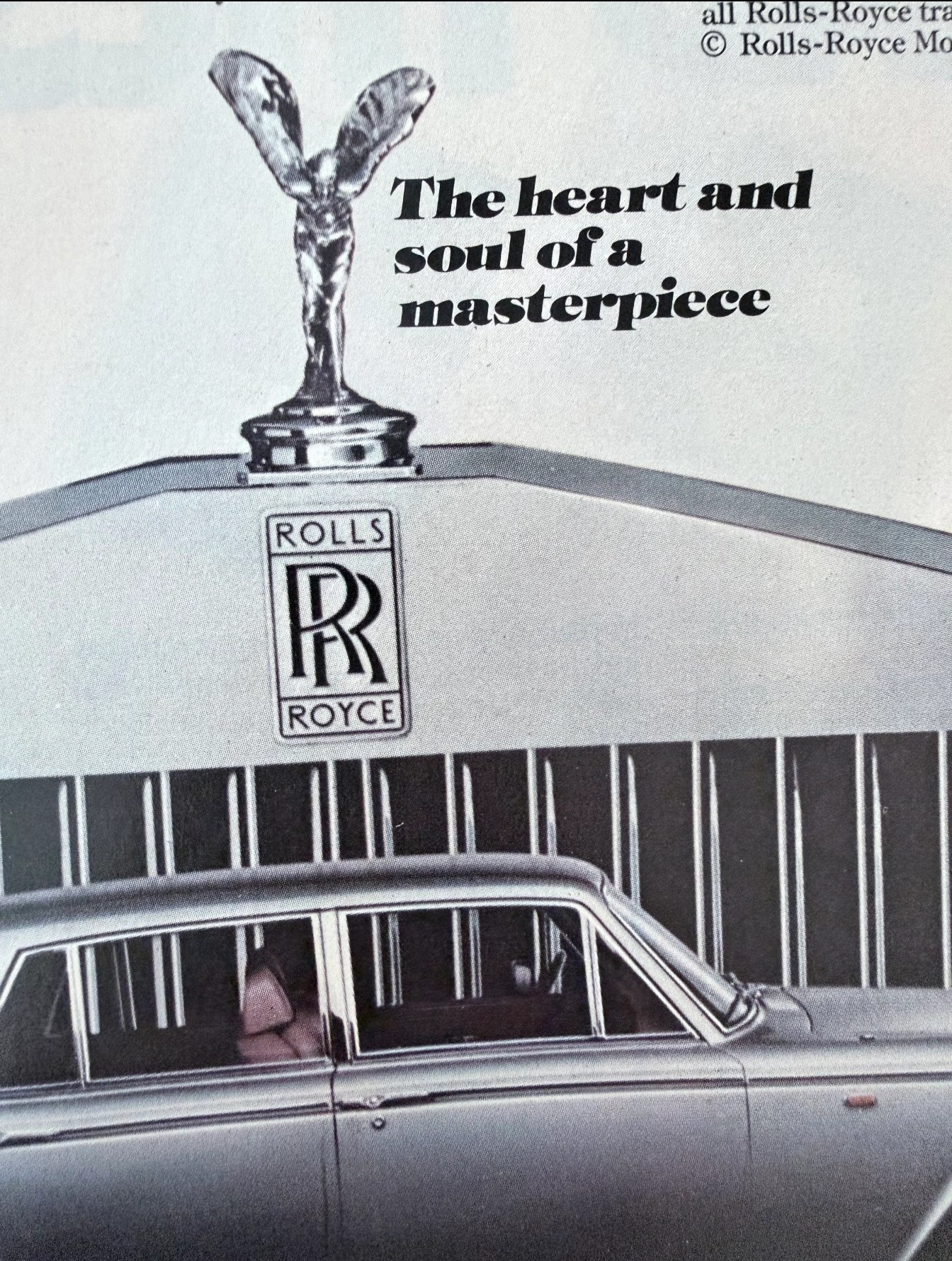
The artifact under exhaustive, uncompromising, and unprecedented museum-grade analysis is an exceptionally preserved Historical Relic originating from the absolute zenith of British automotive engineering and aristocratic luxury. This Primary Art Document is a monumental, full-page theatrical advertisement for the Rolls-Royce Silver Shadow II, forensically and definitively dated to 1977 by the explicit copyright text: "© Rolls-Royce Motors Inc. 1977". This is not a mere car advertisement; it is a "Forensic Manifesto of Absolute Perfection." Published twelve years after the conception of the original 1965 edition, this document heralds the arrival of the refined Silver Shadow II. It aggressively weaponizes the brand's legacy, explicitly stating that more than half of all Rolls-Royce motor cars built since 1904 were still "humming along" in 1977. The visual architecture is dominated by the legendary "Spirit of Ecstasy" mascot, described here as "The heart and soul of a masterpiece", standing guard over the iconic Parthenon-inspired radiator grille. Rescued from the binding of a prestige 1970s periodical, this pre-2000s analog artifact exhibits a beautifully authentic warm ivory oxidation across its surface. This majestic chemical aging transforms a mass-produced piece of luxury propaganda into an irreplaceable, ready-to-frame Primary Art Document of automotive and sociological history. Quick-Reference Summary Table
Category: Automotive
Brand: Roll Royce
The History
The Pinnacle of the Silver Shadow, the Spirit of Ecstasy, and the Industrial Defiance of 1977 ] As the Chief Curator of The Record, the uncompromising guardian of analog history, I welcome you to the absolute, breathtaking zenith of British automotive engineering and aristocratic luxury. The impeccably preserved Historical Relic that lies before you is not a mere, soulless vintage car advertisement designed to temporarily boost showroom traffic. It is a forensic "Sociological Architecture Manifesto," purposefully and meticulously engineered in the transitional year of 1977 (as undeniably and forensically verified by the explicit copyright and trademark text residing in the lower right quadrant: "© Rolls-Royce Motors Inc. 1977"). This artifact was crafted to definitively reassert the unshakeable, godly status of the Rolls-Royce empire amidst global economic shifts and oil crises. This Primary Art Document serves as a historical ledger, heralding the highly anticipated arrival of the Rolls-Royce Silver Shadow II, which represented the ultimate, painstaking refinement and evolutionary peak of the original groundbreaking model introduced twelve years prior in 1965. The bold, imposing, and uncompromising serif headline declares with absolute authority: "The refinement of a masterpiece. The Rolls-Royce Silver Shadow II.". The ultimate display of corporate arrogance and capitalist triumph is heavily embedded in the central copy, which explicitly and haughtily states: "Remarkably enough, more than half the Rolls-Royce motor cars built since 1904 are still humming along in their own quiet ways.". This is not just a boast of mechanical durability; it is a brilliant psychological communication directed squarely at global billionaires. It tells them that they are not purchasing a disposable mode of transportation; they are investing in "The Priceless Asset," securing a piece of immortality and a legacy that will outlive the owner themselves (inspire a legend and a legacy all your own). The Visual Architecture of this advertisement is engineered to forcefully captivate the viewer's soul. It is masterfully divided into two primary visual strikes. First, The Sacred Idol: a dramatic, isolated close-up that grants supreme importance to the iconic Spirit of Ecstasy hood ornament, standing eternally on guard over the legendary Parthenon-inspired radiator grille. The ad explicitly elevates her from a mere piece of chrome to a divine entity, labeling her: "The heart and soul of a masterpiece.". Second, the profile silhouette of the metallic Silver Shadow II parked stoically in front of a monumental structure echoing the vertical lines of the grille itself, presenting an image of monolithic, unyielding stability akin to an ancient Greek temple. In terms of Automotive Engineering, this document extensively chronicles the greatest technological leaps made by Rolls-Royce in that era. The dense, confidence-inspiring text boasts of the new Rack-and-pinion steering system, designed to master the straightest roads and crookedest lanes with equal ease. It highlights the quiet V-8 engine, a self-leveling suspension, a dual braking system, and a redesigned instrument panel featuring an electronic odometer that reads confidently from "000000.0 to 999999.9". Furthermore, it details the unparalleled superiority of the all-but-silent, dual-level air-conditioning system. All of these mechanical miracles serve one singular, aristocratic philosophy: perfectly separating the affluent occupant from the chaotic, noisy world beyond their windows. The ad also emphasizes the obsessive craftsmanship, noting the hand-building of each version took between three and four months, matching exquisite walnut veneers with selected hide leathers via the enduring eye and hand of an artist.
The Paper
The Aesthetics of Decay (Wabi-Sabi) — The Chemical Scars of 1970s Acidic Glossy Pulp ] At The Record, our ultimate, uncompromising reverence is reserved for the inevitable, tragic, and spectacular beauty of analog destruction. This standalone Primary Art Document was printed on high-grade, glossy coated stock from the late 1970s. Despite its premium feel, mass-market magazines of this era utilized highly acidic wood-pulp paper, harboring a fatal chemical death sentence within their very fibers from the millisecond they rolled off the roaring offset printing presses. Direct your curatorial, analytical gaze to the entire surface of the paper. After more than 48 years, ambient oxygen and ultraviolet light have waged a relentless, unstoppable chemical war against the paper's inherent lignin. This irreversible oxidation process has birthed a magnificent, undeniable "patina," elegantly transforming the once-sterile, lifeless white background into a deep, warm Ivory and Amber Patina that permeates every microscopic fiber. The miraculous, magical paradox of this piece is that amidst the structurally degrading paper, the authentic, microscopic analog halftone dots that create the deep shadows of the metallic car body and the reflective highlights on the Spirit of Ecstasy have settled permanently into the brittle pulp, retaining their shocking depth, crispness, and dimensional fidelity. This is the profound Japanese aesthetic of wabi-sabi—the spiritual realization of finding absolute perfection in impermanence, flaw, and decay. This paper is quietly, literally burning itself alive at a molecular level. No modern digital reprint, no ultra-high-resolution scan can ever replicate the fragile, tactile soul, nor the distinct olfactory signature of aging 1970s pulp. Its slow, majestic, and irreversible death is precisely what transfigures it from a disposable magazine page into an immortal piece of Primary Art.
The Rarity
Class A — A Miraculous Survivor of the Brutal Consumer Purges and the Golden Age of Luxury ] To understand the immense, almost incalculable valuation of this artifact, you must comprehend the brutal reality of ephemera survival. High-end promotional materials from the 1970s were manufactured to target a niche audience within elite business and lifestyle periodicals. Once read, they were routinely discarded, thrown into the trash, or banished to damp basements where moisture and mold completely eradicated them. The statistical probability of a full-page, text-heavy Rolls-Royce magazine advertisement surviving nearly five decades in such crisp, visually immaculate condition—completely devoid of devastating structural creases, sharp edges intact, and free from catastrophic moisture rot—is staggeringly, miraculously low. When you fuse this extreme, pristine physical scarcity with the monumental historical presence of the Silver Shadow II—the most commercially successful model that single-handedly sustained the Rolls-Royce empire through severe economic turbulence—alongside the forensic proof of the 1977 copyright and the ultimate homage to the Spirit of Ecstasy, this artifact unequivocally commands the highly prestigious Rarity Class A designation. It has evolved far, far beyond a disposable piece of vintage commercial advertising. It is a highly coveted Historical Relic, demanding to be framed and fiercely protected by an alpha curator or collector who truly understands the heavy, beautiful, and irreplaceable weight of British capitalist history that the modern digital world can never reproduce.
Cite this article
- MLA
- Naodhinsuk, Ronin. “THE TIME TRAVELER'S DOSSIER: THE ENGINEERING OF IMMORTALITY AND ARISTOCRATIC AESTHETICS.” The Record Institute, 10 March 2026, https://therecord.institute/journal/the-time-travelers-dossier-the-engineering-of-immortality-and-aristocratic-aesthetics.
- APA
- Naodhinsuk, R. (2026, March 10). THE TIME TRAVELER'S DOSSIER: THE ENGINEERING OF IMMORTALITY AND ARISTOCRATIC AESTHETICS. The Record Institute. https://therecord.institute/journal/the-time-travelers-dossier-the-engineering-of-immortality-and-aristocratic-aesthetics
- CHICAGO
- Naodhinsuk, Ronin. 2026. “THE TIME TRAVELER'S DOSSIER: THE ENGINEERING OF IMMORTALITY AND ARISTOCRATIC AESTHETICS.” The Record Institute, March 10, 2026. https://therecord.institute/journal/the-time-travelers-dossier-the-engineering-of-immortality-and-aristocratic-aesthetics.