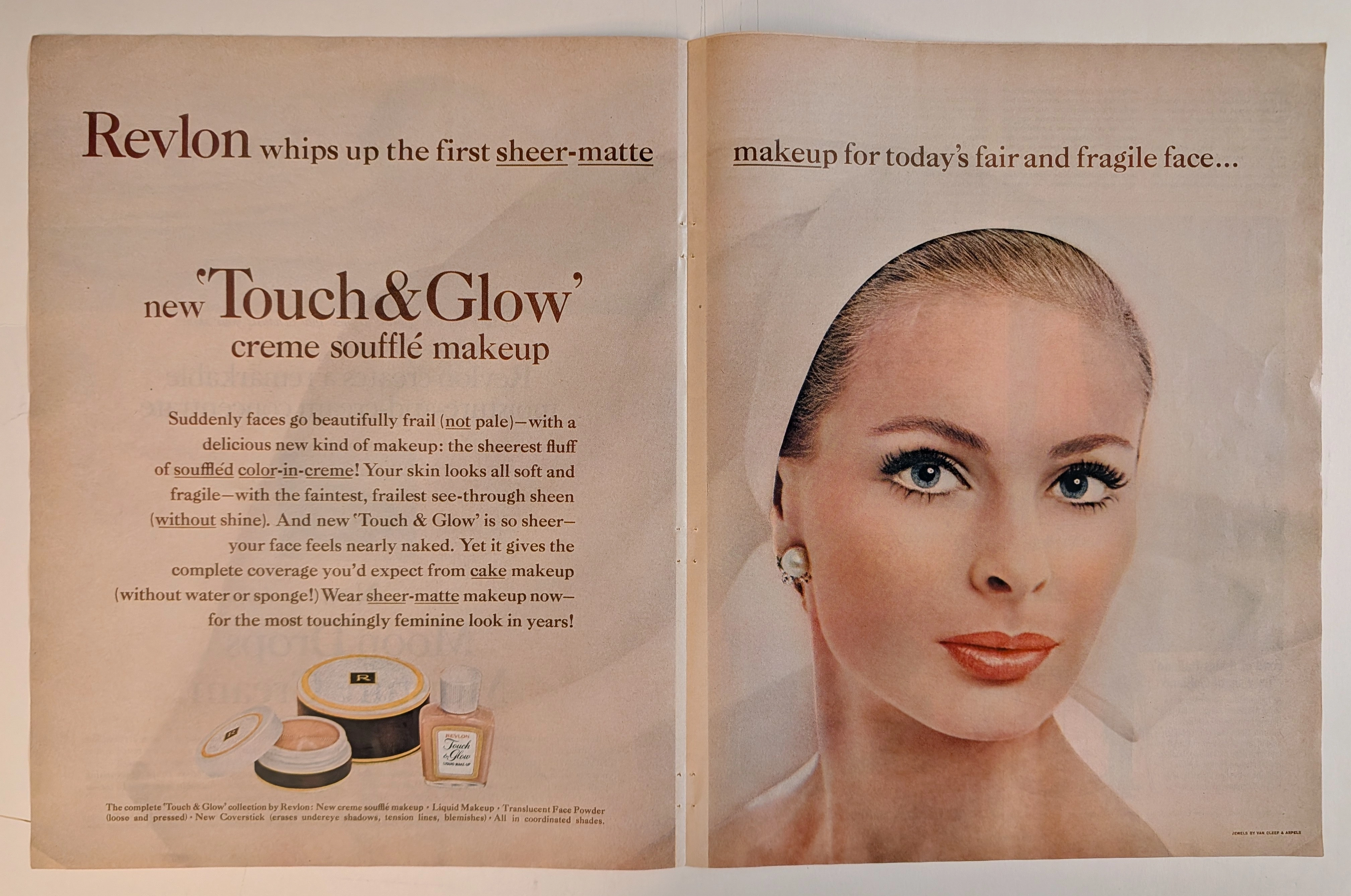
( THE HISTORY: Charles Revson's Psychology, the Feminine Ideal, and the Haute Joaillerie Alliance ) As the Chief Curator of The Record, I invite you to submerge your senses into the psychological battlefield of mid-century consumerism. The impeccably preserved Double-Page Historical Relic before you is not a mere cosmetic wallpaper. It is a calculated "Psychological Blueprint" engineered to define and control the parameters of feminine beauty in the early 1960s. This is a masterwork by Revlon, orchestrated by Charles Revson, the titan of the cosmetics industry who famously declared: "In the factory we make cosmetics; in the store we sell hope." To decode the immense historical gravity of this Primary Art Document, we must analyze the sociological context of Mid-Century America. The sweeping headline—"Revlon whips up the first sheer-matte makeup for today's fair and fragile face..."—is a flawless encapsulation of the era's gendered expectations. In the early 60s, women were not necessarily marketed to look strong or pragmatic; the ultimate status symbol was to appear aristocratic, flawless, and as delicate as porcelain. The "fragile" aesthetic implied a life of luxury, shielded from harsh labor or the elements. In terms of technological evolution in the beauty industry, this advertisement marks a critical turning point. The 1950s were dominated by heavy "cake makeup" (like Max Factor's Pan-Cake), which required water to apply and left a thick, mask-like finish. Revlon was selling the future: "Creme Soufflé Makeup." It promised a whipped, aerated texture that delivered full coverage without the stifling weight, achieving the coveted "Sheer-Matte" finish—a face that felt "nearly naked." Paired with the heavy, graphic black eyeliner and subdued lips that defined the dawn of the 1960s (pioneered by icons like Audrey Hepburn), this page perfectly archives a monumental shift in cosmetic fashion. The Historical Masterstroke: The truly priceless nature of this artifact lies hidden in a microscopic, yet infinitely powerful detail. Direct your focus to the small text in the bottom right corner: "JEWELS BY VAN CLEEF & ARPELS," and observe the magnificent pearl and diamond cluster earring adorning the model. This is no coincidence; it is a masterclass in Psychological Luxury Marketing. Revlon was a mass-market brand accessible in local drugstores and department stores. But Charles Revson craved the aura of the aristocracy. By strategically partnering with Van Cleef & Arpels—a Parisian house of Haute Joaillerie whose pieces cost tens of thousands of dollars—Revlon brilliantly hijacked their prestige. When the image of a $2 Revlon makeup jar is placed directly alongside elite European diamonds, the consumer's brain subconsciously fuses the two levels of luxury. The woman buying "Touch & Glow" wasn't just buying foundation; she was purchasing the manufactured feeling of being a high-society woman wearing Van Cleef. This advertisement is a definitive historical record of how mid-century capitalism successfully elevated a democratic commodity into an aspirational luxury object. ( THE PAPER: The Aesthetics of Decay — The Center Seam of Time ) At The Record, we do not worship pristine modern reproductions; we revere the "Signatures of Time." This historical artifact is a Double-Page Spread, surgically rescued from the spine of a decaying periodical. The fashion magazines of this era were printed on high-speed presses using acidic wood-pulp paper. It was an inherently fragile medium, harboring a chemical death sentence. The most beautiful physical attribute of this piece is its "Center Seam"—the vertical line bearing the original staple holes that once bound the magazine together. This is the ultimate proof of its authenticity as a Primary Art Document. Over the past 60 years, the lignin within the paper fibers has engaged in a relentless chemical war with ambient oxygen. This oxidation has birthed a stunning, warm ivory "patina" that radiates from the edges inward. The vintage halftone lithography dots making up the model's flawless face have settled permanently into the degrading, brittle pulp. This is the profound aesthetic of wabi-sabi—the Japanese philosophy of finding perfection in impermanence and decay. This paper is quietly burning itself alive at a molecular level, and it is this exact, irreversible death that transfigures it into immortal art. ( THE RARITY: Class A — The Survival of the Double-Page Spread ) While preserving a single vintage magazine page is challenging, rescuing a complete, intact Double-Page Spread without the imagery tearing, splitting at the seam, or being consumed by moisture is an archival triumph. The vast majority of 1960s fashion magazines were cut up for mood boards, thrown into the trash, or lost to environmental rot. When you synthesize the sociological history of 1960s beauty standards, the brilliant cross-branding alliance with Van Cleef & Arpels, and the breathtaking physical condition of this decaying analog double-spread, this artifact undeniably commands a Rarity Class A designation. It has evolved far beyond commercial ephemera. It is a massive, highly coveted Historical Relic, demanding to be framed and exhibited by a curator who truly understands the heavy, beautiful weight of mid-century architectural glamour.
THE TIME TRAVELER'S DOSSIER: THE ILLUSION OF FRAGILITY AND THE ARCHITECTURE OF 60S BEAUTY
The artifact under rigorous, museum-grade analysis is a breathtaking, meticulously preserved Double-Page Historical Relic originating from the glamorous, highly engineered world of early 1960s American publishing. It features a sweeping, visually arresting advertisement for Revlon's "Touch & Glow" creme soufflé makeup. This Primary Art Document is not merely a cosmetic promotion; it is a profound sociological blueprint of mid-century feminine ideals. The ad's commanding copy, declaring makeup for "today's fair and fragile face," perfectly encapsulates the era's prescribed aesthetic: an aristocratic, porcelain delicacy juxtaposed with the striking, graphic eye makeup synonymous with the early 1960s. Crucially, this artifact documents the absolute genius of Charles Revson’s psychological marketing. By explicitly styling the model with "JEWELS BY VAN CLEEF & ARPELS" (as verified by the microscopic credit in the bottom right corner and the exquisite pearl/diamond earring), Revlon brilliantly anchored its accessible consumer cosmetics to the highest echelons of European haute joaillerie. Rescued from the binding of a forgotten periodical, this expansive double-page spread is printed on inherently acidic, mass-market wood-pulp paper. It is currently undergoing a slow, majestic chemical degradation. This natural oxidation—visible in the warm ivory patina and the delicate aging of the central seam—transforms a disposable commercial message into an irreplaceable, ready-to-frame Primary Art Document of mid-century beauty history.
Cite this article
- MLA
- Naodhinsuk, Ronin. “THE TIME TRAVELER'S DOSSIER: THE ILLUSION OF FRAGILITY AND THE ARCHITECTURE OF 60S BEAUTY.” The Record Institute, 7 March 2026, https://therecord.institute/journal/the-time-travelers-dossier-the-illusion-of-fragility-and-the-architecture-of-60s-beauty.
- APA
- Naodhinsuk, R. (2026, March 7). THE TIME TRAVELER'S DOSSIER: THE ILLUSION OF FRAGILITY AND THE ARCHITECTURE OF 60S BEAUTY. The Record Institute. https://therecord.institute/journal/the-time-travelers-dossier-the-illusion-of-fragility-and-the-architecture-of-60s-beauty
- CHICAGO
- Naodhinsuk, Ronin. 2026. “THE TIME TRAVELER'S DOSSIER: THE ILLUSION OF FRAGILITY AND THE ARCHITECTURE OF 60S BEAUTY.” The Record Institute, March 7, 2026. https://therecord.institute/journal/the-time-travelers-dossier-the-illusion-of-fragility-and-the-architecture-of-60s-beauty.