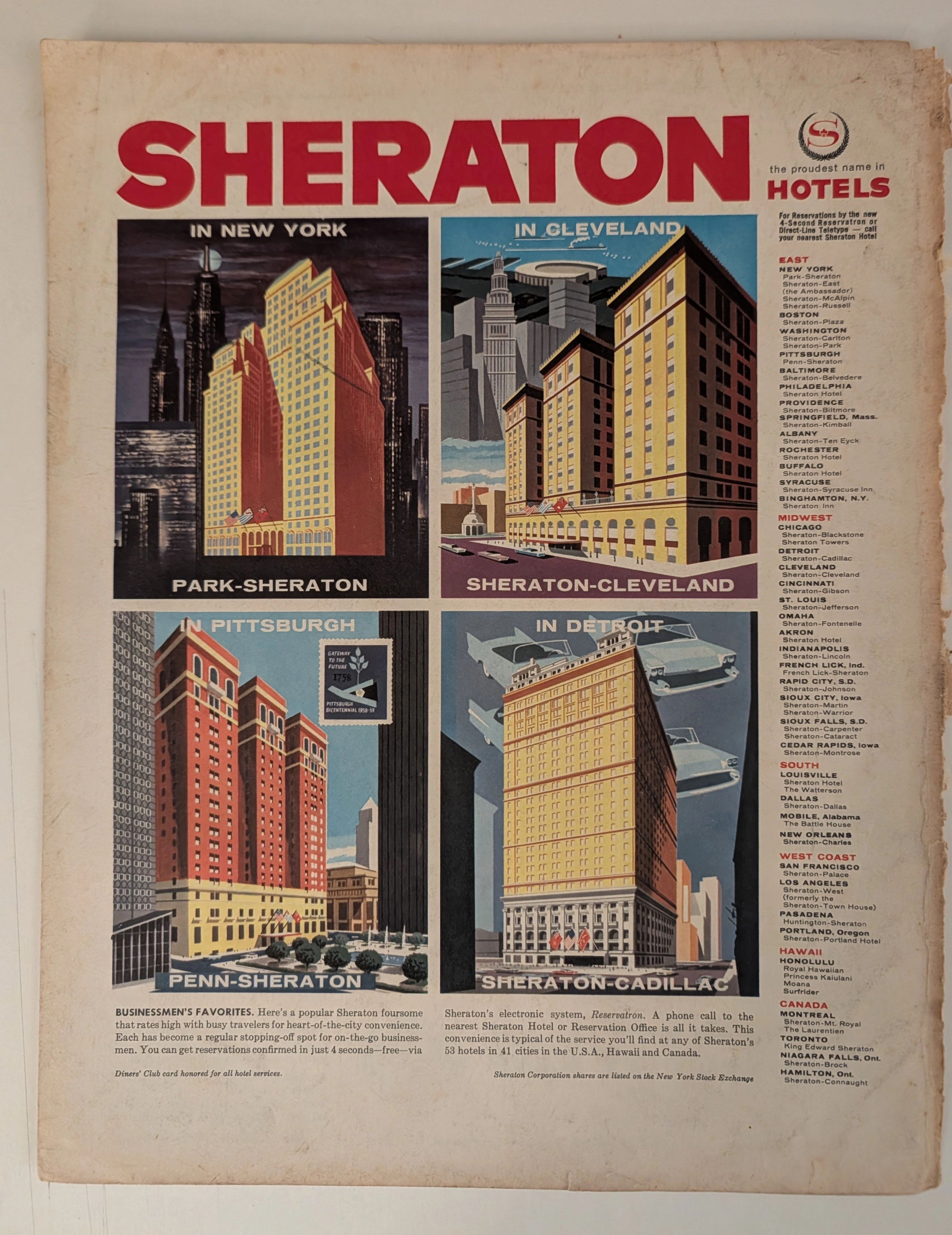
( THE HISTORY: The Sheraton Empire, the Reservatron Innovation, and the Diners' Club Revolution ) As the Chief Curator of The Record, the guardian of analog history, I welcome you to the absolute, breathtaking zenith of post-war American capitalist ambition. The impeccably preserved Historical Relic that lies before you is not merely a piece of disposable hotel advertising. It is a forensic "Sociological Blueprint of Corporate Travel," meticulously engineered during an era of unprecedented American supremacy. This Primary Art Document represents the sheer might of Sheraton Hotels, a conglomerate that boldly declared itself "the proudest name in HOTELS". The initial, staggering revelation of this artifact is its forensic dating precision. If you direct your analytical focus to the illustration of the Penn-Sheraton building in Pittsburgh, you will discover a meticulously rendered postage stamp bearing the text: "GATEWAY TO THE FUTURE 1758 PITTSBURGH BICENTENNIAL 1958-59". This microscopic detail serves as an undeniable historical hallmark, confirming that this masterpiece was published exactly between 1958 and 1959—the heart of the Cold War and the dawn of the Space Age. The Visual Architecture of this document is a monumental four-panel layout, aggressively showcasing four hyper-stylized architectural titans: Park-Sheraton (New York): Depicted as a towering monolith against a dramatic night sky, with a glowing moon and the iconic Chrysler Building lurking in the background, symbolizing the absolute center of global wealth. Sheraton-Cleveland: Showcasing a booming industrial metropolis with the majestic Terminal Tower standing guard behind the glowing hotel facade. Penn-Sheraton (Pittsburgh): The Steel City immortalized alongside its Bicentennial stamp. Sheraton-Cadillac (Detroit): The most visually arresting, surreal panel. The grand hotel is surrounded by ethereal, translucent mid-century automobiles—complete with massive, aggressive tail-fins—floating in the sky like alien spacecraft. This is a masterful, artistic homage to the "Motor City" at the height of its global automotive dominance. Yet, the true, earth-shattering historical gravity of this document lies hidden in the typography at the bottom. Sheraton is actively promoting two world-altering innovations. First: "Sheraton's electronic system, Reservatron.". This is a vital piece of computing history. The Reservatron was one of the earliest commercial electronic reservation systems ever deployed in the hospitality industry, promising confirmed reservations in just 4 seconds. This advertisement captures the exact moment the world began transitioning into the digital age. Second: "Diners' Club card honored for all hotel services.". In the 1950s, consumer credit was financial sorcery. The Diners' Club pioneered the plastic credit card, liberating the elite "Businessmen" from carrying massive amounts of cash. By accepting this card, Sheraton defined the new standard of high-end corporate travel. They seal this aura of immense corporate power with a final flex: "Sheraton Corporation shares are listed on the New York Stock Exchange". This is not selling a room; it is selling absolute financial authority. ( THE PAPER: The Aesthetics of Decay (Wabi-Sabi) — The Chemical Scars of Capitalism Burning Alive ) At The Record, our ultimate, uncompromising reverence is reserved for the inevitable, tragic, and spectacular beauty of analog destruction. This standalone Primary Art Document was surgically rescued, liberated, and meticulously preserved. Mass-market business magazines in the 1950s were printed on highly acidic wood-pulp paper. They were explicitly designed by their publishers for mass, disposable consumption, harboring a fatal chemical death sentence within their very fibers from the millisecond they rolled off the printing press. Direct your curatorial gaze to the physical borders of this artifact. The right margin exhibits a violently jagged, rough tear. This is not careless damage; it is the forensic, physical evidence of a rescued relic, surgically liberated from the glued binding of a decaying magazine destined for the incinerator. Over the course of nearly 70 years, ambient oxygen and ultraviolet light have waged a relentless, unstoppable chemical war against the paper's inherent lignin. This irreversible oxidation process has birthed the magnificent, undeniable "patina" you see creeping inward from the edges. The once-stark margins have gracefully degraded into a warm, creamy ivory and a deep, burning amber. The authentic analog halftone dots of the lithography ink have settled permanently into the brittle, degrading, and fragile fibers. This is the profound Japanese aesthetic of wabi-sabi—the spiritual realization of finding absolute perfection in impermanence and decay. This paper is quietly, literally burning itself alive at a molecular level. Its slow, majestic, and irreversible death is precisely what transfigures it into an immortal piece of Primary Art. ( THE RARITY: Class A — A Miraculous Survivor of Corporate Expansion ) To understand the immense valuation of this artifact, you must comprehend the brutal survival odds of corporate travel ephemera from the 1950s. These publications were exclusively designed to be read in waiting rooms or airplanes and then immediately discarded. The statistical probability of a magazine page containing such complex, multi-paneled, hyper-detailed illustrations surviving nearly seven decades in such crisp, visually immaculate condition—with vibrant ink and no devastating moisture rot—is staggeringly, miraculously low. When you fuse this extreme physical scarcity with the monumental historical significance of the "Reservatron" and the dawn of the "Diners' Club", alongside the surreal automotive art of the Detroit panel, this artifact unequivocally commands the highly prestigious Rarity Class A designation. It has evolved far, far beyond a disposable piece of vintage advertising. It is a highly coveted Historical Relic, demanding to be framed and fiercely protected by an alpha curator or collector who truly understands the heavy, beautiful, and irreplaceable weight of American corporate history.
THE TIME TRAVELER'S DOSSIER: THE ARCHITECTURE OF POWER AND THE BIRTH OF THE DIGITAL WORLD IN THE 50S
The artifact under exhaustive, uncompromising museum-grade analysis is a remarkably preserved Historical Relic originating from the absolute zenith of the post-war American economic boom. This Primary Art Document is a sweeping, monumental full-page advertisement for the Sheraton Hotels empire, forensically dated to circa 1958–1959 via the explicitly illustrated Pittsburgh Bicentennial (1758-1958) stamp embedded within the artwork. This document is not merely a travel advertisement; it is a profound "Sociological Blueprint of the American Corporate Ascendancy." Visually anchored by four hyper-stylized, architectural illustrations of Sheraton's flagship properties—New York, Cleveland, Pittsburgh, and Detroit—the piece captures the era's unbridled optimism. Each panel is a masterpiece of mid-century commercial illustration, particularly the Detroit panel featuring ethereal, floating tail-fin automobiles symbolizing the Motor City's dominance. Furthermore, this artifact documents critical milestones in global business history. It proudly advertises the acceptance of the Diners' Club card, marking the revolutionary dawn of the modern credit card era. It also boasts of Sheraton's "Reservatron" electronic system—one of the earliest commercial applications of computing in the hospitality industry—and proudly declares its listing on the New York Stock Exchange. Rescued from the binding of a forgotten, heavy-stock periodical, this pre-2000s analog artifact is an unforgeable testament to the Japanese aesthetic of wabi-sabi. Printed on inherently acidic wood-pulp paper, it exhibits a beautifully violent, jagged right margin and a deep, warm amber oxidation across its surface. This majestic, unstoppable chemical degradation transforms a mass-produced corporate propaganda piece into an irreplaceable, ready-to-frame Primary Art Document of mid-century architectural and economic history.
Cite this article
- MLA
- Naodhinsuk, Ronin. “THE TIME TRAVELER'S DOSSIER: THE ARCHITECTURE OF POWER AND THE BIRTH OF THE DIGITAL WORLD IN THE 50S.” The Record Institute, 8 March 2026, https://therecord.institute/journal/the-time-travelers-dossier-the-architecture-of-power-and-the-birth-of-the-digital-world-in-the-50s.
- APA
- Naodhinsuk, R. (2026, March 8). THE TIME TRAVELER'S DOSSIER: THE ARCHITECTURE OF POWER AND THE BIRTH OF THE DIGITAL WORLD IN THE 50S. The Record Institute. https://therecord.institute/journal/the-time-travelers-dossier-the-architecture-of-power-and-the-birth-of-the-digital-world-in-the-50s
- CHICAGO
- Naodhinsuk, Ronin. 2026. “THE TIME TRAVELER'S DOSSIER: THE ARCHITECTURE OF POWER AND THE BIRTH OF THE DIGITAL WORLD IN THE 50S.” The Record Institute, March 8, 2026. https://therecord.institute/journal/the-time-travelers-dossier-the-architecture-of-power-and-the-birth-of-the-digital-world-in-the-50s.