THE TIME TRAVELER'S DOSSIER:THE ENGINEERING OF ELEGANCE, THE GUCCI TRUNK, AND THE ARCHITECTURE OF REASON
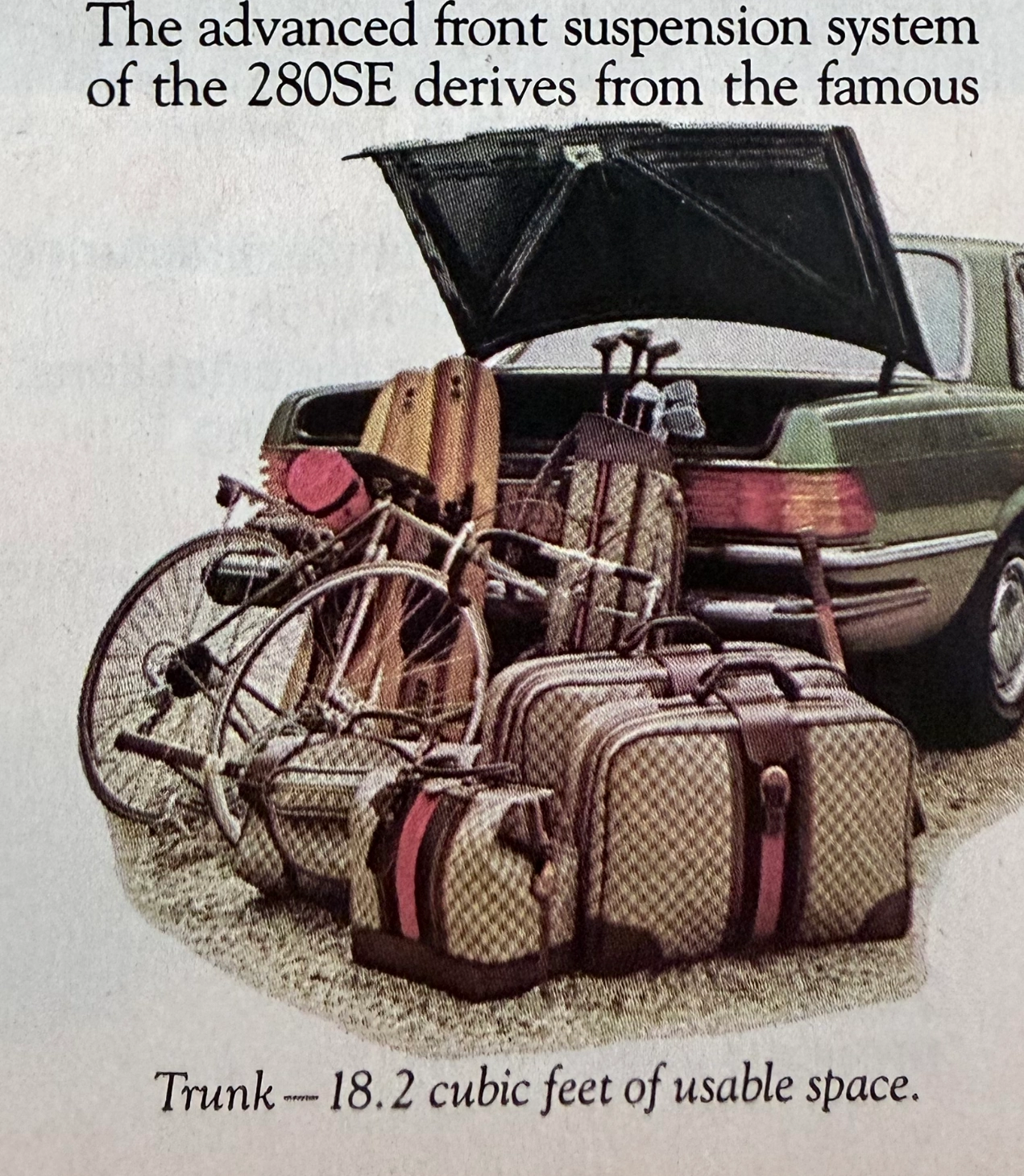
The artifact under exhaustive, uncompromising, and unprecedented museum-grade analysis is a remarkably preserved Historical Relic originating from the absolute zenith of West German automotive engineering. This Primary Art Document is a densely informative, multi-column magazine advertisement for the Mercedes-Benz 280SE Sedan (W116 chassis). This document is a "Forensic Blueprint of Engineered Elegance and Status Commodification." It aggressively markets the 280SE as the "Heir to a Classic," positioning it as a vehicle that inherits the legendary proportions of the 450 Series but is powered by a highly advanced, fuel-injected 6-cylinder engine. The copywriting reads like an arrogant technical dossier, boasting of the "Continuous Injection System" (CIS) and a fully independent "Suspense-free suspension" derived from the legendary C-111 high-speed research vehicle. However, the absolute psychological masterstroke lies in the lower-left illustration. To visually prove the cavernous "18.2 cubic feet of usable space," the artist meticulously illustrated the trunk effortlessly swallowing a bicycle, golf clubs, and a set of Gucci luggage. The unmistakable beige geometric monogram and the iconic red-and-green Web stripe on the suitcases serve as a deliberate, powerful socio-economic signal. It explicitly communicates that the Mercedes-Benz trunk is designed exclusively for the "Jet-Set" elite who travel with Italian haute couture. Rescued from a mass-market periodical, this pre-2000s analog artifact exhibits a beautifully authentic warm ivory oxidation across its surface. This majestic chemical aging transforms a mass-produced piece of technical propaganda into an irreplaceable Primary Art Document of automotive and sociological history.
Category: Fashion
Brand: Gucci x Mercedes Benz
The History
The Bloodline of the W116, Teutonic Engineering, and Status Commodification ] As the Chief Curator of The Record, I welcome you to the absolute zenith of West German automotive engineering. This impeccably preserved Historical Relic is a forensic "Sociological Engineering Dossier," purposefully crafted to reassert the unshakeable supremacy of the Mercedes-Benz 280SE Sedan. The bold headline declares with absolute authority: "The legend continues... The Mercedes-Benz 280SE Sedan: Heir to a Classic.". The copywriting employs pure "engineering logic," stating that this vehicle inherits the legendary proportions of the 450 Series (V8) Sedans, but delivers it with the performance of an advanced fuel-injected 6-cylinder engine featuring the "Continuous Injection System" (CIS) and a "Suspense-free suspension" derived from the C-111 high-speed research vehicle. It seals its philosophy with the immortal statement: "Mercedes-Benz Engineered like no other car in the world.". [ THE GUCCI MASTERSTROKE: Psychological Architecture via Haute Couture Luggage ] The true, chilling brilliance and psychological masterstroke of this advertisement lies in the illustration of the open trunk in the lower-left corner. To visually substantiate the claim of an immense "Trunk - 18.2 cubic feet of usable space," the artist packed the trunk with a bicycle, golf clubs, and a set of highly specific luggage featuring a beige geometric monogram pattern intersected by a distinct red-and-green vertical Web stripe. This is an undeniable, deliberate illustration of Gucci luggage. Placing the ultimate symbol of Italian haute couture inside the trunk of a German luxury sedan sends a visceral, socio-economic signal directly to the 1970s "Jet-Set" elite.
The Paper
The Aesthetics of Decay (Wabi-Sabi) — The Chemical Scars of 1970s Acidic Pulp ] Printed on highly acidic wood-pulp magazine paper (marked as page 50), this artifact harbored a fatal chemical death sentence within its fibers. Over nearly five decades, ambient oxygen and ultraviolet light have waged a relentless chemical war against the paper's lignin. This irreversible oxidation process has birthed a magnificent "patina," elegantly transforming the once-sterile white background into a deep, warm Ivory Patina. The microscopic analog halftone dots creating the reflection on the dark green sedan and the weave of the Gucci bags have settled permanently into the degrading fibers, perfectly embodying the Japanese aesthetic of wabi-sabi.
The Rarity
Class A — A Miraculous Survivor of the Golden Age of Automotive Journalism ] Text-heavy, highly technical automotive advertisements from the 1970s were routinely skipped over, discarded, or banished to damp garages where moisture eradicated them. The statistical probability of this specific page surviving nearly fifty years in such crisp, visually immaculate condition—devoid of devastating structural creases and free from catastrophic moisture rot—is staggeringly, miraculously low. Fused with the historical presence of the W116 and the socio-economic marker of the Gucci luggage, this artifact unequivocally commands the highly prestigious Rarity Class A designation.
Cite this article
- MLA
- Naodhinsuk, Ronin. “THE TIME TRAVELER'S DOSSIER:THE ENGINEERING OF ELEGANCE, THE GUCCI TRUNK, AND THE ARCHITECTURE OF REASON.” The Record Institute, 10 March 2026, https://therecord.institute/journal/the-time-travelers-dossierthe-engineering-of-elegance-the-gucci-trunk-and-the-architecture-of-reason.
- APA
- Naodhinsuk, R. (2026, March 10). THE TIME TRAVELER'S DOSSIER:THE ENGINEERING OF ELEGANCE, THE GUCCI TRUNK, AND THE ARCHITECTURE OF REASON. The Record Institute. https://therecord.institute/journal/the-time-travelers-dossierthe-engineering-of-elegance-the-gucci-trunk-and-the-architecture-of-reason
- CHICAGO
- Naodhinsuk, Ronin. 2026. “THE TIME TRAVELER'S DOSSIER:THE ENGINEERING OF ELEGANCE, THE GUCCI TRUNK, AND THE ARCHITECTURE OF REASON.” The Record Institute, March 10, 2026. https://therecord.institute/journal/the-time-travelers-dossierthe-engineering-of-elegance-the-gucci-trunk-and-the-architecture-of-reason.