THE TIME TRAVELER'S DOSSIER: THE DAWN OF ELEGANCE AND THE EXTINCT $1,500 HOLY GRAIL — The Record Institute Journal
3 Photos
March 6, 2026

THE TIME TRAVELER'S DOSSIER: THE DAWN OF ELEGANCE AND THE EXTINCT $1,500 HOLY GRAIL

Click any image to view in high resolution

The History

" THE HISTORY: The Brutalist Dark Ages, Roudnitska's Genius, and the Playboy Ethos "
As the Chief Curator of The Record, I welcome you to our sensory vault. We do not merely cast a superficial glance at this piece of paper; we forensically dissect the profound cultural shockwave it represents. The artifact before you—an isolated, meticulously preserved Historical Relic featuring the iconic advertisement for EAU SAUVAGE Christian Dior, rescued from a vintage issue of PLAYBOY—is far more than a mid-century grooming ad. It is the precise historical inflection point where modern masculine identity, elegance, and grooming were irrevocably redefined.

​To truly grasp the monumental gravity of this Primary Art Document, you must immerse yourself in the olfactory landscape of the world prior to 1966. For decades following World War II, men's colognes and aftershaves were largely brutalist concoctions. They were heavy, aggressive, suffocating walls of animalic musk (civet and castoreum), sharp pine, pungent tobacco, and dense leather. The cultural mandate of the era dictated that men should smell rugged and unrefined; fragrances were utilized primarily to mask sweat and project an uncompromising, almost aggressive aura of masculinity. Elegance and floral lightness were strictly taboo, relegated exclusively to women's perfumery.
​Enter the legendary House of Dior and the unparalleled genius of Master Perfumer Edmond Roudnitska. Tasked with the daunting challenge of creating Dior's first-ever men's fragrance, Roudnitska brazenly tore up the established rulebook. He envisioned a man who was confident enough to embrace refinement. He engineered a brilliant, sparkling, and impeccably balanced accord of lemon, bergamot, rosemary, and basil. But his stroke of absolute historical genius—the move that cemented his legacy—was the unprecedented inclusion of Hedione (methyl dihydrojasmonate), a newly isolated synthetic compound.

​Hedione provided a luminous, airy, and transparent floral jasmine note without the heavy, narcotic weight of the actual flower. It was entirely revolutionary for a men's scent. It made Eau Sauvage fiercely fresh, yet devastatingly elegant and quietly seductive. It taught an entire generation of men that sophistication and vulnerability did not compromise their masculinity. The ad's beautifully understated copy, "Fresh citrus mingles with brisk herbs and cultivated woods in Eau Sauvage Cologne for men," is a masterclass in quiet, lethal confidence.
​But why was this masterpiece strategically placed in the pages of PLAYBOY? (Note the iconic magazine title printed sideways along the left margin, a subtle nod to its origin). In the late 1960s and 1970s, Hugh Hefner's Playboy was not just a men's magazine; it was the ultimate architectural blueprint for the "Urbane Bachelor." It represented the transition from the domestic family man of the 1950s to the sophisticated, jet-setting, cultured single man of the future. By placing this ad here, Dior executed flawless psychological warfare, specifically targeting the elite, upwardly mobile professional. The visual presentation is astonishing: the bottle, brilliantly designed by Pierre Camin to mimic a gentleman's silver pocket hip flask with its diagonal ribbed glass (godrons) and thimble cap, sits against a rich, masculine background of faux-burl wood. Dior positioned Eau Sauvage not as a mere cosmetic, but as an indispensable accessory of elite bachelorhood, commanding the same respect as a finely tailored suit, a Cuban cigar, or an aged scotch.

​However, the true, chilling gravitas of this Primary Art Document lies in its absolute finality. The original mid-century formulation of Eau Sauvage—rich in unrestricted Hedione and deep, natural oakmoss—along with the exquisite, specific bottle design shown here, are permanently discontinued and extinct. Over the decades, stringent regulations by the International Fragrance Association (IFRA) regarding allergens have banned natural oakmoss and forced massive reformulations. The Eau Sauvage sold in department stores today is a mere ghost, a synthetic echo of Roudnitska's original masterpiece.
​Consequently, authentic vintage bottles from this specific era have ascended to the status of ultimate "Holy Grails" in the global fragrance community. Today, a pristine, sealed vintage bottle of the formulation depicted in this ad commands staggering prices of up to $1,500 USD in the elite collector's market. Therefore, this preserved page transcends its original purpose as advertising; it is a vital piece of historical provenance. It is the birth certificate, the verified documentary evidence of a luxurious ghost of the 20th century that money can scarcely buy anymore.
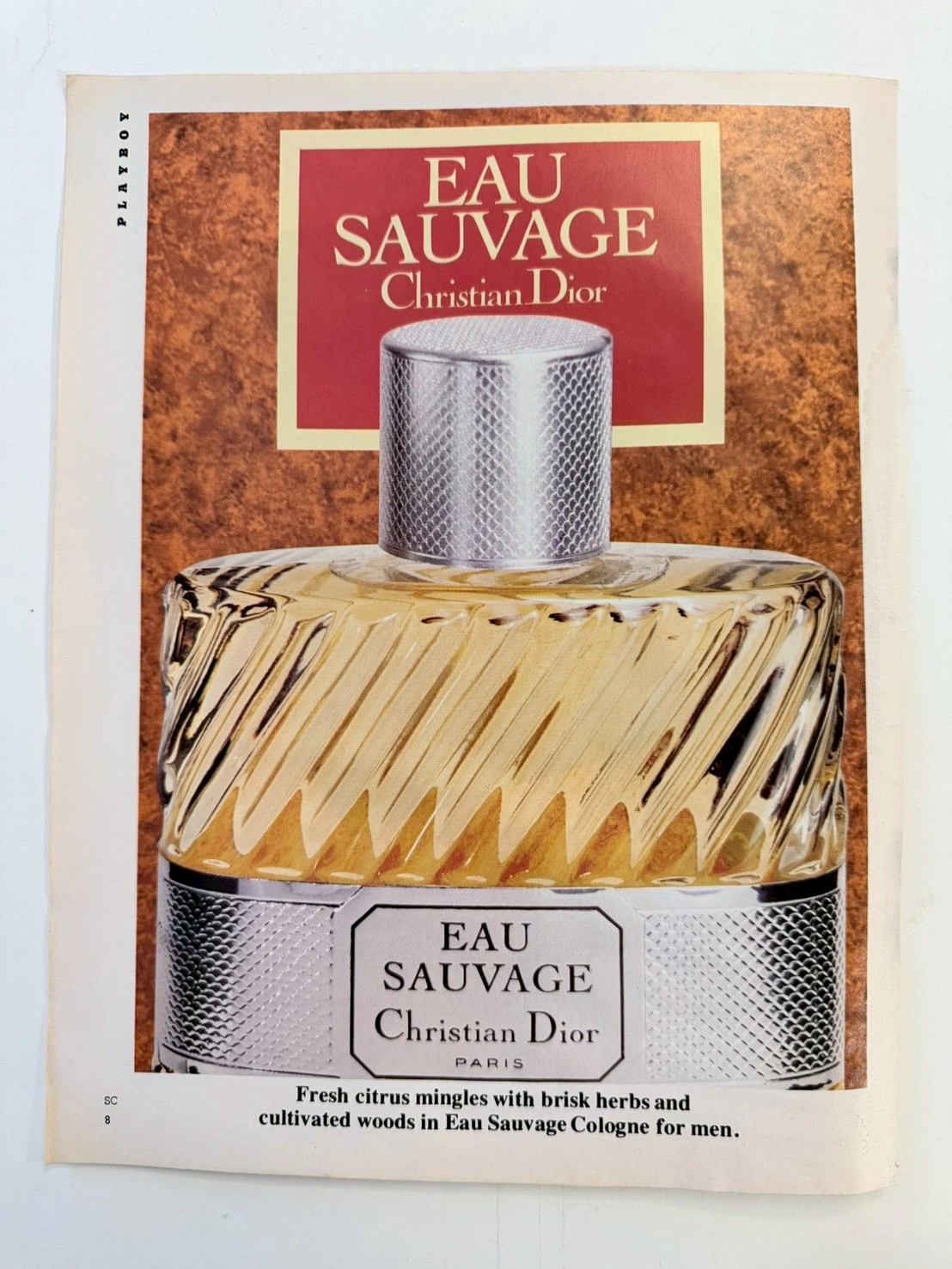
( THE PAPER: The Aesthetics of Decay — The Chemistry of Aging Pulp )
At The Record, our highest reverence is reserved for the inevitable, beautiful destruction of analog media. This standalone Primary Document was surgically rescued from the thick spine of a vintage Playboy. While the publication utilized a high-quality glossy paper stock to ensure image fidelity, beneath that deceptive sheen lies highly acidic wood-pulp—a medium born with a chemical death sentence.

After more than half a century, the glossy coating has developed microscopic fissures, allowing ambient oxygen and UV light to wage a slow, relentless chemical war against the paper's inherent lignin. This oxidation process births the magnificent "patina" you see before you. The once-stark, sterile white margins have gracefully aged into a warm, creamy ivory and deep amber. The high-grade offset lithography ink has settled deep into the degrading, brittle fibers, making the burl wood texture appear hyper-realistic and almost three-dimensional. This is the profound beauty of analog decay—the Japanese aesthetic of wabi-sabi, finding perfection in impermanence. This paper is quietly, literally burning itself alive at a molecular level. You cannot digitally replicate the fragile, tactile soul, nor the faint vanilla-scented off-gassing of an original 1970s magazine page. Its slow, irreversible death is precisely what makes it immortal as a piece of art.

( THE RARITY: Class A — A Surviving Testament to Taste )
Men's magazines from this era were the epitome of mass consumption. They were overwhelmingly read, discarded, hidden in damp basements, thrown into incinerators, or destroyed by mold and neglect. The statistical probability of a magazine page surviving 50 years in such immaculate, crisp condition is astoundingly low. The survival of this preserved ephemera is a physical triumph against the ravages of time.

Because this artifact represents a pivotal cultural revolution in men's fashion, documents an extinct, discontinued formulation currently valued at $1,500 USD, features timeless mid-century minimalist design, and survives on a rapidly disappearing, self-destructing analog medium, this piece undeniably commands a Rarity Class A designation. It has evolved from a disposable commercial message into a highly coveted Historical Relic, ready to be framed in the study of a discerning gentleman who truly understands the heavy, beautiful weight of history.

( THE RARITY: คลาส A — มรดกที่รอดพ้นจากเตาเผาขยะ )
นิตยสารผู้ชายในยุคนั้น คือสิ่งพิมพ์ที่ถูกสร้างมาเพื่อการบริโภคแล้วทิ้ง (Mass Consumption) พวกมันถูกอ่าน ถูกซ่อน ถูกทิ้งลงถังขยะ ถูกเผาในเตาผิง หรือถูกความชื้นและเชื้อราในโรงรถกัดกินจนเปื่อยยุ่ย อัตราการรอดชีวิตของหน้ากระดาษโฆษณาในสภาพที่คมชัดและสมบูรณ์แบบ (Very Good Condition) เช่นนี้ มีเปอร์เซ็นต์ที่ต่ำจนน่าตกใจ การที่กระดาษแผ่นนี้รอดพ้นจากเงื้อมมือของกาลเวลามากว่า 50 ปี ถือเป็นปาฏิหาริย์ทางสิ่งพิมพ์
เมื่อเรานำปัจจัยทั้งหมดมารวมกัน: 1) ความสำคัญในฐานะโฆษณาชิ้นเอกที่พลิกโฉมหน้าประวัติศาสตร์น้ำหอมโลก 2) สถานะการเป็นเอกสารรับรอง (Provenance) ของน้ำหอมรุ่น Discontinued ที่มีมูลค่าสูงถึง $1,500 USD 3) การออกแบบกราฟิกที่เรียบหรูเหนือกาลเวลาของยุค Mid-Century และ 4) ความหายากของกระดาษพิมพ์อนาล็อกที่มีสุนทรียภาพแห่งความเสื่อมสลาย ชิ้นงานนี้จึงถูกกู้คืนและประทับตราให้อยู่ใน Rarity Class A อย่างไร้ข้อกังขา มันคือ Historical Relic ชั้นยอดที่รอให้สุภาพบุรุษผู้มีวิสัยทัศน์ นำไปเข้ากรอบเพื่อครอบครองเศษเสี้ยวของประวัติศาสตร์แห่งความหรูหรา ที่เงินไม่สามารถเสกขึ้นมาใหม่ได้อีกแล้ว

Share This Archive

The Archive Continues

Continue the Exploration

THE TIME TRAVELER'S DOSSIER: THE GOLDEN LIE AND THE PROPAGANDA OF 1936

THE TIME TRAVELER'S DOSSIER: THE GOLDEN LIE AND THE PROPAGANDA OF 1936

The artifact under exhaustive, uncompromising, and unprecedented museum-grade analysis is an exceptionally rare, battle-scarred Historical Relic originating from the absolute zenith of the American tobacco empire. This Primary Art Document is a monumental, full-page advertisement for Lucky Strike Cigarettes, forensically and definitively dated to 1936 by the explicit copyright text: "Copyright, 1936, The American Tobacco Company". This is not merely a vintage tobacco ad; it is a profound "Sociological Blueprint of Corporate Propaganda" from the interwar period. Emerging in the heart of the Great Depression, this artifact captures the audacious peak of 1930s psychological marketing. The commanding headline, "Smoke to Your Throat's Content", represents the era's surreal, medically ironic strategy where tobacco conglomerates aggressively marketed deadly carcinogens as "smooth" and "non-irritating" to the throat. Furthermore, the legendary slogan "It's Toasted" serves as a masterclass in advertising spin, transforming a standard manufacturing process into an exclusive health benefit. Visually, the ad brilliantly normalizes and glamorizes female smoking—a direct continuation of the industry's sociological engineering to double their consumer base. Rescued from the inevitable oblivion of disposable mass media, this pre-2000s analog artifact is a breathtaking embodiment of the Japanese aesthetic of wabi-sabi. Printed on highly acidic wood-pulp paper, it exhibits severe, violent edge trauma, deep structural creasing, ancient tape residue, and a profound, burning amber oxidation across its entire surface. This unstoppable molecular death transforms a piece of mass-produced corporate propaganda into an irreplaceable, ready-to-frame Primary Art Document of American marketing history.

THE TIME TRAVELER'S DOSSIER: THE COMMODIFICATION OF STATUS AND THE ART OF THE ELEGANT ILLUSION

THE TIME TRAVELER'S DOSSIER: THE COMMODIFICATION OF STATUS AND THE ART OF THE ELEGANT ILLUSION

The artifact under exhaustive, uncompromising, and unprecedented museum-grade analysis is an exceptionally preserved Historical Relic originating from the absolute zenith of Madison Avenue's psychological marketing era (circa late 1940s to 1950s). This Primary Art Document is a monumental, full-page advertisement for LORD CALVERT, produced by the Calvert Distillers Corp., New York City. ​This piece represents the visual anchor for one of the most legendary, extensively studied, and phenomenally successful advertising campaigns in the history of American capitalism: "For Men of Distinction". It features a masterful, hyper-realistic portrait of Mr. Hiram U. Helm, Distinguished Rancher, deliberately painted/photographed to exude rugged sophistication, wealth, and aristocratic leisure. The artwork proudly bears the signature of SARRA (Valentino Sarra), a titan of mid-century commercial photography and illustration known for his cinematic lighting and profound character studies. ​This document is a profound "Sociological Blueprint of Aspirational Wealth." It masterfully utilized the psychology of exclusivity, marketing a blended whiskey composed of "65% Grain Neutral Spirits" as a "Custom" blend intended only "for those who can afford the finest". ​Rescued from the inevitable oblivion of disposable mass media, this mid-century analog artifact is a breathtaking embodiment of the Japanese aesthetic of wabi-sabi. Printed on inherently acidic wood-pulp paper, it exhibits a beautifully authentic, warm amber oxidation across its entire surface. This unstoppable molecular death transforms a piece of mass-produced corporate propaganda into an irreplaceable, ready-to-frame Primary Art Document of post-war sociological history.

The Time Traveller's Dossier: Engineering as High Art – 1981 Honda CBX Advertisement

HONDA · Automotive

The Time Traveller's Dossier: Engineering as High Art – 1981 Honda CBX Advertisement

History is not written; it is printed. Before digital algorithms dictated human behavior, societal engineering was executed through the calculated geometry of the four-color offset press. The historical artifact before us is not merely an advertisement; it is a weaponized blueprint of mechanical aspiration and a testament to the golden age of Japanese technological supremacy. This museum-grade archival dossier presents an academic deconstruction of a 1981 print advertisement for the legendary Honda CBX. Operating on a profound binary structure, it documents a calculated paradigm shift within the global motorcycle industry. It illustrates the precise historical fracture where the motorcycle was conceptually transitioned from a stigmatized symbol of counter-culture rebellion into a highly sophisticated, aerodynamic marvel tailored for the affluent connoisseur. Through the lens of late-analog commercial artistry and precise visual forensics, this document serves as a masterclass in psychological marketing, establishing the archetype of the high-tech superbike that unconditionally dominates modern automotive pop culture.

Published by

The Record Institute