THE TIME TRAVELER'S DOSSIER: THE COMMODIFICATION OF STATUS AND THE ART OF THE ELEGANT ILLUSION — The Record Institute Journal
3 Photos
March 8, 2026

THE TIME TRAVELER'S DOSSIER: THE COMMODIFICATION OF STATUS AND THE ART OF THE ELEGANT ILLUSION

Click any image to view in high resolution

Tobacco

The History

(THE HISTORY: The Genesis of "Men of Distinction", SARRA's Lens, and the Psychology of the Capitalist Superman )

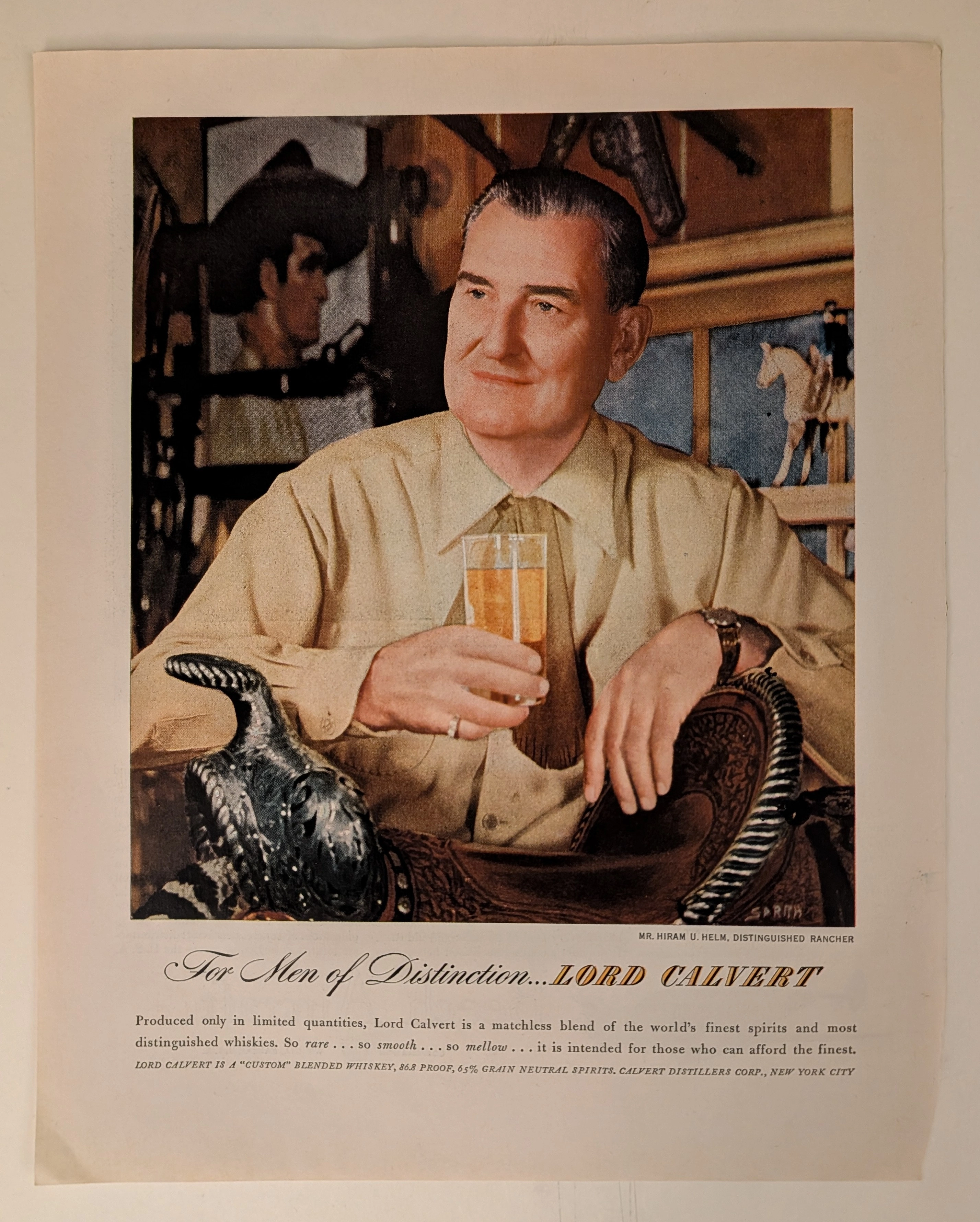
​As the Chief Curator of The Record, the guardian of analog history, I welcome you to the absolute, pulsating epicenter of Madison Avenue's golden age. The impeccably preserved Historical Relic that lies before you is not a mere, soulless vintage liquor advertisement designed to push inventory. It is a forensic "Sociological Blueprint of Aspirational Wealth," meticulously engineered in the mid-century to explicitly define the parameters of male success in post-war America. This Primary Art Document serves as the formidable visual anchor for the legendary LORD CALVERT whiskey campaign.

​This artifact documents what is unarguably one of the greatest, most studied, and phenomenally successful advertising campaigns in corporate history: "For Men of Distinction." During this era, brilliant ad executives realized a profound truth: consumers do not buy products; they buy the idealized reflection of who they desperately want to be. The campaign revolutionized the industry by refusing to use standard male models. Instead, it exclusively featured highly successful, real-world alpha males from various professions. The imposing figure occupying this canvas is Mr. Hiram U. Helm, Distinguished Rancher.

​Analyze the deliberate, culturally loaded Visual Architecture: Mr. Helm is not wearing a stifling Wall Street suit. He is dressed in a meticulously tailored western shirt, sleeves casually rolled up to display rugged, working-class masculinity, while holding a crystal glass of whiskey with effortless grace. The background is a masterclass in psychological staging: the exquisitely tooled leather saddle in the foreground, the equine statues, and the rifles mounted on the wood-paneled wall. This composition violently communicates a specific narrative: The man who has reached the absolute pinnacle of success no longer needs to prove himself in a boardroom; he retreats to his private, opulent empire to drink the finest spirits.

​The monumental artistic gravity of this piece is forensically cemented by the signature SARRA in the lower right corner. Valentino Sarra was an absolute titan of mid-century commercial photography. He was renowned for his signature cinematic lighting and his pioneering "photo-illustration" techniques, which blended the realism of a photograph with the hyper-realistic, glowing textures of an oil painting.

​The Psychological Masterstroke: The true, chilling brilliance of this advertisement lies in the microscopic text at the bottom. The copy haughtily claims that Lord Calvert is "Produced only in limited quantities" and is intended exclusively "for those who can afford the finest". Yet, the mandatory legal text reveals the industrial truth: "LORD CALVERT IS A 'CUSTOM' BLENDED WHISKEY, 86.8 PROOF, 65% GRAIN NEUTRAL SPIRITS." The sheer audacity to take a highly profitable blend containing 65% cheap neutral spirits, brand it as a "Custom" blend, and sell it at a premium price to middle-class men desperate to feel like "Men of Distinction" is the absolute zenith of Madison Avenue marketing spin. It is the masterful commodification of an illusion.

​( THE PAPER: The Aesthetics of Decay (Wabi-Sabi) — The Chemical Scars of 1950s Acidic Pulp Burning Alive )
​At The Record, our ultimate, uncompromising reverence is reserved for the inevitable, tragic, and spectacular beauty of analog destruction. This standalone Primary Art Document was surgically rescued, liberated, and meticulously preserved. Mass-market magazines in the mid-century were printed on highly acidic wood-pulp paper. They were explicitly designed by their publishers for mass, disposable consumption, harboring a fatal chemical death sentence within their very fibers from the millisecond they rolled off the roaring printing presses.
​Direct your curatorial, analytical gaze to the surface of the paper. After more than seven decades, ambient oxygen and ultraviolet light have waged a relentless, unstoppable chemical war against the paper's inherent lignin. This irreversible oxidation process has birthed a magnificent, undeniable "patina," elegantly transforming the once-sterile white margins into a warm, creamy ivory and a deep, toasted amber. The authentic, microscopic analog halftone dots that make up Sarra's cinematic lighting on Mr. Helm's face and the intricate details of the leather saddle have settled permanently into the brittle, degrading, and fragile fibers. This is the profound Japanese aesthetic of wabi-sabi—the spiritual realization of finding absolute perfection in impermanence and decay. This paper is quietly, literally burning itself alive at a molecular level. Its slow, majestic, and irreversible death is precisely what transfigures it from a disposable magazine page into an immortal piece of Primary Art.

​( THE RARITY: Class A — A Miraculous Survivor of the Brutal Consumer Purges )
​To understand the immense valuation of this artifact, you must comprehend the brutal reality of ephemera survival. Millions of these advertisements were printed, but they were manufactured exclusively and purposefully to be thrown away. The statistical probability of a magazine page surviving 70 years in such crisp, visually immaculate condition—where the micro-details of SARRA's signature remain hyper-sharp and the paper bears no devastating, structure-ruining moisture rot—is staggeringly, miraculously low.
​When you fuse this extreme physical scarcity with the monumental, legendary historical presence of the "Men of Distinction" campaign—a veritable holy grail for Americana, advertising history, and sociology scholars globally—this artifact unequivocally commands the highly prestigious Rarity Class A designation. It has evolved far, far beyond a disposable piece of vintage commercial advertising. It is a highly coveted Historical Relic, demanding to be framed and fiercely protected by an alpha curator who truly understands the heavy, beautiful, and irreplaceable weight of American capitalist history.

Share This Archive

The Archive Continues

Continue the Exploration

Anatomy of a Monster: The Moto Guzzi V8 Technical Masterpiece

Anatomy of a Monster: The Moto Guzzi V8 Technical Masterpiece

Unearthing a rare technical illustration of the legendary Moto Guzzi V8 engine by Bob Freeman, preserved on naturally aged, pre-2000 analog print media.

The Marilyn Monroe Enigma: Uncovering 1950s Hollywood Secrets Through Ultra-Rare Vintage Magazine Art (Class SS)

The Marilyn Monroe Enigma: Uncovering 1950s Hollywood Secrets Through Ultra-Rare Vintage Magazine Art (Class SS)

This museum-grade editorial explores an ultra-rare SS-Class archival piece from The Record Institute. It chronicles the 1980 Playboy magazine discovery of lost Marilyn Monroe negatives, eventually solved by legendary illustrator Jon Whitcomb. The artifact not only captures the vulnerability of the 1950s ultimate sex symbol alongside Arthur Miller but also serves as a poignant historical record of the transition from the Golden Age of Illustration to modern photography, celebrating the visceral charm of analog paper preservation.

THE TIME TRAVELER'S DOSSIER: THE STRATOSPHERIC MANSION AND THE AESTHETICS OF DECAY

THE TIME TRAVELER'S DOSSIER: THE STRATOSPHERIC MANSION AND THE AESTHETICS OF DECAY

The artifact under exhaustive, museum-grade analysis is a flawlessly preserved Historical Relic originating from the absolute dawn of the commercial Jet Age (circa late 1950s to early 1960s). This Primary Art Document is a magnificent full-page advertisement for the Douglas DC-8, the aerospace leviathan engineered to rival the Boeing 707 and conquer the global skies. ​Visually anchored by an elegant, sweeping illustration of the aircraft's exterior and a highly detailed, evocative rendering of its opulent passenger lounge, the piece represents the zenith of mid-century aspirational marketing. Signed by an elusive mid-century commercial artist, the illustration captures the "Palomar Lounge"—a private club in the stratosphere where the elite played cards, smoked, and drank champagne beneath a Space-Age celestial diagram. By utilizing the ultimate authority of the era—the airline stewardess—to validate its luxury ("Stewardesses call it... The world's most luxurious jetliner!"), Douglas masterfully sold the illusion of exclusive, aristocratic segregation at 600 miles per hour. ​Rescued from the binding of a forgotten periodical, this pre-2000s analog artifact is an unforgeable testament to the aesthetic of wabi-sabi. Printed on inherently acidic wood-pulp paper, it exhibits a beautifully frayed right margin and a deep, warm ivory oxidation. This majestic chemical degradation transforms a mass-produced corporate propaganda piece into an irreplaceable, ready-to-frame Primary Art Document of aerospace history.

Published by

The Record Institute