The Time Traveler's Dossier: Diners Club International Vintage Advertisement -Doublecard  Credit Card 1979 — The Record Institute JournalThe Time Traveler's Dossier: Diners Club International Vintage Advertisement -Doublecard  Credit Card 1979 — The Record Institute JournalThe Time Traveler's Dossier: Diners Club International Vintage Advertisement -Doublecard  Credit Card 1979 — The Record Institute JournalThe Time Traveler's Dossier: Diners Club International Vintage Advertisement -Doublecard  Credit Card 1979 — The Record Institute Journal
1 / 4

✦ 4 Photos — Click any image to view in high resolution

April 1, 2026

The Time Traveler's Dossier: Diners Club International Vintage Advertisement -Doublecard Credit Card 1979

TravelBrand: Diners ClubPhoto: Unknown (Uncredited Commercial Photographer / Young & Rubicam Agency)
Archive Views: 30
Heritage AdvertisementsTravel & Tourism

The History

To fully appreciate the historical gravity and sociological importance of this artifact, one must meticulously contextualize the highly specific landscape of the American financial and travel sectors at the close of the 1970s. The story embedded within the fibers of this advertisement is not merely about plastic currency; it is an epic saga of post-war economic expansion, the democratization of global travel, and the intense corporate warfare between banking institutions and independent credit networks.

The very genesis of the Travel and Entertainment (T&E) card industry is famously rooted in the restaurant business—born in 1950 when businessman Frank McNamara forgot his wallet while dining at Major's Cabin Grill in New York City. Resolving never to face such culinary embarrassment again, McNamara co-founded the Diners Club, the world's first independent, multi-purpose charge card. For culinary professionals, restaurateurs, and traveling salesmen alike, the Diners Club card became an essential tool of the trade. It operated on a "charge" model, meaning balances had to be paid in full at the end of each month, but crucially, it featured no pre-set spending limit.

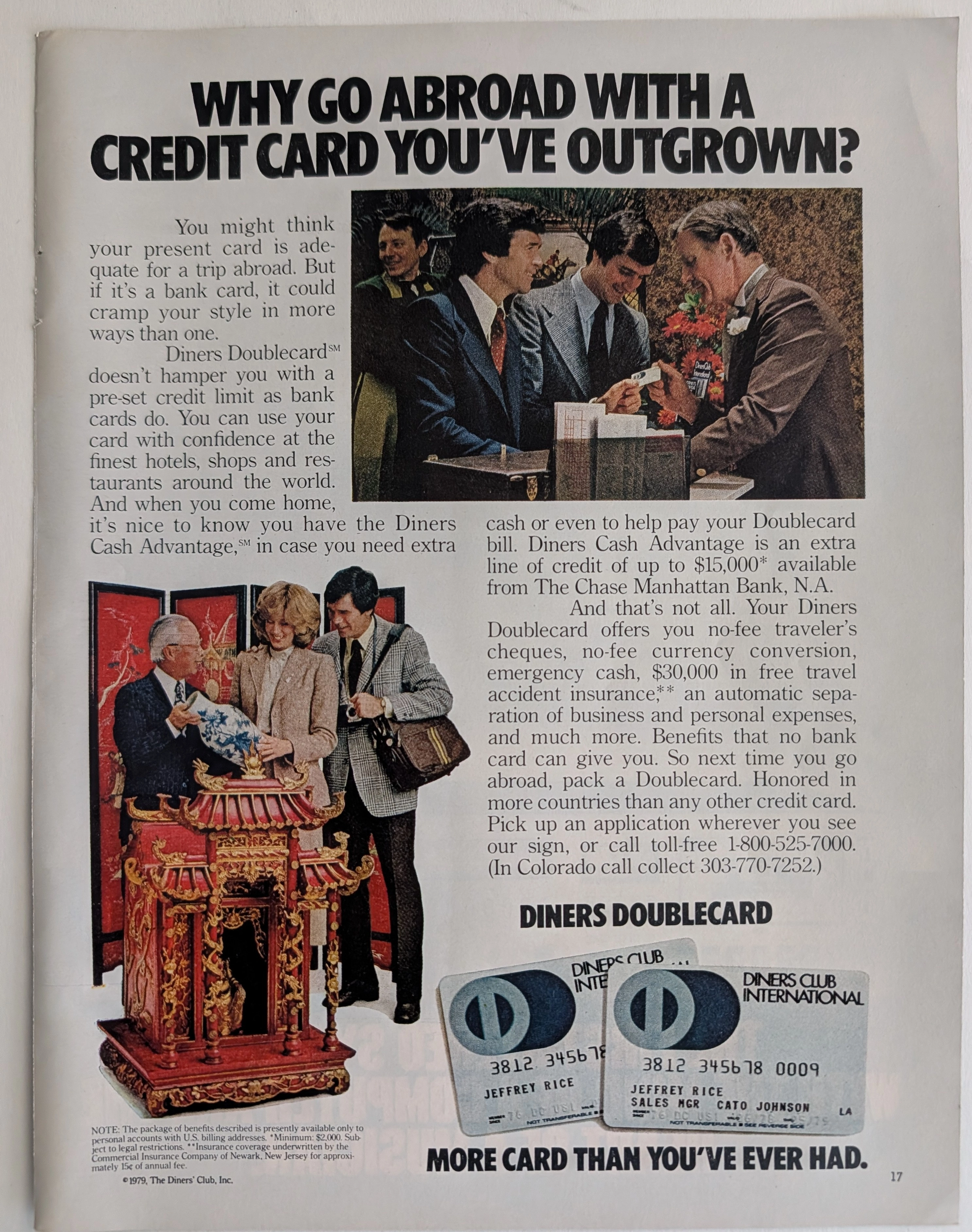
However, by 1979, the financial landscape had drastically evolved. The original pioneer was facing an existential threat from massive banking conglomerates. BankAmericard (which had recently rebranded to Visa in 1976) and Master Charge (soon to be MasterCard) were aggressively flooding the market with revolving credit cards. These bank cards allowed consumers to carry a balance month-to-month, but they came with strict, pre-set credit limits. The headline of this artifact directly attacks this vulnerability: "WHY GO ABROAD WITH A CREDIT CARD YOU'VE OUTGROWN?". The copy masterfully exploits the ego of the affluent traveler: "You might think your present card is adequate for a trip abroad. But if it's a bank card, it could cramp your style in more ways than one." Diners Club was positioning itself not as a tool for the masses, but as the exclusive key for the elite, unrestricted global citizen.

To differentiate itself in this brutal market, Diners Club introduced the "Doublecard" system, which forms the visual and conceptual anchor of this advertisement. The macro imagery in the bottom right corner shows two nearly identical cards issued to a "JEFFREY RICE." The top card is a standard personal account. The bottom card, however, features an additional embossed line: "SALES MGR CATO JOHNSON." This was a brilliant, analog solution to a pervasive accounting nightmare. Before the advent of digital expense management software, separating a business dinner in Tokyo from a personal souvenir purchase in Kyoto required meticulous receipt hoarding. The Doublecard provided "an automatic separation of business and personal expenses." (Historically, Cato Johnson was a real, highly influential promotional marketing agency acquired by Young & Rubicam, making its inclusion on the sample card a clever industry Easter egg by the art directors).

The visual semiotics of the advertisement are equally aggressive in their targeting. The art direction relies on two distinct photographic vignettes to communicate international prestige and purchasing power. In the top right, we see a business transaction—likely a hotel concierge or high-end merchant—in an indeterminate but clearly upscale foreign setting. The businessmen are dressed in peak late-70s corporate attire: wide lapels, patterned sport coats, and thick ties. In the bottom left, the imagery shifts to exoticized leisure. A Western couple is shown purchasing a blue-and-white porcelain vase from an older gentleman. In the foreground sits an incredibly ornate, red and gold carved Asian shrine or cabinet. This object acts as a visual shorthand for "The Orient," signaling to the reader that Diners Club is the accepted currency in the most far-flung and exotic antique markets in the world. The underlying message is clear: whether you are closing a massive corporate deal or acquiring rare foreign antiquities, the Diners Doublecard is the only financial instrument you require.

Furthermore, the fine print of the ad reveals the expanding ecosystem of financial perks designed to keep consumers loyal. It highlights the "Diners Cash Advantage," an extra line of credit up to $15,000 backed by The Chase Manhattan Bank, N.A. It also promises no-fee traveler's cheques, no-fee currency conversion, and $30,000 in free travel accident insurance. In an era of high inflation and economic uncertainty (1979), these tangible safety nets were incredibly attractive to the frequent traveler.

The Paper

As a physical entity, this printed artifact functions as a living, breathing record of late-twentieth-century commercial graphic reproduction and substrate chemistry. Under high-magnification macro-lens examination, this document reveals the stunning complexity of analog color offset lithography, specifically adapted for the high-volume magazine printing of the late 1970s.

The visual brilliance of this artifact is anchored by its capacity to render both sharp typography and complex photographic vignettes using microscopic deposits of liquid pigment. The macro photography of the ornate red and gold shrine provides a museum-grade visualization of the CMYK halftone rosette pattern. Because a printing press cannot print continuous tones, the original photographs were photographed through a halftone screen, breaking the image down into a mathematically rigorous galaxy of microscopic ink dots (Cyan, Magenta, Yellow, and Key/Black). The eye blends these dots together to perceive continuous color and depth. The registration (the alignment of these four color plates) is remarkably tight for a mass-produced magazine, allowing the intricate gold leaf carvings of the shrine to remain distinct and sharp. Similarly, the macro shot of the credit cards shows how the artist utilized specific lighting and drop shadows in the original photography to simulate the raised, tactile feel of the embossed names and numbers on the flat, printed page.

The most profound factor elevating the value of this artifact in the contemporary collector's market is the natural, completely irreversible process of Material Degradation. The expansive margins and the white background behind the text exhibit a genuine, unavoidable "Toning." This chronological transition from the original bright, bleached manufactured paper to a warm, antique ivory hue is caused by the slow, relentless chemical oxidation of Lignin—the complex organic phenolic polymer that naturally binds cellulose fibers together within the raw wood pulp. As the substrate is exposed to ambient oxygen and ultraviolet light over 45 years, the molecular structure of the lignin gracefully breaks down, forming chromophores that darken the paper. This naturally evolving patina represents the absolute core of the wabi-sabi aesthetic. It provides the ultimate, irrefutable scientific proof of the artifact's historical authenticity and its unbroken journey through time.

The Rarity

RARITY CLASS: C (Standard Archival Preservation)

Evaluated under the exacting, rigorous, and uncompromising archival parameters established by The Record Institute, which heavily prioritizes scarcity and historical weight when assigning a class (ranging from Pristine Class OMEGA down to Heavily Degraded Class D), this specific full-page artifact is definitively designated as Class C.

The defining paradox of late-century commercial ephemera is that these documents were produced by the millions as explicitly "disposable media." Inserted into high-volume, mass-market publications in 1979, they were inherently destined to be briefly observed, casually folded, and ultimately discarded.

While financial advertisements from this era are relatively common, finding a perfectly extracted, full-page artifact that so clearly documents a highly specific corporate initiative—in this case, the short-lived "Doublecard" marketing push and the specific branding of Cato Johnson—elevates it into a solid Class C collectible. The structural integrity of this paper remains exceptionally sound. It is free from catastrophic tears at the binding edge, heavy creasing, or destructive moisture damage (foxing). The analog colors remain astonishingly vivid, and the natural lignin oxidation provides a beautiful, mathematically even, warm ivory patina reflecting its late-70s origin. It is a highly prized, museum-worthy piece of financial consumer culture heritage, demanding to be preserved via acid-free, UV-protected conservation framing.
Visual Impact

The aesthetic brilliance of this artifact lies in its masterful execution of a "Dual-Narrative Composition." The art director perfectly visualizes the "Doublecard" concept by splitting the photographic imagery into two distinct, contrasting vignettes. The top right quadrant utilizes cool, muted tones (slate blues, grays) to depict a corporate transaction—representing the logical, business-oriented function of the secondary card. In stark contrast, the bottom left quadrant explodes with warm, passionate colors (the vibrant red and gold of the ornate Asian shrine), symbolizing personal leisure, exotic travel, and the primary card's unlimited potential. This diagonal visual weight guides the reader's eye from the bold headline, down through the contrasting lifestyles, and directly to the product shots of the two embossed cards at the bottom right. The heavy, sans-serif typography anchors the layout, establishing an ironclad air of corporate authority while promising a world of exotic escapism.

Share This Archive

The Archive Continues

Continue the Exploration

THE TIME TRAVELLER'S DOISSIER — THE WWII HOME FRONT AND THE AESTHETICS OF DESTRUCTION

THE TIME TRAVELLER'S DOISSIER — THE WWII HOME FRONT AND THE AESTHETICS OF DESTRUCTION

Executive summary of the original vintage double-page cut sheet featuring Norman Rockwell's WWII masterpiece, "Norman Rockwell Visits a Ration Board" (circa 1944). This artwork masterfully captures the egalitarian struggle of the American home front rationing system. The massive, rust-colored water stain blooming across the highly acidic 80-year-old paper is not damage, but a profound 'historical scar' that exemplifies the beautiful decay of analog media. Surviving wartime paper drives, this frame-ready primary artifact commands a Rarity Class S designation.

The Time Traveller's Dossier: Terrestrial Navigation – The Timberland Boat Shoe and the Evolution of Amphibious Footwear

Timberland · Fashion

The Time Traveller's Dossier: Terrestrial Navigation – The Timberland Boat Shoe and the Evolution of Amphibious Footwear

The evolution of twentieth-century American apparel is deeply intertwined with the adaptation of specialized, utilitarian gear for mainstream, terrestrial use. The historical artifact elegantly positioned upon the analytical table of The Record Institute today is a visually detailed and highly informative full-page print advertisement for The Timberland Boat Shoe. This document gracefully transcends the standard boundaries of footwear marketing. It operates as a highly sophisticated, multi-layered cultural mirror, reflecting a precise era in consumer sociology where the American public began integrating specialized sporting garments into their daily wardrobes. By utilizing a methodical, point-by-point comparative analysis against the established market leader, Sperry Topsider, The Timberland Company presented a scholarly and persuasive argument for superior material construction. This comprehensive dossier conducts a meticulous, nuanced, and exceptionally detailed examination of the artifact, operating under the most rigorous parameters of historical, sociological, and material science evaluation. Dedicating the overwhelming majority of our analytical focus (80%) to its immense historical gravity, we will decode the thoughtful marketing psychology embedded within the "land and sea" narrative, analyze the profound engineering differences highlighted in the construction of the shoe, and explore the sociological shift of maritime fashion into the suburban environment. Furthermore, as we venture deeply into the chemical and physical foundations of this analog printed ephemera (10%), we will reveal the precise mechanical fingerprints of the CMYK halftone rosettes captured in the macro imagery of the embossed leather. Finally, we will assess its archival rarity (10%), exploring how the graceful, natural oxidation of the paper substrate cultivates a serene wabi-sabi aesthetic—a natural, irreversible phenomenon that serves as the primary engine increasing its market value exponentially within the elite global spheres of Vintage Commercial Ephemera and Fashion Archives.

THE TIME TRAVELER'S DOSSIER: THE COMMODIFICATION OF STATUS AND THE ART OF THE ELEGANT ILLUSION

THE TIME TRAVELER'S DOSSIER: THE COMMODIFICATION OF STATUS AND THE ART OF THE ELEGANT ILLUSION

The artifact under exhaustive, uncompromising, and unprecedented museum-grade analysis is an exceptionally preserved Historical Relic originating from the absolute zenith of Madison Avenue's psychological marketing era (circa late 1940s to 1950s). This Primary Art Document is a monumental, full-page advertisement for LORD CALVERT, produced by the Calvert Distillers Corp., New York City. ​This piece represents the visual anchor for one of the most legendary, extensively studied, and phenomenally successful advertising campaigns in the history of American capitalism: "For Men of Distinction". It features a masterful, hyper-realistic portrait of Mr. Hiram U. Helm, Distinguished Rancher, deliberately painted/photographed to exude rugged sophistication, wealth, and aristocratic leisure. The artwork proudly bears the signature of SARRA (Valentino Sarra), a titan of mid-century commercial photography and illustration known for his cinematic lighting and profound character studies. ​This document is a profound "Sociological Blueprint of Aspirational Wealth." It masterfully utilized the psychology of exclusivity, marketing a blended whiskey composed of "65% Grain Neutral Spirits" as a "Custom" blend intended only "for those who can afford the finest". ​Rescued from the inevitable oblivion of disposable mass media, this mid-century analog artifact is a breathtaking embodiment of the Japanese aesthetic of wabi-sabi. Printed on inherently acidic wood-pulp paper, it exhibits a beautifully authentic, warm amber oxidation across its entire surface. This unstoppable molecular death transforms a piece of mass-produced corporate propaganda into an irreplaceable, ready-to-frame Primary Art Document of post-war sociological history.

Published by

The Record Institute

Taxonomy Match

Related Articles

The Time Traveller's Dossier: The Stroke of Seduction – 1970s Christian Dior "Dioressence" Advertisement — related article
Read Article

The Time Traveller's Dossier: The Stroke of Seduction – 1970s Christian Dior "Dioressence" Advertisement

History is not written; it is printed. Before digital algorithms dictated consumer desires, societal engineering was executed through the calculated geometry of the four-color offset press and the masterful stroke of an illustrator's brush. The historical artifact before us is not merely a fragrance advertisement; it is a weaponized blueprint of unapologetic female sensuality and a testament to the absolute zenith of French haute couture marketing. This museum-grade archival dossier presents an academic deconstruction of a vintage 1970s print advertisement for Christian Dior's "Dioressence" perfume. Operating on a profound binary structure, it documents a calculated paradigm shift within the global luxury fragrance industry. It illustrates the precise historical fracture where the polite, restrained elegance of post-war fashion transitioned into the bold, liberated, and sexually assertive era of the 1970s. Through the lens of late-analog commercial artistry—specifically the genius of René Gruau—and precise visual forensics, this document serves as a masterclass in psychological semiotics, establishing the visual tropes of the empowered, enigmatic woman that unconditionally dominate modern luxury branding.

THE TIME TRAVELER'S DOSSIER: THE ARCHITECTURE OF POWER AND THE BIRTH OF THE DIGITAL WORLD IN THE 50S — related article
Read Article

THE TIME TRAVELER'S DOSSIER: THE ARCHITECTURE OF POWER AND THE BIRTH OF THE DIGITAL WORLD IN THE 50S

The artifact under exhaustive, uncompromising museum-grade analysis is a remarkably preserved Historical Relic originating from the absolute zenith of the post-war American economic boom. This Primary Art Document is a sweeping, monumental full-page advertisement for the Sheraton Hotels empire, forensically dated to circa 1958–1959 via the explicitly illustrated Pittsburgh Bicentennial (1758-1958) stamp embedded within the artwork. This document is not merely a travel advertisement; it is a profound "Sociological Blueprint of the American Corporate Ascendancy." Visually anchored by four hyper-stylized, architectural illustrations of Sheraton's flagship properties—New York, Cleveland, Pittsburgh, and Detroit—the piece captures the era's unbridled optimism. Each panel is a masterpiece of mid-century commercial illustration, particularly the Detroit panel featuring ethereal, floating tail-fin automobiles symbolizing the Motor City's dominance. Furthermore, this artifact documents critical milestones in global business history. It proudly advertises the acceptance of the Diners' Club card, marking the revolutionary dawn of the modern credit card era. It also boasts of Sheraton's "Reservatron" electronic system—one of the earliest commercial applications of computing in the hospitality industry—and proudly declares its listing on the New York Stock Exchange. Rescued from the binding of a forgotten, heavy-stock periodical, this pre-2000s analog artifact is an unforgeable testament to the Japanese aesthetic of wabi-sabi. Printed on inherently acidic wood-pulp paper, it exhibits a beautifully violent, jagged right margin and a deep, warm amber oxidation across its surface. This majestic, unstoppable chemical degradation transforms a mass-produced corporate propaganda piece into an irreplaceable, ready-to-frame Primary Art Document of mid-century architectural and economic history.

THE TIME TRAVELER'S DOSSIER: BLOOD CAPITALISM AND THE WEAPONIZATION OF WHISKEY — related article
Read Article

THE TIME TRAVELER'S DOSSIER: BLOOD CAPITALISM AND THE WEAPONIZATION OF WHISKEY

This impeccably preserved Historical Relic is a Primary Art Document from the brutal crucible of World War II, featuring a sweeping advertisement for THREE FEATHERS V.S.R. Blended Whiskey. It chronicles the ultimate mid-century psychological strategy of "Patriotic Capitalism." The artifact is forensically and definitively dated to the WWII era by the explicit, government-aligned directive in the upper right corner: "Buy War Bonds regularly!". Visually, the brand masterfully hijacked American nationalism by rendering its iconic three feathers in a vibrant Red, White, and Blue patriotic color scheme. Surviving the aggressive scrap paper drives of the 1940s, the acidic analog paper exhibits a profound integration of the deep crimson ink into its degrading fibers, perfectly encapsulating the analog aesthetic of wabi-sabi. This slow chemical death elevates this rescued wartime artifact to an irreplaceable Primary Art Document of Rarity Class A.

THE TIME TRAVELER'S DOSSIER: HOLLYWOOD PROPAGANDA AND THE DAWN OF MULTIMEDIA SYNERGY — related article
Read Article

THE TIME TRAVELER'S DOSSIER: HOLLYWOOD PROPAGANDA AND THE DAWN OF MULTIMEDIA SYNERGY

The artifact under exhaustive, uncompromising, and unprecedented museum-grade analysis is a remarkably preserved Historical Relic originating from the zenith of Hollywood's post-war epic era. This Primary Art Document is a monumental, full-page theatrical advertisement for the 1959 biographical epic "John Paul Jones", produced by the legendary independent film mogul Samuel Bronston and distributed by Warner Bros.. ​This is not merely a movie poster; it is a "Forensic Blueprint of Cold War American Nationalism and Multimedia Synergy." Released in 1959, at the height of the Cold War, the advertisement aggressively weaponizes the foundational mythos of the United States Navy. The commanding, blood-red headline, "I have not yet begun to fight!", serves as a psychological anchor, projecting unyielding American defiance to both domestic audiences and global adversaries. Visually dominated by the rugged, heroic portrait of Robert Stack, the ad expertly balances masculine wartime aggression with romantic subplots and diplomatic intrigue featuring Charles Coburn as Benjamin Franklin. Furthermore, it showcases elite Hollywood casting power by explicitly highlighting a "Special Appearance by Bette Davis as Catherine the Great" in a striking red cameo vignette. ​Crucially, this artifact documents an early, masterful execution of cross-platform corporate synergy. The bottom corner explicitly markets the original Max Steiner soundtrack on Warner Bros. Records, proving that the commercialization of the "Original Motion Picture Soundtrack" was already highly codified. ​Rescued from the inevitable oblivion of disposable entertainment media, this pre-2000s analog artifact is a breathtaking embodiment of the Japanese aesthetic of wabi-sabi. Printed on inherently acidic mid-century wood-pulp paper, it exhibits beautifully authentic edge wear and a profound, warm amber oxidation across its surface. This unstoppable molecular death transforms a mass-produced piece of Hollywood propaganda into an irreplaceable, ready-to-frame Primary Art Document of cinematic and sociological history.

THE TIME TRAVELER'S DOSSIER:THE ENGINEERING OF ELEGANCE, THE GUCCI TRUNK, AND THE ARCHITECTURE OF REASON — related article
Read Article

THE TIME TRAVELER'S DOSSIER:THE ENGINEERING OF ELEGANCE, THE GUCCI TRUNK, AND THE ARCHITECTURE OF REASON

The artifact under exhaustive, uncompromising, and unprecedented museum-grade analysis is a remarkably preserved Historical Relic originating from the absolute zenith of West German automotive engineering. This Primary Art Document is a densely informative, multi-column magazine advertisement for the Mercedes-Benz 280SE Sedan (W116 chassis). ​This document is a "Forensic Blueprint of Engineered Elegance and Status Commodification." It aggressively markets the 280SE as the "Heir to a Classic," positioning it as a vehicle that inherits the legendary proportions of the 450 Series but is powered by a highly advanced, fuel-injected 6-cylinder engine. The copywriting reads like an arrogant technical dossier, boasting of the "Continuous Injection System" (CIS) and a fully independent "Suspense-free suspension" derived from the legendary C-111 high-speed research vehicle. ​However, the absolute psychological masterstroke lies in the lower-left illustration. To visually prove the cavernous "18.2 cubic feet of usable space," the artist meticulously illustrated the trunk effortlessly swallowing a bicycle, golf clubs, and a set of Gucci luggage. The unmistakable beige geometric monogram and the iconic red-and-green Web stripe on the suitcases serve as a deliberate, powerful socio-economic signal. It explicitly communicates that the Mercedes-Benz trunk is designed exclusively for the "Jet-Set" elite who travel with Italian haute couture. ​Rescued from a mass-market periodical, this pre-2000s analog artifact exhibits a beautifully authentic warm ivory oxidation across its surface. This majestic chemical aging transforms a mass-produced piece of technical propaganda into an irreplaceable Primary Art Document of automotive and sociological history.

THE TIME TRAVELER'S DOSSIER :THE BIRTH OF THE WIDE-TRACK — related article
Read Article

THE TIME TRAVELER'S DOSSIER :THE BIRTH OF THE WIDE-TRACK

The artifact currently subjected to our uncompromising, museum-grade analysis is a profoundly preserved Historical Relic excavated from the turning point of Detroit's "horsepower and handling" wars. This Primary Art Document is a full-page magazine advertisement for the 1959 Pontiac, explicitly introducing the brand's revolutionary "Wide-Track" engineering. Functioning as a "Forensic Blueprint of Automotive Rebranding," the document masterfully weaponizes the peerless artistic talents of Fitz and Van to transform Pontiac from a conservative, aging brand into America's most aggressive performance marque. Its historical context is irrefutably anchored by the extreme macro details of its proprietary engineering claims and the highly coveted "Body by Fisher" corporate hallmark. Grounded by these physical timestamps, the microscopic artist signature, and its breathtaking wabi-sabi chemical degradation, this artifact commands an irreplaceable status, cementing its Rarity Class A designation.