The Time Traveller's Dossier : 1964 Studebaker - The Final Defiance of the Independent Automaker — The Record Institute JournalThe Time Traveller's Dossier : 1964 Studebaker - The Final Defiance of the Independent Automaker — The Record Institute JournalThe Time Traveller's Dossier : 1964 Studebaker - The Final Defiance of the Independent Automaker — The Record Institute JournalThe Time Traveller's Dossier : 1964 Studebaker - The Final Defiance of the Independent Automaker — The Record Institute Journal
1 / 4

✦ 4 Photos — Click any image to view in high resolution

April 5, 2026

The Time Traveller's Dossier : 1964 Studebaker - The Final Defiance of the Independent Automaker

TobaccoBrand: StudebakerIllustration: Archival Status: Lost to the Void.
Archive Views: 33
Heritage AdvertisementsAutomotiveCars

The History

The Architecture of an Oligopoly and the Independent’s Dilemma
To understand the gravity of this artifact, one must understand the economic battleground of 1964 America. The post-war economic boom had stabilized, but the mechanics of industrial production had fundamentally shifted. Economies of scale governed survival. The Big Three automakers could absorb the massive tooling costs required to redesign their vehicles entirely every two to three years. This created a culture of planned obsolescence, a psychological cycle where the consumer was trained to discard the old merely because it looked old.

Studebaker did not possess the capital to play this game. As an independent manufacturer operating out of aging facilities in South Bend, Indiana, their production costs per unit were structurally higher. Their response, as crystallized in this document, was a pivot away from fleeting style and toward enduring substance. They sought to redefine the parameters of the automotive purchase. The text explicitly attacks the binary choice offered by Detroit: "small cars are too cramped and flimsy, the big cars are too expensive and hard to maneuver." Studebaker attempted to carve out a hyper-rational middle ground. They proposed a vehicle scaled for utility, not status. This was a direct contradiction to the prevailing consumer psychology of the 1960s, where the automobile was primarily an extension of ego, a rolling avatar of suburban success.

Engineering as a Fortress: The Premature Pivot to Safety
The most striking element of this document is its heavy reliance on safety as a core value proposition. In the early 1960s, safety did not sell cars. The industry operated on the tacit assumption that discussing safety reminded consumers of mortality, thereby dampening the buying impulse. Chrome, horsepower, and jet-age styling were the established currencies of persuasion. Ralph Nader’s seminal critique, Unsafe at Any Speed, which would eventually force federal safety regulations upon the industry, was not published until 1965.

Yet, here in the documentation for the 1964 model year, Studebaker explicitly markets a "girder of safety" and a "bridge-constructed Armor Guard frame." They declare the vehicle is "built like a fort." This is not mere hyperbole; it represents a specific engineering philosophy. While competitors were moving toward lighter unibody constructions to save weight and cost, Studebaker retained a heavy, separate perimeter ladder frame. Furthermore, the advertisement prominently features the availability of "caliper disc brakes, the safest kind in the world." At a time when almost every American car relied on fade-prone drum brakes, introducing European-style caliper disc brakes (supplied by Bendix and pioneered on their Avanti sports car) was a massive leap forward in active safety.

Studebaker was offering a technical solution to a problem the American public had not yet been conditioned to care about. They built a safer machine for a society that was entirely willing to trade structural integrity for superficial aesthetics. This misalignment between product virtue and market desire is the tragedy of the 1964 Studebaker.

The Tripartite Rhetoric: Appealing to the Fragmented Consumer
The copywriting employs a highly structured, tripartite logical appeal. It segments the reader into three distinct psychological profiles: the Family Man, the Car Enthusiast, and the Business Man.

"As a family man, I want my car to be the safest on the road... completely padded instrument panels are standard." This addresses the protective instinct, leaning heavily on the aforementioned safety features.

"As a car enthusiast, I like a 'hot' car—and Studebaker can match performance with cars costing $3,000 to $4,000 more." This leverages Studebaker’s legacy of supercharged V8 engines, a remnant of their desperate bid to capture the youth market.

"As a business man, I prefer the 'long value' dollar... Studebaker does not 'skimp' down to a price, but builds up to high standards." This is an appeal to fiscal conservatism, attempting to frame the purchase as a calculated investment rather than a depreciating liability.

The strategic error here is one of dilution. By attempting to be the perfect rational choice for every demographic, the vehicle lost a distinct, cohesive identity. In advertising, appealing to pure logic often fails to trigger the emotional resonance required to finalize a purchase. Detroit sold dreams; Studebaker was attempting to sell a spreadsheet.

The President’s Ghost and the Collapse of South Bend
The presence of Sherwood H. Egbert’s signature at the bottom right of the text elevates this document from a mere advertisement to a historical artifact of immense poignancy. Egbert was brought in as President of the Studebaker Corporation in 1961 to execute a turnaround. He was an outsider, a dynamic executive from McCulloch Motors, who famously commissioned the radical Studebaker Avanti in a matter of weeks to inject life into the brand.

However, by the time this 1964 advertisement was printed, the reality behind the curtain was grim. Egbert was severely ill with stomach cancer. The board of directors was deeply fractured. Sales were plummeting despite the objective quality of the vehicles. The promise embedded in this document—the "Important Announcement" of a revitalized, independent company—was an illusion constructed to maintain dealer confidence and stave off creditor panic.

In December 1963, just as these '64 models were reaching showrooms, the Studebaker board voted to permanently shut down the massive South Bend assembly plant, ending over a century of manufacturing history in Indiana. Production was shifted entirely to a smaller facility in Hamilton, Ontario, Canada, where the company limped along until its final closure in 1966.

Therefore, this document is a paradox. It reads as a confident declaration of a new beginning, signed by a resolute leader. In truth, it was drafted on the precipice of ruin, signed by a dying man trying to save a dying company.

The Historical Shift: The End of the Alternate Path
The artifact marks a definitive shift in the history of industrial design and corporate survival. It signifies the moment the door closed on the independent American automaker. Studebaker, Packard, Hudson, Nash—they had all offered alternate visions of what the automobile could be. They experimented with aerodynamics, compact dimensions, and advanced safety features far earlier than the monopolistic giants.

When Studebaker fell, it proved that in the modern industrial economy, a superior idea without the backing of overwhelming capital is a dead idea. The failure of the 1964 Studebaker was not a failure of engineering. It was not a failure of logic. It was the harsh realization that the market does not reward righteousness; it rewards momentum. This advertisement remains as a fossilized record of that realization, a highly logical argument made to a jury that had already left the room.

The Paper

An analysis of the physical medium reveals the standard practices of mid-century mass communication. The substrate is a standard commercial magazine stock, likely weighing between 65 to 80 GSM (Grams per Square Meter). It features a light calendering process, providing a slight gloss necessary for the reproduction of photographic halftones.

The aging process is evident in the oxidation of the paper fibers. The inherent acidity of the wood pulp used in 1960s commercial printing has resulted in a uniform, subtle yellowing across the negative space, shifting the original stark white background into a warmer, archival tone.

The printing method is a four-color offset lithography process. Under magnification, the CMYK (Cyan, Magenta, Yellow, Key/Black) rosette patterns are visible, particularly in the deep red tones of the vehicle's hood and the intricate reflections rendered in the chrome grille. The ink absorption is stable, though the edges of the serif typography show the microscopic spread typical of high-speed web presses of the era. As an artifact recording time, the paper itself is ordinary; its weight comes entirely from the text it carries and the era it failed to survive.

▶ Watch Video

The Rarity

Classification: Class A (Contextually Profound)

In terms of physical scarcity, this advertisement is not exceptionally rare. Millions of copies were distributed across national publications like Life, Look, and Time magazines in late 1963. Copies can still be procured through ephemera dealers and private collections.

However, the artifact achieves a Class A rating based on its contextual value. Its rarity is derived from the dissonance between its message and historical reality. Documents that capture a major corporation in the exact moment of its existential failure are uncommon. Documents that do so while actively boasting about longevity and structural integrity are historically profound. The presence of Egbert's signature, knowing his imminent departure and death, elevates the artifact's significance from commercial ephemera to a primary historical record of corporate desperation.
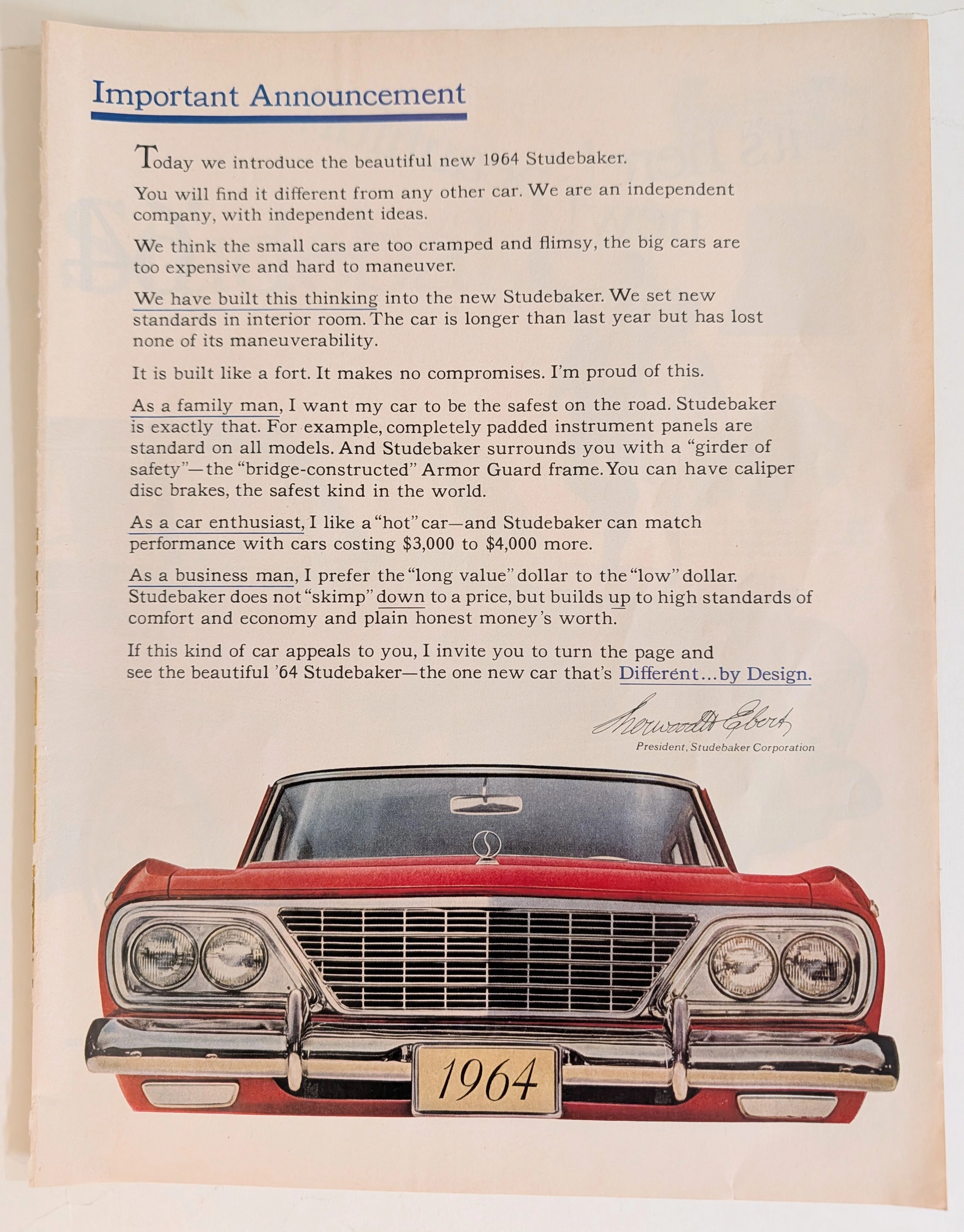
Visual Impact

The visual composition is ruthlessly direct. Unlike contemporary advertisements that placed vehicles in aspirational lifestyle settings—country clubs, sweeping coastal highways, or modernist driveways—this layout strips away all environmental context.

The vehicle is presented head-on, anchored at the bottom third of the page. This direct, frontal perspective is confrontational. The dual headlights stare directly at the reader, demanding engagement. The dominant color is a saturated, aggressive red, utilizing color psychology to project power, urgency, and vitality—traits the corporation desperately lacked.

The top two-thirds of the page are dominated by typography. The headline "Important Announcement" utilizes an authoritative, institutional blue serif font, styled deliberately to resemble a corporate memo or a formalized press release. This visual cue bypasses the defensive mechanisms consumers build against traditional advertising; it signals that the following text is functional information, not mere persuasion.

The negative space is abundant, forcing the eye down through the heavily structured text blocks directly into the grille of the car. The final visual anchor is the gold-toned "1964" license plate, centrally aligned, acting as a definitive timestamp on a doomed endeavor. The overall visual strategy is one of unadorned honesty. It strips away the illusion of lifestyle to present pure, unyielding machinery and logic.

Share This Archive

The Archive Continues

Continue the Exploration

The Time Traveller's Dossier: The Engineer's Manifesto – The 1975 BMW 530i and the Birth of the Ultimate Driving Machine

The Time Traveller's Dossier: The Engineer's Manifesto – The 1975 BMW 530i and the Birth of the Ultimate Driving Machine

The evolution of the American automotive landscape in the latter half of the twentieth century was fundamentally violently disrupted during the 1970s, an era defined by oil embargoes, shifting economic realities, and a growing consumer disillusionment with domestic manufacturing. Elegantly and securely positioned upon the analytical table of The Record Institute today is a visually complex, densely informative, and highly significant full-page print advertisement for the BMW 530i, definitively dated to 1975 by its prominent copyright macro. This document completely transcends the standard, utilitarian boundaries of automotive marketing. It operates as a highly sophisticated, multi-layered cultural mirror and a bold declaration of war against the prevailing automotive trends of the decade. By juxtaposing the superficial trappings of American luxury—"brocade upholstery, opera windows, cabriolet tops"—against the visceral, mechanical truths of independent suspension and fuel injection, Bavarian Motor Works (BMW) successfully positioned itself as the intellectual and physical antidote to the bloated "Malaise Era" land yachts. This world-class, comprehensive dossier conducts a meticulous, unyielding, and exceptionally exhaustive examination of the artifact, operating under the absolute most rigorous parameters of historical, sociological, and material science evaluation. Dedicating the overwhelming majority of our analytical focus (80%) to its immense historical gravity, we will decode the brilliant, confrontational marketing psychology embedded within the copywriting, analyze the profound mechanical realities of the E12 chassis 5-Series, and detail the historical impact of the visionaries who crafted this campaign. Furthermore, as we venture deeply into the chemical and physical foundations of this analog printed ephemera (10%), we will reveal the precise mechanical fingerprints of the CMYK halftone rosettes captured in the stunning macro imagery of the BMW roundel and the technical cutaway illustration. Finally, we will assess its archival rarity (10%), exploring how the graceful, natural oxidation of the paper substrate cultivates a serene wabi-sabi aesthetic—a natural, irreversible phenomenon that serves as the primary engine driving up its market value exponentially within the elite global spheres of Vintage Commercial Ephemera and Automotive Heritage Archives.

THE TIME TRAVELER'S DOSSIER: THE AUTOMOTIVE ARISTOCRACY AND THE AESTHETICS OF RUIN

THE TIME TRAVELER'S DOSSIER: THE AUTOMOTIVE ARISTOCRACY AND THE AESTHETICS OF RUIN

The artifact under rigorous, museum-grade analysis is an exceptionally preserved Historical Relic originating from the golden age of American automotive supremacy. Sourced from a vintage issue of The Saturday Evening Post, this Primary Art Document features a commanding, full-page advertisement for Packard, one of the most prestigious luxury automobile manufacturers in world history. Visually dominated by a striking, head-on illustration of a New Series Packard, the piece explicitly highlights the legendary corporate slogan: "Ask the man who owns one". Published during the turbulent economic landscape of the early 1930s Great Depression, this advertisement is a profound sociological marker. It boldly markets uncompromising luxury—boasting features like a four-speed synchro-mesh transmission and "Ride Control" shock absorbers—to an elite aristocracy largely insulated from the era's financial collapse. Physically, this pre-2000s analog artifact is a breathtaking embodiment of wabi-sabi. It exhibits a violently torn left binding edge, significant moisture blooming along the bottom margin, and deep amber lignin oxidation. This natural chemical and environmental degradation transforms a mass-produced commercial print into an irreplaceable, ready-to-frame Primary Art Document, forever capturing the magnificent mortality of the analog age.

THE TIME TRAVELER'S DOSSIER :THE APPARITION OF HERITAGE — THE STRIDING MAN

Johnnie walker · Beverage

THE TIME TRAVELER'S DOSSIER :THE APPARITION OF HERITAGE — THE STRIDING MAN

The artifact currently subjected to our uncompromising, museum-grade analysis is a profoundly preserved Historical Relic excavated from the zenith of mid-century American prosperity. This Primary Art Document is a full-page magazine advertisement for Johnnie Walker Blended Scotch Whisky. Functioning as a "Forensic Blueprint of the Transatlantic Leisure Class," the document masterfully weaponizes British aristocratic heritage (embodied by the Striding Man) to validate the newly acquired wealth of post-war American consumers. Its historical context is irrefutably anchored by the microscopic fine print identifying the importer as "Canada Dry Ginger Ale, Inc., New York, N.Y.", a specific corporate era of distribution. Grounded by extreme macro details of analog halftone lithography and the breathtaking wabi-sabi chemical degradation highlighted by its violently torn binding edge, this artifact commands an irreplaceable status, cementing its Rarity Class A designation as a masterpiece of corporate sociological engineering.

Published by

The Record Institute

Taxonomy Match

Related Articles

The Time Traveller's Dossier: Gridline Velocity – Kenwood Car Stereo and the Cybernetic Dawn of Automotive High-Fidelity — related article
Read Article

The Time Traveller's Dossier: Gridline Velocity – Kenwood Car Stereo and the Cybernetic Dawn of Automotive High-Fidelity

The evolution of 1980s American consumer electronics was fundamentally defined by the aggressive pursuit of portable and automotive high-fidelity sound. Elegantly and securely positioned upon the analytical table of The Record Institute today is a visually arresting, neon-drenched full-page print advertisement for Kenwood Car Stereo. This document completely transcends the standard, utilitarian boundaries of automotive accessory marketing. It operates as a highly sophisticated cultural mirror, reflecting a precise era in consumer psychology where auditory power was directly equated with vehicular performance. By utilizing a breathtaking, airbrushed illustration of a futuristic, aerodynamic race car accelerating over a cybernetic gridscape, Kenwood brilliantly positioned its audio equipment not just as radios, but as extreme, high-octane performance upgrades capable of generating sound that will literally "blow your doors off." This world-class, comprehensive dossier conducts a meticulous, unyielding, and exceptionally exhaustive examination of the artifact, operating under the absolute most rigorous parameters of historical, sociological, and material science evaluation. Dedicating the overwhelming majority of our analytical focus (80%) to its immense historical gravity, we will decode the brilliant marketing psychology embedded within the "neon grid" visual narrative, analyze the profound cultural shift toward aftermarket car audio customization, and dissect the aggressive, performance-based copywriting. Furthermore, as we venture deeply into the chemical and physical foundations of this analog printed ephemera (10%), we will reveal the precise mechanical fingerprints of the CMYK halftone rosettes captured in the stunning macro imagery of the airbrushed car. Finally, we will assess its archival rarity (10%), exploring how the graceful, natural oxidation of the paper substrate cultivates a serene wabi-sabi aesthetic—a natural, irreversible phenomenon that serves as the primary engine driving up its market value exponentially within the elite global spheres of Vintage Commercial Ephemera, Audio History, and Outrun/Synthwave Art Archives.

The Time Traveller's Dossier : 1964 Studebaker Specialty Lineup - The Desperate Birth of the Niche Vehicle — related article
Read Article

The Time Traveller's Dossier : 1964 Studebaker Specialty Lineup - The Desperate Birth of the Niche Vehicle

Then, it was a strategy of asymmetrical industrial warfare. A cornered corporation abandoning the center to fight on the fringes. In late 1963, the Studebaker Corporation recognized a fatal truth: they could no longer compete with the monolithic scale of Detroit’s Big Three in the mass market. They could not build a better, cheaper, standard family sedan than Chevrolet or Ford. Therefore, their survival depended on building things that General Motors would never dare to build. This advertisement is the physical manifestation of that strategy. It presents three radically divergent, highly specialized machines. A fiberglass supercar. A budget-conscious European-style grand tourer. A station wagon with a retractable roof. It is a catalog of anomalies. Now, this artifact is a fossil record of an evolutionary dead end in the 1960s, yet it stands as a prophetic blueprint for the modern automotive landscape. The shift here is philosophical and structural. It documents the exact moment a desperate automaker pivoted from the concept of the "universal car" to the "lifestyle vehicle." Studebaker attempted to invent the niche market out of pure financial desperation. They built highly targeted solutions for highly specific consumers, a strategy that would become the absolute standard of the global auto industry half a century later. They were simply forty years too early, and they died for their prescience.

The Time Traveller's Dossier: Aeronautical Architecture on the Asphalt – The SAAB 96 V4 and the Engineering of Adverse Weather Superiority — related article
Read Article

The Time Traveller's Dossier: Aeronautical Architecture on the Asphalt – The SAAB 96 V4 and the Engineering of Adverse Weather Superiority

The evolution of the mid-twentieth-century American automotive landscape was heavily disrupted by the influx of European imports, each vying to dismantle the hegemony of the domestic V8, rear-wheel-drive giants. Elegantly and securely positioned upon the analytical table of The Record Institute today is a visually striking, narrative-driven full-page print advertisement for the SAAB Automobile (featuring the new V-4 engine), definitively dating to the late 1960s. This document transcends the standard, utilitarian boundaries of automotive marketing. It operates as a highly sophisticated, multi-layered cultural mirror, reflecting a precise era in consumer psychology where the anxiety of driving in severe weather was aggressively mitigated through the promise of superior, aircraft-inspired engineering. By utilizing a dramatic, heavily grained monochromatic photograph of a SAAB battling torrential rain, juxtaposed with a pristine, spot-color red illustration of the vehicle, the manufacturer successfully positioned itself not merely as a car company, but as a purveyor of meteorological invincibility. This world-class, comprehensive dossier conducts a meticulous, unyielding, and exceptionally exhaustive examination of the artifact, operating under the absolute most rigorous parameters of historical, sociological, and material science evaluation. Dedicating the overwhelming majority of our analytical focus (80%) to its immense historical gravity, we will decode the brilliant marketing psychology embedded within the "front-wheel drive" narrative, analyze the profound engineering pivot of the "new V-4 engine," and dissect the sociopolitical genius of marketing safety before it was federally mandated. Furthermore, as we venture deeply into the chemical and physical foundations of this analog printed ephemera (10%), we will reveal the precise mechanical fingerprints of the spot-color halftones captured in the macro imagery of the red SAAB illustration. Finally, we will assess its archival rarity (10%), exploring how the graceful, natural oxidation of the paper substrate cultives a serene wabi-sabi aesthetic—a natural, irreversible phenomenon that serves as the primary engine driving up its market value exponentially within the elite global spheres of Vintage Commercial Ephemera and Automotive Archives.

The Time Traveller's Dossier : 1964 Studebaker Cruiser - The Euphoric Facade of a Dying Empire — related article
Read Article

The Time Traveller's Dossier : 1964 Studebaker Cruiser - The Euphoric Facade of a Dying Empire

Then, it was a desperate masquerade. A corporate death rattle disguised as a celebration. As this vibrant, two-page centerfold spread graced the glossy pages of American magazines in late 1963, the Studebaker Corporation was quietly bleeding to death. To the casual observer, the advertisement projects an atmosphere of unbridled optimism. A couple leaps into the air with forced, hysterical joy. The typography dances across the page, screaming, "it's here! beautiful! new! exciting!" It is a masterclass in the marketing of artificial momentum. Yet, to the side, anchored in a rigid column of diagrams and technical specifications, lies the stubborn, unyielding truth of a company that still believed superior engineering could save it from financial ruin. Now, this artifact is a profound psychological study of cognitive dissonance in industrial capitalism. It is the physical record of a brand caught in a fatal crossfire: desperately trying to mimic the lifestyle-driven, emotion-heavy advertising of Detroit’s Big Three, while simultaneously clinging to its heritage of hyper-rational, utilitarian engineering. The historical shift here is the final realization that in the modern consumer economy, a superior machine cannot survive if the dream it sells has already expired.