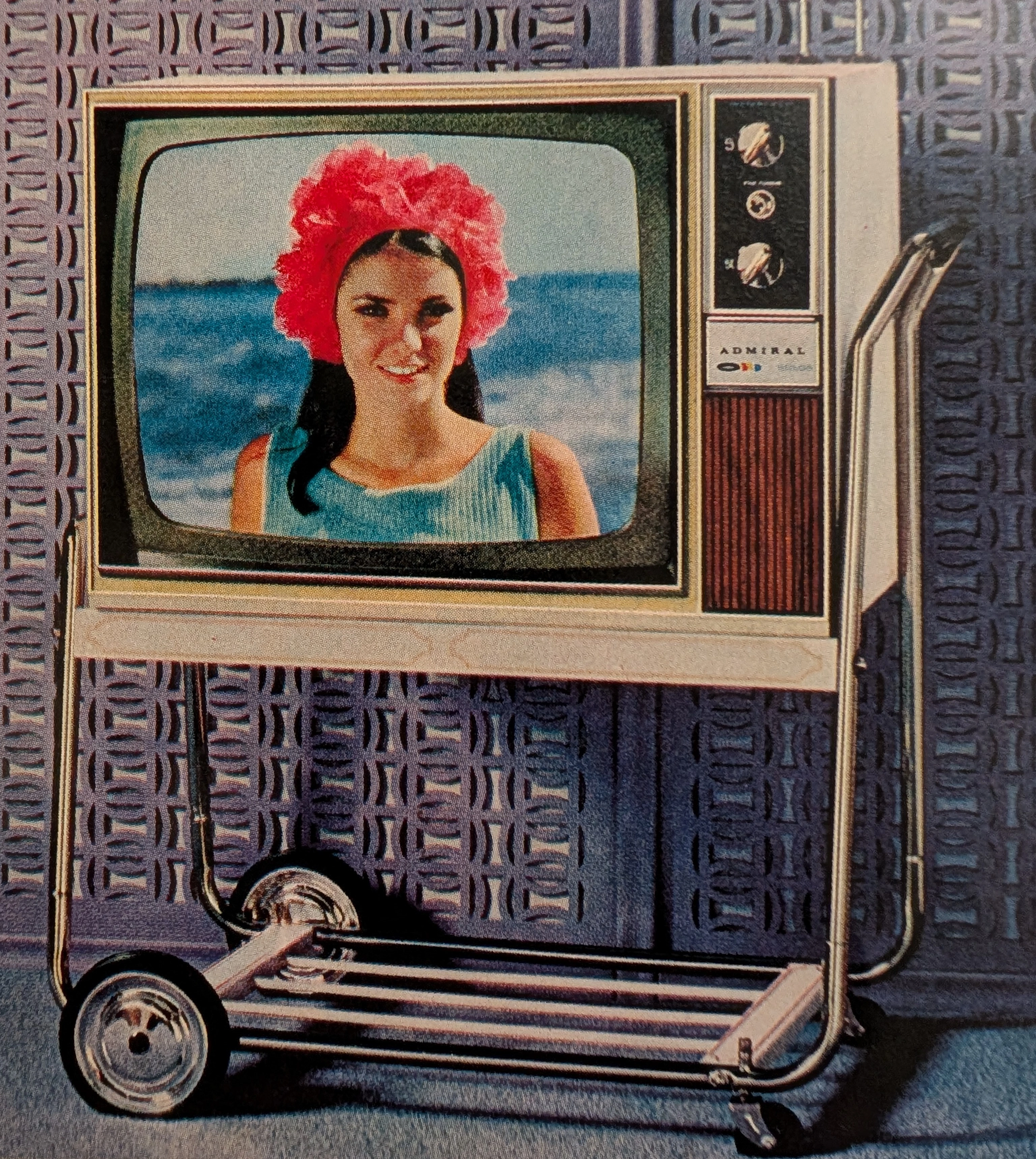
The Time Traveller's Dossier: The Architecture of the Airwaves – Admiral Color Television, the Sonar Remote, and the Transformation of the American Living Room
The History
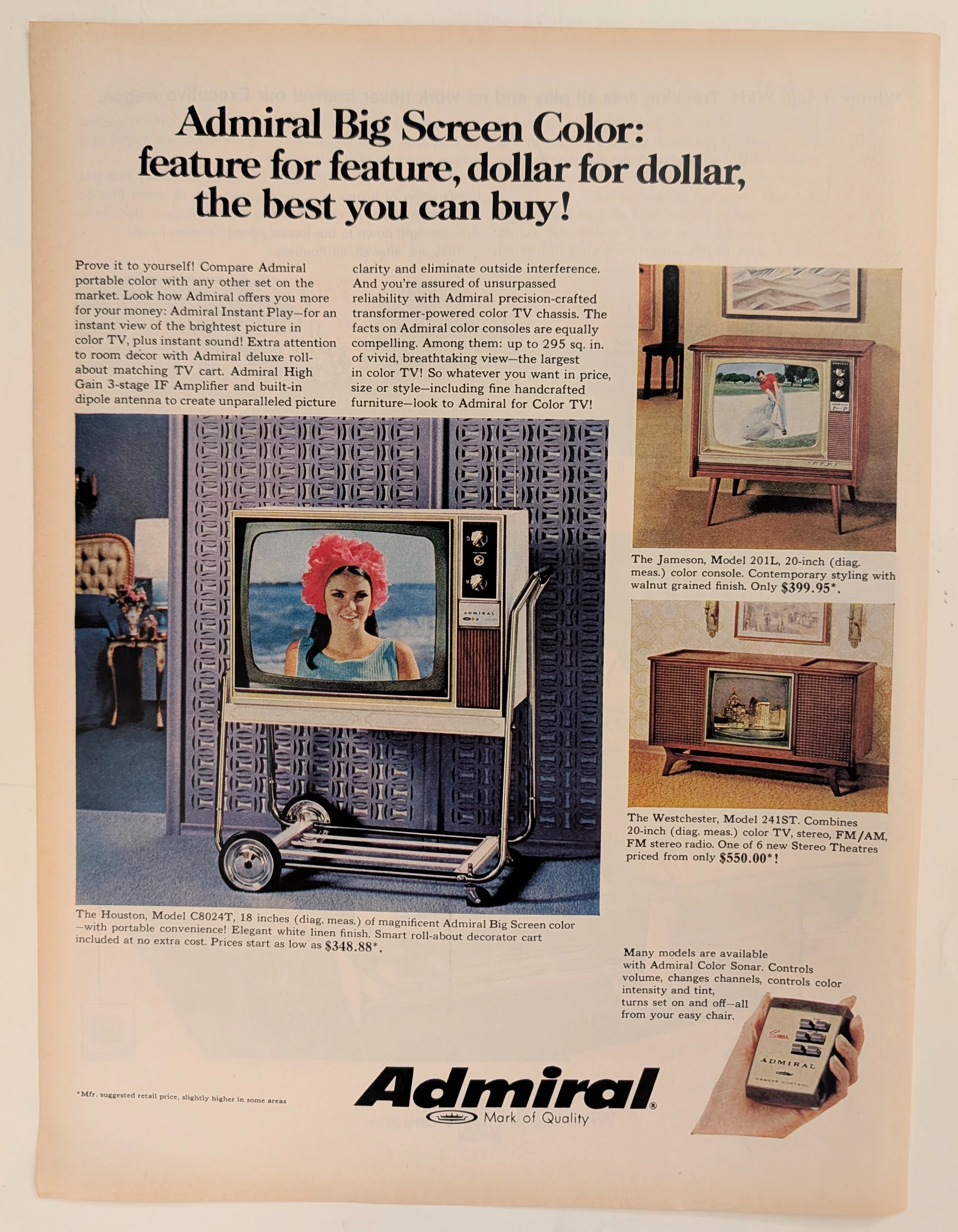
To fully appreciate the immense historical gravity, cultural magnitude, and sociological importance of this artifact, one must meticulously contextualize the complex, highly dominant landscape of the American consumer electronics industry during the late 1960s. This era was the absolute battleground for the "Color Revolution." While color broadcasting technology had existed since the 1950s, the late 1960s marked the precise moment when major networks shifted the entirety of their prime-time programming to full color. This catalyst triggered a fierce technological arms race among titans like RCA, Zenith, Motorola, and the Admiral Corporation. Admiral, founded by Ross Siragusa in 1934, positioned itself as a purveyor of "unsurpassed reliability" and technological innovation wrapped in traditional aesthetics.
The first major technological warfare documented in this artifact is the boast of "Admiral Instant Play." Prior to the late 1960s, Cathode Ray Tube (CRT) televisions required a significant, often frustrating "warm-up" period. Viewers had to turn the dial and wait for the vacuum tubes and the picture tube filaments to heat up before an image would slowly materialize on the screen. Admiral's "Instant Play" technology fundamentally altered the relationship between the viewer and the medium. By maintaining a constant, low-level flow of electrical current to the tube filaments even when the set was technically "off," the television could produce "an instant view of the brightest picture in color TV, plus instant sound!" This eliminated the friction of waiting, transforming television viewing into an immediate, frictionless dopamine response. It was a monumental leap in user experience, permanently changing the pacing of American media consumption.
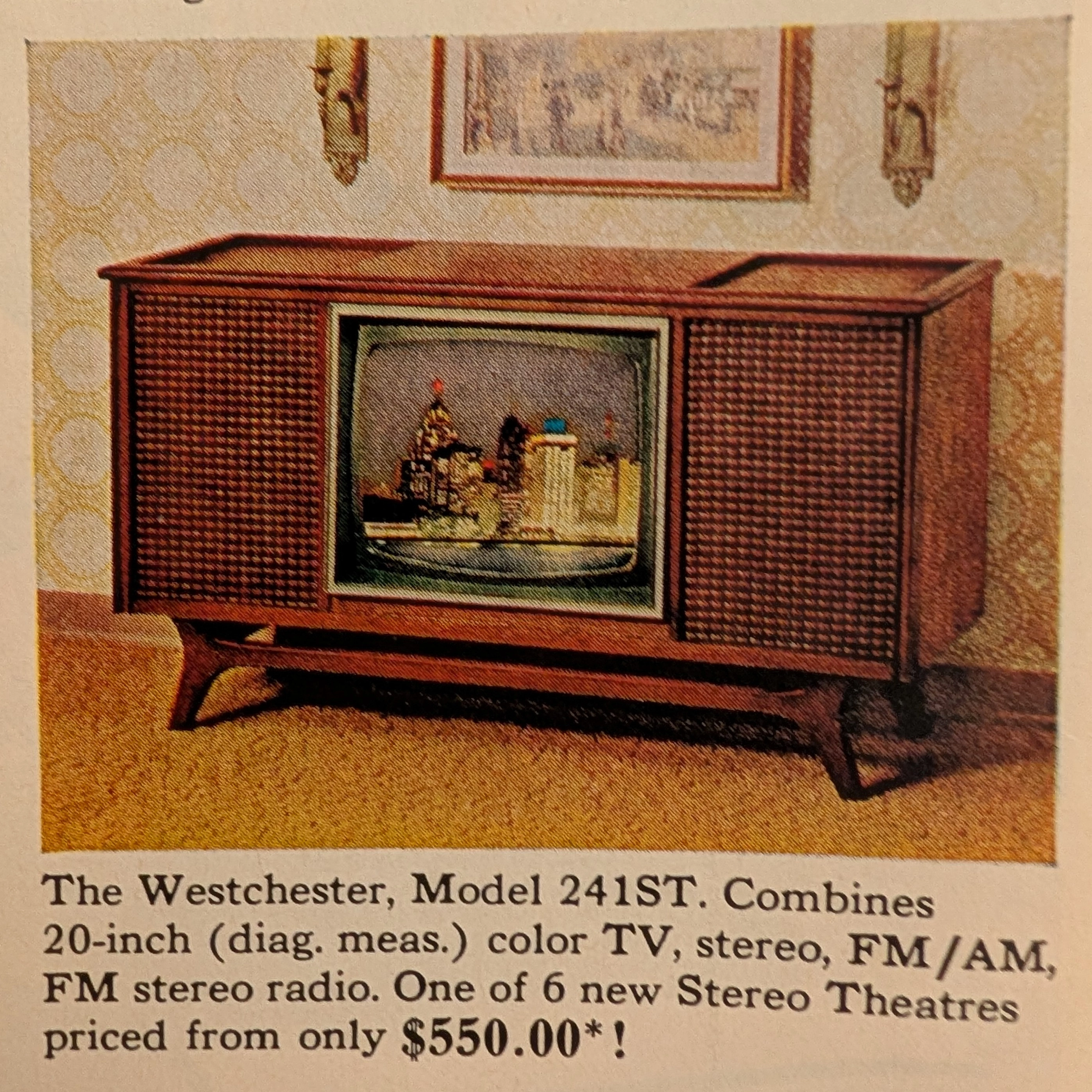
Equally significant is the artifact's documentation of the "Stereo Theatre" concept, perfectly encapsulated by The Westchester, Model 241ST. In the mid-century mindset, exposing raw technology was considered aesthetically vulgar. A television could not merely be a machine; it had to be "fine handcrafted furniture." The Westchester represents the absolute zenith of this design philosophy. Priced from an astonishing "$550.00" (an enormous capital investment in the late 1960s, equivalent to roughly $4,800 today), this massive wooden monolith combined a 20-inch color TV, a stereo phonograph, and an FM/AM stereo radio into a single, overwhelming piece of cabinetry. It was designed to anchor the living room, replacing the fireplace as the architectural focal point of domestic life. The use of heavy, acoustically engineered wooden cabinets with woven speaker grilles masked the complex "precision-crafted transformer-powered color TV chassis" inside, allowing middle-class families to embrace the future without abandoning the visual comforts of the past.
Conversely, the artifact also highlights a fascinating counter-movement toward domestic mobility with The Houston, Model C8024T. While the Westchester was a monolithic anchor, The Houston offered "portable convenience" on an "Admiral deluxe roll-about matching TV cart." This explicitly catered to a burgeoning desire for flexible interior design. The television was no longer confined to the living room; it could be wheeled into the dining room for dinner viewing or the bedroom. The marketing description of its "Elegant white linen finish" reveals a highly gendered marketing approach, specifically targeting female consumers who were the primary decision-makers regarding interior décor. The juxtaposition of the massive wooden Westchester and the mobile, linen-finished Houston demonstrates Admiral's strategic attempt to conquer every conceivable spatial layout within the suburban home.
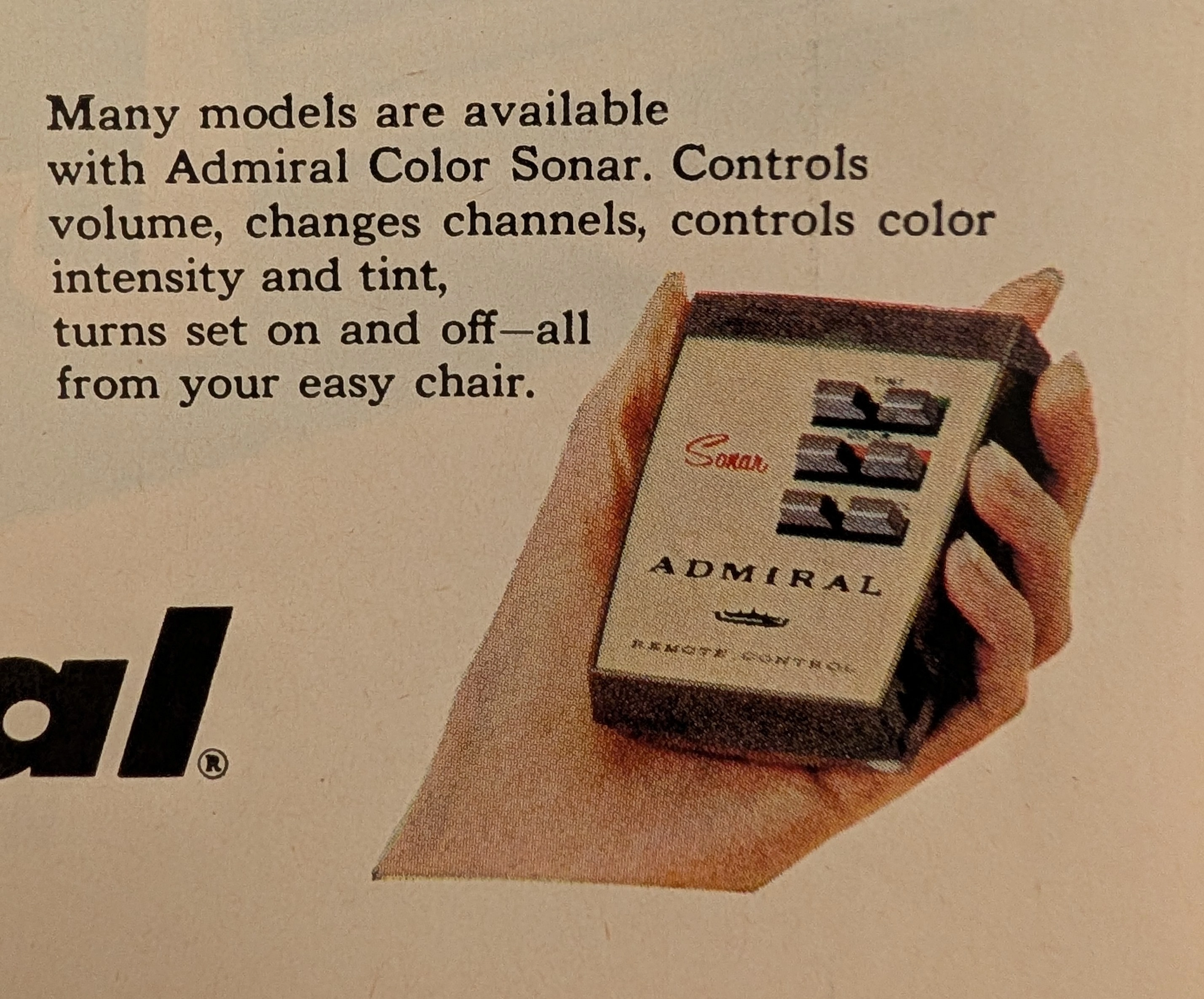
However, the absolute crown jewel of technological history captured in this artifact rests in the lower right corner: the Admiral Color Sonar Remote Control. This device is a profound artifact of the space age. Before the ubiquity of infrared (IR) remotes in the 1980s, wireless remote controls operated on ultrasonics. The "Sonar" moniker was not a marketing exaggeration; it was a literal description of the physics at play. Inside early versions of these remotes were tuned aluminum rods. When the user pressed a heavy, mechanical button, a spring-loaded hammer would strike a specific rod, generating a high-frequency ultrasonic sound wave (inaudible to human ears, but famously irritating to household dogs). A microphone array on the television would detect this specific frequency and trigger a motor to physically rotate the tuning dial or adjust the volume potentiometer.
The introduction of the Color Sonar remote was a sociological earthquake. The copy promises the ability to "Controls volume, changes channels, controls color intensity and tint, turns set on and off—all from your easy chair." Prior to this invention, the viewer was a captive audience; changing the channel required physical exertion, meaning people were far more likely to sit through commercials or dull programming. The Sonar remote shattered this paradigm. It invented the concept of "channel surfing." It transferred ultimate power from the broadcaster directly into the hand of the viewer, fundamentally altering the pacing of television programming and the advertising industry forever. The image of the hand holding the Sonar remote is the visual genesis of the modern, interactive media consumer.
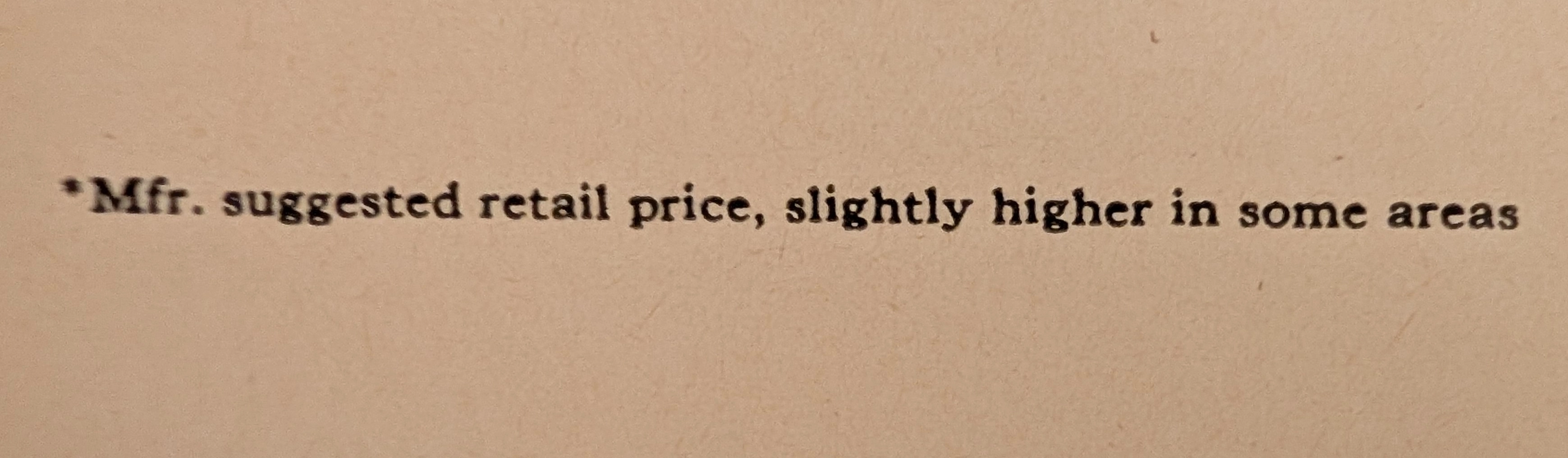
Finally, the economic reality of this era is quietly recorded in the microscopic typographical asterisk: "*Mfr. suggested retail price, slightly higher in some areas". This tiny addendum speaks volumes about the logistics of mid-century commerce. Before the era of national big-box retailers and standardized algorithmic pricing, the cost of shipping massive, heavy CRT televisions across the country significantly impacted the final retail cost. Consumers in rural or geographically isolated areas paid a premium for the luxury of the airwaves, a stark reminder of the physical weight of analog technology.
The Paper
As a physical entity, this printed artifact functions as a living, breathing, and profound record of mid-twentieth-century graphic reproduction and substrate chemistry. Under exceptional, high-magnification macro-lens examination, this document reveals the stunning complexity and mathematical precision of analog color printing.
The extraordinary macro photographs of the television screens—particularly the golfer on the Jameson model and the city skyline on the Westchester—provide a textbook visualization of a CMYK halftone rosette pattern. The vibrant green of the golf course and the glowing yellow lights of the urban skyline are not solid, continuous swatches of ink. Instead, they are meticulously constructed from a precise, mathematically rigorous galaxy of microscopic ink dots. Cyan, Magenta, Yellow, and Key (Black) inks are elegantly and systematically layered at highly specific angles to trick the human eye and the biological visual cortex into perceiving a continuous, vibrant, and dimensional photographic reality out of mere clusters of ink. The texture of the uncoated magazine paper stock further illustrates how the ink absorbed into the organic fibers, creating a soft, matte finish characteristic of 1960s high-volume offset printing.
Yet, the most profound and impactfully beautiful factor elevating the immense value of this artifact in the contemporary global collector's market is the natural, organic, and entirely irreversible process of Material Degradation. The expansive margins of the page exhibit a genuine, unavoidable "Toning." This gradual, chronological transition from the original bright, bleached manufactured paper to a warm, antique ivory and golden hue is caused by the slow, relentless chemical oxidation of Lignin—the complex organic phenolic polymer that naturally binds cellulose fibers together within the raw wood pulp of the paper. As the substrate is exposed to ambient oxygen and ultraviolet light over a span of nearly six decades, the molecular structure of the lignin gracefully breaks down. This naturally evolving patina represents the absolute core of the wabi-sabi aesthetic. It is precisely this authentic, unreplicable degradation that acts as the primary engine driving up its market value exponentially among elite curators and collectors, as it provides the ultimate, irrefutable scientific proof of the artifact's historical authenticity and its delicate journey through time.
The Rarity
RARITY CLASS: B (Very Good Archival Preservation with Natural Margin Toning)
Evaluated under the most exacting, rigorous, and uncompromising archival parameters established by The Record Institute (which spans a meticulous classification system from Pristine Class A down to Heavily Degraded Class D), this artifact is definitively and securely designated as Class B.
The remarkable and defining paradox of mid-century commercial ephemera is that these specific documents were produced by the millions as explicitly and intentionally "disposable media." Inserted into high-volume consumer publications of the late 1960s, they were inherently destined by their very nature to be briefly observed, casually folded, used as scrap paper, or ultimately discarded into the recycling bins of history. For a full-page, text-heavy, and graphically significant advertisement to survive entirely intact without catastrophic structural tearing, without destructive moisture staining, or without the fatal, irreversible fading of the delicate, light-sensitive halftone inks constitutes a highly significant statistical archival anomaly.
The structural integrity of this paper remains exceptionally sound. While the rich analog colors—particularly the deep, cavernous blacks of the typography and the vibrant hues on the simulated television screens—remain astonishingly vibrant, there is a beautiful, mathematically even, natural lignin oxidation reflecting its era. This displays a pronounced, warm ivory patina heavily along the expansive margins. This environmental interaction does not detract from its immense value; rather, it authentically validates the document's chronological journey. The sheer sociopolitical weight of the subject matter—the definitive documentation of the transition to Color TV, the birth of ultrasonic remote controls, and the zenith of the "Stereo Theatre"—makes this a highly prized, museum-worthy piece of consumer culture heritage, requiring acid-free, UV-protected conservation framing to ensure its historical permanence.
Visual Impact
The aesthetic brilliance and psychological power of this artifact lie in its masterful execution of "Informational Density and Aspirational Framing." The art director was tasked with justifying an exorbitant price point to the consumer, necessitating a layout that felt substantial, authoritative, and technologically supreme.
The composition utilizes a standard, yet highly effective, catalog-style grid, heavily weighted on the left side by the striking image of the Houston model on its roll-about cart. The image on the screen—a woman in a vibrant, almost surreal red floral hat—is intentionally chosen for maximum chromatic impact, proving the "unparalleled picture clarity" of the Admiral chassis. The right side of the page acts as an upscale gallery, isolating the heavier, wooden console models like art pieces against muted, upper-middle-class wallpaper backgrounds. The visual hierarchy guides the eye flawlessly: starting from the bold, declarative headline, sweeping down the left column of dense, persuasive technical copy, across the vibrant visual proof on the TV screens, and finally resting on the ultimate symbol of futuristic luxury in the bottom right corner—the hand holding the Color Sonar remote control. It is a masterclass in utilizing layout to simultaneously educate the consumer on complex technology while stroking their aspirational desires for domestic status.
Exhibition Halls
The Archive Continues
Continue the Exploration
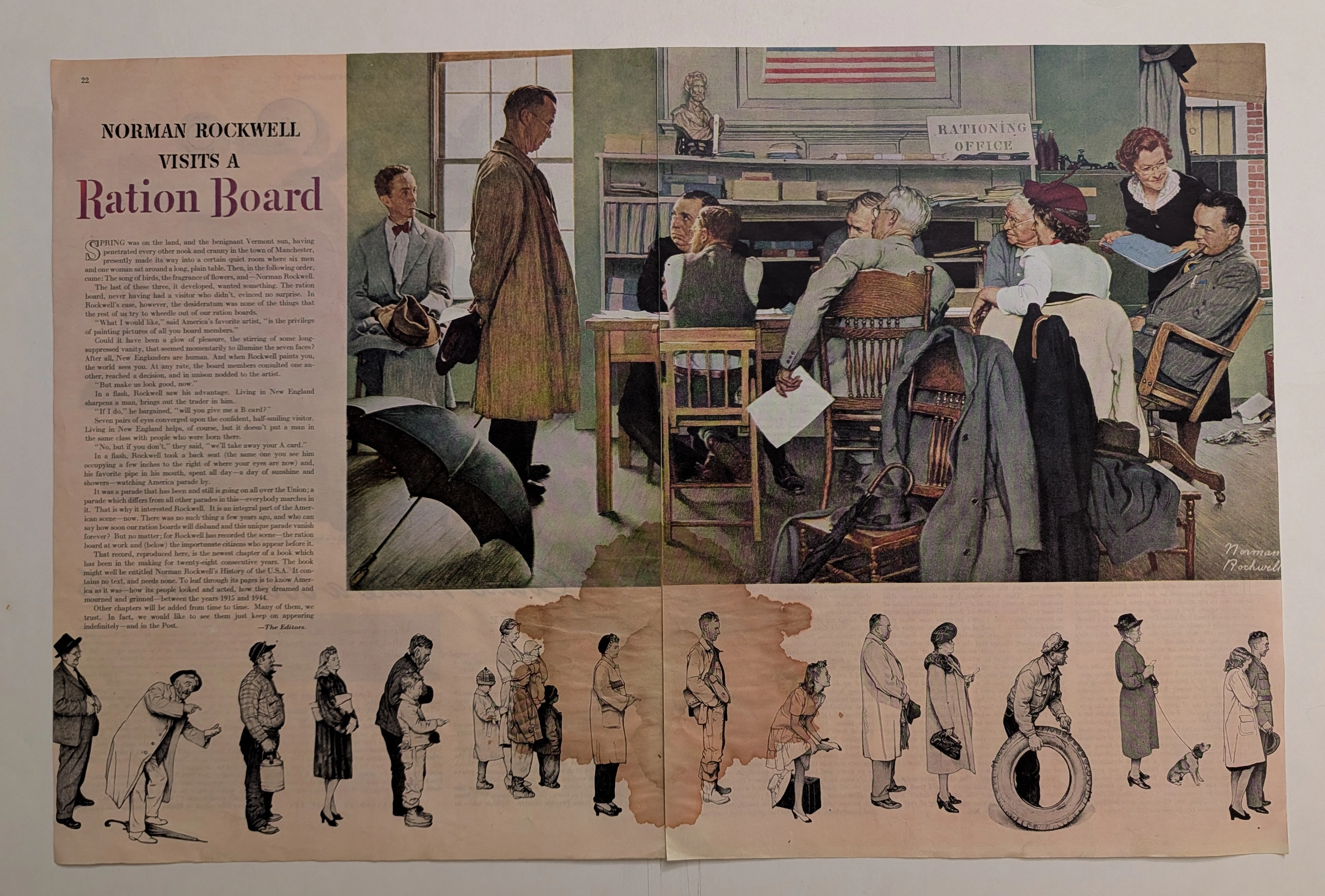
THE TIME TRAVELLER'S DOISSIER — THE WWII HOME FRONT AND THE AESTHETICS OF DESTRUCTION
Executive summary of the original vintage double-page cut sheet featuring Norman Rockwell's WWII masterpiece, "Norman Rockwell Visits a Ration Board" (circa 1944). This artwork masterfully captures the egalitarian struggle of the American home front rationing system. The massive, rust-colored water stain blooming across the highly acidic 80-year-old paper is not damage, but a profound 'historical scar' that exemplifies the beautiful decay of analog media. Surviving wartime paper drives, this frame-ready primary artifact commands a Rarity Class S designation.
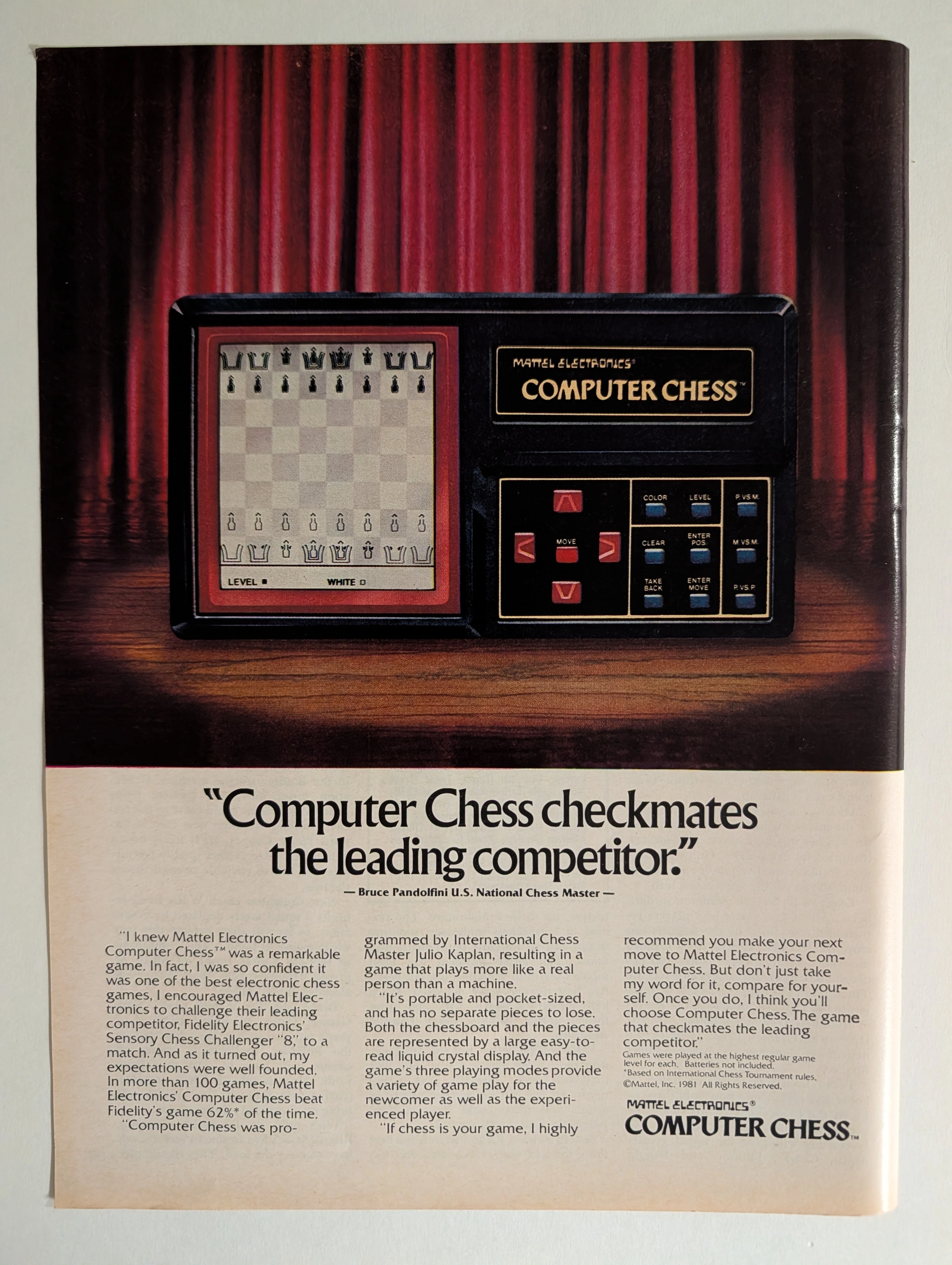
Mattel Electronics Computer Chess 1981 Full-Page Ad | Bruce Pandolfini | Julio Kaplan | Chess AI History | Deep Analysis Rarity Class A
The advertisement analyzed here is a full-page full-color magazine advertisement for the Mattel Electronics Computer Chess™ handheld/tabletop electronic game, copyright © Mattel, Inc. 1981. The ad ran in major American consumer magazines during 1981–1982 — the golden apex of the first electronic game boom. It features a dramatic theatrical photograph of the device spotlit against red velvet curtains on a wooden stage, with a bold competitive claim endorsed by U.S. National Chess Master Bruce Pandolfini: that Mattel's Computer Chess beat Fidelity Electronics' Sensory Chess Challenger '8' in more than 62% of over 100 head-to-head games. The ad also credits International Chess Master Julio Kaplan as programmer. This single page represents the intersection of early consumer AI history, 1980s toy advertising at its most theatrical, and a pivotal moment in the chess-computer arms race that prefigured Deep Blue.
Ballantine · Beverage
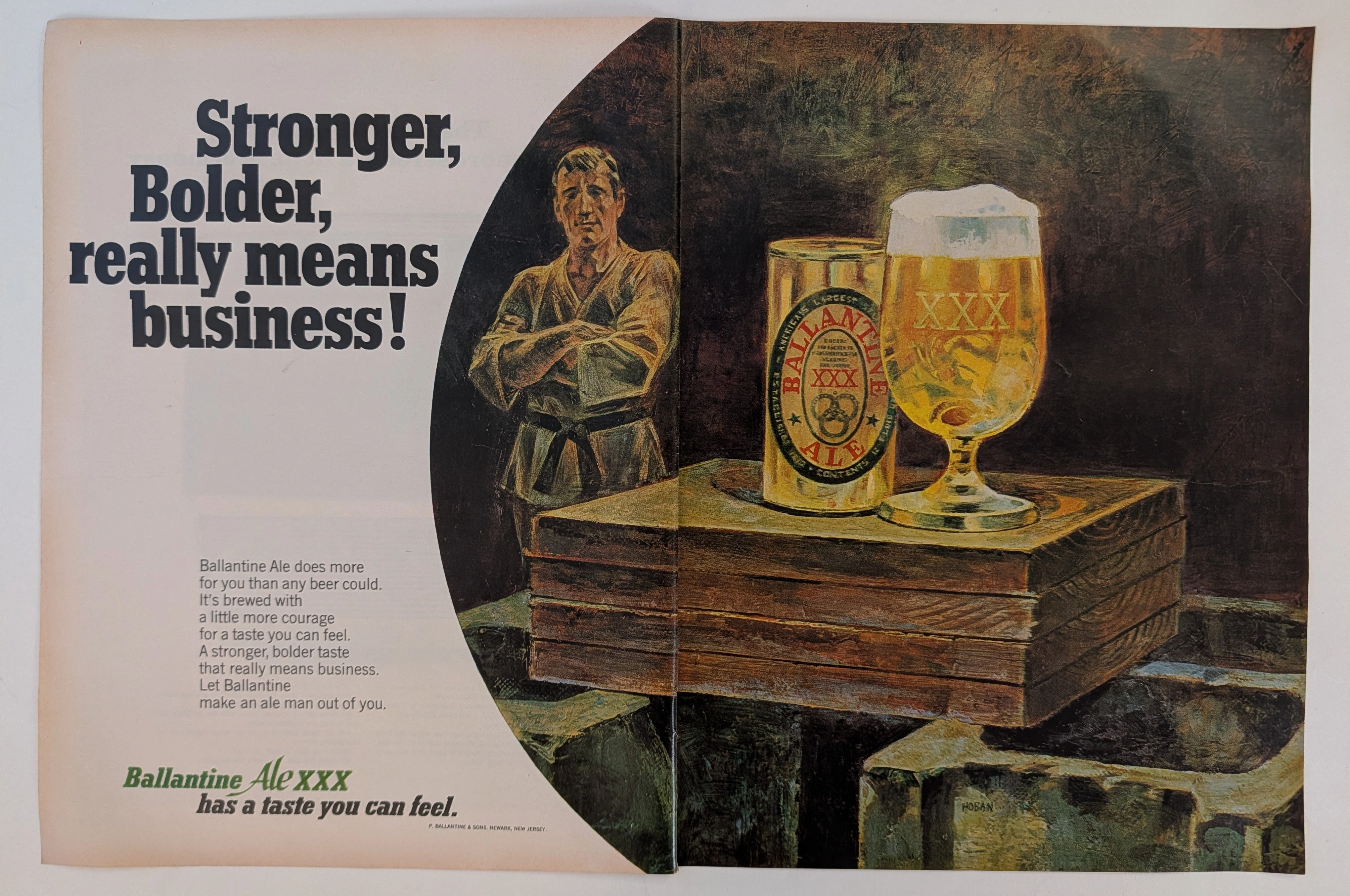
The Time Traveller's Dossier: The Martial Authority of the Brew – An Academic Archival Analysis of the 1968 Ballantine Ale Advertisement
The cultivation of brand identity through visual symbolism is a profound psychological discipline, acting as a mirror to the cultural aspirations of its era. The historical artifact elegantly positioned upon the analytical table of The Record Institute today is a majestic two-page print advertisement for Ballantine Ale, originating from approximately 1968. This document completely transcends the boundaries of conventional beverage promotion; it stands as a masterclass in the semiotics of mid-twentieth-century American masculinity. By seamlessly aligning the consumption of a traditional ale with the disciplined, formidable imagery of a martial arts master, the advertisement constructs a compelling narrative of strength, boldness, and unyielding character. This world-class, comprehensive academic archival dossier will conduct a meticulous and deep examination of the artifact, operating under the most rigorous parameters of historical and material science evaluation. We will decode the strategic copywriting that challenges the consumer to embrace a "stronger, bolder taste," and illuminate the profound historical lineage of the P. Ballantine & Sons brewing empire. Furthermore, as we venture into the chemical and physical foundations of this analog offset lithography, we will reveal the mechanical fingerprints of the halftone rosettes and the graceful, natural oxidation of the paper substrate. This precise intersection of visual nostalgia, mid-century commercial artistry, and the chemistry of time cultivates a serene wabi-sabi aesthetic—a natural phenomenon that serves as the primary engine driving up its market value exponentially within the elite global spheres of Vintage Breweriana collecting.