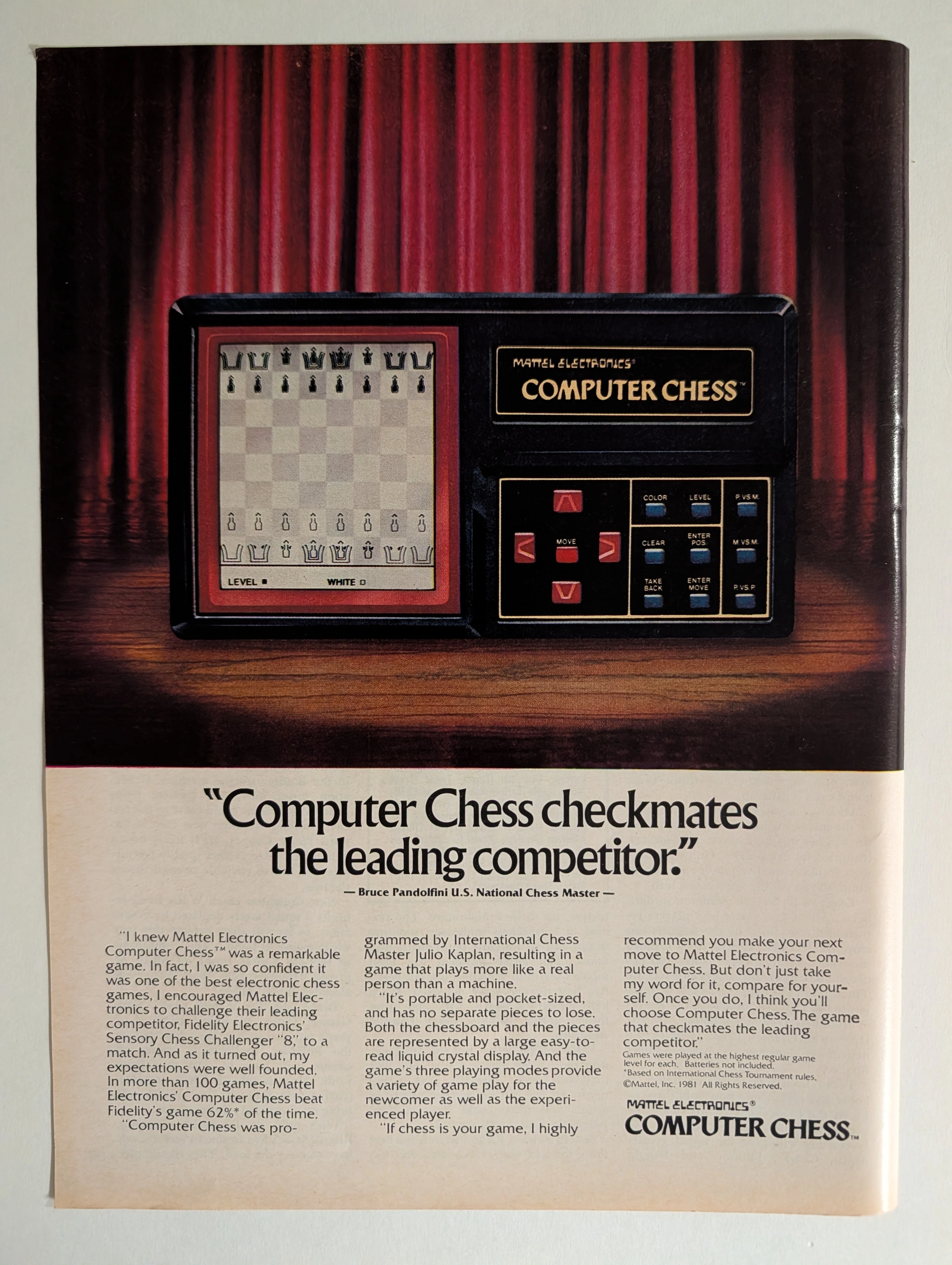
-Historical Context 1.1 The Electronic Game Boom of 1981 — Peak and Context The advertisement under analysis is a full-page full-color promotional piece for Mattel Electronics Computer Chess™, copyright © Mattel, Inc. 1981. It appeared in major American consumer magazines during 1981–1982, at the absolute apex of the first electronic game boom. To understand the significance of this document, one must appreciate what 1981 meant to American consumer electronics. The Atari 2600 had been on the market since 1977 and had created a home gaming culture of unprecedented scale. Handheld electronic games — pioneered by Mattel Electronics with their Football (1977) and Baseball (1978) — had sold tens of millions of units and created a new category of entertainment. Mattel Electronics, a division of Mattel, Inc. of El Segundo, California, had established itself as one of the premier brands in this boom through its Intellivision home console (1979) and its portfolio of LED and LCD handheld sports games. The Computer Chess represented the company's most ambitious single-device challenge: to produce a handheld chess computer capable of defeating its primary competitor on the market. The fact that the advertisement names that competitor directly — Fidelity Electronics' Sensory Chess Challenger '8' — marks this as an unusually aggressive and confident piece of competitive advertising for the era. 1.2 Bruce Pandolfini — The Human Certification The advertisement's central rhetorical strategy is the figure of Bruce Pandolfini, identified as a U.S. National Chess Master, who provides the headline quotation: 'Computer Chess checkmates the leading competitor.' Pandolfini was, in 1981, a recognized figure in the American chess community — a strong master-level player and, significantly, a person who had been involved in training some of the strongest players to visit the United States. His name carried authority with the chess-playing public that a corporate spokesperson could not have replicated. What makes Pandolfini's endorsement particularly effective as advertising copy is its specificity: he does not merely assert that Computer Chess is 'great' or 'unbeatable.' He provides a verifiable statistical claim — 62% wins in over 100 games, played at the highest regular game level — and credits his own professional curiosity ('I was so confident it was one of the best electronic chess games') as the motivation for conducting the test in the first place. This positions the endorsement not as paid promotion but as independent expert validation, which is a sophisticated persuasion technique. Pandolfini's subsequent career amplifies the historical significance of this advertisement considerably. He became the most celebrated chess coach in America, authored numerous instructional books, wrote columns for Chess Life magazine, served as an on-set consultant for the film Searching for Bobby Fischer (1993), and was the technical consultant for The Queen's Gambit (Netflix, 2020) — the most-watched limited series in Netflix history. A 1981 advertisement featuring his name and face is now, retroactively, a document of his early career at a pivotal moment in American chess history. 1.3 Julio Kaplan — The Programmer Who Bridged Chess and AI The body copy of the advertisement reveals something of extraordinary historical interest: the statement that Computer Chess was 'programmed by International Chess Master Julio Kaplan.' Julio Kaplan (born 1950) is a Cuban-American chess player who won the World Junior Chess Championship in 1967 at the age of 16 — one of the youngest World Junior Champions in history — and subsequently earned the International Master title. His involvement in programming a consumer chess computer in 1981 represents a fascinating early example of the collaboration between elite chess knowledge and computational engineering. In the history of chess AI, the period 1977–1990 is characterized by the 'chess master as programmer' approach, where strong players attempted to encode their own strategic knowledge into machines. This contrasted with the pure brute-force computation approach that would eventually dominate. Kaplan's work on Computer Chess places this advertisement at the intersection of two histories: the history of chess (represented by a World Junior Champion) and the history of artificial intelligence (represented by the early attempts to encode human expertise into consumer electronics). The advertisement predates Kasparov vs. Deep Blue by 16 years, but it is documenting the same journey's first steps. 1.4 Fidelity Electronics and the Chess Computer Arms Race The direct naming of Fidelity Electronics' Sensory Chess Challenger '8' as the benchmark competitor is historically revealing. Fidelity Electronics, founded by Sidney Samole in Miami, Florida, had been the dominant force in dedicated chess computers since the introduction of the original Chess Challenger in 1977. The Sensory Chess Challenger series, which allowed piece recognition on the board, was the premium consumer product in this category. For Mattel to directly challenge Fidelity by name was to challenge the reigning champion of the market. The chess computer market of 1977–1985 was one of the most intense competitive technology races in consumer electronics history, analogous in some ways to the smartphone wars of the 2010s. Fidelity, Novag, Mephisto, Saitek, Mattel, and others were releasing new products annually, with each generation improving on the previous in playing strength. This advertisement documents Mattel's challenge at one of the critical moments in that race. The 62% win rate claim, if accurate, represented a significant competitive advantage at a moment when every percentage point of playing strength mattered to the chess-playing consumer. 1.5 The Advertisement's Visual Strategy — Theater as Marketing The photograph at the center of this advertisement is among the most visually striking examples of 1980s toy advertising. Rather than the conventional product-on-white-background or lifestyle-context approach, the creative team chose to present the Computer Chess as a performer on a stage: spotlit against deep crimson velvet curtains parted at the sides, positioned on a wooden stage floor, the machine occupies the center of a theatrical tableau that is simultaneously grand and slightly absurd. A plastic electronic game, occupying the center of a stage that might otherwise host a Shakespearean tragedy or a Carnegie Hall recital. This theatrical framing is a deliberate positioning choice. It elevates the product from 'toy' to 'instrument' — a device worthy of serious consideration, professional endorsement, and a place in the spotlight. The red of the curtains carries associations of importance, drama, and prestige; the spotlighting creates the sense of a reveal or premiere. The combination of these visual choices with the competitive headline creates an advertisement that is simultaneously boastful and seductive, which is exactly what was needed to sell a premium electronic chess game to serious players in 1981. 1.6 Mattel Electronics — Rise and Fall Mattel Electronics at the time of this advertisement's publication was at the peak of its power and ambition. The division had launched in 1976, made its first major impact with Football in 1977, and by 1981 had expanded into home consoles (Intellivision), a full range of sports handhelds, and intelligent games like Computer Chess. The company's marketing budget and media presence in 1981 were substantial, allowing full-page color advertisements in premium publications. The fall came with dramatic speed. The Video Game Crash of 1983 — triggered by the market saturation of low-quality Atari games, most catastrophically E.T. the Extra-Terrestrial, combined with the rise of home computers — devastated the entire electronic game industry. Mattel Electronics closed in 1984. This historical trajectory transforms every piece of Mattel Electronics ephemera into a document from a vanished world — like photographs of a city before its buildings were demolished. The advertisement before us is evidence of a moment of confidence that preceded catastrophe by just two years. -Paper and Production Analysis 2.1 Paper Stock The paper is premium coated stock consistent with major American consumer magazines of 1981. Weight is estimated at 80–100 gsm with a semi-gloss coated surface, produced by offset calendering, providing the smooth and uniform surface required for high-fidelity full-color halftone reproduction. The condition visible in the photograph is Very Good to Fine for its approximate age of 43–44 years. The full-color reproduction remains vivid, the spine shadow at the left edge indicates the page has been maintained within its original bound magazine rather than loose-stored, and no significant yellowing, brittleness, or image degradation is visible. This level of condition after four decades of storage represents above-average preservation. 2.2 Printing Process and Color Fidelity The advertisement was produced using four-color process (CMYK) offset lithography, the standard for premium magazine advertising in 1981. The halftone screen ruling is estimated at 133–150 LPI, consistent with high-end printing specifications for the era. The color fidelity visible in the photograph is remarkable: the deep crimson of the theatrical curtains — a notoriously difficult color to reproduce consistently in CMYK printing, as it requires very precise ink mixing to avoid either orange cast (excess magenta/yellow) or purple cast (excess cyan/magenta) — appears well-controlled and saturated. The gold typography of the 'MATTEL ELECTRONICS' and 'COMPUTER CHESS' logo panels, and the red and blue function buttons, retain clear distinction and vividness. This quality of color preservation after 44 years points to both original print quality and good storage conditions. - Rarity, Market Valuation, and Classification (15%) 3.1 Rarity Factors Several factors converge to elevate this advertisement above a generic 1980s product advertisement. First, it represents a discontinued brand (Mattel Electronics, closed 1984) at the height of its market confidence, making all surviving ephemera inherently terminal documents. Second, it names two historically significant individuals (Pandolfini, now a major cultural figure; Kaplan, World Junior Chess Champion and early AI programmer) whose subsequent careers amplify the document's retrospective significance. Third, it captures a specific moment in chess AI history — the competitive testing of early chess computers against each other — that prefigures the entire subsequent history of chess AI culminating in Kasparov vs. Deep Blue. Fourth, it sits at the intersection of at least four collecting communities: vintage gaming, chess memorabilia, 1980s advertising art, and early AI/computer history. 3.2 Current Market Valuation (2024–2025) Single-page advertisements from 1980s consumer magazines in the technology and gaming categories currently trade in a relatively active but modest market. General ranges: Good condition
Cite this article
- MLA
- Naodhinsuk, Ronin. “Mattel Electronics Computer Chess 1981 Full-Page Ad | Bruce Pandolfini | Julio Kaplan | Chess AI History | Deep Analysis Rarity Class A.” The Record Institute, 3 March 2026, https://therecord.institute/journal/mattel-electronics-computer-chess-1981-full-page-ad-bruce-pandolfini-julio-kaplan-chess-ai-history-deep-analysis-rarity-class-a.
- APA
- Naodhinsuk, R. (2026, March 3). Mattel Electronics Computer Chess 1981 Full-Page Ad | Bruce Pandolfini | Julio Kaplan | Chess AI History | Deep Analysis Rarity Class A. The Record Institute. https://therecord.institute/journal/mattel-electronics-computer-chess-1981-full-page-ad-bruce-pandolfini-julio-kaplan-chess-ai-history-deep-analysis-rarity-class-a
- CHICAGO
- Naodhinsuk, Ronin. 2026. “Mattel Electronics Computer Chess 1981 Full-Page Ad | Bruce Pandolfini | Julio Kaplan | Chess AI History | Deep Analysis Rarity Class A.” The Record Institute, March 3, 2026. https://therecord.institute/journal/mattel-electronics-computer-chess-1981-full-page-ad-bruce-pandolfini-julio-kaplan-chess-ai-history-deep-analysis-rarity-class-a.