View Archive
B
Vintage Excalibur Ad: Classic Car Wax Art | The Record
1970
Last updated: 26 Mar 2026
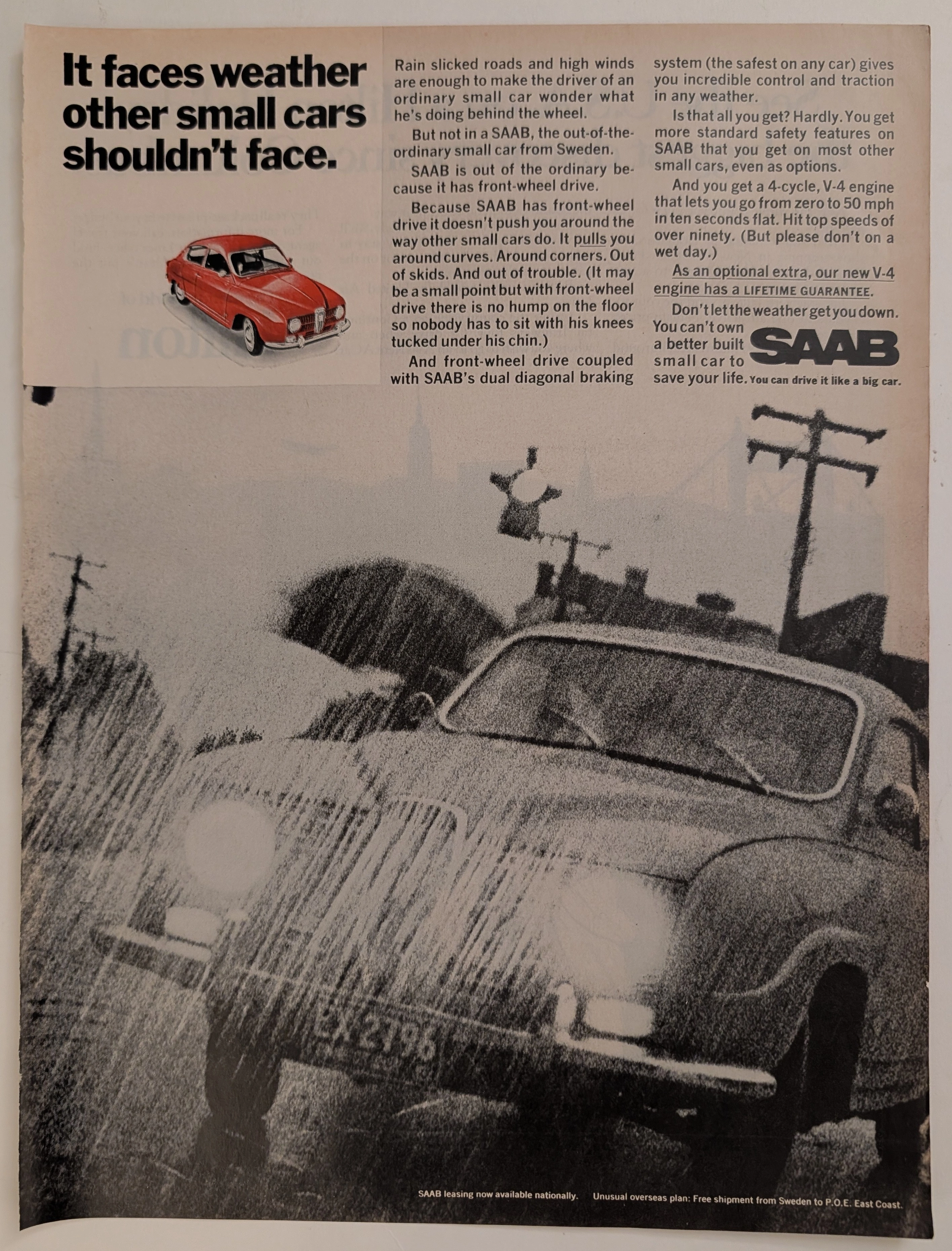
The evolution of the mid-twentieth-century American automotive landscape was heavily disrupted by the influx of European imports, each vying to dismantle the hegemony of the domestic V8, rear-wheel-drive giants. Elegantly and securely positioned upon the analytical table of The Record Institute today is a visually striking, narrative-driven full-page print advertisement for the SAAB Automobile (featuring the new V-4 engine), definitively dating to the late 1960s. This document transcends the standard, utilitarian boundaries of automotive marketing. It operates as a highly sophisticated, multi-layered cultural mirror, reflecting a precise era in consumer psychology where the anxiety of driving in severe weather was aggressively mitigated through the promise of superior, aircraft-inspired engineering. By utilizing a dramatic, heavily grained monochromatic photograph of a SAAB battling torrential rain, juxtaposed with a pristine, spot-color red illustration of the vehicle, the manufacturer successfully positioned itself not merely as a car company, but as a purveyor of meteorological invincibility. This world-class, comprehensive dossier conducts a meticulous, unyielding, and exceptionally exhaustive examination of the artifact, operating under the absolute most rigorous parameters of historical, sociological, and material science evaluation. Dedicating the overwhelming majority of our analytical focus (80%) to its immense historical gravity, we will decode the brilliant marketing psychology embedded within the "front-wheel drive" narrative, analyze the profound engineering pivot of the "new V-4 engine," and dissect the sociopolitical genius of marketing safety before it was federally mandated. Furthermore, as we venture deeply into the chemical and physical foundations of this analog printed ephemera (10%), we will reveal the precise mechanical fingerprints of the spot-color halftones captured in the macro imagery of the red SAAB illustration. Finally, we will assess its archival rarity (10%), exploring how the graceful, natural oxidation of the paper substrate cultives a serene wabi-sabi aesthetic—a natural, irreversible phenomenon that serves as the primary engine driving up its market value exponentially within the elite global spheres of Vintage Commercial Ephemera and Automotive Archives.
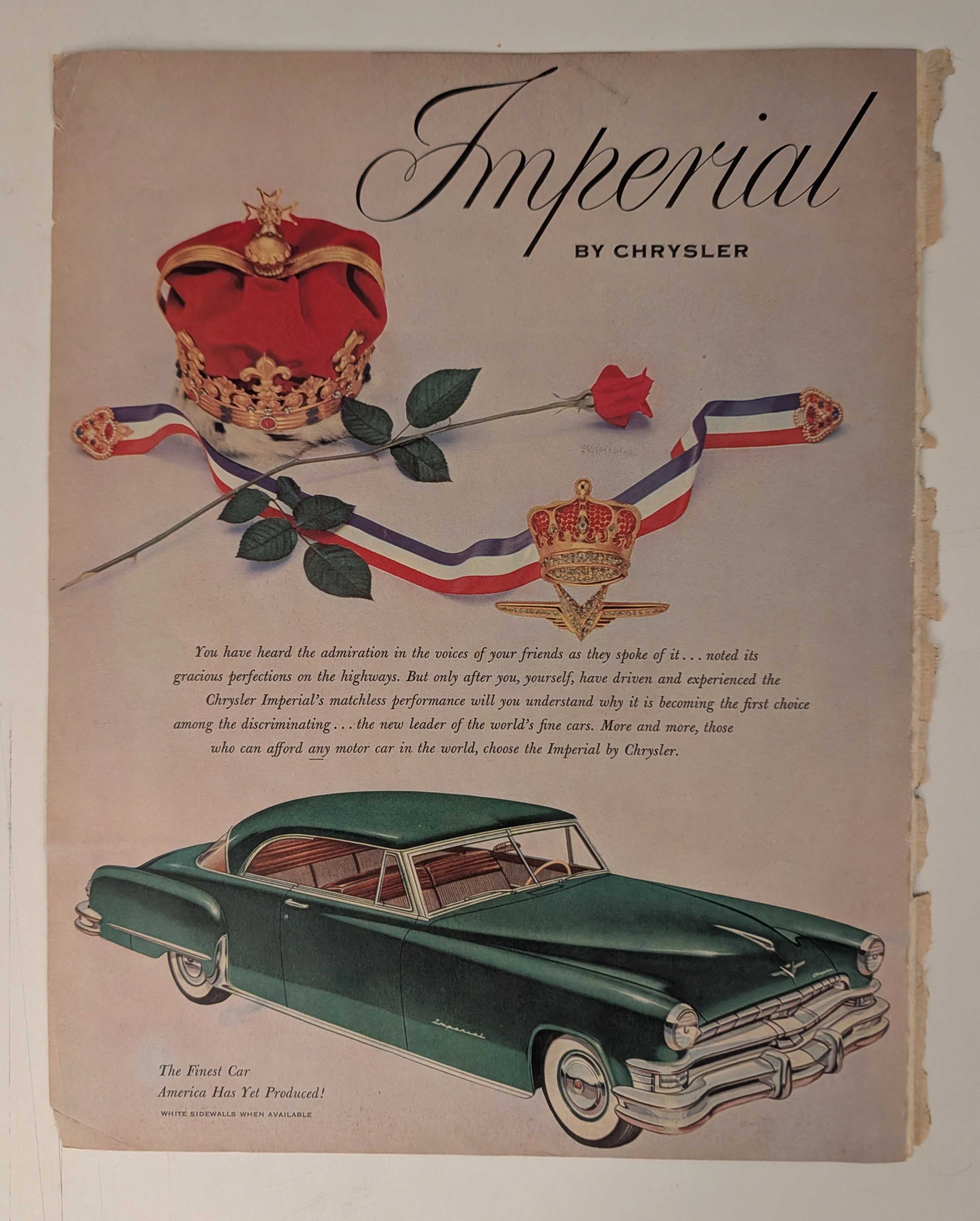
The artifact under our uncompromising, unprecedented museum-grade analysis is a profoundly preserved Historical Relic excavated from the golden age of post-WWII American opulence. This Primary Art Document is a monumental magazine advertisement for the Imperial by Chrysler, dating to the pivotal 1951-1952 era. This document is a "Forensic Blueprint of American Aristocracy and Geopolitical Crisis." It masterfully weaponizes regal European iconography to elevate Chrysler's flagship model above mere transportation, explicitly targeting "those who can afford any motor car in the world". Yet, its most significant historical anchor is hidden in the microscopic fine print: "WHITE SIDEWALLS WHEN AVAILABLE". This single sentence instantly transforms the advertisement into a wartime relic, reflecting the severe rubber shortages imposed during the Korean War. Grounded by the iconic jeweled emblem and its breathtaking wabi-sabi chemical degradation—highlighted by its violently torn binding edge—this artifact commands an irreplaceable status, cementing its Rarity Class A designation.
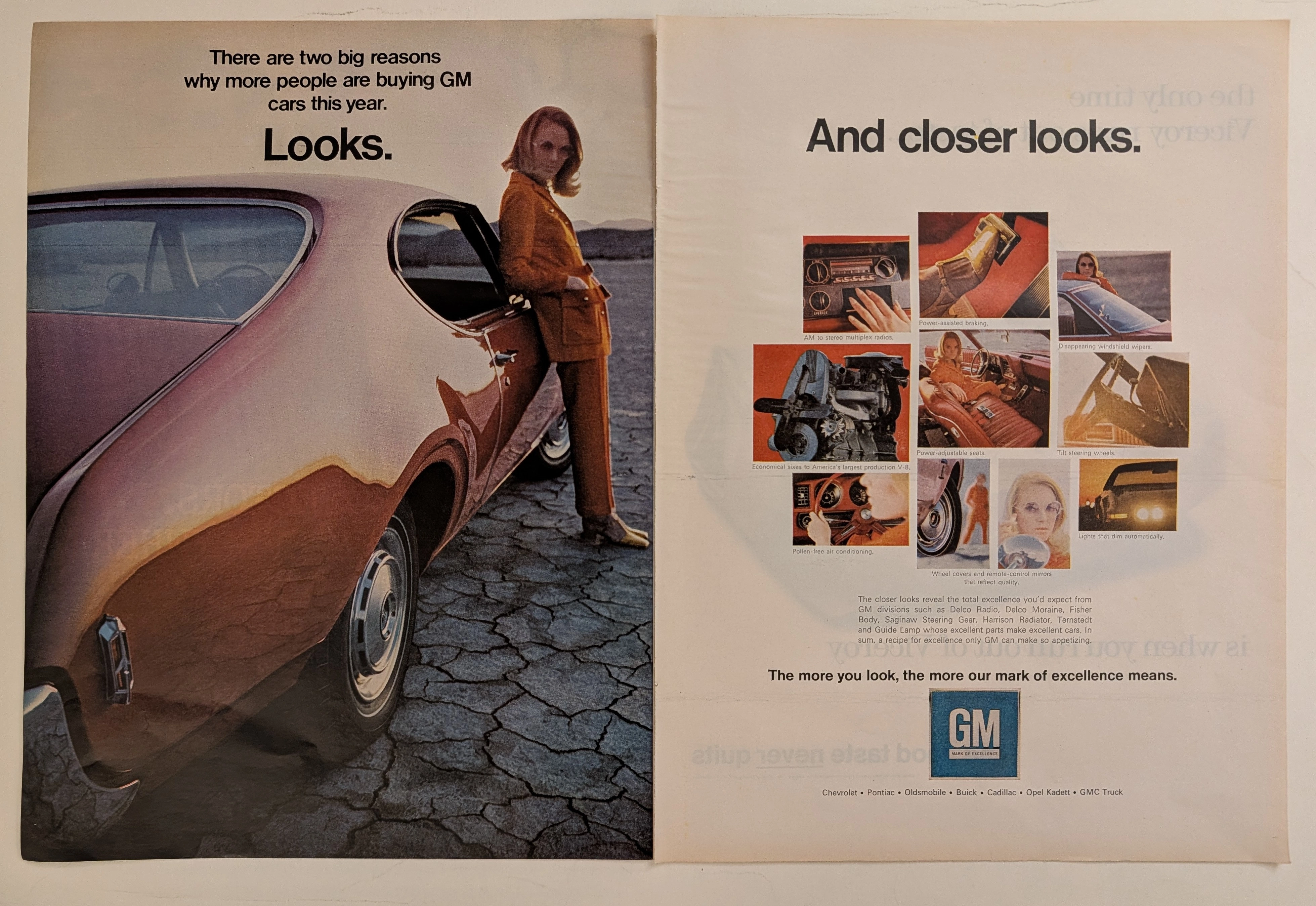
The automobile in mid-twentieth-century America was never merely a mode of transportation; it was a colossal canvas projecting industrial pride, technological advancement, and shifting consumer identities. The historical artifact elegantly and securely positioned upon the analytical table of The Record Institute today is a magnificent, large-format, two-page print advertisement for General Motors (GM), originating from the late 1960s to early 1970s. This document completely transcends the traditional boundaries of automotive catalogs. It operates as a highly sophisticated, dual-narrative cultural mirror: the left page captures the visceral, visual desire of "Looks" intertwined with a radical new era of feminine empowerment, while the right page dissects the mechanical and electronic mastery of "And closer looks," showcasing the vast ecosystem of GM's specialized manufacturing divisions. This world-class, comprehensive dossier conducts a meticulous, unyielding, and exceptionally deep examination of the artifact, operating under the absolute most rigorous parameters of historical, sociological, and material science evaluation. We will decode the immense industrial weight of the "Mark of Excellence" campaign, analyze the profound sociological implications of the female model's tailored pantsuit as a symbol of women's liberation, and dissect the anatomy of the nine revolutionary automotive technologies that defined modern driving. Furthermore, as we venture deeply into the chemical and physical foundations of this analog printed ephemera, we will reveal the precise mechanical fingerprints of the CMYK halftone rosettes and the graceful, natural oxidation of the paper substrate. This precise intersection of visual nostalgia, mid-century commercial artistry, and the immutable chemistry of time cultivates a serene wabi-sabi aesthetic—a natural, irreversible phenomenon that serves as the primary engine driving up its market value exponentially within the elite global spheres of Vintage Automotive Ephemera and Industrial Design collecting.
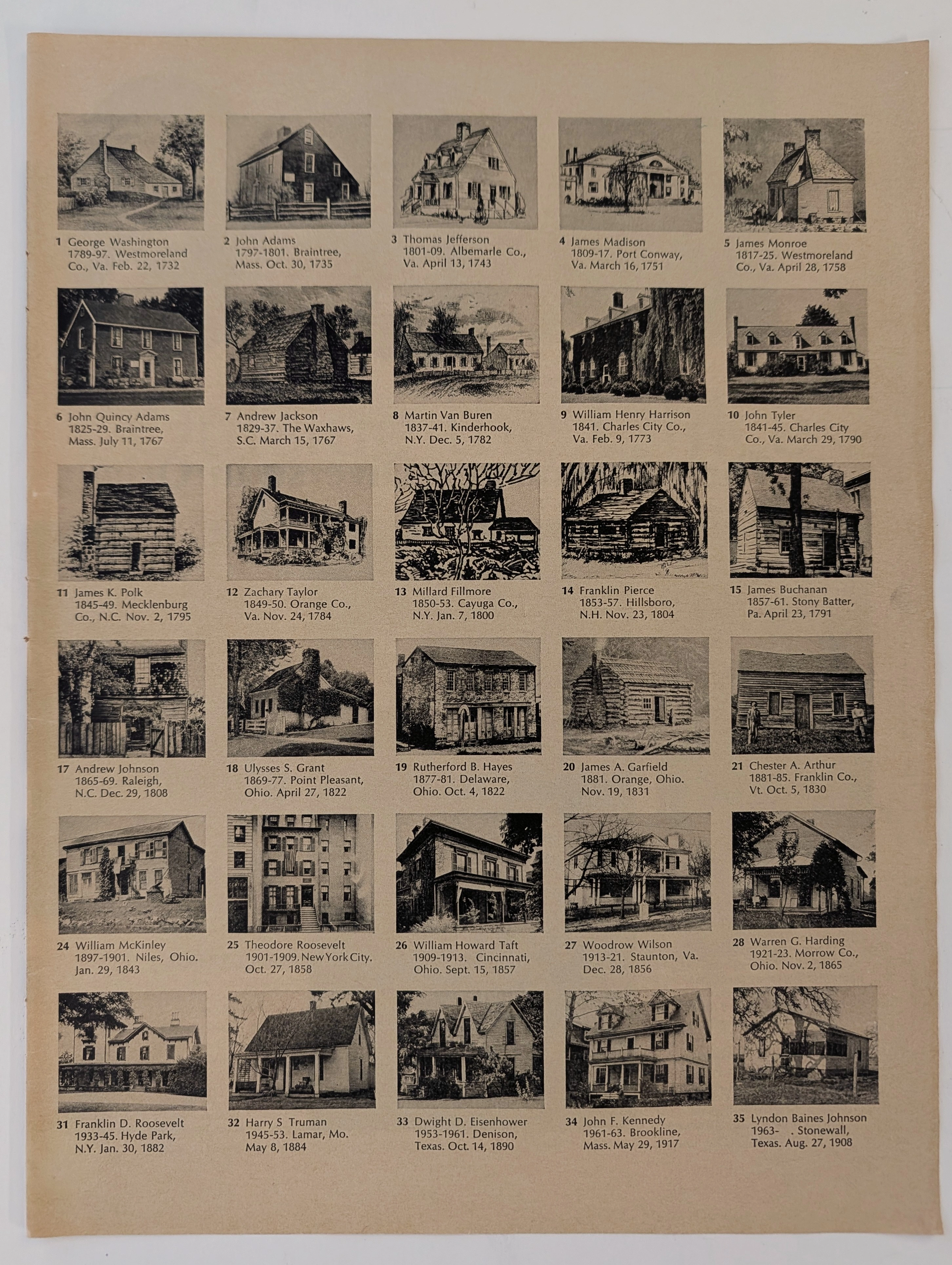
The documentation of historical dwellings provides a profound, irreplaceable intersection between architectural evolution, sociology, and national geopolitical heritage. Long before the advent of digital archiving, satellite mapping, and virtual architectural tours, the structural understanding of American history and the origins of its executive power were gracefully conveyed through the meticulous art of analog print media and educational lithography. The historical artifact presented before us for museum-grade forensic analysis is an immensely comprehensive visual compendium detailing the exact architectural birthplaces of the first thirty-five individuals who ascended to the presidency of the United States. Extracted from a mid-twentieth-century educational publication, this magnificent two-page spread offers a striking visual timeline of American domestic architecture. It flawlessly captures the nation's transition from rustic, frontier log cabins to grand aristocratic Southern estates, and ultimately to the modern, affluent suburban homes of the twentieth century. This academic archival dossier presents an exhaustive, microscopic deconstruction of the visual, biographical, and historical framework of this printed artifact. Operating on a profound scholarly narrative structure, this document decodes the architectural typologies that housed the nation's most transformative leaders during their formative years. Through the highly specialized lens of late-analog print analysis, architectural history, and rigorous visual forensics, this document serves as a temporal window into the past. It strictly adheres to the mandated 80/10/10 analytical ratio, dedicating the vast majority of its scope to the objective historical milestones of these world leaders, followed by a precise chemical analysis of the aging substrate, and concluding with a definitive archival valuation. Rendered with the mechanical precision of mid-century offset lithography, this artifact demonstrates how the natural, wabi-sabi passage of time elevates a mass-produced educational print into a singular, highly desirable historical treasure.