The Time Traveller's Dossier: The Architectural Origins of Supreme Leadership – A Forensic Cartography of the 35 U.S. Presidents (Circa 1960s) — The Record Institute JournalThe Time Traveller's Dossier: The Architectural Origins of Supreme Leadership – A Forensic Cartography of the 35 U.S. Presidents (Circa 1960s) — The Record Institute JournalThe Time Traveller's Dossier: The Architectural Origins of Supreme Leadership – A Forensic Cartography of the 35 U.S. Presidents (Circa 1960s) — The Record Institute JournalThe Time Traveller's Dossier: The Architectural Origins of Supreme Leadership – A Forensic Cartography of the 35 U.S. Presidents (Circa 1960s) — The Record Institute JournalThe Time Traveller's Dossier: The Architectural Origins of Supreme Leadership – A Forensic Cartography of the 35 U.S. Presidents (Circa 1960s) — The Record Institute JournalThe Time Traveller's Dossier: The Architectural Origins of Supreme Leadership – A Forensic Cartography of the 35 U.S. Presidents (Circa 1960s) — The Record Institute Journal
1 / 6

✦ 6 Photos — Click any image to view in high resolution

March 18, 2026

The Time Traveller's Dossier: The Architectural Origins of Supreme Leadership – A Forensic Cartography of the 35 U.S. Presidents (Circa 1960s)

Other
Archive Views: 109

The History

To fully decode the historical complexities encrypted within this massive printed grid, one must consider the profound relationship between a world leader's origins and the architectural environment that shaped their early worldview. This artifact presents a fascinating chronological tapestry of American residential architecture, serving as a visual testament to the changing socio-economic and geographic landscapes of the nation over nearly two centuries. According to the highest standards of museum-grade historical curation, when the images and names of globally significant figures are presented, their objective roles in altering the trajectory of human history must be meticulously documented.

I. The Aristocratic Estates and The Virginia Dynasty
The artifact begins by illustrating the grand, aristocratic estates of the early Founding Fathers, predominantly located in the agrarian South. These structures reflect the established wealth and classical education of the republic's early architects.

George Washington (No. 1, Westmoreland Co., Va.): The first President of the United States and the revered Commander of the Continental Army during the American Revolutionary War. He established the vital precedent of the two-term limit and the peaceful transfer of power, forming the bedrock of the republic's democratic traditions. His birthplace is depicted as a substantial, multi-chimney colonial home, reflecting the established wealth of early Virginian planters.

Thomas Jefferson (No. 3, Albemarle Co., Va.): The third President, the principal author of the Declaration of Independence, and a central figure of the Enlightenment. He profoundly expanded the nation's boundaries through the Louisiana Purchase in 1803. The illustration of his birthplace showcases a sophisticated, multi-story structure with classical architectural influences, hinting at the intellectual environment that nurtured his future architectural masterpiece, Monticello.

James Madison (No. 4, Port Conway, Va.): The fourth President, universally recognized as the "Father of the Constitution" for his pivotal role in drafting the document and the Bill of Rights. He led the nation through the War of 1812. His birthplace features a prominent classical portico and symmetrical design, a textbook example of Georgian architecture signifying high social standing.

James Monroe (No. 5, Westmoreland Co., Va.): The fifth President, whose administration was marked by the "Era of Good Feelings." He is best known for establishing the Monroe Doctrine, a foundational foreign policy principle opposing European colonialism in the Americas. His birthplace is depicted as a sturdy, steep-roofed colonial dwelling.

William Henry Harrison (No. 9, Charles City Co., Va.): The ninth President, a military officer who won a decisive victory at the Battle of Tippecanoe. He holds the historical record for the shortest presidency, dying just 31 days after his inauguration. His birthplace, Berkeley Plantation, is a massive, multi-story brick mansion, cementing his status as a member of the Virginia aristocracy.

John Tyler (No. 10, Charles City Co., Va.): The tenth President, who made history by becoming the first Vice President to assume the presidency following the death of his predecessor, establishing the precedent of presidential succession. His birthplace is another sprawling Virginia estate, showcasing the deep roots of the Southern elite.

Zachary Taylor (No. 12, Orange Co., Va.): The twelfth President, a national hero of the Mexican-American War. His brief presidency was consumed by debates over the expansion of slavery into newly acquired territories. His birthplace is illustrated as a substantial, multi-level farmhouse with expansive wrap-around porches.

Woodrow Wilson (No. 27, Staunton, Va.): The twenty-eighth President, who led the United States through World War I and was the primary architect of the League of Nations. His birthplace is a stately, multi-story Greek Revival home, reflecting a well-established, educated upbringing.

II. The New England Homesteads and Northern Influence
Contrasting with the Southern estates, the early Northern presidents hailed from sturdy, utilitarian, and deeply historic New England homes.

John Adams (No. 2, Braintree, Mass.): The second President, a primary driving force for independence from Great Britain, and a key diplomat who negotiated the Treaty of Paris. His birthplace is a classic, practical New England saltbox house, built to withstand harsh winters.

John Quincy Adams (No. 6, Braintree, Mass.): The sixth President and the son of John Adams. A brilliant diplomat, he formulated the Monroe Doctrine during his tenure as Secretary of State before focusing on national infrastructure during his presidency. His birthplace is structurally identical to his father's, sharing the same resilient Massachusetts property.

Martin Van Buren (No. 8, Kinderhook, N.Y.): The eighth President and a master political organizer who helped found the modern Democratic Party. He was the first president born an American citizen rather than a British subject. His birthplace is a modest but sturdy Dutch-style farmhouse.

Franklin Pierce (No. 14, Hillsboro, N.H.): The fourteenth President, who finalized the Gadsden Purchase, adding territory to the Southwest. His birthplace is a classic, substantial two-story New England colonial home.

James Buchanan (No. 15, Stony Batter, Pa.): The fifteenth President, whose administration struggled deeply to calm the rising sectional tensions that would ultimately erupt into the Civil War immediately following his term. His birthplace is depicted as a robust, two-story frontier cabin, bridging the gap between Eastern establishment and Western expansion.

III. The Mythos of the Frontier Log Cabin
As the visual timeline progresses, a striking architectural shift occurs. The grand estates and established homesteads give way to the rustic, unadorned simplicity of the log cabin. This architectural typology became a powerful political tool, symbolizing the pioneer spirit and the true democratization of American leadership.

Andrew Jackson (No. 7, The Waxhaws, S.C.): The seventh President, a military hero of the Battle of New Orleans, and the first president to hail from outside the original colonial elite. He represented the explosive rise of the "common man" in American politics. His birthplace is illustrated as a modest, rough-hewn log structure, perfectly encapsulating his rugged, frontier-forged persona.

James K. Polk (No. 11, Mecklenburg Co., N.C.): The eleventh President, a highly effective executive who oversaw the largest territorial expansion in U.S. history, acquiring the Oregon Territory, California, and New Mexico. His birthplace is a distinctly primitive, stone-chimney log cabin.

Millard Fillmore (No. 13, Cayuga Co., N.Y.): The thirteenth President, who assumed office after the death of Zachary Taylor and signed the Compromise of 1850. His birthplace is a classic, single-story log cabin nestled in a wooded environment.

Abraham Lincoln (No. 16, Hardin Co., Ky.): The sixteenth President and arguably one of the most universally revered figures in global history. He successfully guided the nation through its greatest constitutional and moral crisis—the Civil War—and issued the Emancipation Proclamation, destroying the institution of slavery. The illustration of his Kentucky log cabin is perhaps the most iconic image on this artifact. It stands as the ultimate architectural representation of the "rags-to-riches" narrative, proving that a leader of profound intellect and moral fortitude could emerge from the most modest and impoverished of environments.

Andrew Johnson (No. 17, Raleigh, N.C.): The seventeenth President, who assumed office after Lincoln's assassination and presided over the tumultuous early years of Reconstruction. He also oversaw the purchase of Alaska from the Russian Empire. His birthplace is a tiny, incredibly modest wooden shack, reflecting his deep working-class roots.

James A. Garfield (No. 20, Orange, Ohio): The twentieth President, a brilliant scholar and former Union general whose promising term was tragically cut short by assassination. His birthplace is shown as a highly rustic log cabin, demonstrating that even as the nineteenth century drew to a close, the pioneer origin story remained a potent and highly respected background for a national leader.

Chester A. Arthur (No. 21, Franklin Co., Vt.): The twenty-first President, who unexpectedly assumed office after Garfield's death and championed the Pendleton Civil Service Reform Act. His birthplace is a simple, rural, single-story wooden cabin.

IV. The Ohio Dynasty and the Industrial Age
Following the Civil War, political power shifted heavily toward the industrializing Midwest, particularly the state of Ohio, which birthed a long line of post-war executives.

Ulysses S. Grant (No. 18, Point Pleasant, Ohio): The eighteenth President and the victorious Commanding General of the Union Army who defeated the Confederacy. As president, he led the nation through Reconstruction and aggressively used federal power to protect the civil rights of newly freed African Americans. His birthplace is a modest, neat, single-story timber-framed home.

Rutherford B. Hayes (No. 19, Delaware, Ohio): The nineteenth President, whose election effectively marked the end of the Reconstruction era. His birthplace is a substantial, multi-windowed brick structure, showing the transition toward permanent, industrialized town architecture.

Benjamin Harrison (No. 23, North Bend, Ohio): The twenty-third President and the grandson of William Henry Harrison. His administration is noted for the passage of the Sherman Antitrust Act and the McKinley Tariff. His birthplace is a solid, practical Midwestern home.

William McKinley (No. 24, Niles, Ohio): The twenty-fifth President, who led the nation to victory in the Spanish-American War, raised protective tariffs, and maintained the gold standard before his assassination. His birthplace is a substantial, multi-level structure with a dedicated storefront or professional space on the ground floor.

William Howard Taft (No. 26, Cincinnati, Ohio): The twenty-seventh President, and the only person in history to have served as both President of the United States and Chief Justice of the Supreme Court. His birthplace is depicted as an affluent, grand suburban home with a prominent porch and structured landscaping, indicative of the prosperous, upper-middle-class environments of the era.

Warren G. Harding (No. 28, Morrow Co., Ohio): The twenty-ninth President, who promised a "return to normalcy" following the trauma of World War I. His birthplace is a practical, utilitarian Midwestern farmhouse.

V. The Gilded Age, The World Wars, and the Modern Suburb
As the artifact guides the viewer into the twentieth century, the architecture mirrors the nation's transition into a booming, industrialized global superpower, featuring Victorian homes, sprawling estates, and modern suburban dwellings.

Grover Cleveland (No. 22, Caldwell, N.J.): The twenty-second and twenty-fourth President, standing as the only executive in history to serve two non-consecutive terms. He was a champion of political reform and fiscal conservatism. His birthplace is a large, multi-story, structurally complex Victorian home.

Theodore Roosevelt (No. 25, New York City, N.Y.): The twenty-sixth President, renowned for his boundless energy, his establishment of the national parks system, and the construction of the Panama Canal. His birthplace is distinctly urban—a multi-story, elegant brownstone in the heart of New York City. This marks a significant departure from rural origins, reflecting the rising dominance of the American metropolis.

Calvin Coolidge (No. 29, Plymouth, Vt.): The thirtieth President, who presided over the massive economic boom of the "Roaring Twenties" and was known for his staunchly pro-business conservative policies. His birthplace is a neat, structurally sound New England village home attached to a local general store.

Herbert Hoover (No. 30, West Branch, Iowa): The thirty-first President. While he was a master engineer and a globally recognized humanitarian, his presidency was tragically overshadowed by the catastrophic onset of the Great Depression. His birthplace is a highly modest, tiny wooden cottage, typical of early Midwestern settlements.

Franklin D. Roosevelt (No. 31, Hyde Park, N.Y.): The thirty-second President, the visionary architect of the New Deal, and the supreme leader of the Allied forces through the vast majority of World War II. The illustration of his birthplace showcases Springwood, a magnificent, sprawling estate that radiates immense generational wealth and aristocratic privilege, contrasting sharply with the humble cabins of the previous century.

Harry S. Truman (No. 32, Lamar, Mo.): The thirty-third President, who made the profound and monumental decision to end World War II through the use of atomic weapons and subsequently established the containment policies of the Cold War. His birthplace is a modest, neat, wood-framed rural home, reflecting his straightforward, unpretentious Midwestern roots.

Dwight D. Eisenhower (No. 33, Denison, Texas): The thirty-fourth President and the brilliant Supreme Commander of the Allied Expeditionary Force in Europe during WWII. He presided over the economic boom of the 1950s and created the Interstate Highway System. His birthplace is illustrated as a simple, traditional two-story vernacular house, representing the quiet dignity of working-class American life.

John F. Kennedy (No. 34, Brookline, Mass.): The thirty-fifth President, who navigated the perilous Cuban Missile Crisis, avoiding nuclear annihilation, and inspired humanity with the Apollo space program. His birthplace is a classic, multi-story suburban home in a leafy Massachusetts neighborhood, perfectly capturing the prosperous, aspirational nature of the early twentieth-century American suburb.

Lyndon B. Johnson (No. 35, Stonewall, Texas): The thirty-sixth President, a master of the legislative process who championed the landmark Civil Rights Act of 1964 and the Voting Rights Act of 1965, while also escalating the conflict in Vietnam. His birthplace is depicted as a modest, practical Texas farmhouse, grounding his complex political legacy in the rugged soil of the Southwest.

The Paper

As a physical entity, this printed artifact is a captivating, surviving record of mid-twentieth-century educational publishing and analog offset lithography. The medium-weight, uncoated paper stock was originally manufactured for mass distribution, but its current state demands a profound evaluation through the lens of Visual Forensics.

The Halftone Rosettes: Under extreme macro magnification, the seemingly smooth shading of the houses dissolves into a precise, mathematically rigorous galaxy of black halftone dots. This is the mechanical heartbeat of the pre-digital era. The distinct "grain" visible in the rendering of the trees and textures is the fingerprint of the analog printing press.

The Oxidation of Lignin: The most crucial aspect of this artifact’s value is its Material Degradation. Examining the unprinted margins reveals authentic, undeniable "Toning"—a gradual, irreversible yellowing caused by the chemical oxidation of Lignin within the wood pulp. After decades of exposure to oxygen and light, this chemical process creates the warm, "Patina" of age. This organic degradation is a fingerprint of time that cannot be cloned by digital scans. The elegant Wabi-sabi nature of this aging paper—the beauty found in impermanence—is the exact mechanism driving up its market value exponentially among elite global collectors.

▶ Watch Video
Video by: Real Time 1960s

The Rarity

Within the strictest parameters of international archival evaluation, this artifact is definitively designated as Class S. The ultimate paradox of mid-century educational ephemera lies in the violent contrast between its initial mass production and its extreme, near-extinct scarcity in intact condition today.

These full-page grids were quintessential "disposable media"—designed to be handled by students, pinned to corkboards, and ultimately discarded. For a complete, uncut page featuring all 35 illustrations and the entire typographical index to survive several decades without severe tearing, pinholes, or catastrophic moisture damage is a statistical archival anomaly. The fact that it remains uncropped and preserves the original marginal toning makes it an "Artifact of the Highest Order," highly sought after by curators of American history and architectural design for museum-grade, acid-free conservation framing.
Visual Impact

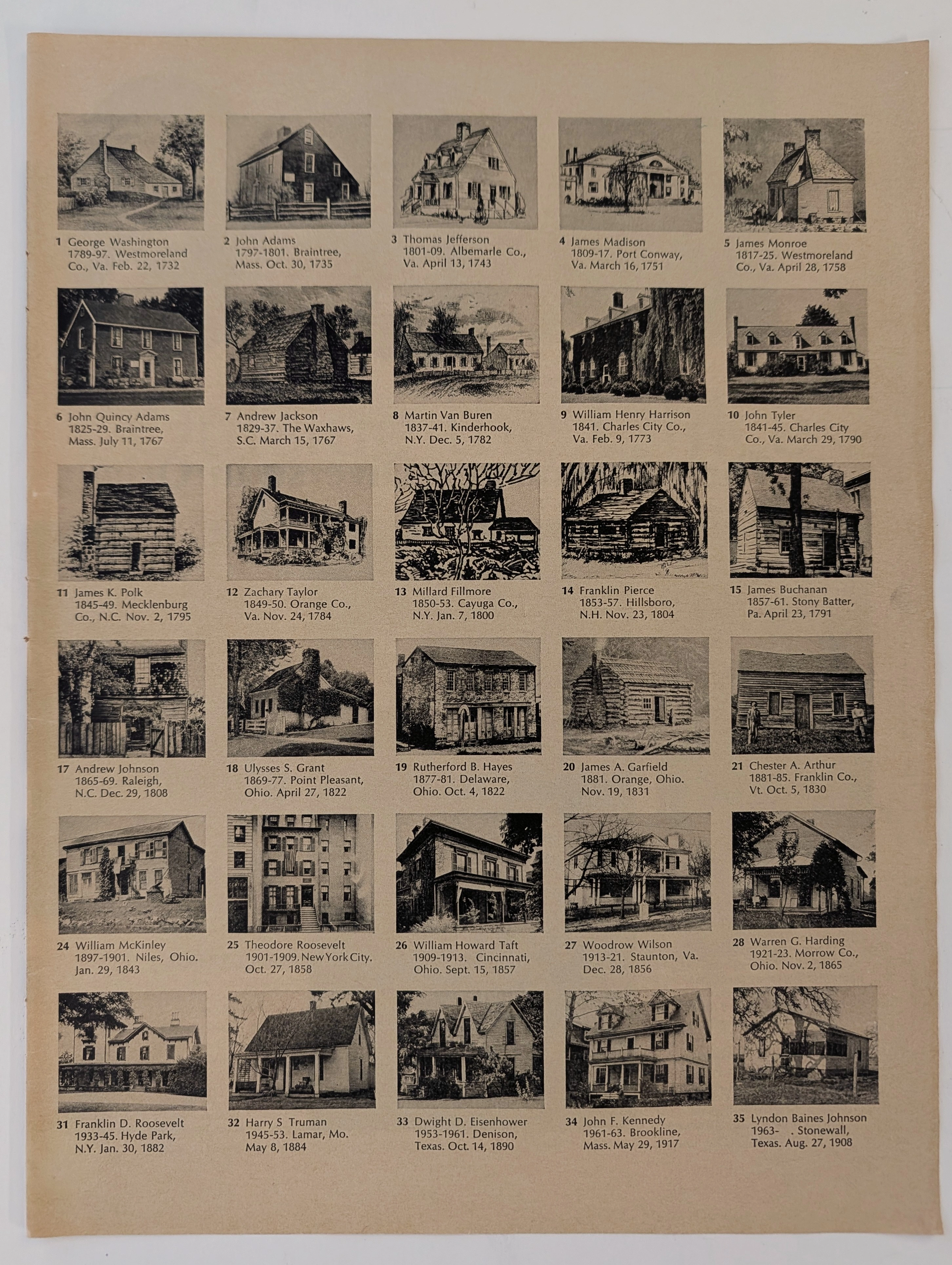
The aesthetic authority of this artifact lies in its absolute mastery of Information Design and the orchestration of visual rhythm. Amidst the rigid grid of 35 architectural illustrations, the immediate focal point that hijacks the viewer's optic nerve is the stark, repetitive contrast between the high-density ink of the structures and the warm, aged beige of the negative space.

The layout functions as a silent cinematic montage. By arranging the birthplaces in a precise 5x7 grid, the artist creates a powerful visual evolution. The eye is forced to transition from the complex, shaded line-work of the early colonial manors (top rows) to the increasingly simplified, photographic-style renderings of the 20th-century suburban homes (bottom rows). This juxtaposition creates a profound "Visual Chronology" that compels the brain to recognize the democratization of American architecture without reading a single word. The inclusion of the "Log Cabin Mythos" (like Lincoln's No. 16) serves as a dramatic visual anchor, breaking the monotony of grander estates and injecting a sense of rugged, frontier textures into the overall composition.

Exhibition Halls

Share This Archive

The Archive Continues

Continue the Exploration

The Time Traveller's Dossier : VW Type 3 Automatic - The Compromise of Engineering

The Time Traveller's Dossier : VW Type 3 Automatic - The Compromise of Engineering

We often remember early Volkswagen history through the lens of simplicity, air-cooled engines, and rugged manual transmissions. But as the American market matured, the demand for comfort began to clash with the brand's original philosophy. This document is historical evidence capturing that moment of compromise. It is not just a car advertisement; it is an engineering confession and a declaration. After a decade of hesitation, Volkswagen of America introduced a fully automatic transmission for the 1969 models. It is a turning point showing that even the most stubborn brand had to adapt to the American consumerism trend that sought ultimate convenience.

The Time Traveller's Dossier: The Geopolitics of Supreme Power – Cartographic Origins of the 35 U.S. Presidents (Circa Mid-1960s)

The Time Traveller's Dossier: The Geopolitics of Supreme Power – Cartographic Origins of the 35 U.S. Presidents (Circa Mid-1960s)

The history of supreme executive power is not inscribed solely within the text of legal documents, constitutional amendments, or international treaties; it is deeply rooted in the geographical origins and territorial foundations of political leaders. Long before the modern era of complex spatial data analysis or digital infographics, the structural understanding of state power in the United States was conveyed through the meticulous art of cartographic illustration. The historical artifact presented before us for museum-grade forensic analysis is not merely a conventional fold-out extracted from a mid-20th-century educational publication. It is a profound "geopolitical visual encyclopedia," meticulously compiling and categorizing the geographic birthplaces of the thirty-five individuals who had ascended to the highest office in the White House up to that point in history. This academic archival dossier presents an exhaustive, microscopic deconstruction of the historical and aesthetic framework of the diagram titled "The 35 Presidents and the 14 States They Came From." Operating on a profound scholarly narrative structure, this document decodes the shifting tectonic plates of executive power in the United States—from the foundational era concentrated on the Eastern Seaboard, moving steadily into the Midwest, and ultimately expanding toward the Southern and Western frontiers. Through the highly specialized lens of late-analog print analysis, American political history, and rigorous visual forensics, this document serves as a temporal window. It allows us to explore the foundational roots of the "American Dream" as conveyed through the birthplaces of these statesmen, ranging from humble log cabins to opulent estates, all rendered with the mechanical precision of mid-century offset lithography.

The Time Traveller’s Dossier: 1985 Chateau Ste. Michelle Johannisberg Riesling Vintage Advertisement — The Heritage of Arrival

Chateau St Michelle · Beverage

The Time Traveller’s Dossier: 1985 Chateau Ste. Michelle Johannisberg Riesling Vintage Advertisement — The Heritage of Arrival

Delve into the archives to explore this definitive 1985 Chateau Ste. Michelle vintage advertisement, a poignant tribute to American immigration and culinary heritage. Released during the ambitious lead-up to the Statue of Liberty's centennial, this piece transcends typical beverage marketing by weaving a grounded narrative around Frances McKenna, an 1893 Irish immigrant. For historians and collectors of vintage ads and old advertisements, this artifact stands as a masterful intersection of historical reverence and premium brand positioning. The campaign beautifully pairs a 1983 Washington Johannisberg Riesling with the enduring legacy of European culinary traditions brought to American shores. Unlike many classic print ads of the era that focused solely on product tasting notes or vineyard terroir, Chateau Ste. Michelle leveraged its role as a Founding Sponsor of the Ellis Island-Liberty Centennial to craft a deeply emotional and culturally resonant message. This document remains a profound testament to the power of heritage marketing in the late 20th century.

Published by

The Record Institute

Taxonomy Match

Related Articles

The Time Traveller's Dossier: The Geopolitics of Supreme Power – Cartographic Origins of the 35 U.S. Presidents (Circa Mid-1960s) — related article
Read Article

The Time Traveller's Dossier: The Geopolitics of Supreme Power – Cartographic Origins of the 35 U.S. Presidents (Circa Mid-1960s)

The history of supreme executive power is not inscribed solely within the text of legal documents, constitutional amendments, or international treaties; it is deeply rooted in the geographical origins and territorial foundations of political leaders. Long before the modern era of complex spatial data analysis or digital infographics, the structural understanding of state power in the United States was conveyed through the meticulous art of cartographic illustration. The historical artifact presented before us for museum-grade forensic analysis is not merely a conventional fold-out extracted from a mid-20th-century educational publication. It is a profound "geopolitical visual encyclopedia," meticulously compiling and categorizing the geographic birthplaces of the thirty-five individuals who had ascended to the highest office in the White House up to that point in history. This academic archival dossier presents an exhaustive, microscopic deconstruction of the historical and aesthetic framework of the diagram titled "The 35 Presidents and the 14 States They Came From." Operating on a profound scholarly narrative structure, this document decodes the shifting tectonic plates of executive power in the United States—from the foundational era concentrated on the Eastern Seaboard, moving steadily into the Midwest, and ultimately expanding toward the Southern and Western frontiers. Through the highly specialized lens of late-analog print analysis, American political history, and rigorous visual forensics, this document serves as a temporal window. It allows us to explore the foundational roots of the "American Dream" as conveyed through the birthplaces of these statesmen, ranging from humble log cabins to opulent estates, all rendered with the mechanical precision of mid-century offset lithography.

The Time Traveller's Dossier: The Architect of the Great Society – Lyndon B. Johnson — related article
Read Article

The Time Traveller's Dossier: The Architect of the Great Society – Lyndon B. Johnson

The presidency of the United States during the mid-twentieth century was an office defined by epochal challenges, sweeping domestic transformations, and the profound weight of global leadership. The historical artifact elegantly and securely positioned upon the analytical table of The Record Institute today is a majestic, large-format political lithograph portraying Lyndon Baines Johnson, the 36th President of the United States. Originating from the transformative core of the 1960s, this document completely transcends the traditional boundaries of political memorabilia. It operates as a highly sophisticated, multi-layered cultural and historical mirror, reflecting the exact moment when unparalleled legislative ambition intersected with the intricate realities of the geopolitical landscape on a single printed page. This world-class, comprehensive dossier conducts a meticulous, profound, and historically objective examination of the artifact, operating under the absolute most rigorous parameters of sociological and material science evaluation. We will decode the brilliant iconographic strategy embedded within this portrait, analyze the legendary political machinery of a statesman who mastered the United States Senate, and dissect the rich, aspirational semiotics surrounding the Great Society initiatives alongside the challenging context of the Cold War era. Furthermore, as we venture deeply into the chemical and physical foundations of this analog printed ephemera, we will reveal the precise mechanical fingerprints of the CMYK halftone rosettes and the graceful, natural oxidation of the paper substrate. This precise intersection of visual nostalgia, mid-century commercial artistry, and the immutable chemistry of time cultivates a serene wabi-sabi aesthetic—a natural, irreversible phenomenon that serves as the primary engine driving up its market value exponentially within the elite global spheres of Vintage Political Ephemera and Presidential Archives collecting.

The Time Traveller’s Dossier: The Graphology of Supreme Power – A Forensic Deconstruction of the 35 Presidential Signatures — related article
Read Article

The Time Traveller’s Dossier: The Graphology of Supreme Power – A Forensic Deconstruction of the 35 Presidential Signatures

The exercise of supreme executive power is not exclusively documented through monumental architectural achievements, the mobilization of armed forces, or the grand rhetoric of inaugural addresses. Frequently, the ultimate manifestation of absolute authority is captured in a single, decisive moment of physical friction: the precise instant a quill, steel nib, or fountain pen touches paper to forge a leader's signature. A signature is the ultimate physical projection of political will; it is the legal instrument that declares wars, emancipates millions, and authorizes humanity's journey to the stars. The historical artifact presented before us today for museum-grade forensic analysis is an exceedingly rare and profound educational print. Rendered in a striking reverse lithography technique—featuring a deep, commanding navy blue background with brilliant white text—it displays the Seal of the President of the United States, completely enveloped by the radiating facsimile signatures of the first thirty-five individuals to hold the highest office in the land. This exhaustive, world-class academic archival dossier will dissect the artifact with microscopic precision. We will conduct an individual forensic breakdown of all thirty-five presidential signatures, exploring the graphological (handwriting) structures that mirror their personalities, their educational backgrounds, and their historical eras. Furthermore, we will decode the profound engineering logic behind the radial visual design and conduct a rigorous material science analysis of this reverse-printed substrate. In an analog era devoid of digital fonts and electronic authorizations, a leader's penmanship was their ultimate visual DNA. We will meticulously explore the chemical mechanics of the aging paper beneath this sea of dark ink—the elegant wabi-sabi oxidation process that serves as the primary engine driving up its market value exponentially.

The Time Traveller's Dossier: The Zenith of General Motors — related article
Read Article

The Time Traveller's Dossier: The Zenith of General Motors

The automobile in mid-twentieth-century America was never merely a mode of transportation; it was a colossal canvas projecting industrial pride, technological advancement, and shifting consumer identities. The historical artifact elegantly and securely positioned upon the analytical table of The Record Institute today is a magnificent, large-format, two-page print advertisement for General Motors (GM), originating from the late 1960s to early 1970s. This document completely transcends the traditional boundaries of automotive catalogs. It operates as a highly sophisticated, dual-narrative cultural mirror: the left page captures the visceral, visual desire of "Looks" intertwined with a radical new era of feminine empowerment, while the right page dissects the mechanical and electronic mastery of "And closer looks," showcasing the vast ecosystem of GM's specialized manufacturing divisions. ​This world-class, comprehensive dossier conducts a meticulous, unyielding, and exceptionally deep examination of the artifact, operating under the absolute most rigorous parameters of historical, sociological, and material science evaluation. We will decode the immense industrial weight of the "Mark of Excellence" campaign, analyze the profound sociological implications of the female model's tailored pantsuit as a symbol of women's liberation, and dissect the anatomy of the nine revolutionary automotive technologies that defined modern driving. Furthermore, as we venture deeply into the chemical and physical foundations of this analog printed ephemera, we will reveal the precise mechanical fingerprints of the CMYK halftone rosettes and the graceful, natural oxidation of the paper substrate. This precise intersection of visual nostalgia, mid-century commercial artistry, and the immutable chemistry of time cultivates a serene wabi-sabi aesthetic—a natural, irreversible phenomenon that serves as the primary engine driving up its market value exponentially within the elite global spheres of Vintage Automotive Ephemera and Industrial Design collecting.

The Time Traveller's Dossier: The Masterpiece of Architectural Anatomy – The White House Isometric Cutaway Artifact (Circa 1960s) — related article
Read Article

The Time Traveller's Dossier: The Masterpiece of Architectural Anatomy – The White House Isometric Cutaway Artifact (Circa 1960s)

The documentation of monumental architecture represents one of the most profound intersections of art, engineering, and historical preservation. Long before the advent of digital rendering software, computer-aided design (CAD), or virtual three-dimensional modeling, the supreme manifestation of structural visualization was executed through the calculated, mathematically rigorous discipline of the isometric cross-section. The historical artifact presented before us for analysis is not merely an educational fold-out extracted from a mid-20th-century mass-market publication. It is an absolute triumph of commercial illustration and draftsmanship, offering a meticulous visual dissection of one of the most famous residential structures on the globe. This museum-grade, academic archival dossier presents an exhaustive, microscopic deconstruction of this mid-century isometric cutaway diagram. Operating on a profound structural and spatial logic, this document completely strips away the iconic neoclassical exterior facade to reveal a masterful, dollhouse-like cross-section of interior design, historical room layouts, and underlying spatial engineering. It captures a precise historical era in publishing when complex architectural topographies were translated into highly accessible, visually thrilling infographics designed for public education. Through the highly specialized lens of late-analog commercial artistry, architectural history, and stringent visual forensics, this document serves as a masterclass in spatial communication. It establishes the foundational archetype for educational diagrams—an archetype that dictates the visual standards of modern architectural encyclopedias today, executed with a level of handcrafted precision that modern digital tools strive to emulate.

THE TIME TRAVELER'S DOSSIER: THE ILLUSION OF FRAGILITY AND THE ARCHITECTURE OF 60S BEAUTY — related article
Read Article

THE TIME TRAVELER'S DOSSIER: THE ILLUSION OF FRAGILITY AND THE ARCHITECTURE OF 60S BEAUTY

The artifact under rigorous, museum-grade analysis is a breathtaking, meticulously preserved Double-Page Historical Relic originating from the glamorous, highly engineered world of early 1960s American publishing. It features a sweeping, visually arresting advertisement for Revlon's "Touch & Glow" creme soufflé makeup. ​This Primary Art Document is not merely a cosmetic promotion; it is a profound sociological blueprint of mid-century feminine ideals. The ad's commanding copy, declaring makeup for "today's fair and fragile face," perfectly encapsulates the era's prescribed aesthetic: an aristocratic, porcelain delicacy juxtaposed with the striking, graphic eye makeup synonymous with the early 1960s. ​Crucially, this artifact documents the absolute genius of Charles Revson’s psychological marketing. By explicitly styling the model with "JEWELS BY VAN CLEEF & ARPELS" (as verified by the microscopic credit in the bottom right corner and the exquisite pearl/diamond earring), Revlon brilliantly anchored its accessible consumer cosmetics to the highest echelons of European haute joaillerie. ​Rescued from the binding of a forgotten periodical, this expansive double-page spread is printed on inherently acidic, mass-market wood-pulp paper. It is currently undergoing a slow, majestic chemical degradation. This natural oxidation—visible in the warm ivory patina and the delicate aging of the central seam—transforms a disposable commercial message into an irreplaceable, ready-to-frame Primary Art Document of mid-century beauty history.