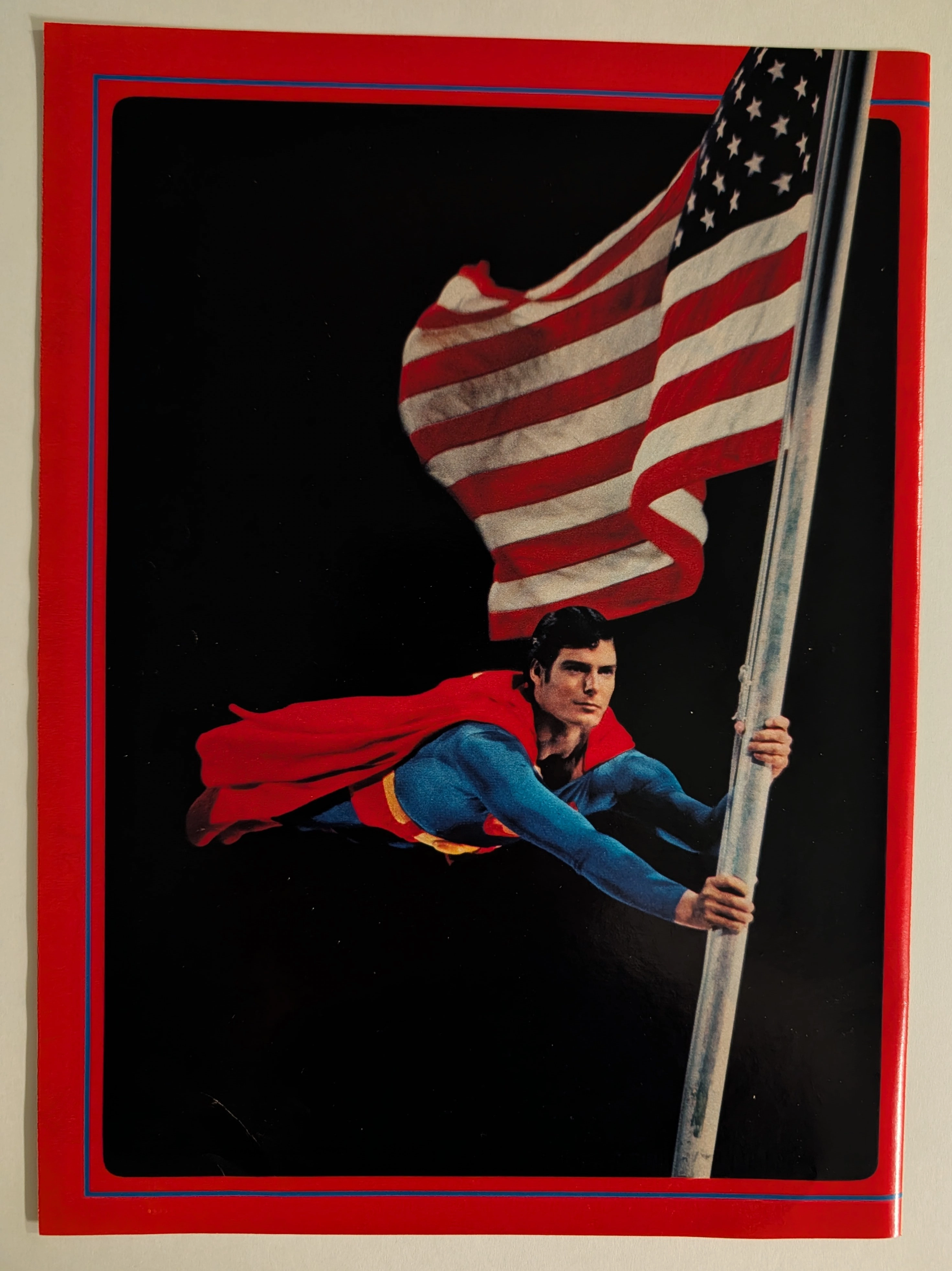
1. Historical Context 1.1 Superman: The Movie — The Film That Changed Everything Released on December 15, 1978, Superman: The Movie directed by Richard Donner is arguably the most historically significant superhero film ever made — not because it was the first (serials and television had depicted Superman for decades), but because it was the first to prove, irrefutably, that a superhero property could be treated with the narrative seriousness, production values, and star power of a major Hollywood dramatic film. With a production budget of approximately $55 million — the largest in film history at the time — and worldwide box office receipts of over $300 million, it established the economic template for the superhero blockbuster genre that would come to dominate global cinema in the twenty-first century. The film was produced by Alexander and Ilya Salkind under a Warner Bros. distribution deal, with a screenplay by Mario Puzo (of The Godfather fame), Tom Mankiewicz, David and Leslie Newman. The supporting cast was extraordinary by any standard: Marlon Brando, fresh from The Godfather and Last Tango in Paris, as Jor-El; Gene Hackman, fresh from his Oscar-winning performance in The French Connection, as Lex Luthor; Margot Kidder as Lois Lane; Glenn Ford, Phyllis Thaxter, Jeff East, and Jackie Cooper in supporting roles. The music by John Williams became one of the most recognizable film scores in history. Every element of the production communicated that this was not a children's entertainment — it was a serious artistic undertaking. The tagline 'You will believe a man can fly' was not merely promotional copy — it was a promise and a challenge. The visual effects team, led by Derek Meddings and Les Bowie, developed techniques for depicting convincing flight that had never been achieved before, and largely succeeded. The film won a Special Achievement Academy Award for its visual effects. Geoffrey Unsworth's cinematography — Unsworth died during production, with his work completed by Ernest Day — gave the film a visual grandeur that matched its epic ambitions. 1.2 Christopher Reeve — The Definitive Superman Christopher D'Olier Reeve was born on September 25, 1952 in New York City, trained at the Juilliard School (where his classmates included Robin Williams), and had a modest stage career before being cast as Superman at the age of 24. The casting decision was controversial: producers had considered Sylvester Stallone, Robert Redford, Warren Beatty, Ryan O'Neal, James Caan, and Burt Reynolds before Reeve was identified. He was, at the time of casting, essentially unknown to the general public. To prepare for the role, Reeve underwent a rigorous physical transformation under the supervision of David Prowse (who had played Darth Vader's body in Star Wars the previous year), adding approximately 18 kilograms of muscle to his naturally lean frame. But the physical preparation was only half of what made his performance exceptional. Reeve's genius was his dual characterization: the ability to make Superman and Clark Kent seem genuinely like different people using nothing but posture, vocal register, and the energy he brought to each character. This is one of the most technically difficult acting challenges in mainstream cinema — to create the illusion of disguise when no physical disguise exists — and Reeve executed it with such conviction that audiences accepted the conceit completely. The arc of Reeve's life after Superman is one of the most profoundly moving stories in Hollywood history. On May 27, 1995, he was thrown from a horse during an equestrian competition in Culpeper, Virginia, and suffered a fracture of the first and second cervical vertebrae that left him paralyzed from the shoulders down, requiring a ventilator to breathe. Rather than retreating from public life, Reeve became the world's most prominent advocate for spinal cord injury research, testifying before Congress, co-founding the Christopher & Dana Reeve Foundation, and continuing to direct and produce films. He died on October 10, 2004, at the age of 52. His legacy is double: the definitive cinematic Superman and the real-world embodiment of the heroism his character represented. Both dimensions of this legacy drive collector interest in his memorabilia. 1.3 The Flagpole Image — One of Cinema's Great Promotional Photographs The image depicted on this postcard is one of the most iconic promotional stills from Superman: The Movie. It captures Christopher Reeve as Superman clinging to a metal flagpole, angled dramatically downward in the frame, while a large American flag billows behind him against a pure black background. The low angle of the shot — we look up at Superman rather than down at him — creates the visual impression of enormous physical power and authority. The diagonal line of the flagpole introduces dynamic movement into what might otherwise be a static composition, and the rippling flag adds texture and the impression of wind and flight. The scene this image likely derives from occurs early in the film during Superman's first public appearance in Metropolis — rescuing Lois Lane from a helicopter, catching a thief, and ultimately preventing a large American flag from falling from the Metropolis Daily Planet building's flagpole. The deliberate inclusion of the American flag in Superman's debut scene is a choice loaded with symbolic significance: Superman has always been coded as the quintessential American hero, the embodiment of American ideals (truth, justice, the American way), and the flag functions as a visual shorthand for the entire cultural complex he represents. To show Superman holding the flag on his first night in the city is to announce his role and his allegiance simultaneously. The lighting design — pure black background with dramatic spotlight illumination — is characteristic of the film's promotional photography, which consistently sought to present Superman as a figure of light against darkness, literally and metaphorically. This aesthetic approach influenced superhero promotional photography for decades afterward and remains instantly recognizable to anyone who encountered it during the film's original release. 1.4 The Postcard Format and Movie Merchandise of 1978–1980 The movie postcard as a format had been a standard piece of film promotion since the silent era, but the commercial possibilities of movie merchandising were transformed by the extraordinary success of Star Wars (1977), which demonstrated that a film's merchandise could generate revenues exceeding the film's own box office. By 1978, when Superman was released, every major Hollywood production included a comprehensive licensed merchandise program. The Salkind organization and Warner Bros. worked with numerous licensed manufacturers to produce Superman merchandise including action figures, lunchboxes, T-shirts, novelizations, comic adaptations, trading cards, posters, and postcards. The red-and-blue bordered design visible on this postcard is consistent with the official Superman: The Movie brand standards. The red outer border, thin blue inner rule, and the Superman logo or associated imagery in similar border treatments appear across a range of officially licensed Superman merchandise from this period. This design consistency was a deliberate brand management decision: it allowed consumers to immediately identify official Superman merchandise versus unlicensed knockoffs, which were a significant commercial problem in the late 1970s. 2. Paper and Production Analysis 2.1 Paper Stock and Condition The postcard is printed on heavy glossy coated card stock, estimated at 200–300 gsm, with a high-gloss finish. This weight and surface finish is consistent with premium movie postcard production of the late 1970s, which used heavier and more durable stock than standard mail postcards to protect the image quality and withstand handling. The condition visible in the photograph is Good to Very Good for its approximate age of 45–47 years. Most notably, the color fidelity is exceptional: the pure black of the background retains its depth, the Superman costume colors (primary blue, red, and yellow) remain vivid, and the red border shows no significant fading or yellowing. The slight white mark visible at the upper-left corner is consistent with surface contact wear or minor corner softening over decades of storage, but does not represent structural damage. 2.2 Printing and Image Quality The postcard was produced using four-color offset lithographic printing at a quality level consistent with premium commercial printing of the late 1970s. The key technical achievement visible in this piece is the quality of the black background reproduction: achieving a flat, even, deep black in offset lithography requires precise control of ink coverage, dot gain, and paper absorbency, all of which must remain consistent across the full print run. The continued depth and evenness of the black after 45 years speaks to the quality of both the original printing and the storage conditions. The registration of the color separations across the detailed Superman costume appears precise, with no visible color fringing or misregistration. The promotional photograph itself — a studio or controlled-location photograph from the film's production — is reproduced with clarity and detail consistent with a high-quality photographic original. 3. Rarity, Market Valuation, and Classification 3.1 Rarity Factors Christopher Reeve Superman memorabilia occupies a distinctive position in the collectibles market. Three independent factors converge to drive demand above what might otherwise be expected for a 45-year-old postcard. First, Christopher Reeve's death in 2004 fixed the supply of authentic Reeve-related material permanently — no new first-hand material can be created. Second, Superman: The Movie is now recognized as a landmark film of cinema history, not merely of superhero history, which broadens the collector base beyond Superman fans to film history collectors generally. Third, the ongoing cultural resonance of the Christopher Reeve portrayal — which continues to be referenced, celebrated, and contrasted with every subsequent Superman performance — ensures sustained public awareness that drives new collectors to seek primary-period material. The specific image shown — the flagpole and American flag scene — is one of the most reproduced and recognized images from the film, which cuts both ways for collectors: it is highly desirable because of its iconic status, but relatively more common than obscure behind-the-scenes images. The quality of the specific example shown — particularly its vivid color retention — elevates it within its category. 3.2 Current Market Valuation (2024–2025) Official Superman: The Movie postcards and photo cards from the 1978–1980 period trade in the following ranges depending on condition: Good
Cite this article
- MLA
- Naodhinsuk, Ronin. “THE TIME TRAVELLER'DOISSIER : SUPERMAN — The Christopher Reeve Flagpole Postcard and the Birth of the Superhero Blockbuster.” The Record Institute, 4 March 2026, https://therecord.institute/journal/the-time-travellerdoissier-superman-the-christopher-reeve-flagpole-postcard-and-the-birth-of-the-superhero-blockbuster.
- APA
- Naodhinsuk, R. (2026, March 4). THE TIME TRAVELLER'DOISSIER : SUPERMAN — The Christopher Reeve Flagpole Postcard and the Birth of the Superhero Blockbuster. The Record Institute. https://therecord.institute/journal/the-time-travellerdoissier-superman-the-christopher-reeve-flagpole-postcard-and-the-birth-of-the-superhero-blockbuster
- CHICAGO
- Naodhinsuk, Ronin. 2026. “THE TIME TRAVELLER'DOISSIER : SUPERMAN — The Christopher Reeve Flagpole Postcard and the Birth of the Superhero Blockbuster.” The Record Institute, March 4, 2026. https://therecord.institute/journal/the-time-travellerdoissier-superman-the-christopher-reeve-flagpole-postcard-and-the-birth-of-the-superhero-blockbuster.