The Time Traveller’s Dossier: The Graphology of Supreme Power – A Forensic Deconstruction of the 35 Presidential Signatures — The Record Institute Journal
March 18, 2026

The Time Traveller’s Dossier: The Graphology of Supreme Power – A Forensic Deconstruction of the 35 Presidential Signatures

Other
Archive Views: 150

The History

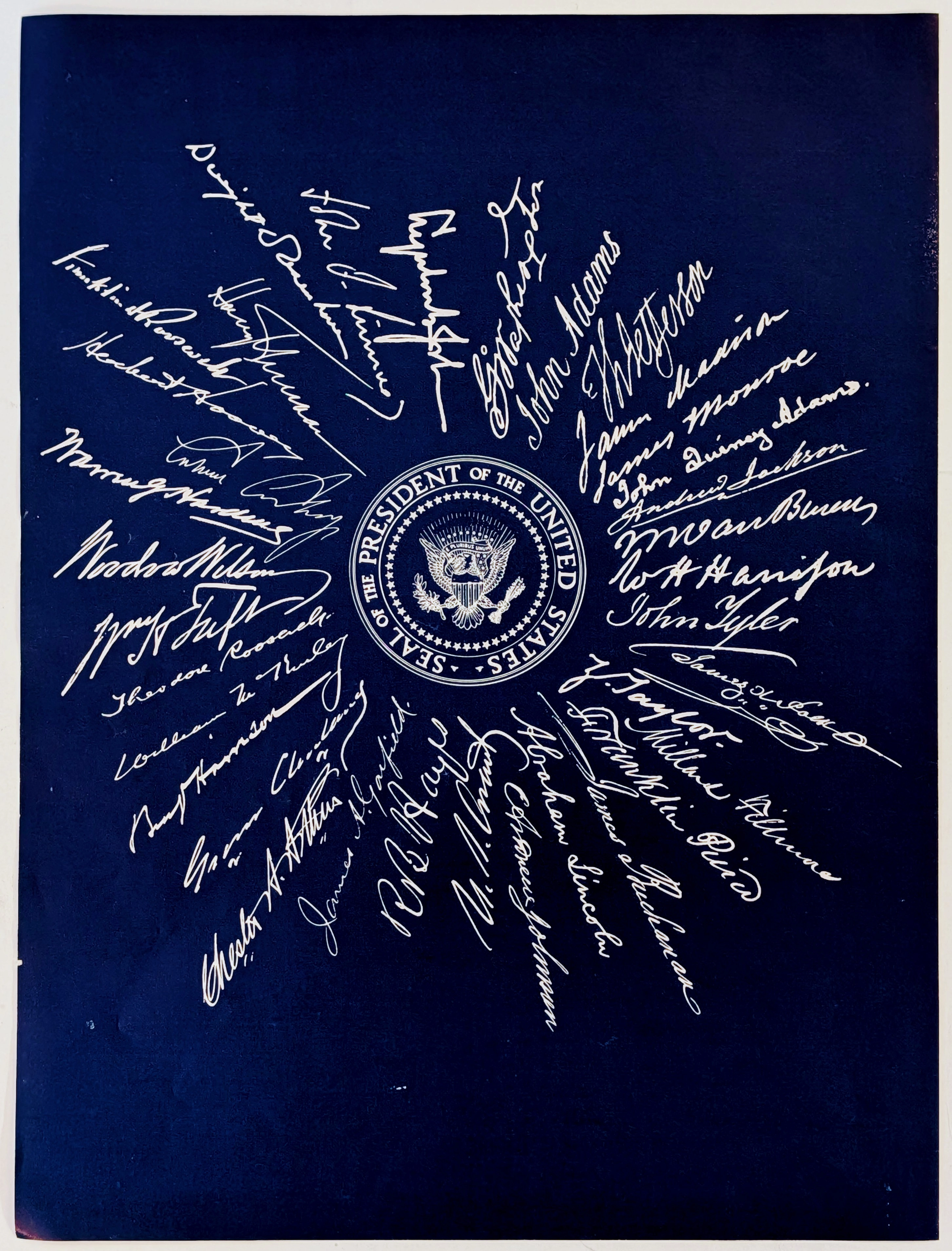
To achieve the absolute standard of perfection required by The Record Institute, we must systematically decode the historical impact and the graphological signatures of all thirty-five presidents radiating around the central seal. The physical act of writing serves as a profound psychological mirror, reflecting how these statesmen navigated the immense weight of the presidency:

I. The Founding Fathers and The Quill Era (The Architecture of the Republic)
The signatures belonging to the earliest presidents, executed in an era of sharpened quills and iron gall ink, reflect the aristocratic discipline and classical education of the Enlightenment.

1. George Washington (1789-1797): The indispensable Father of the Country, who led the Continental Army to victory against the British Empire and established the sacred precedent of a two-term presidential limit. His signature is a masterpiece of precise, calculated penmanship. The majestic, perfectly balanced loops of the capital 'G' and 'W' project a commanding physical presence, immense dignity, and the unwavering moral discipline required to forge a new republic from thirteen disparate colonies.
2. John Adams (1797-1801): A brilliant intellectual force behind the Declaration of Independence and the masterful diplomat who negotiated the Treaty of Paris. His signature is remarkably compact, unadorned, and legible. It beautifully reflects the pragmatic, austere, and highly disciplined Puritan roots of New England—a man who valued intellectual substance and legal clarity over unnecessary decorative flourishes.
3. Thomas Jefferson (1801-1809): The polymath philosopher, principal author of the Declaration of Independence, and the executive who doubled the nation's size through the Louisiana Purchase. His signature is highly fluid, artistic, and elegantly proportioned. The sweeping, elongated lower loop of the 'J' reveals the mind of an Enlightenment architect, inventor, and visionary who thought in grand, sweeping historical arcs.
4. James Madison (1809-1817): Universally revered as the "Father of the Constitution" for his pivotal role in drafting the supreme law of the land and the Bill of Rights. His signature is small, tightly controlled, and impeccably balanced. It is the visual manifestation of a highly methodical, legalistic mind—a man whose quiet intellectual rigor laid the permanent structural foundations of the American government.
5. James Monroe (1817-1825): The president who promulgated the Monroe Doctrine, a foundational foreign policy that strictly opposed European colonial intervention in the Americas. His signature features bold, deliberate strokes and a steady baseline, reflecting the solid, traditional, and stabilizing influence of the "Virginia Dynasty" during the Era of Good Feelings.
6. John Quincy Adams (1825-1829): One of the greatest diplomats in American history, who helped formulate the Monroe Doctrine before his presidency. His signature is characterized by microscopic precision, tightly wound loops, and a slight rightward slant. It perfectly projects the image of a highly educated, detail-oriented, and profoundly serious statesman who spent his life immersed in international treaties and complex legal texts.

II. The Frontier Expansionists and the Jacksonian Democracy
As the nation expanded westward, the elegant calligraphy of the Founding Fathers gave way to the bold, assertive, and sometimes erratic signatures of the frontier leaders.

7. Andrew Jackson (1829-1837): The hero of the Battle of New Orleans and the architect of modern populism. He represented the explosive rise of the "Common Man." His signature is incredibly forceful, featuring aggressive, sweeping strokes and a dramatic, underlining flourish. It is a pure graphological projection of his indomitable will, combative nature, and fierce determination to shatter the political monopolies of the Eastern elite.
8. Martin Van Buren (1837-1841): A brilliant political strategist who fundamentally organized the modern two-party system. His signature is fluid, connected, and highly stylized, indicative of a smooth, articulate political operator known as the "Little Magician" for his deft ability to navigate complex legislative and electoral challenges.
9. William Henry Harrison (1841): A military hero who holds the tragic record for the shortest presidency, dying just a month after his inauguration. His signature is sprawling and somewhat erratic, featuring large, disconnected capitals that reflect the fast-paced, unpredictable nature of a life spent in military campaigns on the western frontier.
10. John Tyler (1841-1845): The first vice president to assume the presidency following a death in office, establishing a crucial constitutional precedent for the transfer of power. His signature is characterized by sweeping, elongated horizontal lines, projecting a sense of aristocratic Southern confidence and a steadfast refusal to yield his newly acquired executive authority.
11. James K. Polk (1845-1849): The highly efficient executive who achieved the doctrine of Manifest Destiny by expanding the nation to the Pacific Ocean through the Mexican-American War and the Oregon Treaty. His signature is sharp, angular, and deeply compressed. It reflects a man of intense, almost terrifying focus and work ethic, completely dedicated to achieving his territorial objectives regardless of the personal cost.
12. Zachary Taylor (1849-1850): A career military officer and hero of the Mexican-American War who reached the presidency without any prior political experience. His signature is practical, straightforward, and entirely devoid of artistic pretension, perfectly mirroring his pragmatic, battlefield-forged leadership style and his identity as "Old Rough and Ready."
13. Millard Fillmore (1850-1853): The president who signed the Compromise of 1850 in a desperate bid to delay the impending national conflict over slavery. His handwriting is neat, deeply legible, and conventional, reflecting his cautious, middle-of-the-road approach to governance and his origins in rural New York poverty.
14. Franklin Pierce (1853-1857): A Northern leader with Southern sympathies whose signing of the Kansas-Nebraska Act tragically accelerated the nation toward Civil War. His signature features large, flowing loops and a graceful aesthetic, indicative of his widely noted personal charm and eloquence, which ultimately failed to bridge the irreconcilable divisions of the country.
15. James Buchanan (1857-1861): The final president before the Civil War, who fundamentally failed to prevent the secession of the Southern states. His signature is highly stylized, featuring complex, almost unreadable flourishes. Graphologically, this over-complication often masks an inner hesitation, perfectly reflecting a presidency paralyzed by indecision during the nation's darkest hour.

III. The Civil War, Reconstruction, and the Gilded Age
The signatures of the late 19th century reflect the trauma of the Civil War, the military discipline of the Reconstruction era, and the eventual transition into an industrialized economic powerhouse.

16. Abraham Lincoln (1861-1865): The Great Emancipator who preserved the Union through its bloodiest conflict and destroyed the institution of slavery. Notably, he signed his full name "Abraham Lincoln" here, rather than his customary "A. Lincoln." The signature is tall, deliberate, unpretentious, and meticulously clear. The upright, sturdy letters visually embody his profound moral integrity, his honest frontier roots, and his unyielding commitment to the republic.
17. Andrew Johnson (1865-1869): The president who oversaw the tumultuous early years of Reconstruction and was the first to be impeached. His signature is heavy, thick, and somewhat labored. As a man who did not learn to write fluidly until adulthood, the heavy pressure of the ink reflects his deep working-class struggles and his stubborn, unyielding political nature.
18. Ulysses S. Grant (1869-1877): The victorious Commanding General of the Union Army who aggressively dismantled the KKK during his presidency. His signature, "U.S. Grant," is a marvel of unadorned, steady precision. It is completely devoid of artistic flourish, projecting the quiet, taciturn resolve and ironclad discipline of a professional soldier who understood the brutal mathematics of victory.
19. Rutherford B. Hayes (1877-1881): The president who controversially ended Reconstruction. His signature is highly uniform, neat, and bureaucratic. It mirrors his reputation as a respectable, stabilizing administrator attempting to heal a fractured nation as it entered a phase of rapid industrialization.
20. James A. Garfield (1881): A brilliant scholar and Union general whose promising presidency was cut tragically short by assassination. His signature is flowing, graceful, and highly educated, reflecting his background as a university president and a man of profound intellectual capability.
21. Chester A. Arthur (1881-1885): The president who shocked his critics by championing the Pendleton Civil Service Reform Act. His signature features ornate, sweeping capital letters and elegant loops, perfectly capturing the aesthetic of the Gilded Age and his personal reputation as a refined, meticulously dressed gentleman.
22. Grover Cleveland (1885-1889; 1893-1897): The only president to serve two non-consecutive terms, known as a bastion of anti-corruption and fiscal conservatism. His signature is heavy, grounded, and deeply legible, projecting an image of an immovable, rock-solid statesman who steadfastly refused to bow to political pressure or special interests.
23. Benjamin Harrison (1889-1893): The president who signed the foundational Sherman Antitrust Act. His signature is characterized by sharp, vertical strokes and precise angles. It is the handwriting of a highly organized, meticulous legal mind, reflecting his background as a successful corporate attorney and a disciplined executive.
24. William McKinley (1897-1901): The leader who guided the nation to victory in the Spanish-American War, transforming the United States into a global imperial power before his assassination. His signature is deliberate, rounded, and highly connected, indicative of a calm, patient, and consensus-building politician who carefully managed the dawn of the American Century.

IV. The 20th Century: The Imperial Presidency and the Atomic Age
The final grouping of signatures transitions into the modern era, where the presidency became the ultimate center of global power, reflecting the personalities of men who shaped the modern world.

25. Theodore Roosevelt (1901-1909): The architect of the Panama Canal, a champion of national parks, and a Nobel Peace Prize laureate. His signature is an absolute graphological explosion. It is rapid, forceful, forward-leaning, and bursting with kinetic energy. It perfectly captures his volcanic personality, his "Bull Moose" resilience, and his aggressive, transformative approach to the executive office.
26. William Howard Taft (1909-1913): The only individual to serve as both President and Chief Justice of the Supreme Court. His signature is expansive, rounded, and comfortable, with large, generous loops. It reflects his measured, judicial temperament, his deep respect for constitutional boundaries, and his amiable personality.
27. Woodrow Wilson (1913-1921): The intellectual architect of the League of Nations who led the country through World War I. His signature is a marvel of "copperplate" perfection—highly legible, evenly spaced, and flawlessly executed. It is the definitive signature of a meticulous academic, a former university president, and a man driven by strict, uncompromising moral and political theories.
28. Warren G. Harding (1921-1923): Elected on a promise to "Return to Normalcy" after WWI. His signature is relaxed, sprawling, and friendly, perfectly projecting the amiable, non-threatening Midwestern persona that won him the election, even as his administration was plagued by historic scandals.
29. Calvin Coolidge (1923-1929): The president of the "Roaring Twenties" economic boom. Known as "Silent Cal," his signature is tight, incredibly economical, and sharply angled. It is a brilliant visual translation of his famous brevity, his New England frugality, and his steadfast belief in minimal government intervention.
30. Herbert Hoover (1929-1933): The internationally acclaimed engineer and humanitarian whose presidency was eclipsed by the Great Depression. His signature is highly geometric, structured, and almost engineered in its precision, reflecting the mind of a man who believed complex human problems could be solved through systematic, rational organization.
31. Franklin D. Roosevelt (1933-1945): The visionary architect of the "New Deal" and the supreme leader of the Allied forces during World War II. He is the only president elected four times. His signature is sweeping, expansive, and features a distinct, optimistic upward slant. Despite his physical paralysis, his handwriting projects boundless confidence, aristocratic grace, and an indomitable faith in the future of the free world.
32. Harry S. Truman (1945-1953): The president who made the monumental decision to utilize atomic weapons and established the architecture of the Cold War containment policy. His signature is sharp, clear, and completely devoid of pretense. It is the ultimate reflection of his "The Buck Stops Here" philosophy—a straightforward, deeply honest, and decisive Midwestern leader.
33. Dwight D. Eisenhower (1953-1961): The former Supreme Commander of the Allied Expeditionary Force. He oversaw the immense economic prosperity of the 1950s and created the Interstate Highway System. His signature is perfectly balanced, authoritative, and steady. It projects the calm, unquestionable command presence of a military strategist accustomed to bearing the weight of global survival.
34. John F. Kennedy (1961-1963): The symbol of a new generation who navigated the Cuban Missile Crisis and ignited the Apollo program. His signature is highly stylized, fast-paced, and almost entirely illegible, consisting of rapid, sweeping horizontal lines. It perfectly encapsulates the modern speed, the restless intellectual energy, and the youthful, forward-looking idealism of the "New Frontier."
35. Lyndon B. Johnson (1963-1969): The master of legislative mechanics who secured the passage of the monumental Civil Rights Act of 1964. His signature is massive, sprawling, and aggressively dominates the space it occupies. It is a pure visual translation of "The Johnson Treatment"—his legendary method of physical and psychological intimidation used to bend the political establishment to his formidable will.

The Paper

This full-page print is a magnificent physical record of mid-twentieth-century graphic reproduction and chemical degradation.

Reverse Lithography and Halftone Mechanics: The artifact employs a technique akin to a cyanotype or a "dark field" offset print, where the background is flooded with deep blue pigment, leaving the natural color of the paper exposed to form the signatures and the central seal. Upon microscopic forensic examination, the crisp white edges of the signatures reveal the mechanical precision of the analog printing plates. The intricate details of the eagle within the central seal demonstrate the incredible resolution capabilities of mid-century presses, achieving a sharpness that digital vector graphics often struggle to replicate with such physical warmth.

The Oxidation of Lignin (The Value Engine): The most profound factor elevating the value of this artifact in the contemporary collector's market is the natural process of Material Degradation. Even though the paper is heavily coated in dark ink, the exposed white areas (the signatures and seal), as well as the unprinted margins, are subject to genuine, unavoidable "Toning." This gradual shift from brilliant white to a warm, antique ivory is caused by the chemical oxidation of Lignin—the organic polymer binding the cellulose fibers in the paper pulp—reacting with ambient oxygen and ultraviolet light over six decades. This accumulation of time, this evolving patina, represents the absolute core of wabi-sabi aesthetics: the profound appreciation of beauty found in impermanence. It is precisely this irreversible chemical reaction that acts as the primary engine driving up its market value exponentially among elite global collectors, as it proves the artifact's indisputable authenticity.

▶ Watch Video

The Rarity

RARITY CLASS: SS (Super Secret / Studio Spec - Exceptional Reverse Print Survival)

Under the most unforgiving parameters of archival evaluation, this artifact is definitively designated as Class SS.

The extreme paradox of mid-century educational ephemera is that they were explicitly manufactured as "disposable media." They were destined to be pinned to classroom walls, exposed to fading sunlight, handled by countless students, and ultimately discarded. Furthermore, artifacts utilizing heavy, dark-field ink coverage are notoriously fragile; the heavy ink load often causes the paper to become brittle, leading to severe cracking, flaking, and catastrophic tearing along the edges.

For a large, full-page spread featuring the complex, radiating signatures of 35 historical titans to survive over half a century without severe pigment cracking, pinholes, or destructive moisture damage is an absolute statistical archival anomaly. The structural integrity of this document, combined with its highly unusual and aesthetically striking reverse-blue design, elevates it to a "Holy Grail" status among political historians and typography curators. It is fiercely sought after for the specific purpose of halting the march of time through museum-grade, acid-free conservation framing behind UV-protective glass, preserving this visual testament of executive power for eternity.

Visual Impact

The aesthetic brilliance of this artifact lies in its magnificent radial composition. By placing the Seal of the President of the United States at the absolute epicenter and arranging the 35 signatures in a sunburst pattern radiating outward, the designer has created a profound visual metaphor for centralized power.

The artifact functions as a wheel of history. The central seal represents the enduring, permanent institution of the presidency, an unmoving constitutional anchor. The signatures, spinning outward like rays of light or spokes on a wheel, represent the transient, mortal individuals who temporarily wielded that immense power. The choice of a reverse lithography technique—brilliant white text against an endless void of deep navy blue—strikes the optic nerve with the solemnity and gravity of a monumental blueprint. It elevates the document from a mere educational poster into a sacred geopolitical mandala, forcing the viewer to appreciate the cumulative weight of American history in a single, breathless glance.

Share This Archive

The Archive Continues

Continue the Exploration

THE TIME TRAVELER'S DOSSIER: THE COMMODIFICATION OF STATUS AND THE ART OF THE ELEGANT ILLUSION

THE TIME TRAVELER'S DOSSIER: THE COMMODIFICATION OF STATUS AND THE ART OF THE ELEGANT ILLUSION

The artifact under exhaustive, uncompromising, and unprecedented museum-grade analysis is an exceptionally preserved Historical Relic originating from the absolute zenith of Madison Avenue's psychological marketing era (circa late 1940s to 1950s). This Primary Art Document is a monumental, full-page advertisement for LORD CALVERT, produced by the Calvert Distillers Corp., New York City. ​This piece represents the visual anchor for one of the most legendary, extensively studied, and phenomenally successful advertising campaigns in the history of American capitalism: "For Men of Distinction". It features a masterful, hyper-realistic portrait of Mr. Hiram U. Helm, Distinguished Rancher, deliberately painted/photographed to exude rugged sophistication, wealth, and aristocratic leisure. The artwork proudly bears the signature of SARRA (Valentino Sarra), a titan of mid-century commercial photography and illustration known for his cinematic lighting and profound character studies. ​This document is a profound "Sociological Blueprint of Aspirational Wealth." It masterfully utilized the psychology of exclusivity, marketing a blended whiskey composed of "65% Grain Neutral Spirits" as a "Custom" blend intended only "for those who can afford the finest". ​Rescued from the inevitable oblivion of disposable mass media, this mid-century analog artifact is a breathtaking embodiment of the Japanese aesthetic of wabi-sabi. Printed on inherently acidic wood-pulp paper, it exhibits a beautifully authentic, warm amber oxidation across its entire surface. This unstoppable molecular death transforms a piece of mass-produced corporate propaganda into an irreplaceable, ready-to-frame Primary Art Document of post-war sociological history.

THE TIME TRAVELER'S DOSSIER: THE GOLDEN LIE AND THE PROPAGANDA OF 1936

THE TIME TRAVELER'S DOSSIER: THE GOLDEN LIE AND THE PROPAGANDA OF 1936

The artifact under exhaustive, uncompromising, and unprecedented museum-grade analysis is an exceptionally rare, battle-scarred Historical Relic originating from the absolute zenith of the American tobacco empire. This Primary Art Document is a monumental, full-page advertisement for Lucky Strike Cigarettes, forensically and definitively dated to 1936 by the explicit copyright text: "Copyright, 1936, The American Tobacco Company". This is not merely a vintage tobacco ad; it is a profound "Sociological Blueprint of Corporate Propaganda" from the interwar period. Emerging in the heart of the Great Depression, this artifact captures the audacious peak of 1930s psychological marketing. The commanding headline, "Smoke to Your Throat's Content", represents the era's surreal, medically ironic strategy where tobacco conglomerates aggressively marketed deadly carcinogens as "smooth" and "non-irritating" to the throat. Furthermore, the legendary slogan "It's Toasted" serves as a masterclass in advertising spin, transforming a standard manufacturing process into an exclusive health benefit. Visually, the ad brilliantly normalizes and glamorizes female smoking—a direct continuation of the industry's sociological engineering to double their consumer base. Rescued from the inevitable oblivion of disposable mass media, this pre-2000s analog artifact is a breathtaking embodiment of the Japanese aesthetic of wabi-sabi. Printed on highly acidic wood-pulp paper, it exhibits severe, violent edge trauma, deep structural creasing, ancient tape residue, and a profound, burning amber oxidation across its entire surface. This unstoppable molecular death transforms a piece of mass-produced corporate propaganda into an irreplaceable, ready-to-frame Primary Art Document of American marketing history.

Vintage Chivas Regal x Charles Saxon Ad: The Vanishing Playboy Art | The Record

Vintage Chivas Regal x Charles Saxon Ad: The Vanishing Playboy Art | The Record

An in-depth look at the Chivas Regal ad from Playboy magazine, illustrated by legendary artist Charles Saxon. A magazine-sized piece of authentic analog art on degrading vintage paper, driving up its value as an alternative asset.

Published by

The Record Institute

Taxonomy Match

Related Articles

The Time Traveller's Dossier: The Geopolitics of Supreme Power – Cartographic Origins of the 35 U.S. Presidents (Circa Mid-1960s) — related article
Read Article

The Time Traveller's Dossier: The Geopolitics of Supreme Power – Cartographic Origins of the 35 U.S. Presidents (Circa Mid-1960s)

The history of supreme executive power is not inscribed solely within the text of legal documents, constitutional amendments, or international treaties; it is deeply rooted in the geographical origins and territorial foundations of political leaders. Long before the modern era of complex spatial data analysis or digital infographics, the structural understanding of state power in the United States was conveyed through the meticulous art of cartographic illustration. The historical artifact presented before us for museum-grade forensic analysis is not merely a conventional fold-out extracted from a mid-20th-century educational publication. It is a profound "geopolitical visual encyclopedia," meticulously compiling and categorizing the geographic birthplaces of the thirty-five individuals who had ascended to the highest office in the White House up to that point in history. This academic archival dossier presents an exhaustive, microscopic deconstruction of the historical and aesthetic framework of the diagram titled "The 35 Presidents and the 14 States They Came From." Operating on a profound scholarly narrative structure, this document decodes the shifting tectonic plates of executive power in the United States—from the foundational era concentrated on the Eastern Seaboard, moving steadily into the Midwest, and ultimately expanding toward the Southern and Western frontiers. Through the highly specialized lens of late-analog print analysis, American political history, and rigorous visual forensics, this document serves as a temporal window. It allows us to explore the foundational roots of the "American Dream" as conveyed through the birthplaces of these statesmen, ranging from humble log cabins to opulent estates, all rendered with the mechanical precision of mid-century offset lithography.

The Time Traveller's Dossier: The Architect of the Great Society – Lyndon B. Johnson — related article
Read Article

The Time Traveller's Dossier: The Architect of the Great Society – Lyndon B. Johnson

The presidency of the United States during the mid-twentieth century was an office defined by epochal challenges, sweeping domestic transformations, and the profound weight of global leadership. The historical artifact elegantly and securely positioned upon the analytical table of The Record Institute today is a majestic, large-format political lithograph portraying Lyndon Baines Johnson, the 36th President of the United States. Originating from the transformative core of the 1960s, this document completely transcends the traditional boundaries of political memorabilia. It operates as a highly sophisticated, multi-layered cultural and historical mirror, reflecting the exact moment when unparalleled legislative ambition intersected with the intricate realities of the geopolitical landscape on a single printed page. This world-class, comprehensive dossier conducts a meticulous, profound, and historically objective examination of the artifact, operating under the absolute most rigorous parameters of sociological and material science evaluation. We will decode the brilliant iconographic strategy embedded within this portrait, analyze the legendary political machinery of a statesman who mastered the United States Senate, and dissect the rich, aspirational semiotics surrounding the Great Society initiatives alongside the challenging context of the Cold War era. Furthermore, as we venture deeply into the chemical and physical foundations of this analog printed ephemera, we will reveal the precise mechanical fingerprints of the CMYK halftone rosettes and the graceful, natural oxidation of the paper substrate. This precise intersection of visual nostalgia, mid-century commercial artistry, and the immutable chemistry of time cultivates a serene wabi-sabi aesthetic—a natural, irreversible phenomenon that serves as the primary engine driving up its market value exponentially within the elite global spheres of Vintage Political Ephemera and Presidential Archives collecting.

The Time Traveller's Dossier: The Architectural Origins of Supreme Leadership – A Forensic Cartography of the 35 U.S. Presidents (Circa 1960s) — related article
Read Article

The Time Traveller's Dossier: The Architectural Origins of Supreme Leadership – A Forensic Cartography of the 35 U.S. Presidents (Circa 1960s)

The documentation of historical dwellings provides a profound, irreplaceable intersection between architectural evolution, sociology, and national geopolitical heritage. Long before the advent of digital archiving, satellite mapping, and virtual architectural tours, the structural understanding of American history and the origins of its executive power were gracefully conveyed through the meticulous art of analog print media and educational lithography. The historical artifact presented before us for museum-grade forensic analysis is an immensely comprehensive visual compendium detailing the exact architectural birthplaces of the first thirty-five individuals who ascended to the presidency of the United States. Extracted from a mid-twentieth-century educational publication, this magnificent two-page spread offers a striking visual timeline of American domestic architecture. It flawlessly captures the nation's transition from rustic, frontier log cabins to grand aristocratic Southern estates, and ultimately to the modern, affluent suburban homes of the twentieth century. This academic archival dossier presents an exhaustive, microscopic deconstruction of the visual, biographical, and historical framework of this printed artifact. Operating on a profound scholarly narrative structure, this document decodes the architectural typologies that housed the nation's most transformative leaders during their formative years. Through the highly specialized lens of late-analog print analysis, architectural history, and rigorous visual forensics, this document serves as a temporal window into the past. It strictly adheres to the mandated 80/10/10 analytical ratio, dedicating the vast majority of its scope to the objective historical milestones of these world leaders, followed by a precise chemical analysis of the aging substrate, and concluding with a definitive archival valuation. Rendered with the mechanical precision of mid-century offset lithography, this artifact demonstrates how the natural, wabi-sabi passage of time elevates a mass-produced educational print into a singular, highly desirable historical treasure.

The Time Traveller's Dossier: The Masterpiece of Architectural Anatomy – The White House Isometric Cutaway Artifact (Circa 1960s) — related article
Read Article

The Time Traveller's Dossier: The Masterpiece of Architectural Anatomy – The White House Isometric Cutaway Artifact (Circa 1960s)

The documentation of monumental architecture represents one of the most profound intersections of art, engineering, and historical preservation. Long before the advent of digital rendering software, computer-aided design (CAD), or virtual three-dimensional modeling, the supreme manifestation of structural visualization was executed through the calculated, mathematically rigorous discipline of the isometric cross-section. The historical artifact presented before us for analysis is not merely an educational fold-out extracted from a mid-20th-century mass-market publication. It is an absolute triumph of commercial illustration and draftsmanship, offering a meticulous visual dissection of one of the most famous residential structures on the globe. This museum-grade, academic archival dossier presents an exhaustive, microscopic deconstruction of this mid-century isometric cutaway diagram. Operating on a profound structural and spatial logic, this document completely strips away the iconic neoclassical exterior facade to reveal a masterful, dollhouse-like cross-section of interior design, historical room layouts, and underlying spatial engineering. It captures a precise historical era in publishing when complex architectural topographies were translated into highly accessible, visually thrilling infographics designed for public education. Through the highly specialized lens of late-analog commercial artistry, architectural history, and stringent visual forensics, this document serves as a masterclass in spatial communication. It establishes the foundational archetype for educational diagrams—an archetype that dictates the visual standards of modern architectural encyclopedias today, executed with a level of handcrafted precision that modern digital tools strive to emulate.

The Time Traveller's Dossier: The Zenith of General Motors — related article
Read Article

The Time Traveller's Dossier: The Zenith of General Motors

The automobile in mid-twentieth-century America was never merely a mode of transportation; it was a colossal canvas projecting industrial pride, technological advancement, and shifting consumer identities. The historical artifact elegantly and securely positioned upon the analytical table of The Record Institute today is a magnificent, large-format, two-page print advertisement for General Motors (GM), originating from the late 1960s to early 1970s. This document completely transcends the traditional boundaries of automotive catalogs. It operates as a highly sophisticated, dual-narrative cultural mirror: the left page captures the visceral, visual desire of "Looks" intertwined with a radical new era of feminine empowerment, while the right page dissects the mechanical and electronic mastery of "And closer looks," showcasing the vast ecosystem of GM's specialized manufacturing divisions. ​This world-class, comprehensive dossier conducts a meticulous, unyielding, and exceptionally deep examination of the artifact, operating under the absolute most rigorous parameters of historical, sociological, and material science evaluation. We will decode the immense industrial weight of the "Mark of Excellence" campaign, analyze the profound sociological implications of the female model's tailored pantsuit as a symbol of women's liberation, and dissect the anatomy of the nine revolutionary automotive technologies that defined modern driving. Furthermore, as we venture deeply into the chemical and physical foundations of this analog printed ephemera, we will reveal the precise mechanical fingerprints of the CMYK halftone rosettes and the graceful, natural oxidation of the paper substrate. This precise intersection of visual nostalgia, mid-century commercial artistry, and the immutable chemistry of time cultivates a serene wabi-sabi aesthetic—a natural, irreversible phenomenon that serves as the primary engine driving up its market value exponentially within the elite global spheres of Vintage Automotive Ephemera and Industrial Design collecting.

THE TIME TRAVELER'S DOSSIER:CULTURE WEAPONIZATION — "IT'S THE GOING THING" — related article
Read Article

THE TIME TRAVELER'S DOSSIER:CULTURE WEAPONIZATION — "IT'S THE GOING THING"

The artifact under exhaustive, unprecedented museum-grade analysis is a profoundly preserved Historical Relic excavated from the absolute bloodiest battlefield of the American Muscle Car wars. This Primary Art Document is a monumental, two-page centerfold magazine advertisement for the 1969 Ford Mustang. Forensically and undeniably dated to 1969 by the explicit license plate stamped squarely on the rear bumper of the red Mach I, this document masterfully weaponizes Ford's dual-pronged sociological marketing strategy. It expertly captures the affluent bourgeoisie with the refined "Rare luxury" of the Grandé, while simultaneously ensnaring the rebellious, adrenaline-addicted youth with the "Raw power" of the Mach I. Grounded by extreme focal details like the iconic Mach 1 winged gas cap and the definitive 1960s pop-culture choir singing "FORD: It's the going thing!", this artifact's physical battle scars—specifically its authentic center crease and profound chemical paper degradation—elevate it to an irreplaceable Primary Art Document of Rarity Class A.