The Time Traveller's Dossier : Schenley '43 - The Distiller's War
The History
To understand this artifact, one must first calibrate to the crushing gravity of 1943. The world was entirely consumed by fire. The Axis powers had stretched the map to its breaking point. For the United States, the initial shock of Pearl Harbor had crystallized into a grim, unyielding industrial marathon. The nation was no longer merely fighting a war; it had become a colossal, singular organism dedicated solely to the production of lethality and logistics.
In this era, consumerism died overnight. The American economy, previously built on abundance and choice, was radically restructured by the War Production Board. Raw materials—steel, rubber, nylon, copper, and crucially, grain—were seized by the mandate of survival.
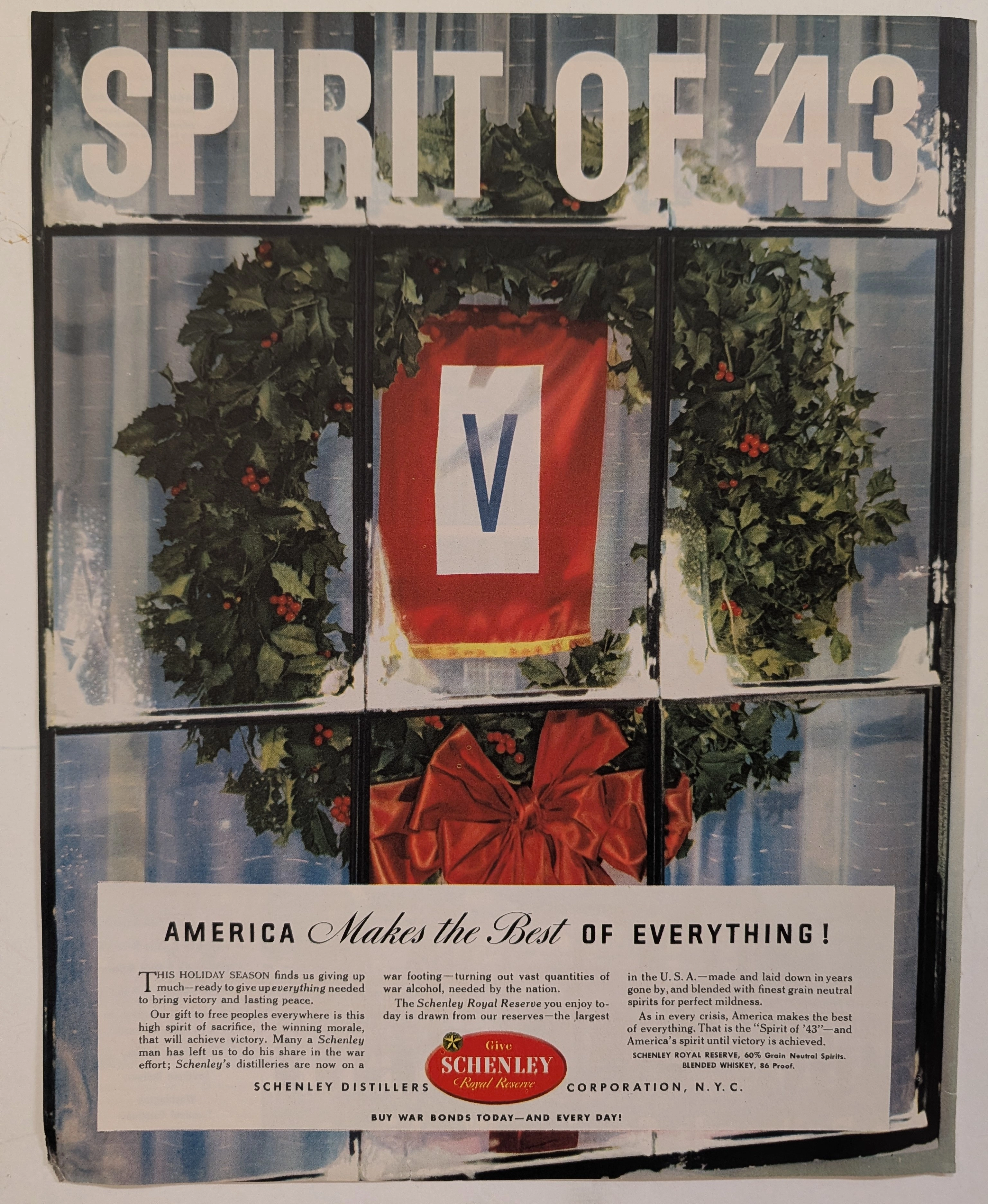
This advertisement by Schenley Distillers Corporation does not exist to sell you a drink for tonight. It exists to justify its existence in a world where drinking for pleasure was rapidly becoming a secondary, almost guilty, luxury. The headline "SPIRIT OF '43" is a deliberate, heavy-handed double entendre. It refers to the liquid trapped in the aging barrels, yes. But fundamentally, it demands the psychological fortitude required of the civilian populace. It is a command disguised as a celebration.
The Alchemy of War: From Spirits to Munitions
Look closely at the text. It speaks of distilleries turning out "vast quantities of war alcohol, needed by the nation." This is not a metaphor. It is the literal, chemical pivot of the artifact's era.
When the Japanese Empire swept through Southeast Asia, they severed the Allied supply lines to natural rubber plantations. The American military machine—reliant on tires for jeeps, gaskets for aircraft, and treads for tanks—was facing catastrophic paralysis. The solution was synthetic rubber, specifically Buna-S. But producing synthetic rubber required astronomical quantities of butadiene, which could be synthesized from industrial ethanol.
Simultaneously, the production of smokeless gunpowder for artillery and small arms required massive volumes of alcohol as a solvent. Antifreeze for bombers flying at sub-zero altitudes required alcohol. Medical supplies required alcohol.
The distilleries of America, masters of ethanol production, were drafted. Almost overnight, Schenley, Seagram’s, and Hiram Walker ceased the production of consumer whiskey. Their copper stills, previously calibrated for taste and aroma, were run continuously at maximum heat to produce 190-proof industrial alcohol. This artifact documents that exact pivot. Schenley is proudly declaring that their factories are weapons. They are no longer makers of joy; they are architects of the arsenal of democracy.
The Architecture of Sacrifice: Home Front Psychology
The visual core of this artifact is profoundly domestic, yet entirely militarized. We look through a window pane, frosted at the edges, signifying the bitter winter of 1943. But the focus is the banner hanging inside the glass.
It is a service flag. Specifically, it bears the bold 'V' for Victory. In millions of American windows, banners hung with blue stars for sons serving overseas, and gold stars for sons who would never return. The wreath surrounding it is a Christmas wreath.
This juxtaposition is calculated and devastating. Christmas is the ultimate symbol of familial unity, warmth, and peace. Yet, the window is defined by the war. The artifact captures the painful cognitive dissonance of the 1943 holiday season. Families were separated. The hearth was cold. Rationing dictated the holiday dinner.
Schenley leverages this pain with absolute precision. The copy reads: "This Holiday Season finds us giving up much—ready to give up everything needed to bring victory and lasting peace." The corporation inserts itself into the living room, standing shoulder-to-shoulder with the grieving, the anxious, and the rationing public. It is a psychological masterstroke. They are not a faceless conglomerate; they are your neighbor, sharing the burden of the frost.
The Corporate Pivot: Selling Nothing to Maintain Everything
From a purely strategic standpoint, this artifact represents one of the most fascinating challenges in the history of advertising. How does a brand maintain its market dominance when it is legally forbidden from manufacturing its primary product?
The answer lies in "The Reserve."
Because no new whiskey was being distilled for public consumption, the entire industry was forced to rely on the aging barrels stored in their warehouses before the war mandate hit. Schenley Royal Reserve was a blend, carefully rationed out to the public to ensure the company's name did not evaporate from the collective consciousness.
The advertisement is a placeholder. It is a massive, expensive billboard shouting into the void: "Do not forget us." They remind the consumer that the Schenley they enjoy today is drawn from "the largest in the U.S.A." This projects power, stability, and reassurance. In a world of terrifying uncertainty, Schenley promises that their reserves are deep, their quality remains uncompromised (blended with "finest grain neutral spirits"), and that when the war ends, they will still be there.
Competitors played similar games. But Schenley's aggressive tying of their corporate identity to the literal war effort—highlighting the industrial alcohol—was a distinct path. They were selling patriotic patience. Every drop of whiskey you couldn't buy was a bullet fired at the enemy. Therefore, your lack of whiskey was a patriotic act.
The 'E' Pennant: The Militarization of Civilian Labor
Nestled within the visual hierarchy of the ad is a small, but highly significant emblem: The Army-Navy 'E' Award pennant.
This was not a marketing gimmick; it was the highest honor the military could bestow upon a civilian production facility. The 'E' stood for Excellence in Production. To earn it, a factory had to demonstrate exceptional output, overcome massive logistical hurdles, maintain pristine labor relations, and show an unparalleled commitment to the war effort.
By featuring the 'E' pennant alongside the Army and Navy colors, Schenley elevates its factory workers to the status of frontline combatants. The men and women sweating over the industrial stills are framed as soldiers of industry. This tiny emblem in the corner of the artifact does massive heavy lifting. It validates the brand's patriotic claims with the official seal of the United States Armed Forces.
This artifact is a relic of a time when the lines between the state, the corporation, and the citizen were entirely dissolved by necessity. It is a piece of paper that holds the echoes of rationing, the smell of industrial ethanol, and the cold, anxious winter of a world on fire. It is not an ad for whiskey. It is an ad for endurance.
The Paper
This artifact is a study in mid-century mass-market lithography, heavily influenced by wartime austerity. The substrate is a standard magazine stock of the era, likely hovering around 60 to 70 GSM. Due to wartime rationing of high-quality paper pulp and bleaching agents, the paper possesses an inherent warmth, a slight yellow-brown oxidation that was present even before decades of aging took hold.
The printing employs the classic CMYK halftone process. If you examine the gradients in the frosted window panes or the deep reds of the Schenley logo, the microscopic rosettes of ink dots are visible. The registration is remarkably tight for a wartime print run, a testament to the retained skill of the pressmen.
The ink itself has settled into the fibers. The blacks of the typography remain dense, anchored to the page, while the reds have softened slightly, losing their initial aggressive vibrancy to the slow burn of ultraviolet exposure. The paper is dry, slightly brittle at the micro-level. It smells faintly of dust, old wood pulp, and the slow, inescapable oxidation of time. It is a fragile skin that captured a moment of global iron.
The Rarity
Class B: High Contextual Rarity / Moderate Physical Availability.
This advertisement was printed in major national magazines (likely Life, Collier’s, or the Saturday Evening Post) during the late months of 1943. Millions of copies existed at the moment of distribution. However, the survival rate of standard magazine pages from WWII is fractional. Most were recycled for paper drives during the war itself, or discarded in the decades following.
Its true rarity lies not in its monetary value, but in its historical encapsulation. It is highly sought after by military historians, advertising archivists, and brewing/distilling historians. It is the perfect, crystallized specimen of a specific macro-economic event: the total conversion of private luxury to state-mandated utility.
Visual Impact
The composition is an exercise in tension and containment. The frame is rigidly structured by the dark, heavy mullions of the window. This creates a grid, trapping the viewer outside in the cold, looking in.
The color psychology relies on a stark contrast between the icy, pale blues of the frosted glass and the urgent, blood-red warmth of the central 'V' flag, the festive ribbon, and the Schenley logo. The eye is immediately drawn to the absolute center: the blue 'V' against the white rectangle, surrounded by the crimson field. It is a target.
The typography is deliberate in its duality. The headline "SPIRIT OF '43" uses a bold, compressed, almost brutalist sans-serif font. It feels like a military stencil, demanding attention. Conversely, the "SCHENLEY Royal Reserve" logo below utilizes an elegant, sweeping serif font. This visual clash mirrors the core theme of the ad: the brutal reality of wartime necessity crashing into the sophisticated world of luxury spirits. The layout forces the viewer to process the sacrifice before they are allowed to read the brand name.
Exhibition Halls
Tags
The Archive Continues
Continue the Exploration

THE TIME TRAVELLER'S DOISSIER — THE WWII HOME FRONT AND THE AESTHETICS OF DESTRUCTION
Executive summary of the original vintage double-page cut sheet featuring Norman Rockwell's WWII masterpiece, "Norman Rockwell Visits a Ration Board" (circa 1944). This artwork masterfully captures the egalitarian struggle of the American home front rationing system. The massive, rust-colored water stain blooming across the highly acidic 80-year-old paper is not damage, but a profound 'historical scar' that exemplifies the beautiful decay of analog media. Surviving wartime paper drives, this frame-ready primary artifact commands a Rarity Class S designation.

The Time Traveller's Dossier : VW Type 3 Automatic - The Compromise of Engineering
We often remember early Volkswagen history through the lens of simplicity, air-cooled engines, and rugged manual transmissions. But as the American market matured, the demand for comfort began to clash with the brand's original philosophy. This document is historical evidence capturing that moment of compromise. It is not just a car advertisement; it is an engineering confession and a declaration. After a decade of hesitation, Volkswagen of America introduced a fully automatic transmission for the 1969 models. It is a turning point showing that even the most stubborn brand had to adapt to the American consumerism trend that sought ultimate convenience.

์Nocona · Fashion
The Time Traveller’s Dossier: 1981 Nocona Boots Vintage Advertisement — The Hyper-Masculine Mythos of the American West
Discover the untamed and heavily romanticized spirit of the American frontier captured in the 1981 Nocona Boots vintage advertisement. This remarkable illustration transcends typical vintage ads by presenting a hyper-masculine, almost mythological vision of the cowboy ethos at the dawn of the 1980s. Depicting a larger-than-life figure casually lassoing a snarling grizzly bear while sporting a solid gold "Let's Rodeo" ring, this campaign perfectly illustrates how classic print ads constructed powerful narratives of rugged individualism, fearless attitude, and absolute dominance over nature. For archivists, cultural historians, and collectors of old advertisements, this piece stands as a definitive artifact of western Americana. It not only markets the exceptional craftsmanship of "Antique Gray Crushed Goat" leather but also immortally preserves the swagger of the rodeo lifestyle, making it a pivotal and highly prized document in the history of American apparel marketing.