Le Dossier du Voyageur Temporel : Budd Rail - La Révolution à 2¢
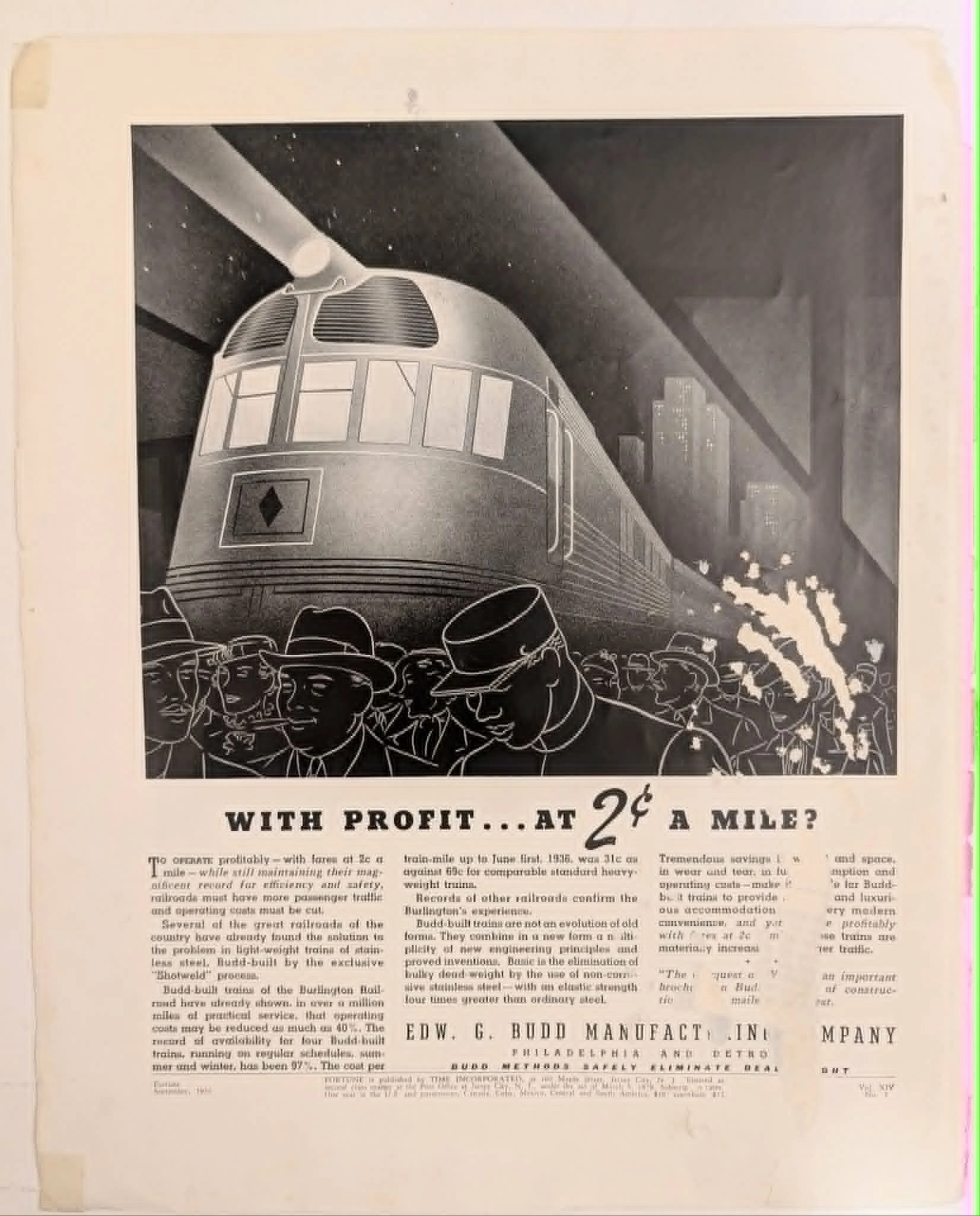
Nous sommes en 1936. L'Amérique est piégée dans les griffes de la Grande Dépression. Les chemins de fer, autrefois monarques absolus des infrastructures américaines, perdent leurs capitaux à un rythme effréné. De Lourdes locomotives à vapeur, alimentées au charbon, tirent d'immenses voitures en acier à travers le continent. Elles sont majestueuses, mais économiquement insoutenables. Le public fuit vers la flexibilité bon marché de l'automobile et les lignes de bus interétatiques nouvellement émergentes. C'est alors qu'entre en scène la Edward G. Budd Manufacturing Company. Cet artefact, une publicité originale du magazine Fortune de septembre 1936, documente une mutation critique de la conception industrielle. Il pose un défi économique radical au statu quo : « WITH PROFIT... AT 2¢ A MILE? » (Avec profit... à 2¢ le mille ?). Il ne s'agit pas simplement d'un argument de vente pour un nouveau train. C'est une notice nécrologique pour l'âge d'or du rail lourd, et un certificat de naissance pour l'ère moderne du transport de masse léger et à grande vitesse.
Category: Technology
The History
L'abîme économique des chemins de fer des années 1930 Pour comprendre la signification de cet artefact, il faut d'abord observer les ruines financières du système ferroviaire américain du milieu des années 1930. Le krach boursier de 1929 avait décimé les volumes de passagers. En 1933, les revenus des passagers à travers les États-Unis avaient chuté de près de 50 % par rapport à leurs sommets des années 1920. La stratégie traditionnelle des chemins de fer reposait sur la masse et l'inertie. Les lourdes voitures Pullman, construites en acier au carbone lourd, nécessitaient une énergie immense pour se déplacer. Un train de voyageurs standard à vapeur pouvait facilement peser plus de 1 000 tonnes, tout en ne transportant que quelques centaines de passagers. Le coût d'exploitation par train-mille était exorbitant, oscillant souvent autour de 69 cents. Facturer aux passagers le tarif standard de l'ICC (Interstate Commerce Commission) de 2 à 3 cents par mille signifiait que, si un train n'était pas rempli à sa capacité maximale, il roulait à perte nette. Les compagnies ferroviaires étaient piégées dans un cercle vicieux : les coûts d'exploitation élevés imposaient des prix de billets élevés, ce qui poussait les passagers dans les bras des concurrents, entraînant de nouvelles baisses de revenus. Le salut de l'acier inoxydable et la technologie Shotweld La Edward G. Budd Manufacturing Company de Philadelphie a abordé cette crise à partir d'un héritage industriel entièrement différent. Budd n'était pas un constructeur de locomotives traditionnel comme Baldwin ou l'American Locomotive Company (Alco). L'expertise de Budd résidait dans l'emboutissage automobile et la métallurgie. Ils comprenaient la tôle, l'efficacité structurelle et, surtout, ils comprenaient l'acier inoxydable. Le cœur de la percée technologique mentionnée dans le texte de cette publicité est le procédé exclusif « Shotweld ». Les techniques de soudage standard détruisaient les propriétés métallurgiques de l'acier inoxydable, le rendant fragile et sensible à la corrosion aux points de soudure. Edward G. Budd, avec son ingénieur en chef Earl J. Ragsdale, inventa une méthode de soudage par résistance électrique contrôlée. En chronométrant précisément le courant électrique — en ne l'appliquant que pendant une fraction de seconde (un « shot ») — ils pouvaient fusionner de minces feuilles d'acier inoxydable sans altérer sa structure cristalline ni réduire sa résistance à la corrosion. Ce saut métallurgique permit à Budd de construire des trains en utilisant un acier inoxydable à haute résistance à la traction qui possédait une résistance élastique quatre fois supérieure à celle de l'acier de construction ordinaire. Le matériau étant intrinsèquement inoxydable, il ne nécessitait pas les lourdes couches de peinture protectrice utilisées sur l'acier au carbone. Plus important encore, il permettait des conceptions structurelles monocoques à parois incroyablement minces. Le train cessait d'être un châssis lourd supportant une boîte ; le corps entier devenait un tube porteur et léger. Le changement de paradigme du Burlington Zephyr La publicité fait référence aux données de performance réelles recueillies jusqu'au 1er juin 1936. Elle note que les trains construits par Budd pour le Burlington Railroad (en particulier le célèbre Pioneer Zephyr et ses successeurs) avaient atteint plus d'un million de milles de service pratique. Les chiffres fournis dans le texte représentent un triomphe industriel : Coût d'un train lourd traditionnel : Environ 69 cents par train-mille. Coût du train léger en acier inoxydable Budd : 31 cents par train-mille. Cela représentait une réduction des coûts de plus de 55 %. Soudain, exploiter un train à un tarif passager de 2 cents par mille n'était plus une recette pour la faillite, mais une entreprise hautement rentable. De plus, la publicité se targue d'un taux de disponibilité de 97 % pour ces trains, tant en été qu'en hiver, prouvant que légèreté ne rimait pas avec fragilité. Le paysage concurrentiel : Budd contre Pullman et ALCO Le milieu des années 1930 a été le témoin d'une bataille technologique féroce pour l'avenir de la vitesse et de l'efficacité du rail. Le principal concurrent de Budd dans la révolution légère était la Pullman-Standard Car Manufacturing Company, qui privilégiait les alliages d'aluminium pour ses premiers autorails aérodynamiques, tels que le M-10000 de l'Union Pacific. Bien que l'aluminium offrît des gains de poids comparables, il lui manquait l'immense résistance à la traction et la capacité de survie aux collisions de l'acier inoxydable soudé par le procédé Shotweld de Budd. Simultanément, les fabricants traditionnels de locomotives à vapeur tentèrent de répliquer en carénant des machines conventionnelles pour les rendre aérodynamiques. Cependant, ces géants de la vapeur souffraient toujours de coûts de maintenance élevés, d'une usure des voies causée par les lourdes pièces alternatives et d'une faible efficacité thermique. L'intégration par Budd de carrosseries légères en acier inoxydable avec des moteurs à combustion interne avancés — principalement en partenariat avec l'Electro-Motive Corporation (EMC) de General Motors pour les moteurs diesel à deux temps — créa un système intégré qui rendit le transport régional à vapeur obsolète.
The Paper
En tant qu'objet physique, cette page du numéro de septembre 1936 du magazine Fortune sert de témoin matériel de l'époque de sa création. Fortune, fondé par Henry Luce en 1930, était célèbre pour ses valeurs de production sans compromis, destinées à refléter la puissance de l'industrie américaine, même pendant la Dépression. Composition de l'encre et technologie d'impression L'illustration est exécutée à l'aide d'une encre noire de carbone à base d'huile de haute densité. Sous examen microscopique, l'impression présente les caractéristiques d'accumulation d'encre et la profondeur tonale riche associées à l'héliogravure, une méthode que Fortune utilisait pour donner à ses illustrations une qualité artistique et photographique. Les parties textuelles utilisent une impression typographique nette, mise en évidence par un léger effet de gaufrage dans la fibre du papier, créant une frontière tactile autour de chaque caractère. Dégradation et caractère textural Le papier présente une belle patine uniforme. Les bords affichent une transition vers une teinte crème-ivoire chaude, causée par la lente oxydation naturelle des traces de lignine au sein de la pâte de bois sur une période de neuf décennies. La surface conserve une texture couchée semi-mate et lisse, qui a protégé l'encre d'une décoloration ou d'un écaillage significatif. Les brûlures ou déchirures localisées visibles sur le bord droit de l'artefact racontent une histoire de survie — le vestige de manipulations, d'un stockage dans des environnements non climatisés et du sauvetage final de la page d'un volume mis au rebut.
The Rarity
Cet artefact est classé dans la catégorie Classe S (Valeur contextuelle significative). Bien que les pages du magazine Fortune ne soient pas entièrement uniques, les publicités individuelles de ce calibre — représentant un point de bascule définitif dans la technologie industrielle — sont de plus en plus rares. La plupart des exemplaires de ces magazines ont été démantelés par des collectionneurs pour les illustrations de couverture ou perdus lors des collectes de papier en temps de guerre dans les années 1940. La valeur historique de cette pièce spécifique repose sur sa conservation complète de son texte riche en données. Elle enregistre les coûts opérationnels précis (0,31 contre0,69) qui ont convaincu les conseils d'administration financiers des chemins de fer américains d'abandonner la vapeur et d'embrasser l'ère du diesel léger. C'est un document fondateur de l'histoire du design industriel américain.
Citer cet article
- MLA
- Naodhinsuk, Ronin. “Le Dossier du Voyageur Temporel : Budd Rail - La Révolution à 2¢.” The Record Institute, 17 May 2026, https://therecord.institute/fr/journal/the-time-travellers-dossier-budd-rail-the-2-revolution.
- APA
- Naodhinsuk, R. (2026, May 17). Le Dossier du Voyageur Temporel : Budd Rail - La Révolution à 2¢. The Record Institute. https://therecord.institute/fr/journal/the-time-travellers-dossier-budd-rail-the-2-revolution
- CHICAGO
- Naodhinsuk, Ronin. 2026. “Le Dossier du Voyageur Temporel : Budd Rail - La Révolution à 2¢.” The Record Institute, May 17, 2026. https://therecord.institute/fr/journal/the-time-travellers-dossier-budd-rail-the-2-revolution.