The Time Traveller's Dossier: The Competitive Edge – The 1968 Mercury Lineup and the Architecture of American Automotive Prestige
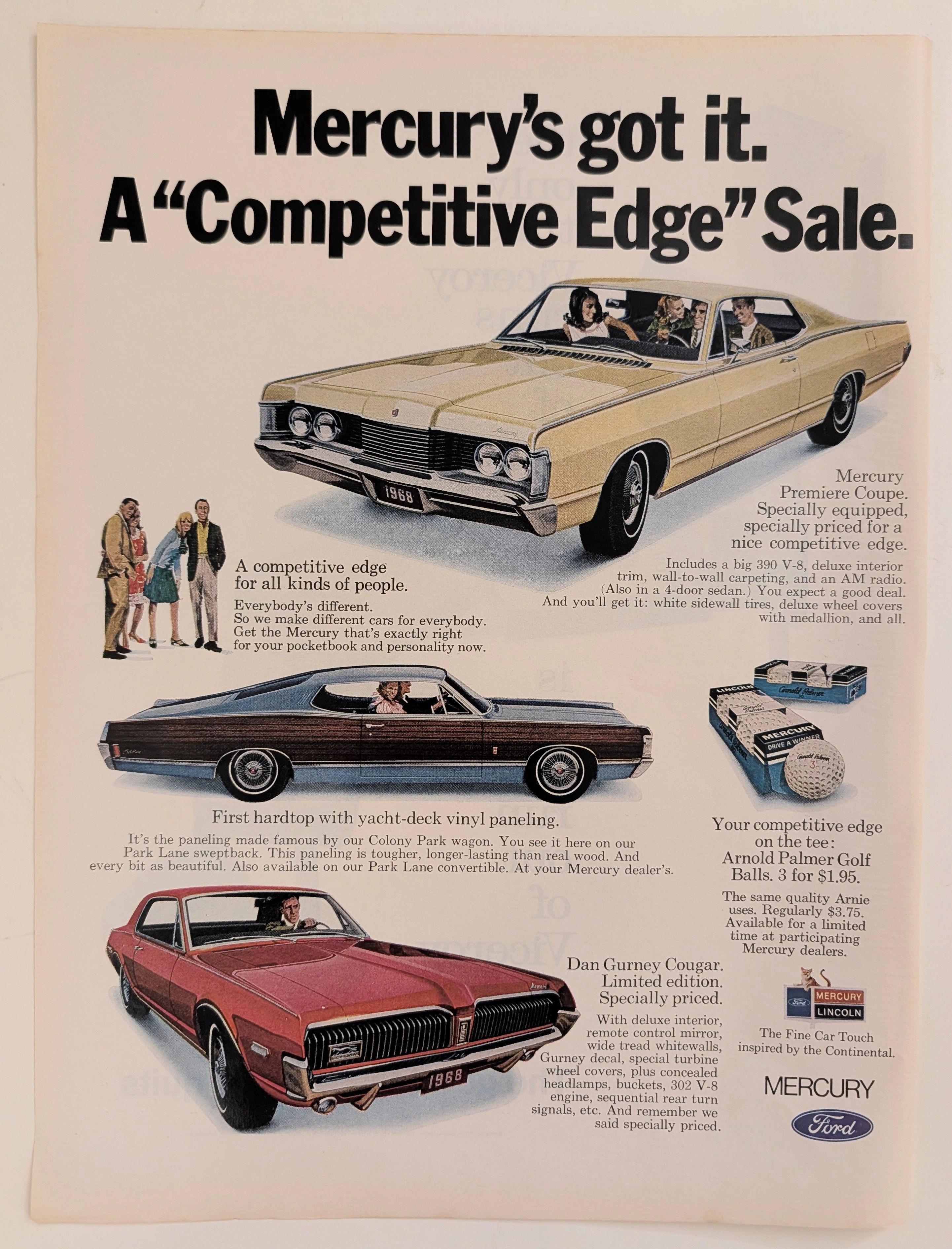
The evolution of the American automotive market in the late 1960s was characterized by a fierce, uncompromising battle for the expanding, affluent middle class. Automakers were no longer simply selling transportation; they were engineering complex lifestyle avatars. The historical artifact elegantly secured upon the analytical table of The Record Institute today is a striking, full-page print advertisement for the 1968 Mercury "Competitive Edge" Sale. This document completely transcends the standard boundaries of automotive marketing. It operates as a highly sophisticated, multi-layered cultural mirror, reflecting the precise era when the Lincoln-Mercury division sought to simultaneously capture the raw, adrenaline-fueled youth market and the established, affluent golfing demographic within a single, unified corporate narrative. This world-class, comprehensive dossier conducts a meticulous, unyielding, and exceptionally exhaustive examination of the artifact, operating under the absolute most rigorous parameters of historical, sociological, and material science evaluation. Dedicating the overwhelming majority of our analytical focus to its immense historical gravity, we will decode the brilliant marketing psychology embedded within the "Competitive Edge" campaign, analyze the profound cultural importance of legendary figures Dan Gurney and Arnold Palmer, and dissect the visual semiotics of the "Sign of the Cat" branding. Furthermore, as we venture deeply into the chemical and physical foundations of this analog printed ephemera, we will reveal the precise mechanical fingerprints of the CMYK halftone rosettes captured in the macro imagery of the vehicles and golf balls. Finally, we will assess its archival rarity, exploring how the graceful, natural oxidation of the paper substrate cultivates a serene wabi-sabi aesthetic—a natural, irreversible phenomenon that serves as the primary engine driving up its market value exponentially within the elite global spheres of Vintage Commercial Ephemera and Automotive Archives.
Category: Automotive
Brand: Ford
The History
To fully appreciate the immense historical gravity, cultural magnitude, and sociological importance of this artifact, one must meticulously contextualize the complex, highly competitive landscape of the American automotive industry in 1968. The Lincoln-Mercury division of the Ford Motor Company was actively fighting a two-front war. On one side, they needed to maintain their status as the sophisticated, luxurious "Fine Car Touch inspired by the Continental", competing directly with General Motors' Buick and Oldsmobile divisions. On the other side, the muscle car era was at its absolute zenith, and Mercury desperately needed to inject youthful, high-octane performance credibility into a brand historically perceived as conservative. The "Competitive Edge" campaign was a masterstroke of multi-demographic targeting, brilliantly utilizing celebrity endorsements to segment the market. To capture the burgeoning youth and performance enthusiast market, Mercury prominently featured the Dan Gurney Cougar. It is absolutely critical to understand the monumental importance of Dan Gurney to American motorsport history. Daniel Sexton Gurney (1931–2018) was not merely a driver; he was an American racing deity. He was a legendary driver, race car constructor, and team owner who achieved victories in Formula One, IndyCar, NASCAR, Can-Am, and the Trans-Am Series. Most notably, in 1967, just a year prior to this advertisement, Gurney achieved a historic, all-American victory at the 24 Hours of Le Mans driving a Ford GT40 Mk IV. By slapping a "Gurney decal" and special turbine wheel covers on a Cougar equipped with a 302 V-8 engine, Mercury instantly transferred Gurney's untouchable, high-speed racing pedigree directly to the suburban driveway. The Dan Gurney Cougar was not just a car; it was a homologated piece of American racing glory available for special purchase. Conversely, to maintain its grip on the affluent, mature demographic, the advertisement strategically pivots to the world of elite country clubs through the inclusion of Arnold Palmer Golf Balls. Arnold Daniel Palmer (1929–2016), affectionately known as "The King," is widely regarded as one of the greatest and most charismatic players in the history of professional golf. Palmer was a cultural phenomenon; his aggressive style of play, working-class background, and immense television appeal democratized golf while simultaneously elevating it to a glamorous national obsession. By offering Arnold Palmer golf balls—"The same quality Arnie uses"—as a promotional tie-in at Mercury dealerships, the brand ingeniously associated its Premiere Coupe and Park Lane models with Palmer's winning aura, sophistication, and upward social mobility. The vehicles themselves represent the peak of 1960s automotive design excess. The Park Lane sweptback hardtop is particularly fascinating. It is proudly advertised as the "First hardtop with yacht-deck vinyl paneling." Historically, simulated wood paneling was strictly reserved for utilitarian station wagons (like the famous Mercury Colony Park). Applying this "tougher, longer-lasting than real wood" paneling to the sleek, aerodynamic flanks of a two-door hardtop was a bold, slightly eccentric design choice that perfectly encapsulates the era's obsession with combining rugged, nautical leisure aesthetics with formal automotive luxury. Finally, the corporate branding block cements the psychological messaging. Resting atop the Mercury/Lincoln/Ford emblem is the iconic "Sign of the Cat"—the cougar mascot. This feline imagery was utilized across the Mercury line to convey a sense of sleek, predatory grace and quiet power, unifying the massive, luxurious Premiere Coupe and the aggressive Dan Gurney Cougar under a single, memorable corporate identity.
The Paper
As a physical entity, this printed artifact functions as a living, breathing, and profound record of mid-twentieth-century graphic reproduction and substrate chemistry. Under exceptional, high-magnification macro-lens examination, this document reveals the stunning complexity and mathematical precision of analog color printing. The extraordinary macro photographs of the red Dan Gurney Cougar and the Arnold Palmer golf ball boxes provide a textbook visualization of a CMYK halftone rosette pattern. The brilliant candy-apple red of the Cougar's hood, the deep shadows within its concealed headlamp grille, and the intricate dimples on the golf ball are not solid swatches of ink. Instead, they are meticulously constructed from a precise, mathematically rigorous galaxy of microscopic ink dots. Cyan, Magenta, Yellow, and Key (Black) inks are elegantly and systematically layered at highly specific angles to trick the human eye and the biological visual cortex into perceiving a continuous, vibrant, and dimensional photographic reality out of mere clusters of ink. The texture of the uncoated magazine paper stock further illustrates how the ink absorbed into the organic fibers, creating a soft, matte finish characteristic of 1960s high-volume offset printing. Yet, the most profound and impactfully beautiful factor elevating the immense value of this artifact in the contemporary global collector's market is the natural, organic, and entirely irreversible process of Material Degradation. The expansive margins and the negative space surrounding the vehicles exhibit a genuine, unavoidable "Toning." This gradual, chronological transition from the original bright, bleached manufactured paper to a warm, antique ivory and golden hue is caused by the slow, relentless chemical oxidation of Lignin—the complex organic polymer that naturally binds cellulose fibers together within the raw wood pulp of the paper. As the substrate is exposed to ambient oxygen and ultraviolet light over a span of decades, the molecular structure of the lignin gracefully breaks down. This naturally evolving patina represents the absolute core of the wabi-sabi aesthetic. It is precisely this authentic, unreplicable degradation that acts as the primary engine driving up its market value exponentially among elite curators and collectors, as it provides the ultimate, irrefutable scientific proof of the artifact's historical authenticity and its delicate journey through time.
The Rarity
rarity RARITY CLASS: B (Very Good Archival Preservation with Natural Margin Toning) Evaluated under the most exacting, rigorous, and uncompromising archival parameters established by The Record Institute (which spans a meticulous classification system from Pristine Class A down to Heavily Degraded Class D), this artifact is definitively and securely designated as Class B. The remarkable and defining paradox of mid-century commercial ephemera is that these specific documents were produced by the millions as explicitly and intentionally "disposable media." Inserted into high-volume consumer publications of 1968, they were inherently destined by their very nature to be briefly observed, casually folded, and ultimately discarded into the recycling bins of history. For a full-page, graphically significant advertisement featuring multiple distinct focal points to survive entirely intact without catastrophic structural tearing, without destructive moisture staining, or without the fatal, irreversible fading of the delicate, light-sensitive halftone inks constitutes a highly significant statistical archival anomaly. The structural integrity of this paper remains exceptionally sound. While the rich analog colors—particularly the vibrant red of the Cougar and the stark blue of the golf ball packaging—remain astonishingly vibrant, there is a beautiful, mathematically even, natural lignin oxidation reflecting its era. This displays a pronounced, warm ivory patina heavily along the expansive margins. This environmental interaction does not detract from its immense value; rather, it authentically validates the document's chronological journey. The sheer sociopolitical weight of the subject matter—the definitive documentation of Mercury leveraging the dual megawatt star power of Dan Gurney and Arnold Palmer—makes this a highly prized, museum-worthy piece of automotive advertising heritage, requiring acid-free, UV-protected conservation framing to ensure its historical permanence.
Cite this article
- MLA
- Naodhinsuk, Ronin. “The Time Traveller's Dossier: The Competitive Edge – The 1968 Mercury Lineup and the Architecture of American Automotive Prestige.” The Record Institute, 24 March 2026, https://therecord.institute/journal/the-time-travellers-dossier-the-competitive-edge-the-1968-mercury-lineup-and-the-architecture-of-american-automotive-prestige.
- APA
- Naodhinsuk, R. (2026, March 24). The Time Traveller's Dossier: The Competitive Edge – The 1968 Mercury Lineup and the Architecture of American Automotive Prestige. The Record Institute. https://therecord.institute/journal/the-time-travellers-dossier-the-competitive-edge-the-1968-mercury-lineup-and-the-architecture-of-american-automotive-prestige
- CHICAGO
- Naodhinsuk, Ronin. 2026. “The Time Traveller's Dossier: The Competitive Edge – The 1968 Mercury Lineup and the Architecture of American Automotive Prestige.” The Record Institute, March 24, 2026. https://therecord.institute/journal/the-time-travellers-dossier-the-competitive-edge-the-1968-mercury-lineup-and-the-architecture-of-american-automotive-prestige.