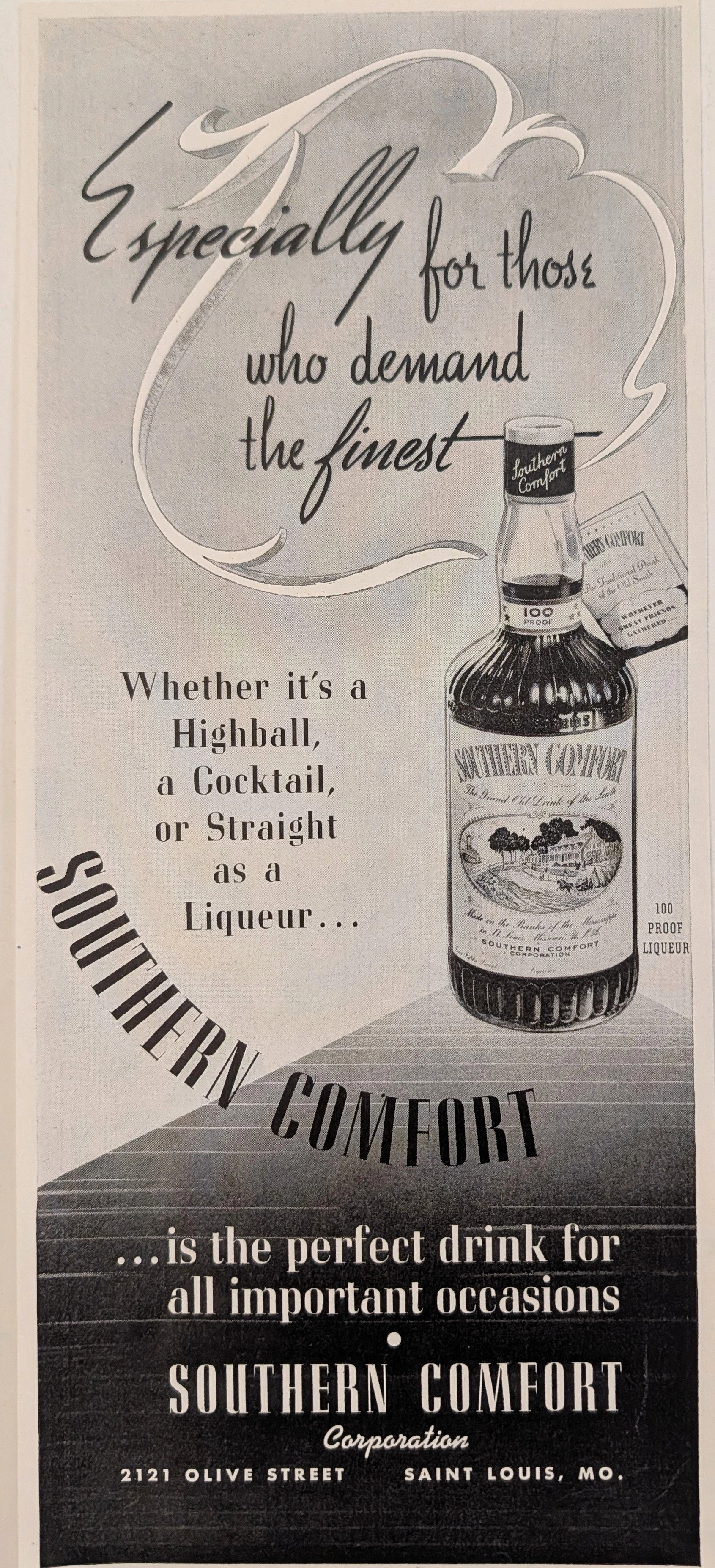
1950s Southern Comfort 100 Proof Liqueur Vintage Advertisement
In the 1950s, American commercial aesthetics were deeply influenced by a cultural desire for refined domestic entertaining and mid-century elegance. This advertisement was a strategic move to frame Southern Comfort as "the perfect drink for all important occasions". It was marketed as a highly versatile spirit, ideal whether mixed as a highball, a cocktail, or served straight as a liqueur. The primary visual is rendered in a classic mid-century halftone print style, highlighting the iconic fluted glass bottle and traditional neck tag proclaiming "WHEREVER GREAT FRIENDS GATHERED...". This specific creative direction deliberately preserves the original flat illustration style, the elegant hand-drawn typography, and the striking contrast of its period grayscale palette. The physical print's visible aged paper texture anchors the piece as a static image that evokes the striking potential of a living 2D artwork. While the overarching layout focuses on typography and product presentation, the meticulously detailed southern plantation scene on the bottle's main label invites fluid, organic motion; one can almost visualize the tiny illustrated horses breathing and trotting, or the leaves rustling seamlessly against the stately home. This distinct clarity of form perfectly supports the imagination of an animated, living tableau, preserving the hand-drawn stroke quality of the original commercial artists. The overall aesthetic is deeply atmospheric. The scene intrinsically suggests a warm, nostalgic, era-appropriate background atmosphere that feels like the advertisement could genuinely come to life on paper. It is easy to envision accompanying ambient period-appropriate background sound—such as the soft clinking of glassware in a sophisticated 1950s lounge, a gently crackling radio playing smooth jazz, or the gentle wind moving across the "Banks of the Mississippi". Firmly anchored by the bold "SOUTHERN COMFORT" typography and the distinguished "100 PROOF" badge, this piece stands as a documented historical record of mid-century commercial artistry.
Category: Alcohol
Year: 1950
Rarity Class: A
Paper & Print Condition
The physical artifact displays the characteristic aged paper texture typical of mid-century print stock, featuring a subtle, tactile grain. The print quality immaculately preserves the original halftone shading and flat graphic technique. The monochrome ink saturation remains remarkably high, resisting significant degradation over the decades. The intricate details, from the elegant cursive typography to the delicate cross-hatching on the fluted glass bottle, remain exceptionally crisp, indicating careful historical preservation.
Provenance & Rarity
This item is a verified original production directly from the Southern Comfort Corporation's promotional efforts in St. Louis, Missouri during the 1950s. Advertisements from this specific era are highly sought after by institutional archives for their precise cultural representation of American entertaining. Furthermore, surviving examples with such pristine preservation of the original layout and typographic quality are exceptionally rare. This high fidelity makes this specific print a highly prized asset for advanced archival projects, including those dedicated to preserving mid-century aesthetics through dynamic living 2D artwork adaptations, where unblemished textures and accurate grayscale values are critical.
Rarity & Condition Summary
Classified as a Class A rarity, this is an exceptional specimen of mid-century commercial lithography. The pristine preservation of the elegant typography, the aged paper texture, and the overarching structural integrity of the flat print solidify its high-tier archival status. Its immaculate condition provides an ideal foundation for advanced preservation efforts, including those that envision the historical artwork coming to life through fluid, organic motion and synchronized era-appropriate audio.