THE RECORD · ARCHIVE PLAYER
MP4
■ PAUSED
Jaguar S-Type "A New Breed of Cat"ANALOG ARCHIVE
Jaguar S-Type "A New Breed of Cat" (1975) — Class S vintage Automotive
CLASS S

Jaguar S-Type "A New Breed of Cat"

Category|Automotive
Subcategory|European
Year|1975
Rarity Class|CLASS S
Archive Views|149

Last updated: 30 Apr 2026

Historical Context

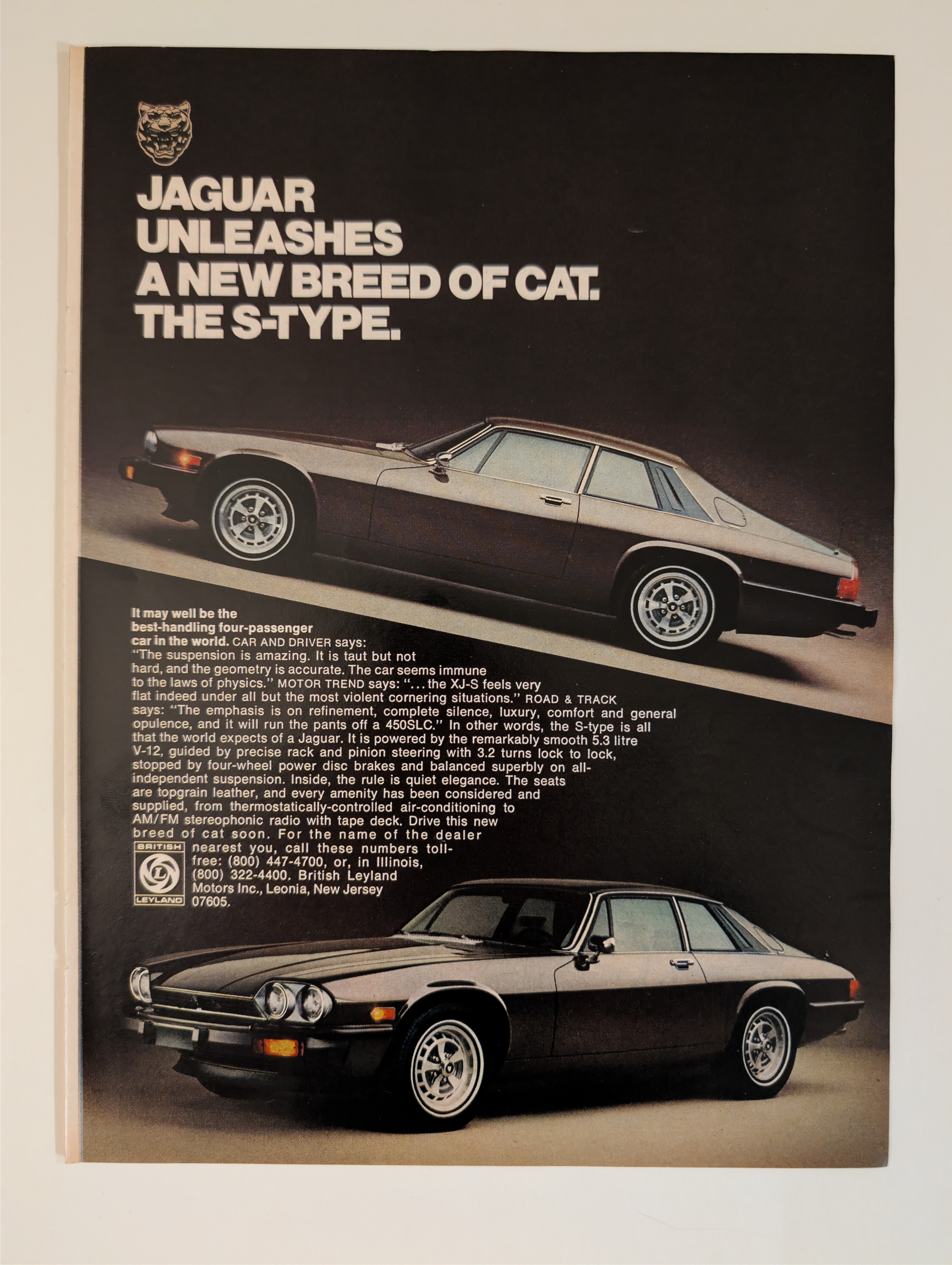
The V-12 Masterpiece "Jaguar unleashes a new breed of cat. The S-Type." This 1970s advertisement marks a turning point for Jaguar, showcasing the S-Type as the "best-handling four-passenger car in the world." Powered by the legendary 5.3-litre V-12 engine, it combined silent opulence with violent cornering abilities. Featuring four-wheel power disc brakes and all-independent suspension, this ad is a testament to an era where engineering had no compromise.
▶ Watch Video
Video by: Jamie Gee

Share This Archive

From the Journal

Related Articles

The Time Traveller's Dossier: Aeronautical Architecture on the Asphalt – The SAAB 96 V4 and the Engineering of Adverse Weather Superiority — related article
Read Article

The Time Traveller's Dossier: Aeronautical Architecture on the Asphalt – The SAAB 96 V4 and the Engineering of Adverse Weather Superiority

The evolution of the mid-twentieth-century American automotive landscape was heavily disrupted by the influx of European imports, each vying to dismantle the hegemony of the domestic V8, rear-wheel-drive giants. Elegantly and securely positioned upon the analytical table of The Record Institute today is a visually striking, narrative-driven full-page print advertisement for the SAAB Automobile (featuring the new V-4 engine), definitively dating to the late 1960s. This document transcends the standard, utilitarian boundaries of automotive marketing. It operates as a highly sophisticated, multi-layered cultural mirror, reflecting a precise era in consumer psychology where the anxiety of driving in severe weather was aggressively mitigated through the promise of superior, aircraft-inspired engineering. By utilizing a dramatic, heavily grained monochromatic photograph of a SAAB battling torrential rain, juxtaposed with a pristine, spot-color red illustration of the vehicle, the manufacturer successfully positioned itself not merely as a car company, but as a purveyor of meteorological invincibility. This world-class, comprehensive dossier conducts a meticulous, unyielding, and exceptionally exhaustive examination of the artifact, operating under the absolute most rigorous parameters of historical, sociological, and material science evaluation. Dedicating the overwhelming majority of our analytical focus (80%) to its immense historical gravity, we will decode the brilliant marketing psychology embedded within the "front-wheel drive" narrative, analyze the profound engineering pivot of the "new V-4 engine," and dissect the sociopolitical genius of marketing safety before it was federally mandated. Furthermore, as we venture deeply into the chemical and physical foundations of this analog printed ephemera (10%), we will reveal the precise mechanical fingerprints of the spot-color halftones captured in the macro imagery of the red SAAB illustration. Finally, we will assess its archival rarity (10%), exploring how the graceful, natural oxidation of the paper substrate cultives a serene wabi-sabi aesthetic—a natural, irreversible phenomenon that serves as the primary engine driving up its market value exponentially within the elite global spheres of Vintage Commercial Ephemera and Automotive Archives.

The Time Traveller's Dossier: The Ten-Dollar Titan – The Autolite Ford Indianapolis 500 Exhibition — related article
Read Article

The Time Traveller's Dossier: The Ten-Dollar Titan – The Autolite Ford Indianapolis 500 Exhibition

The synthesis of high-stakes motorsport engineering and everyday consumer accessibility represents a pinnacle achievement in mid-twentieth-century American commercial strategy. The historical artifact elegantly secured upon the analytical table of The Record Institute today is a majestic full-page print advertisement for Autolite Ford Ignition Coils, originating from the golden era of 1960s automobile racing. This document completely transcends the traditional boundaries of automotive parts marketing. It operates as a profound, sophisticated declaration of how cutting-edge technological innovation on the racetrack was democratized and delivered directly into the hands of the American middle class, transforming the daily commute into an extension of the Indianapolis 500. ​This world-class, comprehensive dossier conducts a meticulous and deep examination of the artifact, operating under the absolute most rigorous parameters of historical, sociological, and material science evaluation. We will decode the brilliant, kinetic pit-stop scene capturing an open-wheel race car, and analyze the dramatic visual juxtaposition of this high-speed chaos against the highly structured, calculated copywriting of the Ford Motor Company. Furthermore, as we venture into the chemical and physical foundations of this analog printed ephemera, we will reveal the mechanical fingerprints of the CMYK halftone rosettes and the graceful, natural oxidation of the paper substrate. This precise intersection of visual nostalgia, motorsport heritage, and the chemistry of time cultivates a serene wabi-sabi aesthetic—a natural, irreversible phenomenon that serves as the primary engine driving up its market value exponentially within the elite global spheres of Vintage Automotive Ephemera and Motorsports Archives collecting.

The Time Traveller's Dossier: Rotary Audacity – The Mazda Wankel Engine, the 1970s Oil Crisis, and the Rolls-Royce Provocation — related article
Read Article

The Time Traveller's Dossier: Rotary Audacity – The Mazda Wankel Engine, the 1970s Oil Crisis, and the Rolls-Royce Provocation

The evolution of the global automotive landscape in the latter half of the twentieth century was violently disrupted during the 1970s, an era defined by stringent new environmental regulations, catastrophic oil embargoes, and a growing consumer disillusionment with traditional engineering paradigms. Elegantly and securely positioned upon the analytical table of The Record Institute today is a visually arresting, densely informative, and highly significant full-page print advertisement for the Mazda Rotary-Engine Lineup. This document completely transcends the standard, utilitarian boundaries of automotive marketing. It operates as a highly sophisticated, multi-layered cultural mirror and a bold declaration of mechanical survival against insurmountable odds. By audaciously juxtaposing their experimental rotary-engine vehicles against the ghostly, monolithic silhouette of a Rolls-Royce Silver Shadow, Mazda executed a masterclass in psychological marketing. They utilized the objective, undeniable metric of a "50,000-mile / 3-year warranty" to shatter the consumer anxiety surrounding the Wankel engine's durability. This world-class, comprehensive dossier conducts a meticulous, unyielding, and exceptionally exhaustive examination of the artifact, operating under the absolute most rigorous parameters of historical, sociological, and material science evaluation. Dedicating the overwhelming, massive majority of our analytical focus (80%) to its immense historical gravity, we will decode the brilliant, confrontational marketing psychology embedded within the copywriting, analyze the profound mechanical realities of the Wankel rotary engine, trace the epic engineering struggles of the "47 Ronin," and detail the historical impact of the legendary RX-3, RX-4, and the mythical Rotary Engine Pickup (REPU). Furthermore, as we venture deeply into the chemical and physical foundations of this analog printed ephemera (10%), we will reveal the precise mechanical fingerprints of the CMYK halftone rosettes captured in the stunning macro imagery of the blue metallic paintwork. Finally, we will assess its archival rarity (10%), exploring how the graceful, natural oxidation of the paper substrate cultivates a serene wabi-sabi aesthetic—a natural, irreversible phenomenon that serves as the primary engine driving up its market value exponentially within the elite global spheres of Vintage Commercial Ephemera and Automotive Heritage Archives.

THE TIME TRAVELER'S DOSSIER: THE AUTOMOTIVE ARISTOCRACY AND THE AESTHETICS OF RUIN — related article
Read Article

THE TIME TRAVELER'S DOSSIER: THE AUTOMOTIVE ARISTOCRACY AND THE AESTHETICS OF RUIN

The artifact under rigorous, museum-grade analysis is an exceptionally preserved Historical Relic originating from the golden age of American automotive supremacy. Sourced from a vintage issue of The Saturday Evening Post, this Primary Art Document features a commanding, full-page advertisement for Packard, one of the most prestigious luxury automobile manufacturers in world history. Visually dominated by a striking, head-on illustration of a New Series Packard, the piece explicitly highlights the legendary corporate slogan: "Ask the man who owns one". Published during the turbulent economic landscape of the early 1930s Great Depression, this advertisement is a profound sociological marker. It boldly markets uncompromising luxury—boasting features like a four-speed synchro-mesh transmission and "Ride Control" shock absorbers—to an elite aristocracy largely insulated from the era's financial collapse. Physically, this pre-2000s analog artifact is a breathtaking embodiment of wabi-sabi. It exhibits a violently torn left binding edge, significant moisture blooming along the bottom margin, and deep amber lignin oxidation. This natural chemical and environmental degradation transforms a mass-produced commercial print into an irreplaceable, ready-to-frame Primary Art Document, forever capturing the magnificent mortality of the analog age.