Dead Brand Stories / Blockbuster
What Happened to Blockbuster?
The king of Friday night was beaten by a company it had reportedly been offered for pocket change — and shrank to a single store in Oregon.
Opening statement
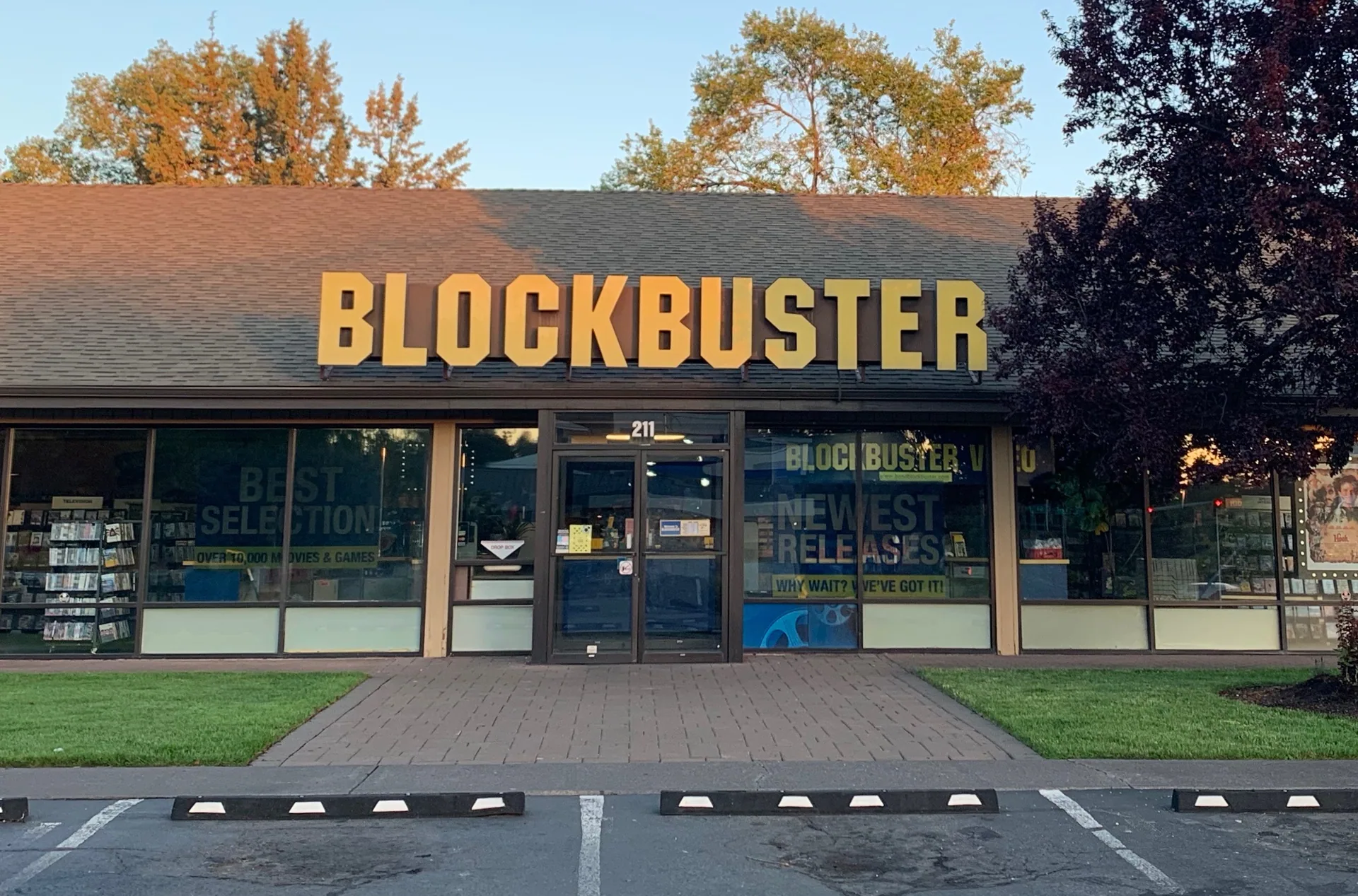
There is a shop in Bend, Oregon, where you can still rent a movie on a Friday night. It has a membership counter, a returns slot, and a wall of new releases, kept exactly the way thousands of other shops once kept theirs. Those other shops are gone. This one is the last Blockbuster on Earth. In 2004, the company behind it operated 9,094 stores, employed 84,300 people, and took in just over $6 billion in a single year. Six years later, it was bankrupt. The distance between those two facts is one of the most instructive collapses in modern retail: Blockbuster was not beaten by a better video store, and it was not beaten by a technology it failed to see. It saw the future, built a working answer to it — and then, at the decisive moment, declined to pay for its own answer. This account is drawn from the record: the company's own SEC filings, the bankruptcy court file, and contemporary reporting. Where the record is disputed — most famously over a $50 million meeting in Dallas in 2000 — both versions are given.
A structured case history
Reading section 01
Watch: Dead Brands No. 1, the short — "What Happened to Blockbuster?"
Reading section 02
The Rise of Blockbuster
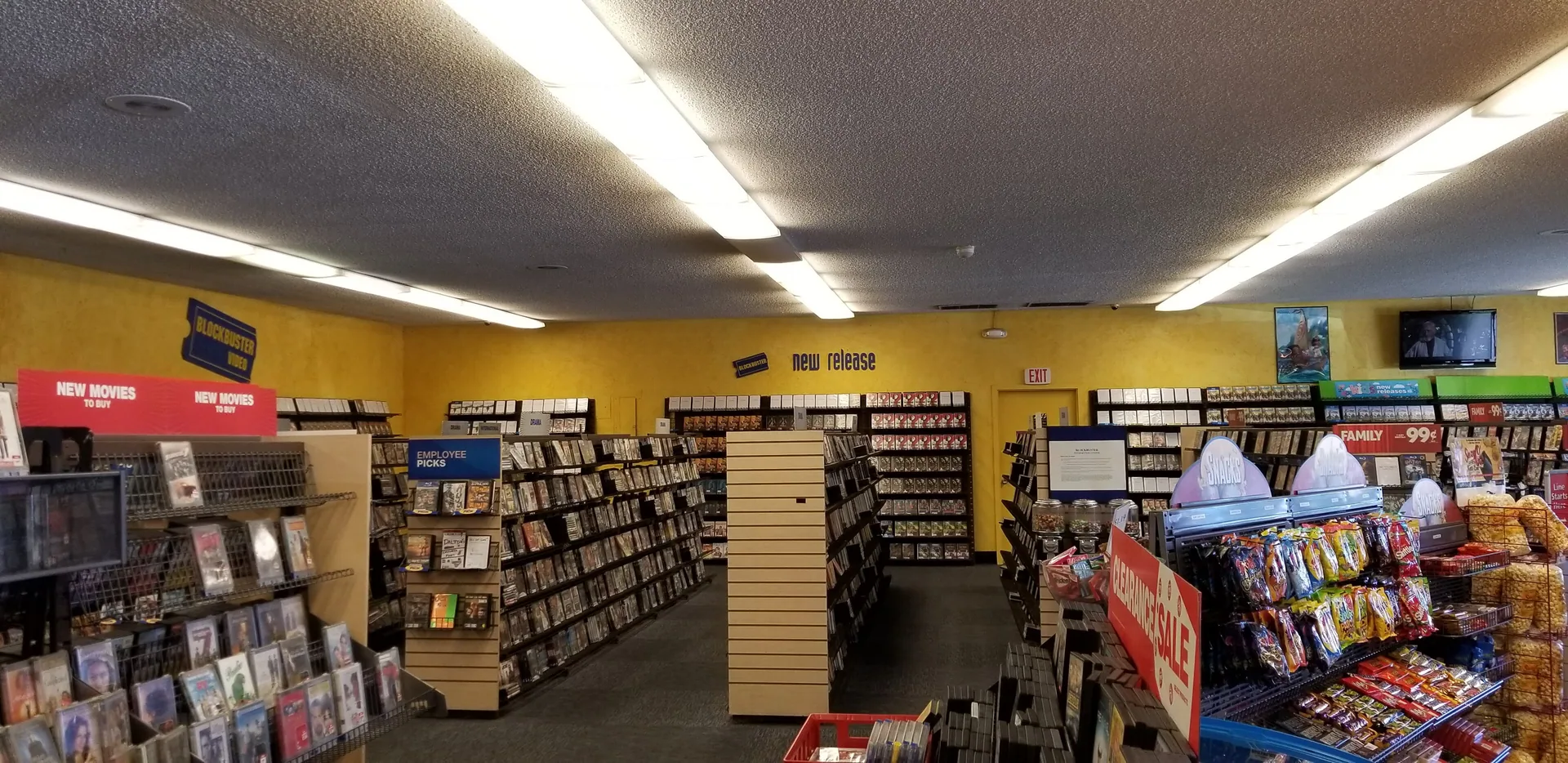
The story starts in Dallas, Texas, on 19 October 1985. That day, a software man named David Cook opened a video rental store unlike any America had seen. Cook came from data: his company had written software for the Texas oil business, and when oil slumped, he went looking for a new industry to organize. Video rental in 1985 was chaos — tiny shops, a few hundred tapes each, paper records, and no real idea what customers wanted. Cook's store opened with 8,000 VHS tapes and 2,000 Betamax tapes, many times what a normal shop carried. Every tape was tracked by computer, and the shelves were stocked using data about the neighborhood around the store. It stayed open until midnight; it was bright, clean and family friendly; and it carried a name built for scale: Blockbuster. When new investors arrived in early 1987, 19 stores were open — and by the end of that year there were 133.
Then the garbage man arrived. Wayne Huizenga had co-founded Waste Management and built a trash empire by buying hundreds of small operators and bolting them together. In 1987, Huizenga and his partners put 18.5 million dollars into Blockbuster and took control. Cook walked away with about 12 million dollars for his shares — stock he later calculated would one day have been worth about 300 million dollars.
Huizenga ran the playbook he had run in trash: buy rivals, open stores at a furious pace, and let franchise owners pay for much of the growth. By the end of 1991 there were more than 2,000 stores; two years later, more than 3,000. At the fastest stretch, a new Blockbuster was opening somewhere in America at a pace of about one a day. But Huizenga was already looking over his shoulder, worrying in public about cable television and video on demand — ways to beam a movie home with no store at all. So in 1994 he sold the company to the media giant Viacom, in a deal worth 8.4 billion dollars. Viacom wanted Blockbuster's cash flow to help pay for its takeover of Paramount Pictures. The king of video rental had become a war chest.
Visual interlude
Reading section 03
The Peak
Under Viacom, Blockbuster became more than a shop. It became a ritual, printed into American childhoods: the blue and yellow sign, the smell of popcorn and plastic, the new-release wall stripped bare by six in the evening, the long negotiation with your parents in the comedy aisle. By 2004 the empire stood at its peak — 9,094 stores, 84,300 employees, and just over six billion dollars of revenue in a single year.
But the machine had a dirty secret, and the secret was the business model. In 2000 alone, late fees brought in nearly 800 million dollars — about 16 cents of every dollar Blockbuster took in came from fining its own customers. Late fees were not a side income; they were the profit engine. When Blockbuster finally scrapped them in 2005, it warned investors the move could cost it hundreds of millions of dollars.
There is a problem with a business that profits when its customers fail: eventually, somebody offers those customers a way to stop failing. That somebody had already knocked on the door.
Visual interlude
Reading section 04
The Fall of Blockbuster
Netflix had been founded in California in 1997 by Reed Hastings and Marc Randolph, on a simple pitch: DVDs by mail, no stores. At first it charged by the disc, like any rental shop; the famous promise — no due dates, no late fees — arrived in September 1999, with its Marquee subscription plan. Company legend blames a single 40-dollar late fee on a returned copy of Apollo 13. True or polished, the grudge behind it was real. By 2000, Netflix had about 300,000 subscribers, and it was losing money fast in the dot-com crash.
So that September, Hastings and Randolph flew to Dallas. By Randolph's account, in his book That Will Never Work, they met chief executive John Antioco, offered to sell him their whole company for 50 million dollars, and Antioco was struggling not to laugh. Antioco's account, set out on LinkedIn in 2022, is flatly different: he says he was not in the meeting at all — he stopped by only to greet the visitors; that the Netflix team had come to pitch a licensing arrangement; that the idea of a sale was apparently raised offhand, when the talks snagged; and that there were never serious negotiations about a purchase. What nobody disputes is the arithmetic. By its own 1999 filing, Blockbuster had over 48 million member accounts in the United States and Canada, and 50 million dollars was about four days of its revenue that year. From inside that building, saying no looked rational. That is what makes this story dangerous: the trap was not stupidity. The trap was success.
First came the divorce. In 2004, Viacom split Blockbuster off as an independent company again, and the split loaded it with 1.45 billion dollars of new borrowing — much of it raised to pay a special dividend of 905.6 million dollars, some 738 million of which went to Viacom itself. Antioco, to his credit, saw what was coming. He scrapped the late fees. He launched Blockbuster Online to fight Netflix through the mail. And in November 2006 he launched the cleverest weapon of all: Total Access, which let online members return a mailed disc at any store and walk out with a free rental on the spot. Netflix, with no stores, could not copy it. It worked: by the end of 2006, the online service had about 2.2 million subscribers, roughly two million of them paying — the two-million goal the company had set itself. Antioco later wrote that the success of Total Access set off serious merger discussions between Blockbuster and Netflix in early 2007 — the closest the two rivals ever came to combining — and that the talks died when he left. That winter, Netflix changed the subject entirely, launching instant streaming; a few months later, Netflix reported something it had never reported before — it lost subscribers. For one brief moment, the empire was winning.
But the counterattack was expensive, and not everyone in the boardroom believed in paying the bill. The activist investor Carl Icahn had fought his way onto the board in 2005, and he wanted profit and discipline, not a subsidy war with Netflix. Antioco later wrote that his plan had called for 200 million dollars to build Blockbuster Online and another 200 million to abolish the late fees; the board would not carry losses on that scale. The end came over his pay: in March 2007, after a public fight over his 2006 bonus — he said the board's own formula entitled him to 7.65 million dollars, the board offered 2.28 million, and they settled at about 3.05 million — Antioco agreed to go. James Keyes, the former head of 7-Eleven, took over in July. Keyes judged that the company could not afford Total Access's losses, and wound the service down; within a few years the online business had faded from the store windows, and by 2010 even the late fees had returned.
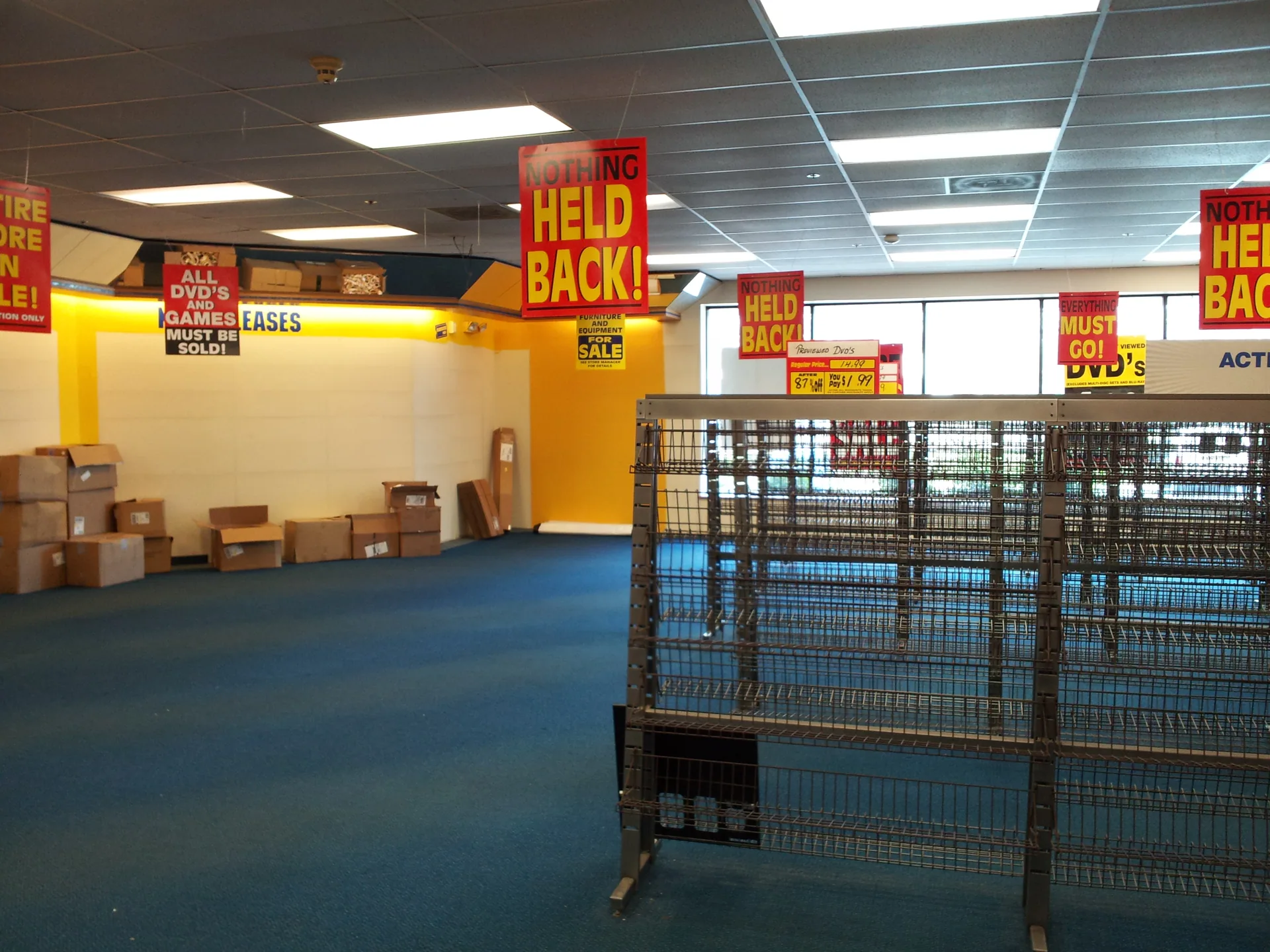
Then the ground moved. The financial crisis of 2008 crushed spending and froze the credit markets, just when a company carrying Blockbuster's debts needed friends with money. A rival called Redbox was renting new movies from kiosks for a dollar a night. Netflix's streaming library kept growing. And the stores — every one a lease, a staff, and walls of plastic — kept costing what they had always cost. On 23 September 2010, Blockbuster filed for Chapter 11 bankruptcy protection in New York. The filing listed about one billion dollars of assets, against roughly 1.5 billion dollars of debts.
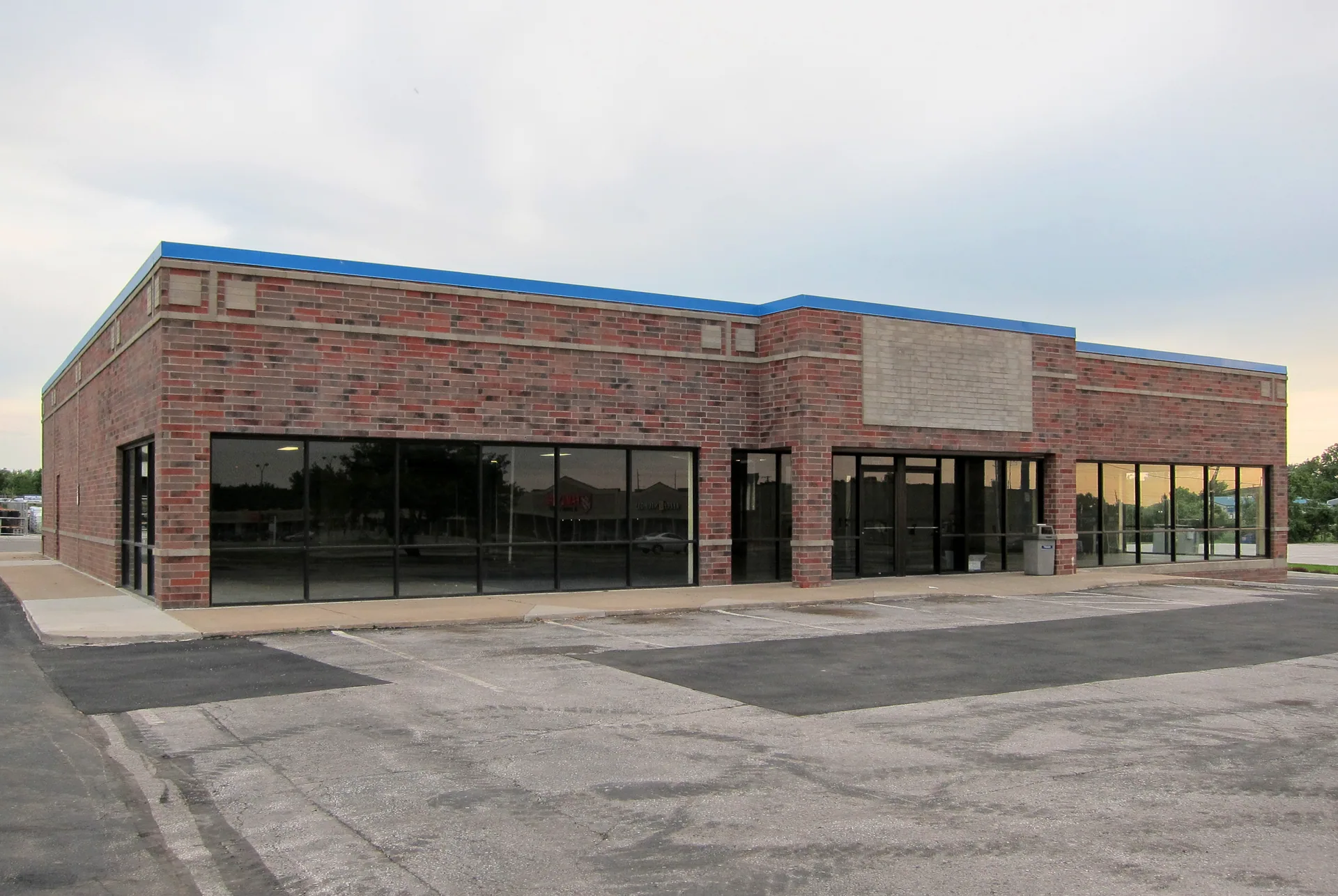
The company Viacom had bought for 8.4 billion dollars was sold again in April 2011, when the satellite company Dish Network picked up the remains at auction for about 320 million dollars. Dish hoped the name could live on as a smaller chain. It could not. By early 2014, every company-owned Blockbuster store had closed.
STAT CARD 9,094 stores → 1 Blockbuster's worldwide store count at its 2004 peak, and the number still trading today.
Visual interlude
Reading section 05
The Afterlife
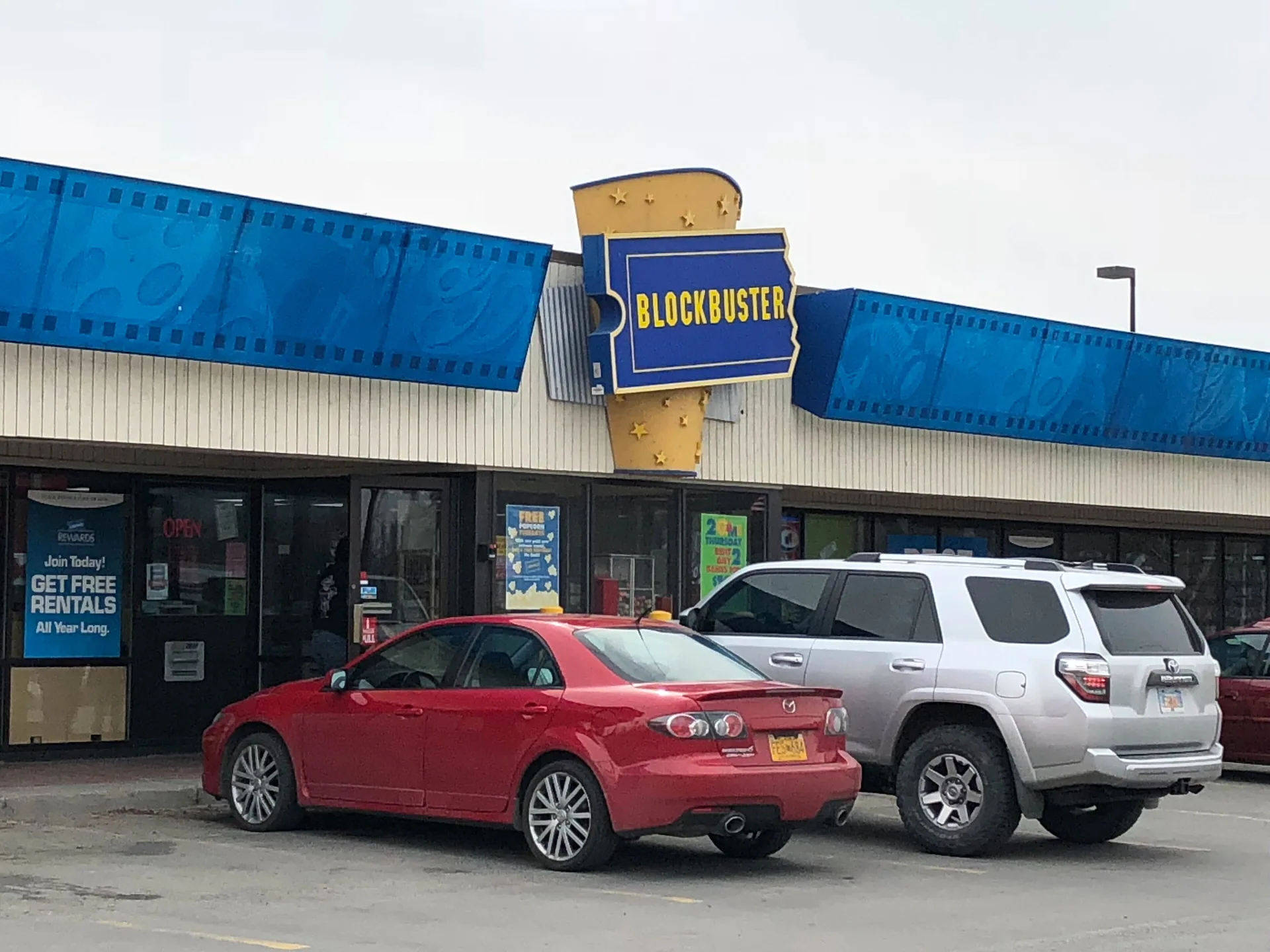
What survived was a trademark, and a handful of franchise stores owned by local families who licensed the name — and simply refused to stop. The strangest chapter is the last one. Long after the company died, its franchise stores kept trading in the coldest corner of America: Alaska. Alaska's slow internet and long dark winters kept renting a physical movie sensible, years after it stopped making sense anywhere else. In 2013, 13 stores were still open there.
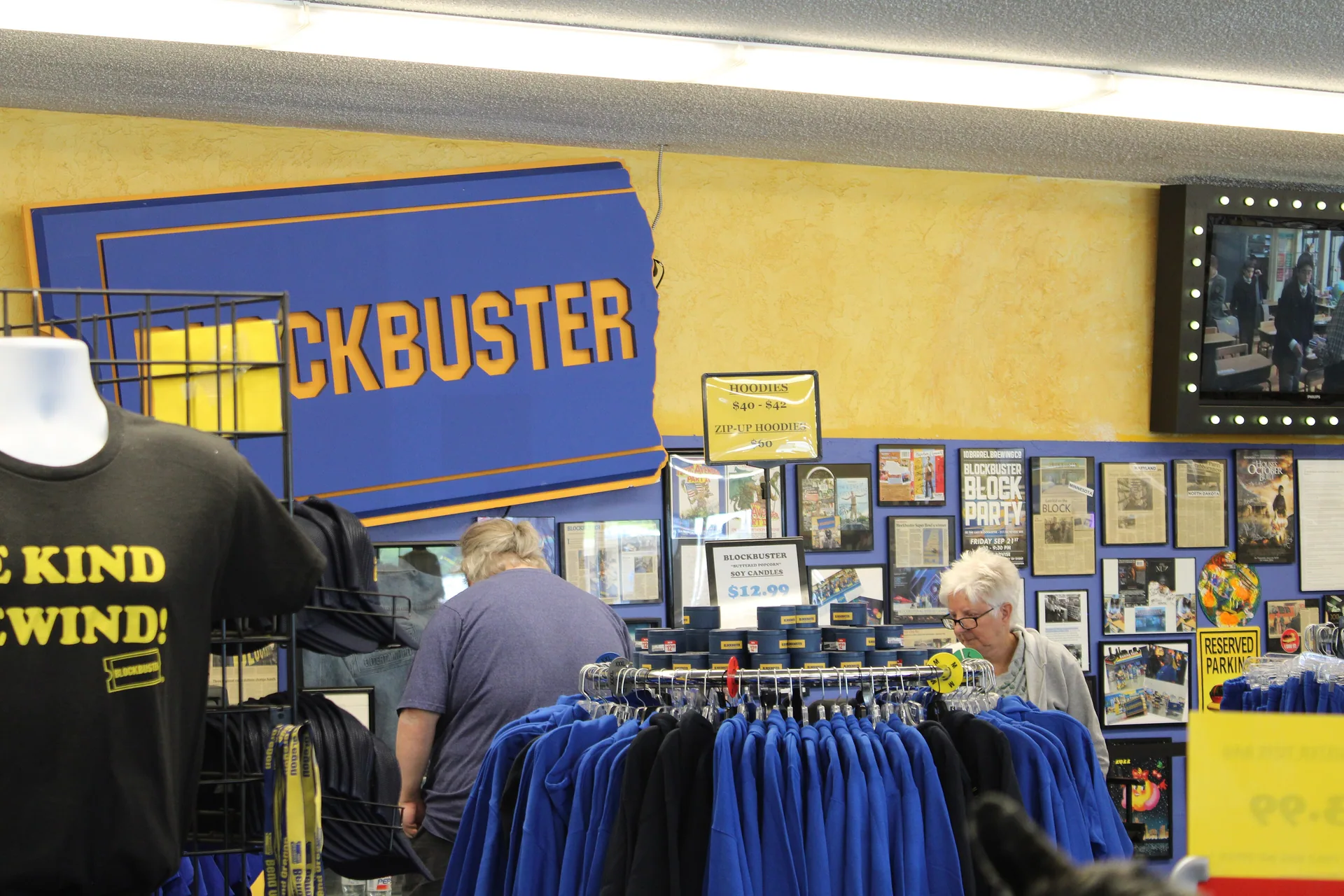
One by one they closed, until only Anchorage and Fairbanks were left. In July 2018, those two rented their last movies, and Bend became the last Blockbuster in America. Comedian John Oliver had tried to save the Anchorage store, shipping it movie memorabilia that had belonged to Russell Crowe. It did not save the store — but when it closed, its owners sent the collection on to Bend, where most of it is a tourist attraction to this day: the robe and shorts from Cinderella Man are on display. The most famous piece — the jockstrap — never arrived; it later turned up back with Oliver's show. Eight months later, in March 2019, the last Blockbuster in Australia closed too, and Bend's last-in-America title became last in the world.
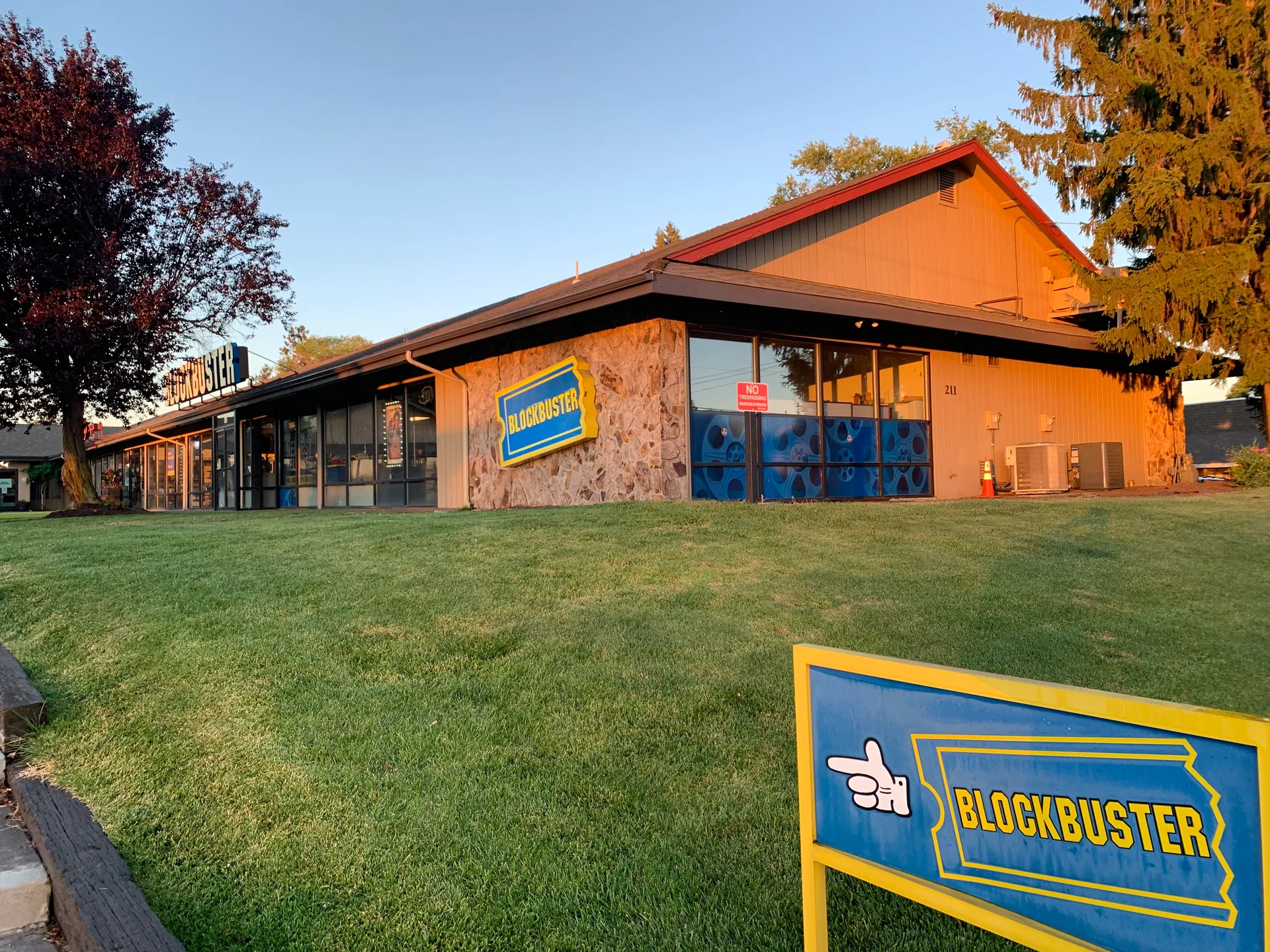
The Bend store opened in 1992 as Pacific Video, part of a small local rental chain, and became a Blockbuster franchise in 2000; and its manager, Sandi Harding, has run it since 2004. Today it survives the way relics do: on memory. Pilgrims drive for hours to stand under the blue and yellow sign. The store sells T-shirts and magnets, takes memberships, and still rents movies by the night. In 2020, a documentary told its story — and that summer, the store listed itself on Airbnb: three nights only, four dollars a night — one cent more than the 3.99-dollar price of a rental — with bookings open only to residents of Deschutes County, the store's home county. For three nights, a few lucky households got the keys to the whole store: the last guests of a vanished empire of Friday nights.
Visual interlude
Reading section 06
The Verdict
So what actually killed Blockbuster? Not one decision, and not one enemy. It was killed by a profit engine that fined its own customers, by a divorce settlement paid for with borrowed money, and by a boardroom that removed its chief executive at the very moment his counterattack was working. Netflix did not beat a better video store. It beat a company that could no longer afford to become a different one. Nine thousand stores are gone. One remains, on Revere Avenue in Bend, Oregon — and it is open tonight.
Watch: Dead Brands No. 1, the full story — "What Happened to Blockbuster?"
Visual interlude
Reading section 07
Timeline
Visual interlude
Reading section 08
Sources & image credits
Sources. Blockbuster FY2004 Form 10-K (peak figures: 9,094 stores, 84,300 employees, 6,053.2 million dollars revenue) and FY1999 Form 10-K (member accounts) — U.S. Securities and Exchange Commission. Chapter 11 petition, Case 10-14997 (SDNY) — U.S. Bankruptcy Court (assets 1.02 billion dollars, debts 1.46 billion dollars). Marc Randolph, That Will Never Work (2019), for the 2000 meeting — disputed by John Antioco (LinkedIn post, June 2022, as reported by Next TV, 3 June 2022; see also Newsweek's updated fact check, 2 February 2022). John Antioco and Carl Icahn, Harvard Business Review, April 2011. Blockbuster Form 8-K, 3 January 2007 (Total Access subscriber figures); Settlement Agreement, Form 8-K Exhibit 10.1, 19 March 2007 (the bonus settlement). Netflix Marquee Program announcement, September 1999. Viacom/Blockbuster split-off announcement, 18 June 2004. Contemporary reporting: AP (Total Access launch; Netflix streaming launch, 16 January 2007; Netflix's first sequential subscriber decline, Q2 2007); NBC (late-fee figures, 2000); Anchorage Daily News via AP (Alaska closures, July 2018); Airbnb announcement, 11 August 2020 (the Bend sleepover). Founding and growth history: International Directory of Company Histories (via Encyclopedia.com) and Reference for Business; Newsweek (1993); Wikipedia, "Blockbuster (retailer)" and "Last Blockbuster". Cook's exit figures (about 12 million dollars; the shares later valued at about 300 million) as reported from Inc.
Image credits (all via Wikimedia Commons; licences as logged at download, November 2026):
Dates. Published: 2026-11-08 · Last verified: 2026-11-09 · Updated: 2026-11-09
Author: Ronin Naodhinsuk
Blockbuster, Netflix, and all other brand names and logos mentioned in this article are trademarks of their respective owners. The Record Institute is an independent archive and is not affiliated with, endorsed by, or connected with Blockbuster, Dish Network, or any successor owner of the brand.
Next episode → No. 2: What Happened to Toys "R" Us?
Video Archive
What Happened to Blockbuster?
Related Articles
- RadioShack — What Happened to RadioShack?
- TWA — What Happened to TWA?
- Woolworth's — What Happened to Woolworth's?